
Lactium,
does it really help with sleep and stress relief?
research showsLactium alone has improvement signals in sleep diaries and some actigraphy indicators. However, perceived scales such as PSQI/ISI and PSG results are mixed, and stress relief relies heavily on surrogate indicators such as blood-pressure/cortisol responses and older small studies. The Korean market’s “improves sleep quality” claim can be viewed as a limited signal, but if broadened to “clearly relieves sleep and stress overall,” the strength of evidence declines.
ads claimDomestic articles and brand explanations introduce Lactium as an “individually recognized sleep-functional ingredient derived from milk protein” and foreground reduced sleep latency, reduced wake after sleep onset, increased total sleep time, improved sleep efficiency, and improved sleep quality. Market products often bundle “sleep health + tension relief caused by stress” with L-theanine, magnesium, vitamin B6, GABA, and similar ingredients rather than Lactium alone. Some informational articles present GABA receptors, cortisol, and a 48-participant human application trial as evidence, but in the actual RCTs, core questionnaires and PSG are not all consistently positive.
Useful facts when choosing a product
- Lactium is a milk protein hydrolysate produced by enzymatic hydrolysis of milk alpha-s1-casein, and alpha-casozepine-family peptides are described as key components.
- In Korea Food Safety Korea, milk protein hydrolysate (Lactium) is listed as an individually recognized functional ingredient for sleep health (No. 2020-2). Regulatory recognition was treated separately from the evidence grade.
- The main standalone sleep RCT dose was 300 mg/day for 4 weeks. The stress-symptom study used 150 mg/day for 30 days, and the acute stress-response study used a design of 200 mg administered three times.
- Domestic products commonly include L-theanine, magnesium, vitamin B6, GABA, and similar ingredients rather than Lactium alone, so stress-relief wording in product advertising may not mean Lactium-alone effect.
- Because it is derived from milk protein, people with milk/casein allergy or those using combination sleep products together with other sedating ingredients/drugs need caution.
What the research actually shows
No dedicated meta-analysis was confirmed. On sleep, standalone ACH/Lactium RCTs are confirmed as Kim 2019 and Chang 2024. Kim 2019 was an n=48 randomized double-blind crossover trial in which sleep-diary TST/SL/SE/WASO and actigraphy SE were significant after 300 mg/day for 4 weeks, but PSQI/ISI/ESS/FSS/BDI/BAI and core PSG indicators were not significant versus placebo. Chang 2024 was a Clin Nutr RCT in chronic insomnia and reports improvements in ISI, GSDS, PSQI, ESS, and HADS in PubMed/institution abstracts, but original tables, funding source, and sample details were limited, so it was given lower weight. Combination studies (Lactium+L-theanine, Lactium+Zizyphus) cannot be attributed to Lactium alone. On stress, Messaoudi 2005 reported SBP/DBP/cortisol responses during acute stress, and Kim 2007 reported stress-related symptom domains in a crossover trial of 63 women, but they were small and had manufacturer/raw-material-company connections.
Why this is classified as C (55)
Sleep efficacy has human RCTs and could be viewed up to the lower end of B, but in the standalone RCT with the most detailed numbers confirmed, positives centered on sleep diaries and PSQI/ISI/PSG were unclear versus placebo. Stress relief has a large share of surrogate indicators and small/industry-funded studies, making C appropriate. For the compound claim as a whole, independent replication of strong clinical perceived benefit and meta-analytic consistency are insufficient, so it is set at C 55.
Counterpoint. Lactium is not an ingredient with only animal/mechanistic data, and some signals such as sleep efficiency and total sleep time repeat in standalone human RCTs. Therefore there is no basis to lower it to “no possibility” or F. However, claims presenting insomnia treatment, broad stress relief, or the entire effect of combination products as if they were Lactium-alone effects go beyond current human evidence.
Rejudgment record. Converged — Draft=blind C. Standalone sleep RCT signals exist, but centered on subjective indicators.
Cross-check — Codex and Claude
Evidence Table
| Study | Design | Sample | Funding | Endpoint | Result | Weight |
|---|---|---|---|---|---|---|
| Kim HJ et al. 2019 | double-blind randomized controlled trial | manufacturer/industry involvement possible | sleep | Standalone Lactium/ACH 300 mg/day, 4-week crossover RCT; sleep diary and actigraphy SE were positive, while PSQI/ISI and PSG were unclear versus placebo. | core | |
| Chang CM et al. 2024 | double-blind randomized controlled trial | manufacturer/industry involvement possible | Standalone ACH RCT in chronic insomnia; abstract reports improvements in several subjective questionnaires. | core | ||
| Lim SE et al. 2024 | randomized controlled trial | 40, | manufacturer/industry involvement possible | Lactium+L-theanine combination RCT, n=40, 8 weeks; primary PSQI and ISI were not significant versus placebo, while some diary indicators were positive. | core | |
| Thiagarajah K et al. 2022 | randomized controlled trial | manufacturer/industry involvement possible | Crossover RCT of alpha-s1-casein tryptic hydrolysate + L-theanine combination. | core | ||
| Scholey A et al. 2017 | not specified | sleep | Lactium+Zizyphus combination sleep RCT; cannot be attributed to the ingredient alone. | supporting | ||
| Messaoudi M et al. 2005 | not specified | manufacturer/industry involvement possible | stress | Reported decreases in SBP/DBP changes and cortisol during Stroop/cold pressor acute stress in healthy people. | supporting | |
| Kim JH et al. 2007 | randomized controlled trial | 63 | manufacturer/industry involvement possible | stress | Crossover RCT in 63 women, 150 mg/day for 30 days; some stress-related symptom domains improved. | supporting |
| Study 8 | not specified | hydration and sleep | Milk protein hydrolysate (Lactium) listed as an individually recognized ingredient for sleep health. | supporting | ||
| Study 9 | not specified | gastrointestinal, sleep, and stress | Domestic product article explaining dual sleep-health functionality by combining Lactium with stress-related ingredients. | supporting | ||
| Study 10 | not specified | hydration, gastrointestinal, and stress | Advertising-style explanation of milk protein hydrolysate functionality for “tension relief caused by stress” and combination products. | supporting | ||
| Study 11 | not specified | 48 | sleep | Explains sleep help based on GABA/cortisol mechanisms and a 48-participant human application trial. | supporting | |
| Study 12 | not specified | liver, gastrointestinal, and sleep | Presents sleep latency, wake after sleep onset, total sleep time, and sleep efficiency improvement as advertising text. | supporting | ||
| MASSTIGE TIMES/Atomy | not specified | gastrointestinal and sleep | Explains Lactium+theanine+magnesium+B6 combination product in terms of sleep quality and tension relief. | supporting |
Receipt — 13 References
Of 13 cited sources, 6 had limited original-page access (blocked or summary-only) and were verified via index/summary, marked partial; the rest were verified at the original page. As of 2026-07-07.
Reviewed and approved: Chamgap Editorial Team · Approval date: 2026-07-07 · Corrections: none
Cite this verdict
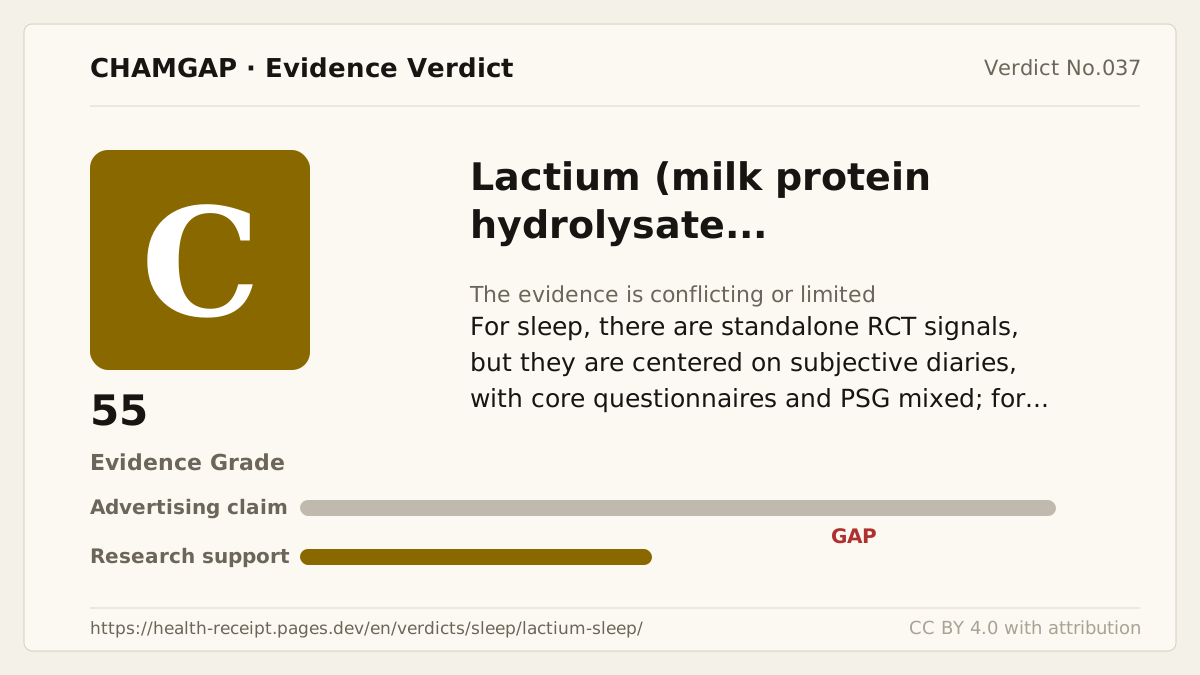
[Chamgap] Lactium x sleep and stress relief — Evidence Grade C·55. 13 cited sources checked. Source: https://chamgap.com/en/verdicts/sleep/lactium-sleep/ · CC BY 4.0CC BY 4.0 — free to use with attribution; do not distort grades, numbers, or verdict meaning.
What this document does and does not do
Chamgap is an information source. It reports what research has and has not confirmed; it does not tell readers what to take or buy. That decision belongs to readers and, when needed, medical or legal professionals. This verdict reflects literature available up to the search date and may change as new research appears. Nothing here is medical advice.