
GABA,
does it really help with Stress and sleep?
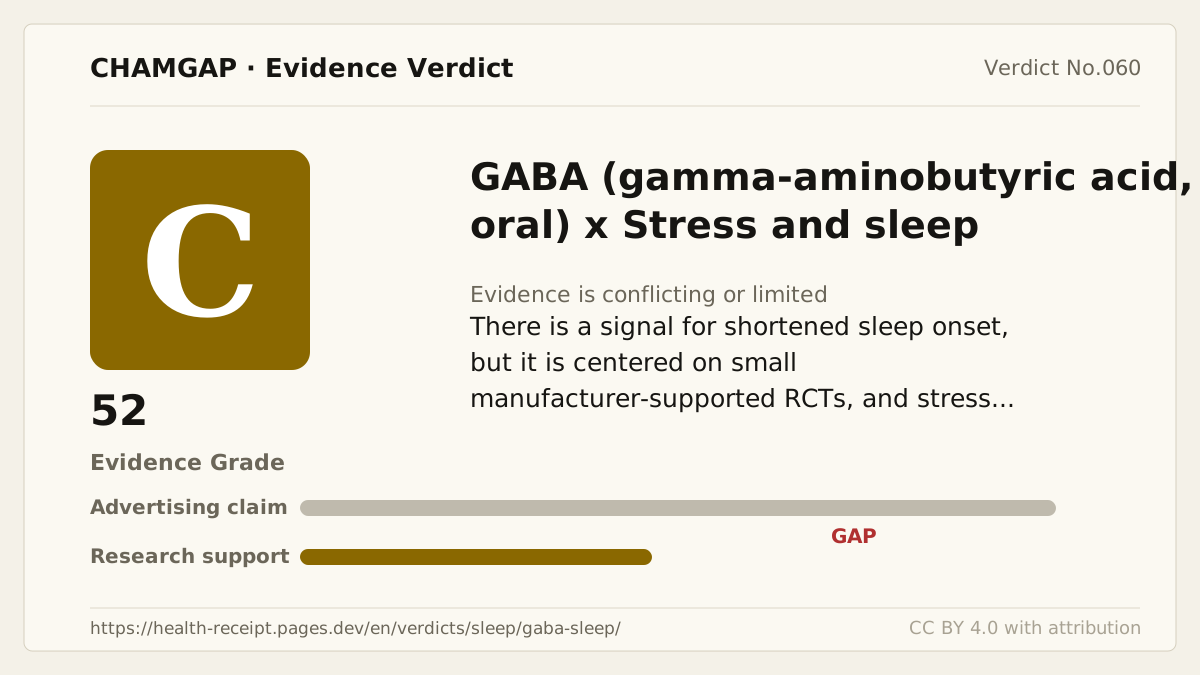
research showsOral GABA shows signals in some small human RCTs of reducing the “time it takes to fall asleep.” However, if broadened to sleep maintenance, total sleep time, or perceived stress improvement, results are inconsistent, and positive sleep studies are concentrated mainly in specific fermented/rice-germ GABA materials and manufacturer-supported studies.
ads claimDomestic market and informational posts tend to describe GABA as “the brain’s brake,” “relief of tension/anxiety,” “improved speed of falling asleep,” and “sleep quality/deep sleep improvement.” Some products and articles emphasize fermented GABA, kimchi-lactic-acid-bacteria fermented GABA, PharmaGABA, and GABA derived from rice bran, barley, or fermented rice germ, and also present combination formulations with theanine, tryptophan, magnesium, and melatonin-like ingredients. Advertising phrases also included expanded claims outside sleep/stress, such as REM sleep increased by 99.6%, help with serotonin production, blood pressure, concentration, and growth hormone.
Useful facts when choosing a product
- Single-ingredient GABA products are sold in various doses such as 100 mg, 250 mg, 500 mg, and 750 mg, while doses used for sleep in clinical trials were mainly 75 mg, 100 mg, and 300 mg/day.
- Domestic informational articles and product promotions often describe combinations with theanine, L-tryptophan, magnesium, and similar ingredients more than GABA alone. Such combination products are difficult to attribute to the effect of GABA alone.
- Positive results in sleep studies are mainly PSG markers such as sleep latency, N3 proportion, and arousal index, or ISI/PSQI submarkers, while sleep efficiency, WASO, REM, and total sleep time are less consistent.
- Stress studies have physiological surrogate markers such as HRV, EEG, cortisol, and CgA as the main positive results, and evidence independently proving improvement in daily perceived stress or anxiety symptoms is limited.
What the research actually shows
A 2020 systematic literature review examined 14 placebo-controlled human trials, but concluded that evidence was limited for stress and very limited for sleep. The key sleep RCTs were a 300 mg/day 4-week PSG study (n=40, GABA 30, placebo 10) and a 75 mg/day 4-week PSG study (completed n=50); both showed shortened sleep latency, but the samples were small and they came from the same research line with Natural Way support/supply. Stress studies centered on surrogate markers such as HRV, cortisol, chromogranin A, and EEG, and subjective tension/anxiety scores were often not significant. No large independent RCT or Cochrane review was identified in the search.
Why this is classified as C (52)
There are human RCTs, and sleep-onset markers show repeated signals, so the grade is not “?” or F. However, key sleep RCTs are small, from a single research line, manufacturer-supported/supplied studies, and independent replication is lacking. Stress claims have primary results mainly as surrogate markers, so under boundary rule 1 the maximum is C, and sleep claims are also capped at C under boundary rule 2b (lack of independent replication plus concentration of positive studies in industry funding).
Counterpoint. The observation of reduced PSG sleep latency in 300 mg and 75 mg fermented/rice-germ GABA studies is a real positive signal. Therefore, it is difficult to view this as repeated lack of effect; the core of the verdict is not absence of effect but the limited effect range and lack of independent reproducibility.
Rejudgment record. convergent — Draft = blind C. Sleep-onset shortening signals are centered on small manufacturer RCTs; oral GABA blood-brain barrier controversy.
Cross-check — Codex and Claude
Evidence Table
| Study | Design | Sample | Funding | Endpoint | Result | Weight |
|---|---|---|---|---|---|---|
| Hepsomali P, Groeger JA, Nishihira J, Scholey A 2020 | systematic review/RCT | not reported | sleep/stress | Systematic review of 14 placebo-controlled human trials based on PubMed search; concluded limited evidence for stress and very limited evidence for sleep. | core | |
| Byun JI, Shin YY, Chung SE, Shin WC 2018 | double-blind RCT | 40, | possible manufacturer/industry involvement | sleep | Adults with insomnia symptoms n=40, 300 mg/day for 4 weeks; PSG sleep latency decreased from 13.4 minutes to 5.7 minutes, group x time p=0.009. | core |
| Yoon S, Byun JI, Shin WC 2022 | double-blind RCT | 50, | possible manufacturer/industry involvement | liver/sleep | Insomnia patients 54 randomized, completed n=50, 75 mg/day for 4 weeks; between-group p=0.0240 for sleep latency change, sleep efficiency not significant. | core |
| Hinton T, Jelinek HF, Viengkhou V, Johnston GA, Matthews S 2019 | cohort | 30, | not reported | stress | Healthy college students n=30, GABA-enriched oolong tea 2.01 mg/200 mL, HRV and immediate stress score assessed; main positive signals centered on HRV. | core |
| Yamatsu A, Yamashita Y, Pandharipande T, Maru I, Kim M 2016 | systematic review | 10, | not reported | liver/sleep | People with sleep problems n=10, 100 mg GABA 1-week crossover trial; shortened sleep latency and increased total non-REM time were reported. | supporting |
| Yoto A, Murao S, Motoki M et al. 2012 | systematic review | 63, | not reported | stress | Adults n=63, single 100 mg GABA, mental-task stress crossover trial; EEG changes appeared but subjective tension/anxiety and similar scores were not significant. | supporting |
| Oketch-Rabah HA, Madden EF, Roe AL, Betz JM 2021 | not specified | not reported | blood pressure/pregnancy | USP safety review: no serious adverse reactions were reported in short-term high-dose and 120 mg/day 12-week studies, but possible blood pressure lowering and lack of pregnancy/lactation data were noted. | supporting | |
| iHerb Korea | not specified | not reported | sleep/anxiety/depression/concentration | Domestic consumer informational article connected GABA deficiency with decreased sleep quality, anxiety, depression, and reduced concentration. | supporting | |
| Study 9 | not specified | not reported | gut/stress | Domestic product promotional article emphasized kimchi-lactic-acid-bacteria fermented GABA, stress reduction, help with serotonin production, and theanine/tryptophan combination. | supporting | |
| Noct Research Blog | not specified | not reported | gut/sleep/anxiety | Domestic informational post claimed anxiety relief and sleep improvement, fermented GABA, and 99.6% increase in sleep quality when combined with theanine. | supporting |
Receipt — 10 References
Of 10 cited sources, 4 had limited original-page access (blocked or summary-only) and were verified via index/summary, marked partial; the rest were verified at the original page. As of 2026-07-07.
Reviewed and approved: Chamgap Editorial Team · Approval date: 2026-07-07 · Corrections: none
Cite this verdict
[Chamgap] GABA x stress and sleep — Evidence Grade C·52. 10 cited sources checked. Source: https://chamgap.com/en/verdicts/sleep/gaba-sleep/ · CC BY 4.0CC BY 4.0 — free to use with attribution; do not distort grades, numbers, or verdict meaning.
What this document does and does not do
Chamgap is an information source. It reports what research has and has not confirmed; it does not tell readers what to take or buy. That decision belongs to readers and, when needed, medical or legal professionals. This verdict reflects literature available up to the search date and may change as new research appears. Nothing here is medical advice.