
L-theanine,
does it really help with sleep and tension relief?
research showsHuman data for the claim that theanine “relieves tension and helps sleep” divide into two types. One is clinical-endpoint evidence measuring perceived effects with validated scales (anxiety STAI, sleep quality PSQI), and the other is surrogate-indicator evidence such as EEG alpha-wave increase, heart rate, and salivary IgA decrease. Three facts anchor the judgment. (1) Much of the surrogate-indicator evidence (alpha waves ↑, cortisol/heart rate ↓ during acute stress) comes from “single-dose (acute)” experiments, and these experiments generally did not measure clinical scales for sleep quality or perceived tension at the same time; alpha waves and perceived improvement were mostly observed in different studies. (2) In the representative long-term RCT measuring both within one study (Hidese 2019, 200 mg/day for 4 weeks, crossover N=30), STAI and PSQI improved versus pre-intake during the theanine period, but cortisol measured together (salivary and serum) did not change significantly. The causal claim “cortisol falls, so tension is relieved” was not supported in this study. (3) In the sleep meta-analysis (Bulman 2025, 19 studies, 897 participants), subjective sleep indicators were significant but effect sizes were small (SMD 0.15~0.43), objective sleep (polysomnography) was inconclusive, and the authors explicitly stated that “pure theanine-alone studies are lacking”; much sleep evidence uses combination formulations. In addition, two independent lines of evidence with different conflict axes add skepticism. An RCT using an independent ingredient unrelated to the raw-material company Suntheanine/Taiyo Kagaku (AlphaWave 2024, Ethical Naturals/KGK Science, 400 mg/day for 4 weeks) had no significant between-group difference versus placebo on the primary stress endpoint (PSS), anxiety (DASS-21), or salivary cortisol; the only between-group significance was a wearable-device surrogate, “light sleep time.” A separate independent meta-analysis (2025 Tea/L-theanine) separated theanine alone and combinations, then judged sleep/relaxation evidence “inconclusive,” with zero low-risk-of-bias studies. In short, small human signals for perceived tension/anxiety improvement exist (so this is not “no human evidence”), but representative positive evidence is concentrated in raw-material-company-funded studies, independent evidence outside industry funding fails to separate from placebo on core perceived endpoints or is inconclusive, and the alpha-wave/cortisol surrogates foregrounded by marketing cannot be said to have been connected to perceived effects in the same studies.
ads claimIn the Korean market, theanine is sold under the MFDS notified-type functional wording “may help relieve tension caused by stress,” and detail pages/media commonly add “deep sleep/good sleep/help falling asleep.” Representative appeals include “relieves tension by increasing brain alpha waves,” “if melatonin makes you fall asleep, theanine makes you sleep deeply,” “non-hormonal relaxation without tolerance or dependence,” “at least 200 mg/day,” and “Suntheanine ingredient.” Two frames overlap. First is the surrogate-to-perception frame (“increases alpha waves and lowers cortisol to relieve tension”); in the studies above, alpha waves/cortisol are hard to regard as connected to perceived scales within the same study, and in Hidese 2019, where cortisol was measured together, it did not change significantly. Second is expansion of the regulatory frame. The MFDS-recognized wording is “may help relieve tension caused by stress,” and “sleep improvement/deep sleep” is not separately recognized functionality. Some domestic media also draw the line that “theanine does not directly increase sleep time, but can be an adjunct for people who have difficulty falling asleep due to tension.” Also, common mention of “caffeine combination” is evidence for focus/arousal combinations (theanine+caffeine), not for sleep/tension relief, and domestic materials also state that “if taken with caffeine, the tension-relief effect may be offset.”
Useful facts when choosing a product
- Regulatory metadata (neutral): theanine is a notified-type functional ingredient recognized in Korea as “may help relieve tension caused by stress” (MFDS Food Safety Korea functional information, viewNo=15). “Sleep improvement/deep sleep” is not separate functionality included in this wording, but a market-added appeal. The daily intake figure 200~250 mg is not supported by this functional-information page itself and requires separate basis in the Health Functional Food Code/raw-material detailed provisions. Regulatory recognition is ingredient/labeling regulation, not a guarantee of effect size or clinical benefit (Methodology 2-1 ④).
- Ingredient brand/conflict metadata: Suntheanine = patented pure L-theanine from Taiyo Kagaku (Japan) (about 98.9% purity, enzymatic production, U.S. GRAS 250 mg/serving). Representative positive evidence in theanine sleep/tension RCTs (Hidese 2019, Kimura 2007) is connected to this company’s ingredient, funding, affiliation, and test-product supply. This raw-material/regulatory information is used only as metadata for ingredient identity and conflict-of-interest axes (A1/A2), not as efficacy evidence.
- Alone vs combination: human evidence for “sleep/tension relief” is generally theanine-alone studies around 200 mg/day. By contrast, theanine+caffeine combination studies (e.g., Kelly 2008, 100 mg+50 mg) examined focus, attention, and arousal (relaxed alertness), and in that study theanine alone had no significant effect. Using combination results as sleep/tension-relief evidence swaps the ingredient/effect.
- Acute vs long-term: surrogate indicators (alpha waves↑, heart rate/IgA↓ under acute stress) are mostly single-dose acute signals. Acute relaxation signals do not mean long-term sleep-quality improvement; long-term sleep evidence consists of Hidese 2019 (4 weeks) and small subjective improvements in the sleep meta-analysis (SMD 0.15~0.43).
- Independent evidence (different conflict axis): the independent-ingredient RCT unrelated to raw-material company Taiyo/Suntheanine (AlphaWave 2024, Ethical Naturals/KGK Science manufacturer funding/conduct, 400 mg/day for 4 weeks) had no significant between-group difference versus placebo on the primary stress endpoint (PSS), anxiety (DASS-21), or salivary cortisol. A separate-axis independent meta-analysis (2025 Tea/L-theanine) judged sleep/relaxation evidence “inconclusive.” These do not have no conflict of interest, but they show that even outside the Suntheanine raw-material-company axis, core endpoints did not separate from placebo.
- Human use amount: about 200~250 mg/day in both clinical/regulatory contexts (some up to 400 mg/day). Domestic media emphasize that the raw material must be at least 200 mg to be recognized as a health functional food and distinguish it from ordinary foods with small amounts.
- Safety (good): serious adverse events are rare in 200~400 mg/day studies up to 8 weeks. Reported events are mostly mild (headache 1~3%, nausea when fasting, mild drowsiness above 400 mg, blood-pressure lowering in antihypertensive users). No tolerance/dependence reports, U.S. GRAS. However, long-term (months to years) safety data and evidence in pregnancy, lactation, and children are limited; information is insufficient under those conditions.
What the research actually shows
The literature divides into five categories. (1) Acute studies measuring only surrogate indicators (alpha waves/acute physiological responses): Kimura 2007 (N=12) lowered heart rate (HR) and salivary IgA (s-IgA) versus placebo during an acute stress task after a single dose (interpreted as sympathetic suppression), but did not measure validated scales of sleep quality or anxiety (PSQI/STAI). EEG alpha-wave increase is summarized in several reviews as a signal of “relaxed alertness,” but it is also mostly acute surrogate research. (2) Evidence measuring clinical scales (anxiety/sleep): in Hidese 2019 (N=30, crossover, 200 mg/day for 4 weeks), STAI-trait anxiety (p=0.006 vs pre-intake) and PSQI total score (p=0.013) improved during the theanine period, while the placebo period had no significant change. Direct comparison of change between conditions showed significance only in PSQI subscales sleep latency, sleep disturbance, and sleeping-medication use (p=0.046~0.0499), while PSQI total and SDS were non-significant trends (p=0.073, 0.084). This study did not measure EEG/alpha waves. (3) Evidence measuring both in one study — a broken-link case: Hidese 2019 also measured cortisol (salivary and serum), and after 4 weeks there was “no significant change.” Perceived effects (scales) improved versus pre-intake, but the surrogate indicator (cortisol) did not move. (4) Caffeine-combination study (focus/arousal, not sleep/tension): Kelly 2008 (N=16, acute, 4-day balanced repeated-measures) reported that theanine 100 mg+caffeine 50 mg improved attention-task accuracy and target discriminability (d') versus placebo and lowered background alpha waves. Crucially, “theanine alone had no significant effect.” This examined focus/attention (relaxed alertness), not “relaxation,” and is not evidence for theanine-alone sleep/tension effects. (5) Synthetic evidence: Williams 2020 descriptive systematic review of tension/anxiety (9 RCTs) concluded that 200~400 mg/day may reduce stress/anxiety in “people exposed to stressful situations,” but did not perform meta-analysis (pooled effect size) and stated larger long-term studies are needed. Bulman 2025 sleep meta-analysis (19 studies, 897 participants) found only small significant subjective sleep effects (SMD 0.15~0.43), no conclusion on objective sleep (polysomnography), and explicitly noted “lack of pure theanine-only studies” as a limitation. (6) Independent evidence with a different conflict axis: AlphaWave 2024 (Ethical Naturals funded, KGK Science conducted, independent ingredient, N=30, 400 mg/day for 4 weeks) showed no significant between-group difference versus placebo on primary stress endpoint PSS (both groups decreased from baseline), DASS-21 anxiety, or salivary cortisol; the only between-group significance was wearable “light sleep time” change (day 28 p=0.026). The 2025 Tea/L-theanine meta-analysis (separate analysis of theanine alone, combinations, and tea) judged sleep/relaxation evidence “inconclusive,” with risk of bias: low risk 0, some concerns 12, high risk 25.
Why this is classified as C (49)
Human RCT evidence exists that measured perceived tension/anxiety (STAI anxiety, PSQI sleep quality) with validated scales (Hidese 2019). In that study, significant improvement in STAI-trait anxiety and PSQI total score was a within-theanine-period pre/post comparison, with no significant change during the placebo period; in direct condition-to-condition (versus placebo) comparison, significance centered on some PSQI subscales, while total score and SDS were trend-level (p=0.073~0.084). Because this is not only animal/cell evidence or pure surrogate indicators (measuring only alpha waves and expanding to perceived effect), it does not fall under “no human evidence.” However, several layers prevent raising the evidence higher. The representative long-term RCT is a single crossover study with N=30; within it, STAI/PSQI significance is pre/post within intake, and direct between-condition comparison left PSQI total only a non-significant trend. The sleep meta-analysis (Bulman 2025) has small effect sizes (SMD 0.15~0.43), is limited to subjective indicators, has no conclusion on objective sleep, and mixes combination formulations. The surrogate indicators emphasized by marketing (alpha waves, cortisol) and perceived-effect scales were generally observed in different studies, and in Hidese 2019, where both were measured, cortisol did not change significantly, so the mechanistic link “surrogate decreases -> perceived effect improves” is not established. Representative positive evidence (Hidese, Kimura) is concentrated in funding/affiliation/test-product links to raw-material company Taiyo Kagaku (Suntheanine), while independent evidence with a different conflict axis is skeptical: independent-ingredient RCT AlphaWave 2024 did not separate from placebo on the primary stress endpoint, anxiety, or cortisol, and an independent meta-analysis (2025 Tea/L-theanine) judged sleep/relaxation “inconclusive” and had zero low-risk-of-bias studies. This shows that core perceived-endpoint evidence is not robust outside industry funding. Regulatoryly, domestic recognized wording is limited to “tension relief,” and market-added “sleep improvement/deep sleep” is not recognized functionality. Overall, a perceived tension/anxiety-improvement RCT exists, so it does not hit the evidence floor (absence of human data), but the surrogate mechanism link breaks, objective sleep is unproven, independent evidence is skeptical, and the evidence is concentrated in industry funding; the score is 49.
Counterpoint. Supportive side (higher): “There is an RCT measuring human scales such as STAI and PSQI (Hidese 2019), and a descriptive review (Williams 2020) and sleep meta-analysis (Bulman 2025) also report significant improvements. It is not only surrogate indicators.” -> It is correct that human-scale evidence exists, so this does not fall under “no human evidence.” However, (a) the representative long-term RCT is a single N=30 crossover, and STAI/PSQI significance is pre/post within intake while direct condition-to-condition total scores were only trends; (b) sleep-meta effect sizes are small and only subjective, with mixed combination formulations; and (c) representative positives are concentrated in raw-material-company funding, while independent evidence with different conflicts (AlphaWave 2024 and 2025 meta) fails to separate from placebo on core perceived endpoints or is inconclusive. Skeptical side (lower): “In the end, it is mostly alpha-wave/cortisol surrogate indicators, and in Hidese, where cortisol was measured together, it did not change. Sleep effect size is also small at SMD 0.15~0.43 and mostly combination formulations, while the independent-ingredient RCT did not separate from placebo. It can also be interpreted as insufficient human evidence.” -> The broken cortisol<->perception link and small effect size are true and stated in the judgment. However, an RCT using validated perceived scales (STAI/PSQI) showed a signal of improvement (within-condition pre/post improvement with no placebo-period change; condition-to-condition comparison significant on some PSQI subscales and trend on total score), so it does not meet the floor of “no human evidence.” The real gap between the two views is not whether to upgrade this evidence high, but how much to discount a real small perceived signal; this judgment scores 49, reflecting surrogate-link failure, industry-funding concentration, small effects, and skepticism from independent evidence.
Cross-check — Codex and Claude
Evidence Table
| Study | Design | Sample | Funding | Endpoint | Result | Weight |
|---|---|---|---|---|---|---|
| Hidese S, Ogawa S, Ota M, Ishida I, Yasukawa Z, Ozeki M, Kunugi H 2019 | randomized controlled trial | 30 | manufacturer/industry involvement possible | liver, gastrointestinal, sleep, and anxiety | Measured both clinical scales and surrogate indicators (link broken); theanine alone; long term (4 weeks); crossover: with pure L-theanine 200 mg/day for 4 weeks (crossover, N=30), STAI-trait anxiety (p=0.006 vs pre-intake) and PSQI total score (p=0.013) improved during the theanine period and no significant change occurred during placebo. Direct between-condition change comparison showed only PSQI subscales sleep latency/sleep disturbance/sleeping-medication use significant (p=0.046~0.0499), while PSQI total and SDS were non-significant trends (p=0.073, 0.084). Salivary/serum cortisol measured together showed no significant change after 4 weeks. EEG/alpha waves were not measured. Perceived effect improved; surrogate cortisol unchanged. Core P-B1 counterexample. | core |
| AlphaWave® L-Theanine RCT 2024 | double-blind randomized controlled trial | 30 | manufacturer/industry involvement possible | liver, gastrointestinal, sleep, and anxiety | Independent evidence with a different conflict axis (skeptical direction); independent ingredient; long term (4 weeks): manufacturer Ethical Naturals and conducting institution KGK Science, independent fermented ingredient unrelated to Taiyo Kagaku (Suntheanine), purity 98~100%. N=30 (15/group), 400 mg/day for 28 days. Primary stress endpoint PSS showed no significant between-group difference versus placebo (both groups decreased from baseline, between-group NS). DASS-21 anxiety did not separate from placebo (placebo was better at day 14), and morning/evening salivary cortisol showed no between-group difference. The only between-group significance was wearable “light sleep minutes” change (day 28 p=0.026), an instrument surrogate not a validated scale. It is not conflict-free (Ethical Naturals funding, KGK Science conduct), but it has a different conflict axis from Taiyo/Suntheanine, and even on this different axis the core perceived endpoints (stress/anxiety) did not separate from placebo. | core |
| 2025 Tea, L-theanine, and L-theanine plus caffeine on sleep and relaxation: a systematic review and meta-analysis 2025 | meta-analysis | 12 | manufacturer/industry involvement possible | liver and sleep | Independent meta-analysis with a different conflict axis (skeptical direction); separated theanine alone and combinations: explicitly separated tea, theanine+caffeine, and theanine alone. Evidence for sleep effect was “inconclusive,” and relaxation also had confidence intervals including null, making evidence insufficient. Risk of bias: low risk 0, some concerns 12, high risk 25 — no low-risk studies. Funding: industry 8, academic 4, government 2, unreported 4; some authors affiliated with Lipton/Unilever (tea-axis conflicts), but methodology was strict. Not conflict-free, but a different conflict axis from Suntheanine, and sleep/relaxation was “inconclusive” even there. | core |
| Bulman A, D'Cunha NM, Marx W, Turner M, McKune A, Naumovski N 2025 | meta-analysis | 19 | liver, gastrointestinal, and sleep | Sleep clinical-scale meta-analysis; single and combination formulations mixed; mostly long-term: 19 studies, 897 participants (18 pooled). Only subjective indicators were significant: sleep latency SMD 0.15 (p=0.04), daytime dysfunction 0.33 (p<0.001), overall sleep quality 0.43 (p=0.03). Effect sizes were small. Objective sleep (polysomnography) had no conclusion. Authors explicitly noted “lack of pure theanine-alone studies” as a limitation, meaning much evidence involved combination formulations. | core | |
| Williams JL, Everett JM, D'Cunha NM et al. 2020 | systematic review of RCTs | 9 | gastrointestinal, anxiety, and stress | Descriptive systematic review of tension/anxiety clinical evidence (not a meta-analysis); theanine alone; acute+long-term mixed: reviewed 9 pure L-theanine RCTs and concluded that 200~400 mg/day may reduce stress/anxiety in “people exposed to stressful situations.” No pooled effect size; explicitly stated larger long-term cohorts are needed. | supporting | |
| Kimura K, Ozeki M, Juneja LR, Ohira H 2007 | not specified | 12 | manufacturer/industry involvement possible | gastrointestinal, sleep, anxiety, and stress | Surrogate indicators only; theanine alone; acute (single dose): after single-dose intake in N=12, heart rate (HR) and salivary IgA (s-IgA) decreased versus placebo during an acute stress task (interpreted as sympathetic suppression by HRV analysis). However, validated scales of sleep quality/anxiety (PSQI/STAI) were not measured; a pure surrogate acute signal. | supporting |
| Kelly SP, Gomez-Ramirez M, Montesi JL, Foxe JJ 2008 | not specified | 16, | gastrointestinal, sleep, cognition, and attention/concentration | Caffeine combination; surrogate indicator (alpha waves)+cognitive task; acute: N=16, 4-day balanced repeated measures. The theanine 100 mg+caffeine 50 mg combination improved attention-task accuracy and target discriminability (d') versus placebo and lowered background alpha waves. Crucially, theanine alone had no significant effect. This studied focus/attention (relaxed alertness), not “relaxation,” and is not evidence for sleep/tension relief. | supporting | |
| Study 8 | not specified | liver, gastrointestinal, sleep, and stress | Domestic primary regulatory evidence (MFDS original): recognized functional wording is “may help relieve tension caused by stress,” and theanine is listed as a notified-type ingredient for this functionality. Sleep improvement/deep sleep functionality is not listed on this page; market-added “deep sleep” appeal is not recognized functionality. Daily intake (200~250 mg) is not separately shown on this page, so additional cross-check against raw-material detailed provisions is needed. | supporting |
Receipt — 8 References
All 8 cited sources were verified for existence at the original page (as of 2026-07-06).
Reviewed and approved: Chamgap Editorial Team · Approval date: 2026-07-06 · Corrections: none
Cite this verdict
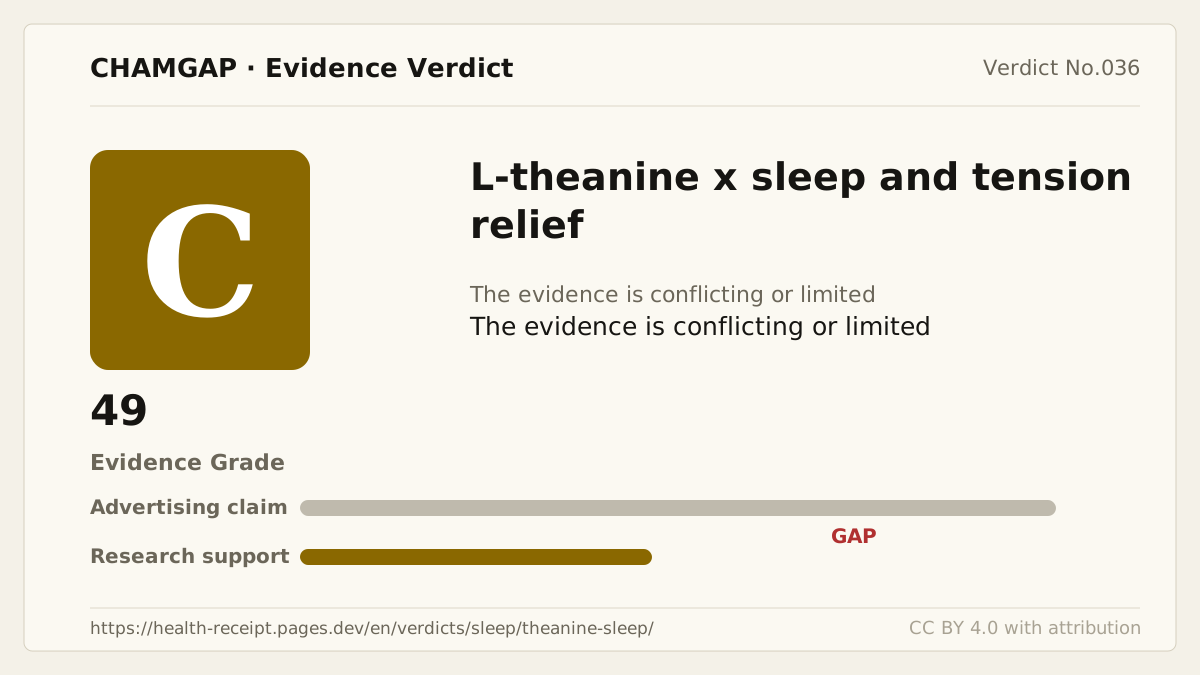
[Chamgap] L-theanine x sleep and tension relief — Evidence Grade C·49. 8 cited sources checked. Source: https://chamgap.com/en/verdicts/sleep/theanine-sleep/ · CC BY 4.0CC BY 4.0 — free to use with attribution; do not distort grades, numbers, or verdict meaning.
What this document does and does not do
Chamgap is an information source. It reports what research has and has not confirmed; it does not tell readers what to take or buy. That decision belongs to readers and, when needed, medical or legal professionals. This verdict reflects literature available up to the search date and may change as new research appears. Nothing here is medical advice.