
Tart cherry,
does it really help with improving sleep quality/sleep duration and post-exercise muscle recovery?
research showsTart cherry juice/concentrate has randomized human-trial signals for both sleep and post-exercise recovery. However, sleep studies are mostly short-term crossover trials with around 8-20 participants, and subjective sleep indicators are not very consistent. Muscle recovery also looks favorable for maximal voluntary contraction (MVC) recovery and some pain indicators, but in the latest meta-analysis, muscle soreness, CK, IL-6, TNF-alpha, and related markers were inconsistent. Safety at ordinary food levels is generally favorable, but juice/concentrate requires attention to sugar, calories, gastrointestinal symptoms, and cherry allergy.
ads claimIn the Korean market, 'natural melatonin,' 'deep sleep,' 'improved sleep quality,' 'overcoming insomnia,' '39-minute increase in sleep time and 4.9% increase in sleep efficiency,' 'recovery from post-exercise muscle fatigue,' 'reduced muscle soreness,' 'antioxidant/anti-inflammatory,' and 'gout/joint management' are promoted together. Informational articles and shopping-mall content also directly import study numbers and connect them to product-choice messages. According to an MFDS news report, 138 online false/exaggerated advertisements for tart cherry products were detected in 2020, and problematic cases included making general foods look like health functional foods or medicines and saying that they were excellent for 'sleep induction' or 'pain relief.'
Useful facts when choosing a product
- The formulation most often used in clinical trials is Montmorency tart cherry juice or concentrate. It is hard to extrapolate directly that capsules, jellies, and powders produce the same effects.
- Common doses in sleep studies are concentrate 30 mL twice daily for 7 days or juice 240 mL twice daily for 14 days. Muscle-recovery studies often involve loading for several days before exercise and intake for several days immediately after exercise.
- The melatonin content of tart cherry itself is far lower than supplement melatonin doses, so if there is an effect, polyphenols, tryptophan metabolism, and inflammatory pathways are likely involved together rather than melatonin alone.
- Many Korean products are sold as general foods or processed fruit-and-vegetable products. MFDS recognition status and evidence grade are separate, but a general food claiming treatment of insomnia or pain becomes a separate regulatory issue.
- Sugar and calories in juice/concentrate differ by product. People who need glucose control should check product labels for sugars, serving size, and concentrate dilution ratio.
What the research actually shows
Sleep: Howatson 2012 was an RCT in 20 healthy adults that gave Montmorency tart cherry concentrate for 7 days and found increased urinary 6-sulfatoxymelatonin and actigraphy-based total sleep time and sleep efficiency. Pigeon 2010, a crossover trial in 15 older adults with chronic insomnia, found key placebo-significant signals mainly in WASO/insomnia severity, while total sleep time and sleep efficiency were not significant versus placebo. Losso 2018 reported an 84-minute increase in PSG sleep time among 8 completers aged 50 or older with insomnia, but it was pilot-sized. A 2023 sleep meta-analysis summarized that across 8 low-to-moderate studies, objective sleep efficiency (Hedges g 0.63) and objective total sleep time (g 1.21) were significant, while subjective sleep efficiency and total sleep time were not. A 2025 systematic review also judged the evidence limited and heterogeneous, with only 3 of 7 intervention studies reporting improvement in major sleep indicators. Muscle recovery: RCTs such as Connolly 2006, Kuehl 2010, Howatson 2010, and Bowtell 2011 observed faster strength recovery or smaller increases in pain. However, the latest 2026 Sports Medicine - Open meta-analysis concluded that across 19 trials, MVC recovery and some CRP time points were positive, but muscle soreness, CK, IL-6, TNF-alpha, and ROM had no consistent pooled effect and certainty was very low to moderate.
Why this is classified as B (68)
Both sleep and muscle recovery have human RCTs and meta-analyses, so this is not a case to lower to C. However, sleep evidence is centered on small samples and pilot studies, and in the 2023 meta-analysis objective indicators were positive while subjective indicators were not significant. Muscle recovery has more studies, but in the latest 2026 meta-analysis effects were narrow to MVC and some CRP time points, muscle soreness and CK were inconsistent, and heterogeneity and single-study sensitivity were large. No large independent RCT or Cochrane-grade conclusive evidence was identified. Therefore the combined claim as a whole is B rather than A, in the middle of the B range.
Counterpoint. It is too broad and conclusive to say, as advertising does, that tart cherry generally 'induces sleep' or 'relieves muscle pain.' Conversely, the claim is not completely unsupported. Some objective sleep duration/efficiency and post-exercise functional recovery signals are repeated, so the core judgment is that effect is possible but effect size, population, formulation, and independent reproducibility are limited.
Rejudgment record. Draft and blinded review converged — There are repeated signals for objective sleep indicators and post-exercise MVC recovery, but studies are small, heterogeneous, and often industry-linked, so B is appropriate.
Cross-check — Codex and Claude
Evidence Table
| Study | Design | Sample | Funding | Endpoint | Result | Weight |
|---|---|---|---|---|---|---|
| Stretton B, Eranki A, Kovoor J et al. 2023 | meta-analysis | not reported | liver/sleep | Meta-analysis of 8 low-to-moderate studies: objective sleep efficiency g=0.63 and objective total sleep time g=1.21 were significant, but subjective indicators were not. | core | |
| Howatson G, Bell PG, Tallent J, Middleton B, McHugh MP, Ellis J 2012 | not specified | 20 | not reported | liver/sleep | In a 7-day crossover RCT of 20 healthy adults, urinary melatonin metabolites and actigraphy total sleep time/sleep efficiency increased. | core |
| Pigeon WR, Carr M, Gorman C, Perlis ML 2010 | not specified | 15 | not reported | sleep | In a crossover RCT of 15 older adults with chronic insomnia, significant placebo-comparative effects were mainly WASO/insomnia severity, while TST and sleep efficiency were not significant. | core |
| Losso JN, Finley JW, Karki N et al. 2018 | not specified | 8 | not reported | liver/gastrointestinal/sleep | In 8 completers aged 50 or older with insomnia, PSG sleep time increased by 84 minutes after 240 mL twice daily for 2 weeks. | core |
| Barforoush F, Ebrahimi S, Karimian Abdar M, Khademi S, Morshedzadeh N 2025 | systematic review | not reported | liver/sleep | A 2025 systematic review judged the evidence limited and heterogeneous, with 3 of 7 intervention studies reporting improvements in sleep time, sleep efficiency, or sleep latency. | supportive | |
| Daab W, Bouzid MA, Nassis GP et al. 2026 | meta-analysis | not reported | liver/muscle/recovery | Meta-analysis of 19 trials: MVC and some CRP time points improved, but muscle soreness, CK, IL-6, TNF-alpha, and others were inconsistent, with certainty very low to moderate. | supportive | |
| Connolly DAJ, McHugh MP, Padilla-Zakour OI 2006 | not specified | 14 | possible manufacturer/industry involvement | pain/strength | Crossover RCT in 14 male college students; average 4-day strength loss was placebo 22% vs cherry juice 4%, and pain was also lower. | supportive |
| Kuehl KS, Perrier ET, Elliot DL, Chesnutt JC 2010 | RCT | 54 | not reported | gastrointestinal/pain | RCT in 54 long-distance relay runners; post-race pain increase was tart cherry 12±18 mm vs placebo 37±20 mm. | supportive |
| Howatson G, McHugh MP, Hill JA et al. 2010 | not specified | 20 | not reported | strength/muscle/recovery | RCT in 20 marathon runners; isometric strength recovery was faster, but other muscle-damage markers were not significant. | supportive |
| Bowtell JL, Sumners DP, Dyer A, Fox P, Mileva KN 2011 | not specified | 10 | possible manufacturer/industry involvement | recovery | Crossover trial in 10 trained men; knee-extension MVC recovery was faster, 24h 90.9% vs 84.9% and 48h 92.9% vs 88.5%. | supportive |
| Study 11 | not specified | 138 | not reported | sleep/pain | MFDS inspection report: medical-evidence-insufficient expressions such as sleep induction and pain relief were found in tart-cherry general-food advertising. | supportive |
| Poison Control | not specified | not reported | not specified | Clinical studies generally found good tolerability, but nausea, vomiting, diarrhea, cherry allergy, and juice sugar issues are mentioned rarely. | supportive |
Receipt — 12 References
Of 12 cited sources, 2 had limited original-page access (blocked or summary-only) and were verified via index/summary, marked partial; the rest were verified at the original page. As of 2026-07-07.
Reviewed and approved: Chamgap Editorial Team · Approval date: 2026-07-07 · Corrections: none
Cite this verdict
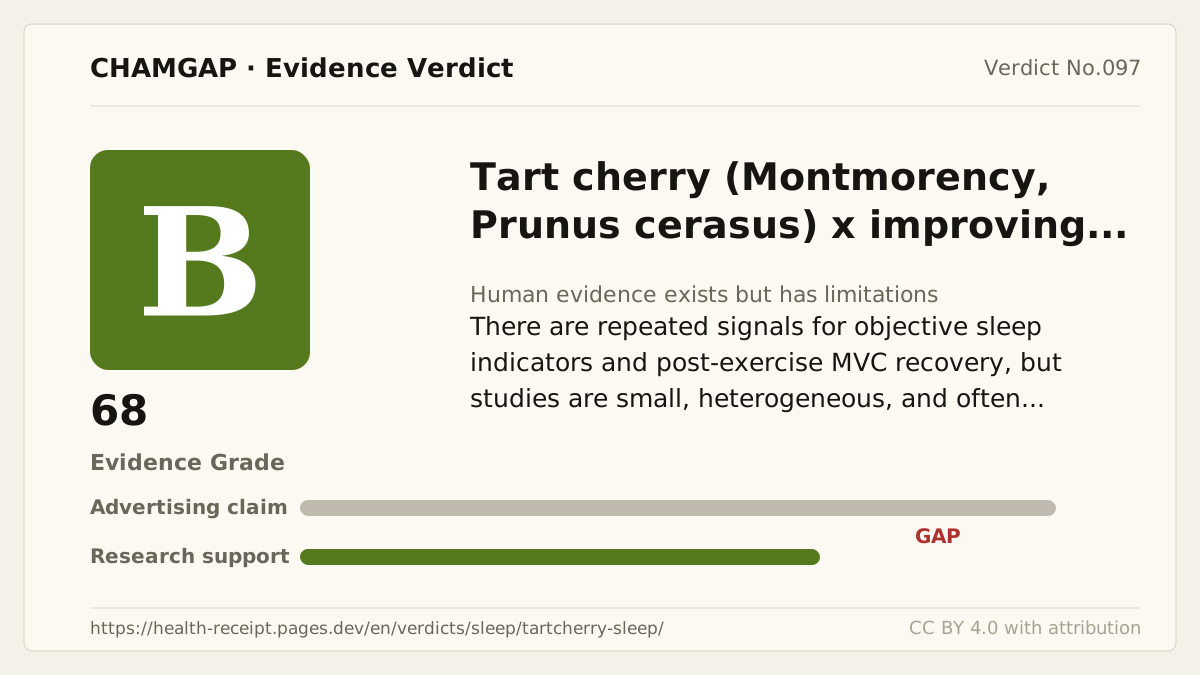
[Chamgap] Tart cherry (Montmorency, Prunus cerasus) × improving sleep quality/sleep duration and post-exercise muscle recovery — Evidence Grade B·68. 12 cited sources checked. Source: https://chamgap.com/en/verdicts/sleep/tartcherry-sleep/ · CC BY 4.0CC BY 4.0 — free to use with attribution; do not distort grades, numbers, or verdict meaning.
What this document does and does not do
Chamgap is an information source. It reports what research has and has not confirmed; it does not tell readers what to take or buy. That decision belongs to readers and, when needed, medical or legal professionals. This verdict reflects literature available up to the search date and may change as new research appears. Nothing here is medical advice.