
NAC,
does it really help with liver, respiratory health, and antioxidant effects?
research showsFor NAC, the evidence changes when the disease group is narrowed. For reducing exacerbations in patients with COPD or chronic bronchitis, several RCTs and Cochrane evidence provide a relatively clear signal, but improvements in lung function, quality of life, and mortality are inconsistent. Liver-health and liver-detox claims mix the established medical use as an acetaminophen-poisoning antidote with supplement-style claims for improved liver function; in MASLD/NAFLD clinical studies, liver enzymes and fatty liver are not clearly improved or remain limited to combination/small data. Antioxidant evidence is centered on markers such as glutathione and MDA, making it difficult to connect directly to clinical efficacy.
ads claimKorean consumer-facing claims generally bundle 'glutathione precursor,' 'powerful antioxidant,' 'protection from reactive oxygen damage,' 'bronchial and respiratory health,' 'liver health and liver detox,' 'phlegm and cough,' and 'immunity.' iHerb Korean product descriptions present NAC 600 mg capsules as supporting immune function, bronchial health, respiratory health, liver health, and as a glutathione precursor. iHerb Korean informational posts also explain that NAC supplements glutathione and helps with paracetamol toxicity, immunity, respiratory health, and liver health. Korean video/blog-style content uses phrases such as 'liver detox,' 'chronic inflammation,' and 'asthma, rhinitis, phlegm, cough.' Domestic reports repeatedly noted enforcement cases stating that NAC is a drug ingredient with expectorant and liver-detoxifying actions rather than a health-functional-food ingredient and cannot be used in foods.
Useful facts when choosing a product
- Ordinary overseas-direct-purchase products commonly come as 600 mg per capsule, and advertising often bundles respiratory, liver, antioxidant, and immune claims into one paragraph.
- According to domestic reporting, acetylcysteine has been treated as a drug ingredient such as an expectorant and an antidote for acetaminophen poisoning, and there have been cases of detection as an ingredient that cannot be used in food. This regulatory fact is separate from the evidence grade but necessary for product distinction.
- Clinical-trial doses overlap with one-capsule advertising amounts, such as 600 mg once daily or 600 mg twice daily in COPD studies and 600 mg three times daily in MASLD studies, but participants were patients and follow-up/evaluation accompanied intake.
- Oral NAC is generally reported in RCTs and reviews to have adverse-event rates similar to placebo, but as a drug ingredient it requires caution for gastrointestinal symptoms, headache, rare hypersensitivity/bronchospasm, and medication issues such as nitroglycerin co-use.
What the research actually shows
Respiratory: Cochrane 2019 reviewed 38 RCTs and 10,377 participants using oral mucolytics in chronic bronchitis/COPD, and many trials included NAC. The proportion of people without exacerbations, days of disability, and hospitalization improved slightly, but effect size became smaller in recent studies and lung function, quality of life, and mortality were limited. For NAC alone, PANTHEON (moderate-to-severe COPD, 1,006 participants, 600 mg bid, 1 year) lowered annual exacerbation rate to 1.16 vs 1.49, RR 0.78, but was manufacturer-funded. BRONCUS (523 participants, 600 mg qd, 3 years) was negative for both FEV1 decline and exacerbation rate, and a 2024 Chinese RCT in 968 mild-moderate COPD patients was also negative for the co-primary endpoints of total exacerbation rate and FEV1 change. Liver: a 2023 liver-function meta-analysis concluded that across 8 controlled trials, AST, ALT, and ALP were not significantly affected, with only albumin/bilirubin partially improved. A 2025 MASLD double-blind RCT also found no difference versus placebo in hepatic steatosis, AST, ALT, or lipids, and only glucose, insulin resistance, CRP, and glutathione improved. Antioxidant: a 2020 oxidative/inflammatory marker meta-analysis reported reduced MDA, IL-8, and homocysteine, but CRP, TNF-alpha, and IL-6 were not significant, and these are surrogate markers rather than clinical endpoints.
Why this is classified as C (56)
Because this is a combined claim, effects were separated. Looking only at COPD/chronic bronchitis exacerbation reduction, human RCTs and meta-analyses show a signal close to B. However, positive large trials include manufacturer funding, and there are primary-endpoint-negative studies such as BRONCUS and a large 2024 RCT. Liver health/liver detox must separate evidence for medical detoxification from evidence for supplement-style liver-function improvement, and supplement-style MASLD/NAFLD evidence is centered on surrogate markers or negative results. Antioxidant evidence is mostly biomarker improvement. Under the boundary rule, claims centered on surrogate markers and expanded to general health advertising are at most C, and the respiratory disease-specific evidence is reflected in an upper-C score of 56.
Counterpoint. NAC is not an ingredient with no clinical evidence. Its uses as an acetaminophen-poisoning antidote and mucolytic are established in medical contexts, and there are repeated clinical signals for reducing COPD/chronic bronchitis exacerbations. However, that evidence does not transfer as written to advertising sentences about 'liver detox, antioxidant effects, and overall lung health in healthy people.'
Rejudgment record. Draft and blinded review converged — Evidence for NAC reducing COPD/chronic-bronchitis exacerbations is acknowledged, but the core evidence for liver detox, antioxidant, and general lung-health advertising is surrogate-marker, combination-product, or disease-specific data, so the combined claim is C.
Cross-check — Codex and Claude
Evidence Table
| Study | Design | Sample | Funding | Endpoint | Result | Weight |
|---|---|---|---|---|---|---|
| iHerb Korea | not specified | not reported | immune/respiratory/liver/gastrointestinal | Korean product descriptions advertise that NAC enhances immune function, bronchial health, respiratory health, and liver health and is a glutathione precursor. | core | |
| iHerb Korea Wellness Hub | not specified | not reported | immune/respiratory/liver/gastrointestinal | Korean informational writing connects NAC to glutathione supplementation, paracetamol toxicity, immunity, respiratory health, and liver health. | core | |
| Study 3 | not specified | not reported | liver | A report citing MFDS explained that acetylcysteine is a drug ingredient with expectorant and liver-detox effects, cannot be used in foods, and was detected at 121 mg per capsule in an offending product. | core | |
| Poole P, Sathananthan K, Fortescue R 2019 | meta-analysis of RCTs | 10,377 | not reported | gastrointestinal/bronchial | Across 38 RCTs and 10,377 participants, oral mucolytics slightly improved no COPD/chronic-bronchitis exacerbation, disability days, and hospitalization, and many studies included NAC. | core |
| Zheng JP et al. 2014 | not specified | 1,006 | possible manufacturer/industry involvement | liver | In a Chinese COPD RCT of 1,006 participants, NAC 600 mg bid for 1 year lowered the primary endpoint annual exacerbation rate to 1.16 vs 1.49, RR 0.78, 95% CI 0.67-0.90. | supportive |
| Decramer M et al. 2005 | not specified | 523 | possible manufacturer/industry involvement | liver | In 523 COPD participants, NAC 600 mg qd for 3 years in an RCT did not differ from placebo in FEV1 decline or annual exacerbation rate. | supportive |
| Tian H/Zhou Y et al. 2024 | not specified | 968 | not reported | not specified | In a 968-participant mild-moderate COPD RCT, NAC 600 mg bid for 2 years did not significantly improve co-primary total exacerbation rate 0.65 vs 0.72, RR 0.90, p=0.10, or FEV1 change. | supportive |
| Huang C et al. 2023 | meta-analysis of RCTs | 1,076 | not reported | not specified | Meta-analysis including 9 RCTs, 1,061 NAC participants, and 1,076 placebo participants found no significant differences in no exacerbation, FEV1, FVC, SGRQ, or GSH. | supportive |
| Nikbaf-Shandiz M et al. 2023 | meta-analysis | not reported | ALT/AST | Meta-analysis of 8 controlled clinical trials found NAC did not significantly lower AST, ALT, or ALP, with only increased albumin and decreased bilirubin observed. | supportive | |
| Sinaeinejad M et al. 2025 | double-blind RCT | 69 | not reported | liver/ALT/AST/gastrointestinal | In a 69-participant MASLD RCT, NAC 600 mg tid for 8 weeks did not significantly improve hepatic steatosis, AST, ALT, or lipids versus placebo, and improved only FBG, insulin, HOMA-IR, CRP, and glutathione. | supportive |
| de Oliveira CPMS et al. 2008 | not specified | 20 | not reported | ALT | In a 20-participant NASH pilot, ALT and some histologic indicators improved after NAC 1.2 g/day plus metformin for 12 months, but a low-calorie diet was also used and there was no NAC-alone/placebo control. | supportive |
| Oliveira CP et al. 2019 | RCT | 53 | not reported | liver | In a biopsy-proven NASH open-label RCT of 53 participants comparing NAC+UDCA+MTF, UDCA+MTF, and NAC+MTF, biochemical and histologic differences among the three groups were not significant after 48 weeks. | supportive |
| Faghfouri AH et al. 2020 | meta-analysis | not reported | not specified | In a meta-analysis of controlled clinical trials, NAC lowered MDA, IL-8, and homocysteine, but CRP, TNF-alpha, and IL-6 were not significant. | supportive | |
| IPFnet/PANTHER-IPF 2014 | RCT | not reported | respiratory/gastrointestinal/bronchial | In IPF patients, NAC was reported to have no benefit over placebo in preserving FVC, making it difficult to extend respiratory claims beyond COPD/chronic bronchitis. | supportive |
Receipt — 14 References
Of 14 cited sources, 1 had limited original-page access (blocked or summary-only) and were verified via index/summary, marked partial; the rest were verified at the original page. As of 2026-07-07.
Reviewed and approved: Chamgap Editorial Team · Approval date: 2026-07-07 · Corrections: none
Cite this verdict
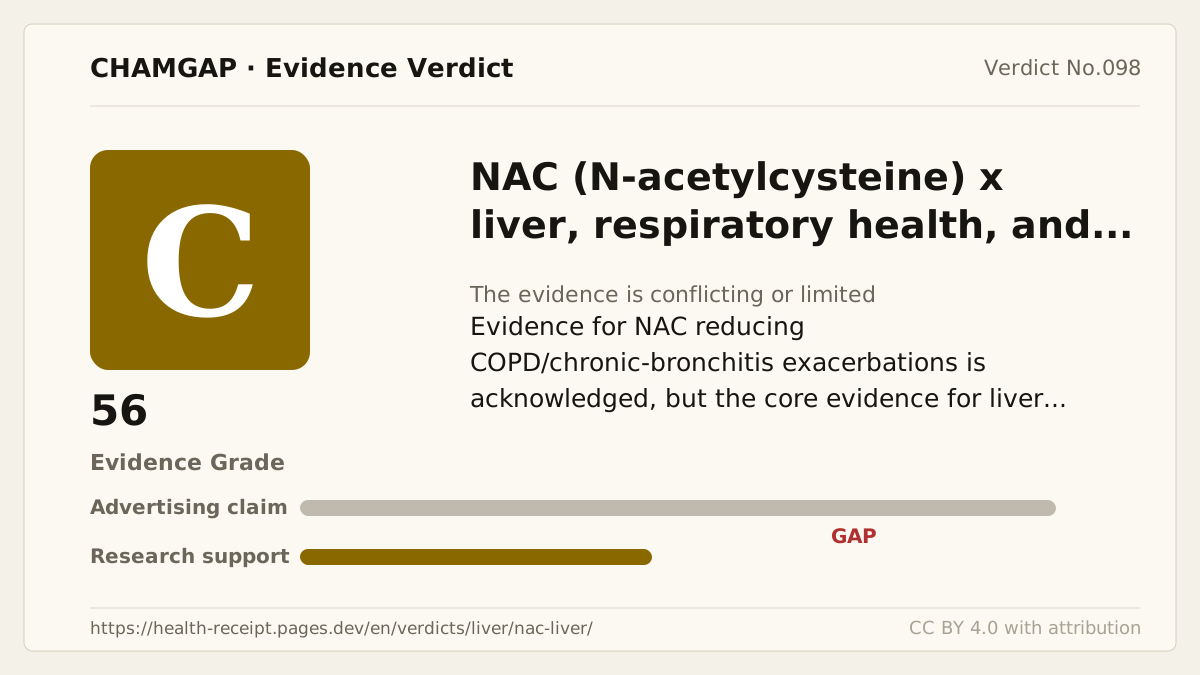
[Chamgap] NAC (N-acetylcysteine) × liver, respiratory health, and antioxidant effects — Evidence Grade C·56. 14 cited sources checked. Source: https://chamgap.com/en/verdicts/liver/nac-liver/ · CC BY 4.0CC BY 4.0 — free to use with attribution; do not distort grades, numbers, or verdict meaning.
What this document does and does not do
Chamgap is an information source. It reports what research has and has not confirmed; it does not tell readers what to take or buy. That decision belongs to readers and, when needed, medical or legal professionals. This verdict reflects literature available up to the search date and may change as new research appears. Nothing here is medical advice.