
Milk thistle,
does it really help with liver health and fatigue improvement?
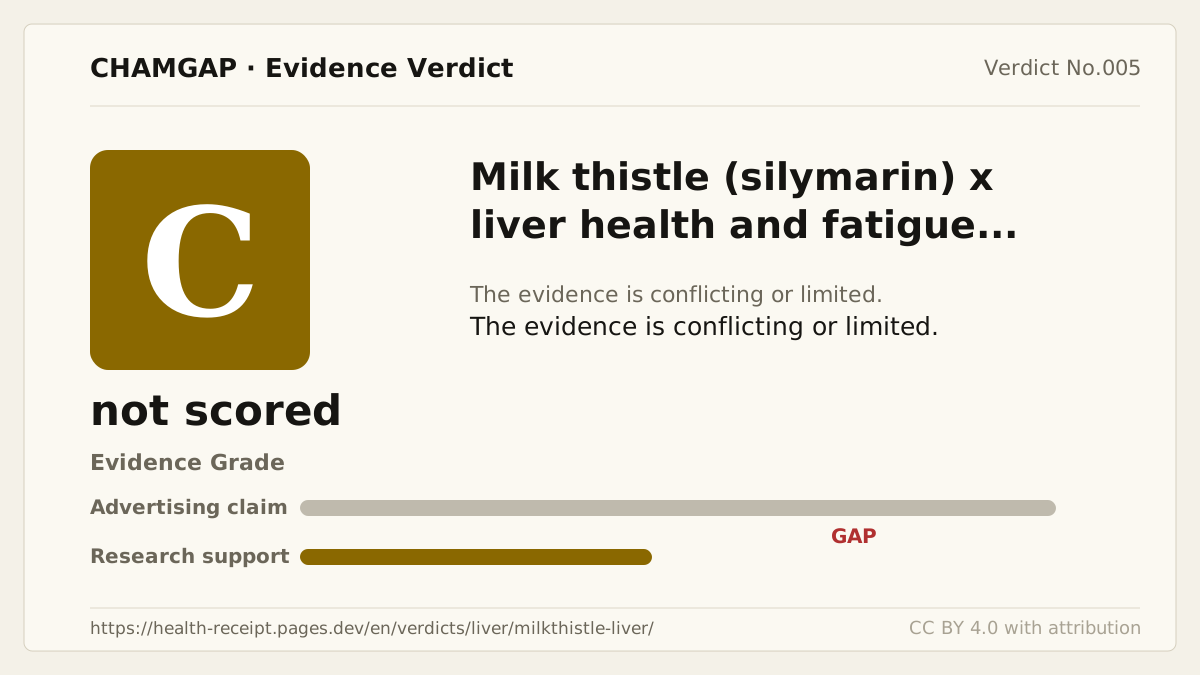
research showsMilk thistle (silymarin) is an ingredient that the Korean MFDS lists as a generic functional ingredient and officially recognizes as one that 'may help liver health' (daily silymarin intake 130mg). However, looking at the international clinical evidence, the markers that show improvement are mostly surrogate markers such as liver enzymes (ALT and AST), while Cochrane reviews and several large RCTs (SyNCH, SyNCH-NASH) did not show effects on real clinical outcomes such as death or histologic improvement. Even those studies were mostly in patients with liver disease rather than healthy general adults, and effects tend to appear only in low-quality trials. 'Fatigue improvement' or 'vitality' is not an MFDS-recognized functionality, and improvement was not confirmed even in quality-of-life measures in clinical trials, so fatigue-oriented advertising has weak support.
ads claimThere are three gaps between advertisements and evidence. (1) Misapplication of the target population: advertisements appeal to 'liver health' in healthy general consumers, but the verified clinical evidence is all in patients with liver disease. Movement in surrogate markers in patients cannot be expanded into evidence for prevention or health improvement in the general population. (2) Packaging surrogate markers as outcomes: advertisements emphasize 'high-dose silymarin,' but the evidence concerns changes in liver-enzyme values (surrogate markers), while clinical outcomes such as death or histology and patient-noticeable improvement were not confirmed in large RCTs (statistical significance is not the same as felt benefit). (3) Claims outside recognized functionality: Coupang listings such as 'liver fatigue' and 'vitality energy,' and ople.com expressions such as 'improves chronic fatigue' and 'removes fatigue,' go beyond the MFDS-recognized functionality, 'may help liver health.' Esther Mall products showing silymarin 130mg meet the MFDS daily-intake standard, so the amount claim itself falls within the regulatory-recognized range.
Useful facts when choosing a product
- The MFDS-recognized daily intake standard is 130mg of the marker component silymarin. Checking whether the product's labeled silymarin or milk-thistle-extract amount meets this standard helps judge whether it meets the generic specification.
- Milk thistle extract is a generic health functional food ingredient. Similar products may contain only small amounts of the ingredient or be sold as 'other processed foods' (ordinary foods), so checking for a health functional food certification mark and item manufacturing number distinguishes actual health functional foods from lookalikes.
- It is useful to distinguish whether the labeled mg refers to total milk thistle extract or the pure active marker silymarin content. The MFDS standard is not total extract but 130mg of the marker component silymarin (failure pattern E2).
- Phrases such as 'liver fatigue,' 'vitality/energy,' and 'chronic fatigue improvement' are not included in the MFDS-recognized functionality, which is 'may help liver health.' Listings that emphasize these appeals go beyond the recognized advertising scope.
What the research actually shows
The 8 verified papers are all in patients with liver disease, including alcoholic liver disease, hepatitis B or C, NAFLD/NASH, and there is no study in healthy general adults. (1) Cochrane review, Rambaldi 2007, PMC8724782 original checked: no significant effect on all-cause mortality (RR 0.78, CI 0.53~1.15). Liver-related mortality decreased in the overall pooled analysis (RR 0.50, CI 0.29~0.88), but disappeared when limited to 'high-quality trials only' (RR 0.57, CI 0.28~1.19). There was no significant effect on complications such as ascites or hepatic encephalopathy (RR 0.95). The authors concluded, 'it cannot be recommended outside clinical trials' [A2 confirmed: effects only in low-quality trials]. (2) SyNCH RCT, Fried 2012, JAMA, PMID 22797645: in chronic hepatitis C patients who failed interferon, even high doses (420 or 700mg three times daily) did not normalize ALT more than placebo, with each group at 4% (p=0.75), and HCV RNA and QoL did not differ [negative result]. (3) SyNCH-NASH, Navarro 2019, PMC6752871 original checked: NAS 2-point reduction was 19%/15%/12% with no significant difference (p=0.79); manufacturer Rottapharm|Madaus supplied active drug/placebo and assumed sponsorship, and multiple authors disclosed relationships [A1 confirmed]. (4) In multiple meta-analyses, de Avelar 2017, Kalopitas 2021, and Malik 2024, ALT and AST decreased statistically significantly, but de Avelar's authors explicitly judged the reductions to have 'no clinical relevance' [B1]. In other words, improvement is limited to surrogate markers, heterogeneity is large, and the signal depends on low-quality trials.
Why this is classified as C (46)
Why it is C: the evidence is conflicting and limited. On one side there is MFDS generic recognition for liver health and statistically significant reductions in liver enzymes in multiple meta-analyses. On the other side there are negative results from the Cochrane review and large independent RCTs such as SyNCH, disappearance of effects when restricted to high-quality trials, and limitation mostly to surrogate markers. Why it is not A to B: there is no strong and consistent benefit on real clinical outcomes such as mortality, histology, or patient-noticeable improvement; effects depend on low-quality trials (A2); the improved markers are mostly surrogate markers (B1); and the evidence populations are all patients, so it cannot be directly transferred to claims for the general population. Why it is not D: there are many actual human RCTs and meta-analyses, not just observational studies, statistical signals recur for surrogate markers, and the MFDS recognizes it as a generic functional ingredient. If 'fatigue improvement' alone is considered, it is around D because it is not regulator-recognized and QoL evidence is absent, but the overall target claim reflects the limited evidence on the 'liver health' axis and is judged C.
Counterpoint. More favorable view, B: milk thistle is one of the few liver-health functional ingredients recognized generically by the MFDS, multiple meta-analyses in different populations and designs reproducibly show ALT and AST reductions, safety is generally good, and Wah Kheong 2017 found positive secondary markers that may be clinically meaningful, including fibrosis and liver stiffness, so it is close to B. Rebuttal: (1) the de Avelar authors who reported enzyme reductions themselves judged them to have 'no clinical relevance' and warned about heterogeneity (I²>50%) and low methodological quality. (2) Whether the effect remains in subanalyses by funding source or in independent high-quality studies has not been verified, and Cochrane found that effects disappear when restricted to high-quality trials. (3) Wah Kheong's positive secondary findings are post hoc-type findings while the primary endpoint (NAS) was negative, so they are not confirmatory evidence, and manufacturer provision is also unconfirmed. (4) Above all, all evidence is in patients, so it does not directly support claims for the general population. Therefore the evidence hierarchy is insufficient to raise it to B.
| Endpoint | S | Surrogate marker - laboratory or imaging measures |
| Replication | R1 | Single confirmatory trial |
| Independence | I0 | Evidence comes only from manufacturer studies |
| Effect size | E~ | Statistically positive but below the threshold |
| Precision | C0 | The confidence interval leaves room for benefit |
The scoring table and the verdict agree (C).
Cross-check — Codex and Claude
Evidence Table
| Study | Design | Sample | Funding | Endpoint | Result | Weight |
|---|---|---|---|---|---|---|
| Rambaldi A, Jacobs BP, Gluud C 2007 | systematic review | liver | Patients with liver disease, not the general population; doses varied across trials; no significant effect on all-cause mortality (RR 0.78, CI 0.53~1.15), liver-related mortality disappeared when limited to high-quality trials, complications were ineffective; funding source not specified in the original text (presumed non-manufacturer). | key | ||
| Fried MW et al. 2012 | randomized controlled trial | liver / ALT | Chronic hepatitis C patients who failed interferon, not the general population; silymarin 420/700mg three times daily for 24 weeks (high dose); ALT normalization was 4% in each group with no difference from placebo (p=0.75), and HCV RNA and QoL did not differ; NIH government funding (whether the manufacturer supplied study drug was not confirmed in the abstract). | key | ||
| Navarro VJ et al. 2019 | double-blind randomized controlled trial | possible manufacturer or industry involvement | Non-cirrhotic NASH patients, not the general population; Legalon 420/700mg three times daily for 48-50 weeks; NAS 2-point reduction reached 19%/15%/12% with no significant difference (p=0.79), and fibrosis and HOMA did not improve; manufacturer Rottapharm|Madaus supplied active drug/placebo and assumed sponsorship, with author relationships disclosed. | key | ||
| Wah Kheong C, Nik Mustapha NR, Mahadeva S 2017 | randomized controlled trial | liver | Biopsy-confirmed NASH patients, not the general population; silymarin 700mg three times daily for 48 weeks; primary endpoint (NAS 30% decrease) did not differ (p=0.467), but secondary fibrosis improvement (p=0.023) and liver-stiffness reduction (p=0.002) were positive; funding and manufacturer provision were not confirmed in the abstract. | key | ||
| de Avelar CR, Pereira EM, de Farias Costa PR, de Jesus RP, de Oliveira LPM 2017 | meta-analysis | liver / ALT / AST | Patients with liver disease, mainly NAFLD and not the general population; ALT (P=0.007) and AST (P<0.001) decreased statistically significantly, but the authors judged them to have 'no clinical relevance,' GGT did not differ, heterogeneity was high (I²>50%); authors declared no conflicts of interest; fatigue was not measured. | supporting | ||
| Kalopitas G, Antza C, Doundoulakis I et al. 2021 | meta-analysis | body weight / ALT / AST | NAFLD patients, not the general population; doses varied across trials; ALT and AST decreased significantly versus placebo regardless of body weight, but the authors warned about quality defects in included studies and concluded that further studies are needed to connect this to histologic improvement. | supporting | ||
| Malik A et al. 2024 | meta-analysis | 820 | possible manufacturer or industry involvement | ALT / AST / LDL | 820 NAFLD/MASLD patients, not the general population; doses varied across trials; ALT MD -17.12 U/L (P<0.004), AST MD -12.56 (P<0.0001), triglycerides and HDL improved, but GGT, LDL, HOMA-IR, and BMI did not differ, and these were not clinical outcomes such as death or histology; conflicts of interest marked 'N/A.' | supporting |
| Calderon Martinez E et al. 2023 | systematic review of randomized controlled trials | 29 | possible manufacturer or industry involvement | liver | 29 RCTs and 3,846 participants across varied diseases, mostly patients and not standard healthy adults; dose, population, and route inclusion criteria were not specified (an acknowledged limitation by the authors); 65.5% showed reduced liver enzymes, 20.7% no change, 13.8% increased, hepatitis C was ineffective, and the conclusion was only 'promising'; authors declared no conflicts of interest. | supporting |
Receipt — 8 References
Of 8 cited sources, 1 had limited original-page access (blocked or summary-only) and were verified via index/summary, marked partial; the rest were verified at the original page. As of 2026-07-06.
Reviewed and approved: Chamgap Editorial Team · Approval date: 2026-07-06 · Corrections: none
Cite this verdict
[Chamgap] Milk thistle (silymarin) x liver health and fatigue — Evidence Grade C·46. 8 cited sources checked. Source: https://chamgap.com/en/verdicts/liver/milkthistle-liver/ · CC BY 4.0CC BY 4.0 — free to use with attribution; do not distort grades, numbers, or verdict meaning.
What this document does and does not do
Chamgap is an information source. It reports what research has and has not confirmed; it does not tell readers what to take or buy. That decision belongs to readers and, when needed, medical or legal professionals. This verdict reflects literature available up to the search date and may change as new research appears. Nothing here is medical advice.