
Choline,
does it really help with Liver health/fatty liver and cognition/memory?
research showsCholine is an essential nutrient, and human evidence clearly links deficiency to fatty liver and liver injury. However, evidence that ordinary supplementation improves the liver of healthy people or broadly improves cognition is weak and depends on form and population. For the liver, a small NAFLD RCT exists, but its primary endpoint was a surrogate oxidative-stress marker such as TBARS, so the maximum is C. For cognition, alpha-GPC and citicoline show signals in patient or memory-impaired groups, but brand/manufacturer funding, short duration, disease-group restriction, and limited independent replication are substantial; ordinary choline/lecithin is repeatedly null or unclear.
ads claimIn the Korean market, searching for choline exposes myo-inositol combination products, choline & inositol, citicoline, alpha-GPC, and phosphatidylcholine/lecithin products together. Coupang search results showed phrases such as 'memory & concentration support,' 'adult brain function supplement,' and 'brain nutrient memory-improvement supplement,' while informational articles described choline as both a 'raw material for brain neurotransmitters' and an 'essential nutrient for liver fat metabolism,' and as 'the key to brain health and fatty-liver prevention.' Alpha-GPC informational content tended to use studies in Alzheimer's patients as a basis for extending to general wellness benefits such as memory and cognitive improvement.
Useful facts when choosing a product
- Market products are more often combinations or salt/precursor forms, such as choline+inositol+folic acid, citicoline+tyrosine, alpha-GPC, and phosphatidylcholine/lecithin, rather than standalone choline.
- The recent RCT directly positive for liver evidence used phosphatidylcholine 2400 mg/day in NAFLD patients for 12 weeks; it is not evidence for improved liver function in generally healthy people.
- Cognitive evidence differs greatly by form. Evidence for choline bitartrate and lecithin cannot be transferred unchanged to alpha-GPC/citicoline product claims, and conversely evidence for alpha-GPC patient groups cannot be applied to general choline products.
- According to NIH ODS, adult adequate intake is 550 mg/day for men and 425 mg/day for women, and the adult upper intake level is 3500 mg/day. General supplement contents are often 10-250 mg, but alpha-GPC/citicoline/combination products use different labeling bases.
What the research actually shows
Liver: controlled-diet depletion-repletion studies and long-term TPN patient studies show that choline deficiency can produce hepatic fat accumulation and liver-enzyme abnormalities and that repletion can reverse them. A 2025 NAFLD RCT reported that phosphatidylcholine 2400 mg/day for 12 weeks improved TBARS, CAP, FibroScan, ALT/AST, and related markers, but it was a single small, single-blind, usual-care-controlled surrogate-marker study whose primary endpoint was TBARS. Cognition: the lecithin Cochrane review did not support clear clinical benefit in dementia/cognitive impairment, and an acute choline bitartrate RCT was null in memory tasks in healthy young adults. The CDP-choline Cochrane review suggested short-term memory/behavior signals in older adults with chronic cerebrovascular cognitive impairment, but noted heterogeneity and short duration. Alpha-GPC has positive signals in a 2023 meta-analysis and a 2024 Korean aMCI RCT, but disease-group restriction, branded ingredient, manufacturer funding, and lack of independent replication remain issues.
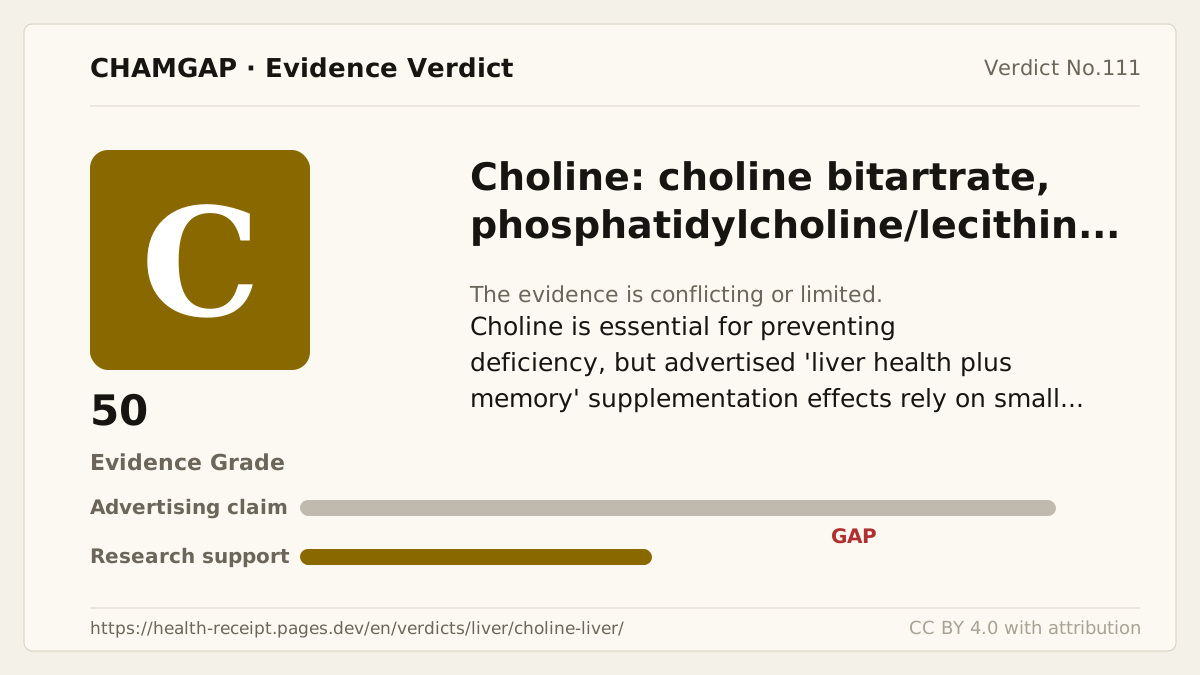
Why this is classified as C (50)
By outcome, liver deficiency prevention/reversal evidence is strong, but improvement of liver health through general supplementation rests mainly on one recent small RCT with TBARS as the primary endpoint, so boundary rule 1 caps it at C. For cognition, the lecithin Cochrane review and choline bitartrate RCT do not support broad supplement claims, while positive alpha-GPC/citicoline evidence is limited by patient groups, short duration, brand/manufacturer funding, and lack of independent replication. C is appropriate for broad consumer advertising claims.
Counterpoint. Physiologic need is a separate issue in deficiency states, long-term TPN, pregnancy/lactation, or other high-requirement situations. Also, alpha-GPC and citicoline have more evidence in cognitive patient groups than ordinary choline supplements, so medical use in specific diagnoses and specific preparations requires separate assessment.
Rejudgment record. Convergent — Choline liver and cognition evidence is centered on surrogate markers and mechanisms, with insufficient evidence for fatty-liver or cognitive clinical effects in the general population
Cross-check — Codex and Claude
Evidence Table
| Study | Design | Sample | Funding | Endpoint | Result | Weight |
|---|---|---|---|---|---|---|
| Sedhom SS et al. 2025 | RCT | 79 | Possible manufacturer/industry involvement | ALT/AST | 79 NAFLD patients analyzed, phosphatidylcholine 2400 mg/day for 12 weeks; improved surrogate markers including the primary TBARS endpoint, CAP, FibroScan, and ALT/AST. | Core |
| Fischer LM et al. 2007 | 57 | liver | Controlled-diet depletion-repletion study in 57 healthy adults; on a low-choline diet, 77% of men, 80% of postmenopausal women, and 44% of premenopausal women showed signs of fatty liver or muscle damage. | Core | ||
| Buchman AL et al. 1995 | RCT | 4 | liver/gut/gastrointestinal | In 4 long-term TPN patients, IV choline chloride 1-4 g/day for 6 weeks resolved hepatic steatosis on CT. | Core | |
| NIH Office of Dietary Supplements | cognition | Official fact sheet summarizing evidence on choline AI, UL, deficiency, NAFLD, cognition, and safety. | Core | |||
| Higgins JPT, Flicker L 2000 | Systematic review of RCTs | 12 | gut/gastrointestinal/cognition | Review of 12 lecithin RCTs (including 265 people with Alzheimer's disease); did not support benefit for treating dementia/cognitive impairment. | Supporting | |
| Fioravanti M, Yanagi M 2005 | Systematic review of RCTs | 14 | gut/gastrointestinal/memory | Review of 14 CDP-choline RCTs; there were short-term memory/behavior improvement signals in older adults with chronic brain disease, but heterogeneity and short follow-up were limiting. | Supporting | |
| Lippelt DP et al. 2016 | Double-blind trial | gut/gastrointestinal/memory | In a double-blind crossover experiment in healthy young adults, acute choline bitartrate 2.0-2.5 g did not improve memory tasks. | Supporting | ||
| Jeon J et al. 2024 | Double-blind RCT | 100 | Possible manufacturer/industry involvement | Korean aMCI, 100 people, SHCog alpha-GPC 600 mg/day for 12 weeks; primary ADAS-cog change was significantly greater than placebo. | Supporting | |
| Nakazaki E et al. 2021 | Double-blind RCT | 100 | Possible manufacturer/industry involvement | 100 people aged 50-85 with AAMI, Cognizin citicoline 500 mg/day for 12 weeks; reported improvements in episodic memory and composite memory. | Supporting | |
| Sagaro GG et al. 2023 | Meta-analysis of RCTs | 861 | gut/gastrointestinal/cognition | Meta-analysis of 8 studies (7 RCTs + 1 cohort, 861 people) in adult-onset cognitive impairment; alpha-GPC alone/combined showed signals of improved MMSE and ADAS-Cog. | Supporting |
Receipt — 10 References
Of 10 cited sources, 1 had limited original-page access (blocked or summary-only) and were verified via index/summary, marked partial; the rest were verified at the original page. As of 2026-07-07.
Reviewed and approved: Chamgap Editorial Team · Approval date: 2026-07-07 · Corrections: none
Cite this verdict
[Chamgap] Choline x liver health/fatty liver and cognition/memory — Evidence Grade C·50. 10 cited sources checked. Source: https://chamgap.com/en/verdicts/liver/choline-liver/ · CC BY 4.0CC BY 4.0 — free to use with attribution; do not distort grades, numbers, or verdict meaning.
What this document does and does not do
Chamgap is an information source. It reports what research has and has not confirmed; it does not tell readers what to take or buy. That decision belongs to readers and, when needed, medical or legal professionals. This verdict reflects literature available up to the search date and may change as new research appears. Nothing here is medical advice.