
Hovenia dulcis fruit,
does it really help with Liver health and hangover?
research showsHangover symptom relief has some positive signals in small human RCTs. However, liver-health claims lack evidence in humans proving long-term liver-function improvement or prevention/treatment of liver disease, and the evidence centers on surrogate markers such as AST after acute alcohol intake or animal data. Therefore, advertising that bundles 'liver health and hangover' is best viewed as limited evidence.
ads claimIn the Korean market, many advertising-style articles and informational posts link Hovenia dulcis fruit or fruit extract to 'hangover relief,' 'liver detox,' 'liver protection,' 'improved liver function,' and 'protection of the liver from alcohol-induced damage.' Korea Yakult Coupers-type reports foreground the daily intake 2460 mg and MFDS individually recognized wording, while reports related to Kwangdong Pharmaceutical promoted liver-protection and hangover-improvement study results for Hovenia fruit extract. Some articles and YouTube/blog-type content strongly connect tea, beverages, and juice forms with hangover relief and liver-health imagery. However, MFDS recognition is an issue of regulatory labeling permission and was considered separate from the evidence grade in this verdict.
Useful facts when choosing a product
- Marketed products commonly come as Hovenia dulcis fruit extract powder, Hovenia beverages, hangover-relief jellies/sticks/pills, fermented forms, or combinations with pueraria, glutathione, or vitamins.
- The standalone HDE dose that repeatedly appears in research is 2460 mg, which is also mentioned in the 2017 RCT and domestic liver-health functional promotional wording.
- The beverages in the 2024 RCT handled both standalone and combination products, such as HDB (0.475% Hovenia dulcis), HDPB (Hovenia+Pueraria lobata), and HDGB (Hovenia+glutathione yeast).
- Hangover relief and liver protection often appear together in advertising, but the clinical evidence centers on acute hangover symptoms and blood alcohol/acetaldehyde markers and should be distinguished from long-term liver-disease clinical outcomes.
What the research actually shows
The 2017 standalone HDE RCT was a randomized crossover trial in 26 ALDH2-heterozygous men given HDE 2460 mg or placebo together with 50 g alcohol as soju. Blood alcohol/acetaldehyde and 1-hour total hangover score did not differ between groups, but reductions in some later symptoms such as headache, dizziness, nausea, and weakness, and differences in AST/inflammatory markers were reported. This trial reported government funding and no author conflicts of interest, but the sample was small and the population was limited to young male ALDH2 heterozygotes. Two 2024 Foods papers evaluated standalone Hovenia drink or Hovenia+pueraria/glutathione yeast combinations, but there were Kwangdong Pharmaceutical employee authors and sample provision; main AUC/Cmax values were nonsignificant, and many signals centered on blood alcohol/acetaldehyde at specific time points or gastrointestinal symptoms. A 2022 systematic review of hangover interventions reviewed 21 RCTs and 386 people, but did not perform meta-analysis because interventions differed, and rated the evidence quality for all efficacy outcomes as very low. Hovenia was treated as a p=0.029 signal from a single study. No large independent RCT or Hovenia-specific Cochrane review was identified.
Why this is classified as C (55)
The compound-claim principle was applied. Hangover relief has human RCT evidence, so the literature is not absent, but sample sizes are about 24-26, independent replication is limited, and the 2024 positive signals have clear manufacturer links. Liver health centers on surrogate markers such as AST, ALT, and GGT or animal/mechanistic studies rather than human clinical improvement of liver disease, so the boundary rule caps it at C. Hangover alone could be discussed as low B, but the bottleneck in the 'liver health and hangover' compound claim is weak liver-health evidence and surrogate-marker dependence.
Counterpoint. The 2017 standalone HDE crossover RCT reported government funding and no conflicts of interest, so the evidence is not entirely industry-funded. Positive signals exist when limited to short-term hangover symptoms, and serious adverse events were not prominent in safety studies. However, this evidence cannot be directly extended to long-term liver-health claims.
Rejudgment record. Draft=blinded convergent — Hangover has small human RCT signals, but liver health is centered on surrogate markers and animal evidence rather than human clinical outcomes, so the compound claim is C
Cross-check — Codex and Claude
Evidence Table
| Study | Design | Sample | Funding | Endpoint | Result | Weight |
|---|---|---|---|---|---|---|
| Kim H, Kim YJ, Jeong HY et al. 2017 | RCT | 26 | Possible manufacturer/industry involvement | AST/hangover | Standalone HDE 2460 mg, n=26 male crossover RCT; there were signals for some hangover symptoms and AST/inflammatory markers, but blood alcohol/acetaldehyde and initial total hangover score did not differ. | Core |
| Paik DH, Lee KW, Shim YY et al. 2024 | Double-blind RCT | 24 | Possible manufacturer/industry involvement | liver | n=30 enrolled, PP n=24 crossover trial; HDB/HDPB lowered blood alcohol/acetaldehyde at some time points, but AUC/Cmax and total AHS were not significant. | Core |
| Lee KW, Xu G, Paik DH et al. 2024 | liver/gut/gastrointestinal | Small crossover trial evaluating Hovenia+pueraria or Hovenia+glutathione yeast combination beverages, centered on some time-point blood alcohol signals and AHS gastrointestinal-symptom signals. | Core | |||
| Roberts E, Smith R, Hotopf M, Drummond C 2022 | Meta-analysis of RCTs | 386 | hangover | Reviewed 21 hangover-intervention RCTs and 386 people, but meta-analysis was impossible because interventions differed; the Hovenia single study had a p=0.029 signal, but overall efficacy evidence quality was rated very low. | Core | |
| Verster JC, van Rossum CJI, Scholey A 2021 | gut/gastrointestinal/hangover | In a review of the U.S. hangover product market, no independent human safety/efficacy data were identified for 82 evaluated products, and disease-modifying claims were common. | Supporting | |||
| Turck D, Castenmiller J, De Henauw S et al. 2015 | EFSA concluded that the safety of Hovenia dulcis hot-water extract as a novel food was not established because of limitations in submitted batch specifications and representativeness of toxicity studies. | Supporting | ||||
| Park JS, Rehman SU, Kim IS, Choi MS, Na CS, Yoo HH 2017 | Preclinical | Possible manufacturer/industry involvement | liver | In an in vitro human liver microsome test, Hovenia fruit extract was reported to have minimal effects on the activity of 7 CYP enzymes. | Supporting |
Receipt — 7 References
Of 7 cited sources, 3 had limited original-page access (blocked or summary-only) and were verified via index/summary, marked partial; the rest were verified at the original page. As of 2026-07-07.
Reviewed and approved: Chamgap Editorial Team · Approval date: 2026-07-07 · Corrections: none
Cite this verdict
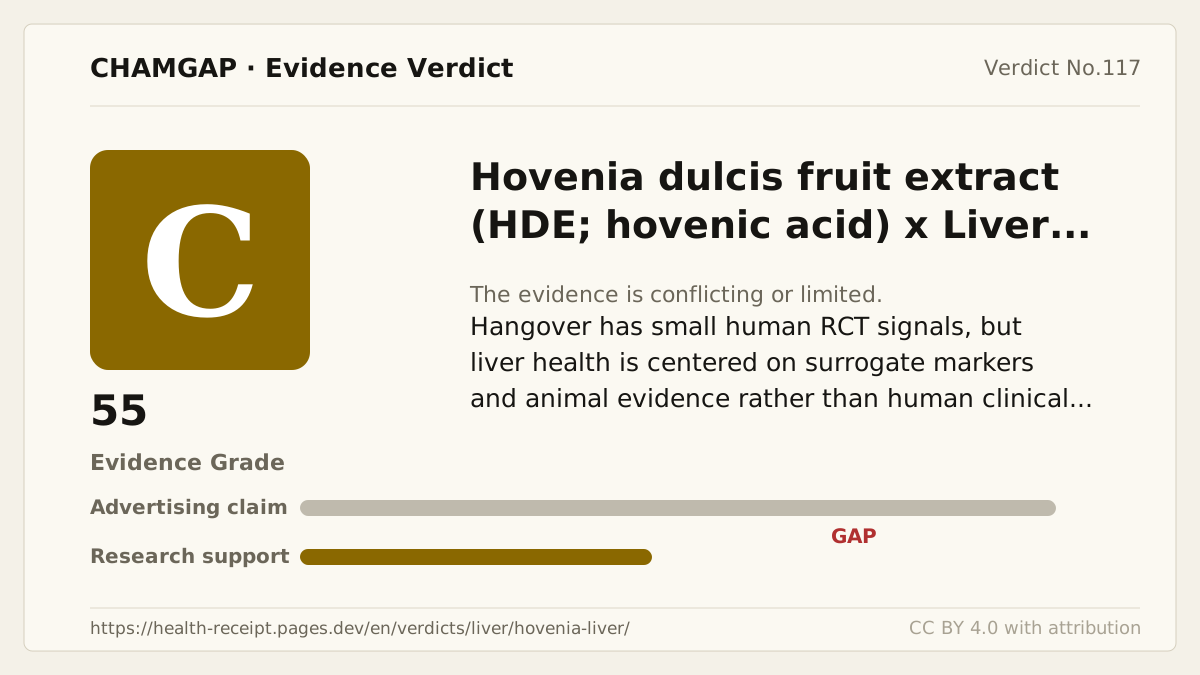
[Chamgap] Hovenia dulcis fruit x liver health and hangover — Evidence Grade C·55. 7 cited sources checked. Source: https://chamgap.com/en/verdicts/liver/hovenia-liver/ · CC BY 4.0CC BY 4.0 — free to use with attribution; do not distort grades, numbers, or verdict meaning.
What this document does and does not do
Chamgap is an information source. It reports what research has and has not confirmed; it does not tell readers what to take or buy. That decision belongs to readers and, when needed, medical or legal professionals. This verdict reflects literature available up to the search date and may change as new research appears. Nothing here is medical advice.