
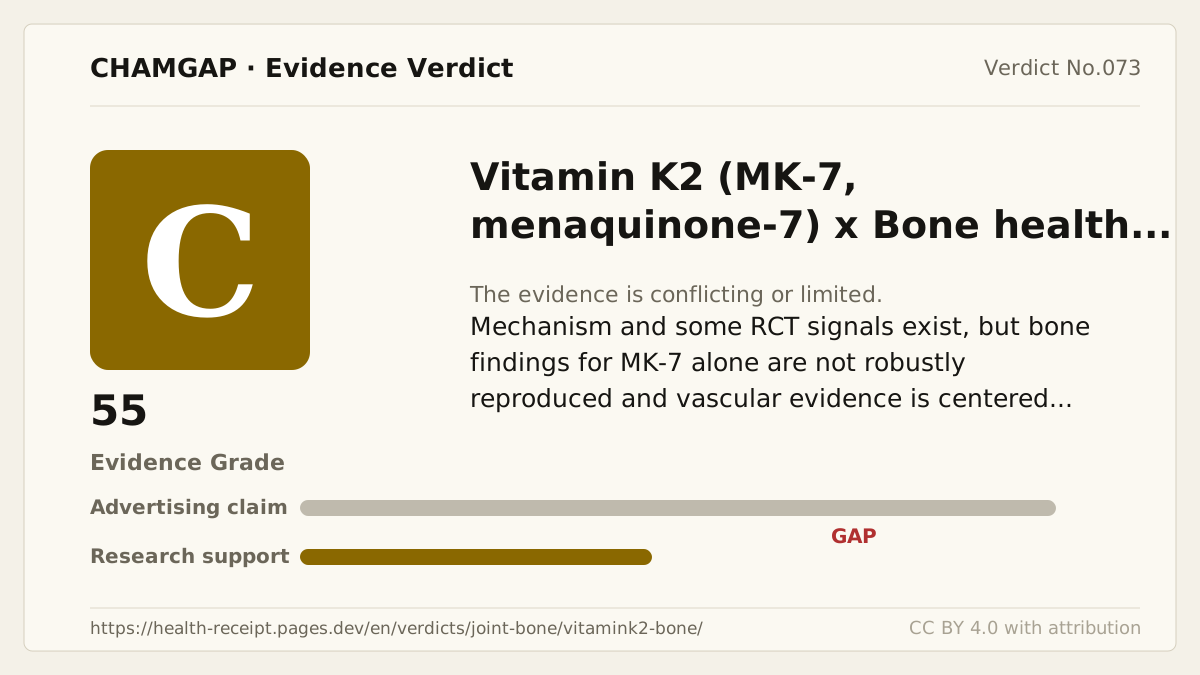
Vitamin K2,
does it really help with Bone health and vascular calcification/calcium metabolism?
research showsThe mechanism by which MK-7 activates vitamin K-dependent proteins such as osteocalcin and MGP is plausible, and human RCTs exist. However, the evidence remains largely surrogate-marker-centered, so it is not yet appropriate to state conclusively for the general population, as advertisements do, that it "sends calcium to bones and prevents vascular calcification." For bone, a 2013 3-year RCT showed favorable lumbar/femoral-neck BMD and bone-strength indices, but a 2021 independent RCT found no difference in BMD or microarchitecture when added to calcium and vitamin D. For vascular calcification, a 2026 CAD-patient RCT found a positive result slowing CAC progression, but 2019 diabetes+CVD and 2022 aortic-valve-calcification RCTs were negative on key imaging endpoints. Therefore, it is best viewed as "plausible, but lacking confirmed clinical effect."
ads claimKorean informational articles and brand pages repeatedly use "calcium paradox," "sends calcium to bones and prevents it from accumulating in blood vessels," "increases bone density," "prevents/inhibits vascular calcification," "cardiovascular protection," and "take with D3 and calcium." The MediQ7 page explains that MGP activation prevents calcium accumulation in vascular walls and reduces cardiovascular-calcification risk, and concludes with prevention of vascular deposition and direction of bone growth/density. A Yuyu Pharma 2026 blog describes K2 as a "calcium traffic light" and presents prevention of vascular calcification, osteoporosis prevention, and cardiovascular protection together. Search results from Yakup Shinmun, Dailypharm, and Yaksa Gongron also showed frames such as "supercritical vitamin K2," "calcium and vitamin D are insufficient," and "sends calcium to bones and prevents vascular calcification." Advertising tends to extend mechanisms and surrogate markers as if they were actual disease prevention.
Useful facts when choosing a product
- MK-7 is a long-chain menaquinone form of vitamin K2 and is sold as a supplement either alone or in combinations with calcium, vitamin D3, and magnesium.
- Clinical-trial doses were 180-375 µg/day in bone studies and 360-720 µg/day in vascular-calcification studies, while general Korean products usually foreground 45-200 µg/day.
- Major biomarkers are ucOC/cOC for bone and dp-ucMGP for vascular effects. These markers repeatedly improve, but more clinically proximate outcomes such as BMD, fracture, CAC, and valve calcification are less consistent.
- Positive vascular-calcification results are also imaging surrogate markers such as CAC/CT. Large RCT evidence showing reductions in myocardial infarction, stroke, or death is not yet available.
- Vitamin K can affect vitamin K antagonist anticoagulants such as warfarin, so this group is rated as requiring caution for safety.
What the research actually shows
Bone: an MK-7 180 µg/day 3-year RCT (n=244) in postmenopausal women reduced worsening in lumbar/femoral-neck BMD/BMC and bone-strength indices and improved ucOC/cOC. However, a 3-year RCT (n=142) adding MK-7 375 µg/day to calcium 800 mg/day and vitamin D3 38 µg/day greatly lowered ucOC but showed no differences in BMD, microarchitecture, or bone-turnover markers. A 2022 VK2 meta-analysis showed lumbar BMD improvement (MD 1.02, 95% CI 0.30-1.75) and ucOC improvement, but the VK2-alone subgroup showed no lumbar BMD difference, and hip/femoral-neck BMD and overall fracture analyses were inconsistent. Vascular: the 2026 VitaK-CAC JAMA Cardiology RCT (n=180 randomized, about 167 analyzed) found that MK-7 360 µg/day significantly reduced 2-year CAC score progression in CAD patients (P=0.02). Conversely, a 2019 diabetes+CVD RCT (n=68) found a trend toward increased femoral artery 18F-NaF PET TBR at 6 months (P=0.06) and no difference in CT calcification mass. The 2022 AVADEC RCT (n=365) found that MK-7 720 µg/day + vitamin D did not improve the 2-year primary endpoint of aortic valve calcification (P=0.64). A 2023 vascular-calcification meta-analysis found a small significant reduction in CAC score progression, MD -17.37, but imaging surrogate markers, mixed disease groups, and mixed positive/negative findings remain substantial.
Why this is classified as C (55)
When the composite claim is separated by effect, bone has RCTs and meta-analyses, but the MK-7-alone effect was not reproduced in an independent RCT and fracture-reduction evidence is unstable. For vascular calcification, the positive 2026 CAC RCT is important, but key 2019 and 2022 RCTs were negative, and significant results are mainly imaging surrogate markers. Under boundary rule 1, surrogate-marker-centered claims are capped at C, and under boundary rule 2b, strong positive bone evidence has a substantial share of manufacturer/NattoPharma-linked studies, making B or higher difficult. Still, several human RCTs exist and the recent CAC RCT was positive, so the rating is the upper-middle part of C (55 points).
Counterpoint. The biological plausibility of vitamin K2 is not weak. Improvements in ucOC and dp-ucMGP are consistent, and the 2026 VitaK-CAC is a relatively important RCT showing significantly reduced CAC progression in CAD patients. Benefits may be clearer in specific groups, over longer durations, at sufficient doses, and in low vitamin K status. However, hard-outcome data remain insufficient to generalize to the broad osteoporosis and cardiovascular-disease prevention level claimed in current advertising.
Rejudgment record. Convergent — Draft = blinded C. Mechanism and some RCT signals exist, but MK-7-alone bone reproducibility and vascular-calcification clinical endpoints are insufficient.
Cross-check — Codex and Claude
Evidence Table
| Study | Design | Sample | Funding | Endpoint | Result | Weight |
|---|---|---|---|---|---|---|
| Knapen MHJ, Drummen NE, Smit E, Vermeer C, Theuwissen E 2013 | 244, | Possibly manufacturer/industry related | In healthy postmenopausal women n=244, MK-7 180 µg/day for 3 years reportedly reduced lumbar/femoral-neck BMD/BMC loss and worsening of bone-strength indices. | Core | ||
| Rønn SH, Harsløf T, Oei L, Pedersen SB, Langdahl BL 2021 | RCT | 142 | Possibly manufacturer/industry related | In postmenopausal women with osteopenia n=142, adding MK-7 375 µg/day to calcium and vitamin D for 3 years lowered ucOC only, with no BMD or microarchitecture difference. | Core | |
| Ma M, Ma Z, He Y et al. 2022 | Meta-analysis/RCT | 6,425 | Liver/gastrointestinal/joint/fracture | A meta-analysis of 16 RCTs and 6,425 participants improved lumbar BMD, but VK2-alone subgroup, hip/femoral-neck BMD, and fracture outcomes were inconsistent. | Core | |
| Vossen LM, de Leeuw PW, Schurgers LJ et al. 2026 | RCT | 180 | Possibly manufacturer/industry related | In CAD patients n=180 randomized, MK-7 360 µg/day for 2 years significantly reduced CAC score and calcium-mass progression versus placebo. | Core | |
| Zwakenberg SR, de Jong PA, Bartstra JW et al. 2019 | Double-blind RCT | 68 | Possibly manufacturer/industry related | In type 2 diabetes+CVD patients n=68, MK-7 360 µg/day for 6 months did not improve femoral artery PET TBR and did not differ on CT calcification mass. | Supporting | |
| Diederichsen ACP, Lindholt JS, Möller S et al. 2022 | Double-blind RCT | 365 | In men with aortic-valve calcification n=365, MK-7 720 µg/day + vitamin D for 2 years did not improve the primary AVC score endpoint or CAC progression. | Supporting | ||
| Xie Y, Xu E, Zhang Y et al. 2023 | Meta-analysis/RCT | 1,533 | Liver | A meta-analysis of 14 RCTs and 1,533 participants showed a small reduction in CAC progression (MD -17.37, 95% CI -34.18 to -0.56), but many other vascular/valve indicators were negative. | Supporting | |
| NIH Office of Dietary Supplements | Vitamin K has no established toxicity upper limit, but it has important interactions with vitamin K antagonist anticoagulants such as warfarin. | Supporting |
Receipt — 8 References
Of 8 cited sources, 2 had limited original-page access (blocked or summary-only) and were verified via index/summary, marked partial; the rest were verified at the original page. As of 2026-07-07.
Reviewed and approved: Chamgap Editorial Team · Approval date: 2026-07-07 · Corrections: none
Cite this verdict
[Chamgap] Vitamin K2 (MK-7, menaquinone-7) × bone health and vascular calcification/calcium metabolism — Evidence Grade C·55. 8 cited sources checked. Source: https://chamgap.com/en/verdicts/joint-bone/vitamink2-bone/ · CC BY 4.0CC BY 4.0 — free to use with attribution; do not distort grades, numbers, or verdict meaning.
What this document does and does not do
Chamgap is an information source. It reports what research has and has not confirmed; it does not tell readers what to take or buy. That decision belongs to readers and, when needed, medical or legal professionals. This verdict reflects literature available up to the search date and may change as new research appears. Nothing here is medical advice.