
Gelatin,
does it really help with Joints, skin, and hair?
research showsHuman evidence that gelatin itself clearly improves joint pain, skin elasticity, or hair condition is limited. Positive clinical results mainly come not from gelatin but from specific hydrolyzed collagen/collagen peptide products, and skin/hair data are small, product-specific, and heavily industry-funded. A C grade is appropriate for general gelatin advertising claims.
ads claimIn Korean advertising and informational content, terms such as gelatin, collagen, low-molecular collagen peptide, and collagen jelly are used interchangeably. Repeated claims include improved skin hydration, elasticity, and wrinkles; hair shine and thickness and nail strengthening; joint/cartilage health and relief of post-exercise discomfort; and all-in-one care with added biotin, vitamin C, hyaluronic acid, glutathione, and similar ingredients. Some informational posts explain that gelatin helps skin hydration, collagen density, skeletal and joint health, and advertorial sales content connects skin, hair, and joints all at once with wording such as 12-week human application test and consumer-perceived effects.
Useful facts when choosing a product
- Gelatin is a gelling protein made by heat and acid/alkali treatment of collagen, while collagen peptides/hydrolysates mainly used in RCTs are non-gelling raw materials that have been enzymatically broken down further.
- Clinical-trial doses usually use collagen peptides 2.5-10 g/day for 8-24 weeks. The gelatin content of jellies, capsule shells, and desserts cannot be considered the same as these doses and raw-material forms.
- Ingested collagen/gelatin does not enter skin or cartilage collagen unchanged. After digestion, amino acids and some peptides are absorbed, and product-specific peptide composition may determine biological effects.
- Skin/hair products often include vitamin C, biotin, zinc, hyaluronic acid, elastin, keratin, cystine, and similar ingredients in addition to collagen, making effects difficult to attribute to gelatin alone.
- Food-grade gelatin is generally treated as a raw material with good safety, but fish, bovine, or porcine-source allergy, religious or dietary restrictions, quality control, and contaminant management should be checked product by product.
What the research actually shows
For joints, collagen hydrolysate/peptide RCTs and meta-analyses exist and show small-to-moderate improvement signals in OA pain/function or exercise-related knee pain. However, key RCTs such as Clark 2008 and Zdzieblik 2021 are linked to GELITA products/funding and use non-gelling low-molecular peptides, not general food gelatin. For skin, RCTs of specific collagen peptides such as Verisol and ELASTEN reported improvements in elasticity, hydration, and wrinkle markers, but a 2025 RCT meta-analysis reported that significant effects disappeared in non-pharmaceutical/non-industry-funded studies and high-quality studies. For hair, there is a 2026 low-molecular fish collagen peptide RCT and manufacturer-presentation-level Verisol data, but independent repetition and direct evidence for general gelatin are insufficient. The gelatin+vitamin C+exercise RCT is a surrogate-marker study of collagen-synthesis markers and is not a trial proving clinical improvement in joints, skin, or hair.
Why this is classified as C (50)
Separated by outcome, joint evidence is strongest because meta-analyses and several RCTs exist for collagen derivatives, but the tested ingredient is not ordinary gelatin and instead specific collagen peptides, with repeated manufacturer funding/product provision in key positive RCTs. Skin has many small RCTs but strong industry/product specificity, and a 2025 independent meta-analysis noted absence of effect in nonindustry-funded and high-quality studies. Hair has recent RCTs but only 1-2 early studies and cannot be generalized to alopecia treatment or ordinary gelatin. Standalone gelatin clinical evidence is surrogate-marker centered, so boundary rules 1 and 2b support a maximum of C.
Counterpoint. If broadened to collagen peptides overall, positive meta-analyses exist for OA pain/function and skin hydration/elasticity, and some RCTs report clinically interpretable improvements in pain or wrinkle/elasticity markers. Therefore, it is excessive to say all collagen-derived supplements lack evidence. The key distinction is ordinary gelatin products, jelly-type products, and specific low-molecular-weight peptide ingredients.
Rejudgment record. Draft=blinded convergent — Standalone gelatin clinical evidence is at a surrogate-marker level, while positive joint, skin, and hair RCTs mostly involve specific hydrolyzed collagen peptides and manufacturer funding, so extrapolation to general gelatin is limited to C
Cross-check — Codex and Claude
Evidence Table
| Study | Design | Sample | Funding | Endpoint | Result | Weight |
|---|---|---|---|---|---|---|
| Clark KL et al. 2008 | Double-blind trial | 97 | Possible manufacturer/industry involvement | joints | In a 24-week double-blind RCT of 147 athletes, collagen hydrolysate 10 g/day reduced some VAS joint-pain markers more than placebo, but 97 participants were analyzable and the study was sponsored by GELITA. | Core |
| Bruyere O et al. 2012 | Double-blind RCT | 200 | joints | In a 200-person RCT of people aged 50 or older with joint pain, after collagen hydrolysate 1200 mg/day for 6 months, responders with at least 20% VAS improvement were reported as 51.6% vs 36.5%. | Core | |
| Liang CW et al. 2024 | Meta-analysis of RCTs | 3165 | pain | In a meta-analysis of 35 OA RCTs and 3165 people, collagen derivatives improved pain SMD -0.35 and function SMD -0.31, and safety signals were similar to controls. | Core | |
| Shaw G et al. 2017 | skin/joints/hair | A small surrogate-marker study showing that taking vitamin-C-containing gelatin before exercise increased collagen-synthesis markers and ex vivo ligament-model signals. | Core | |||
| Proksch E et al. 2014 | Double-blind trial | 23 | hydration/elasticity/skin | In an RCT of 69 women, VERISOL 2.5 g or 5 g/day for 8 weeks significantly improved the primary skin-elasticity marker versus placebo, but hydration, TEWL, and roughness were nonsignificant in the full group. | Supporting | |
| Proksch E et al. 2014 | 114 | Possible manufacturer/industry involvement | wrinkles/AST | In an RCT of 114 women, VERISOL 2.5 g/day for 8 weeks reduced eye-wrinkle volume versus placebo and increased procollagen I and elastin biopsy markers. | Supporting | |
| Bolke L et al. 2019 | RCT | 72 | Possible manufacturer/industry involvement | hydration/elasticity/AST | In an RCT of 72 women, ELASTEN for 12 weeks improved hydration, elasticity, roughness, and density versus placebo, but it was a combination product of collagen peptides + vitamin C + zinc + biotin and was sponsored by Quiris. | Supporting |
| Myung SK, Park Y 2025 | Meta-analysis of RCTs | 1474 | Possible manufacturer/industry involvement | skin | In a meta-analysis of 23 RCTs and 1474 people, skin markers improved overall, but effects were not significant in studies without pharmaceutical/industry funding and in high-quality studies. | Supporting |
| Gwon YR et al. 2026 | Double-blind RCT | 100 | gut/gastrointestinal/hair | In a 100-person RCT of adults with damaged hair, fish low-molecular collagen peptide 2000 mg/day for 24 weeks reportedly improved hair gloss, mechanical properties, diameter, and density versus placebo. | Supporting | |
| FDA Substances Added to Food database: Gelatin | The FDA food-ingredient database lists gelatin for several food technical effects and links related food additive/GRAS regulations. | Supporting |
Receipt — 10 References
Of 10 cited sources, 2 had limited original-page access (blocked or summary-only) and were verified via index/summary, marked partial; the rest were verified at the original page. As of 2026-07-07.
Reviewed and approved: Chamgap Editorial Team · Approval date: 2026-07-07 · Corrections: none
Cite this verdict
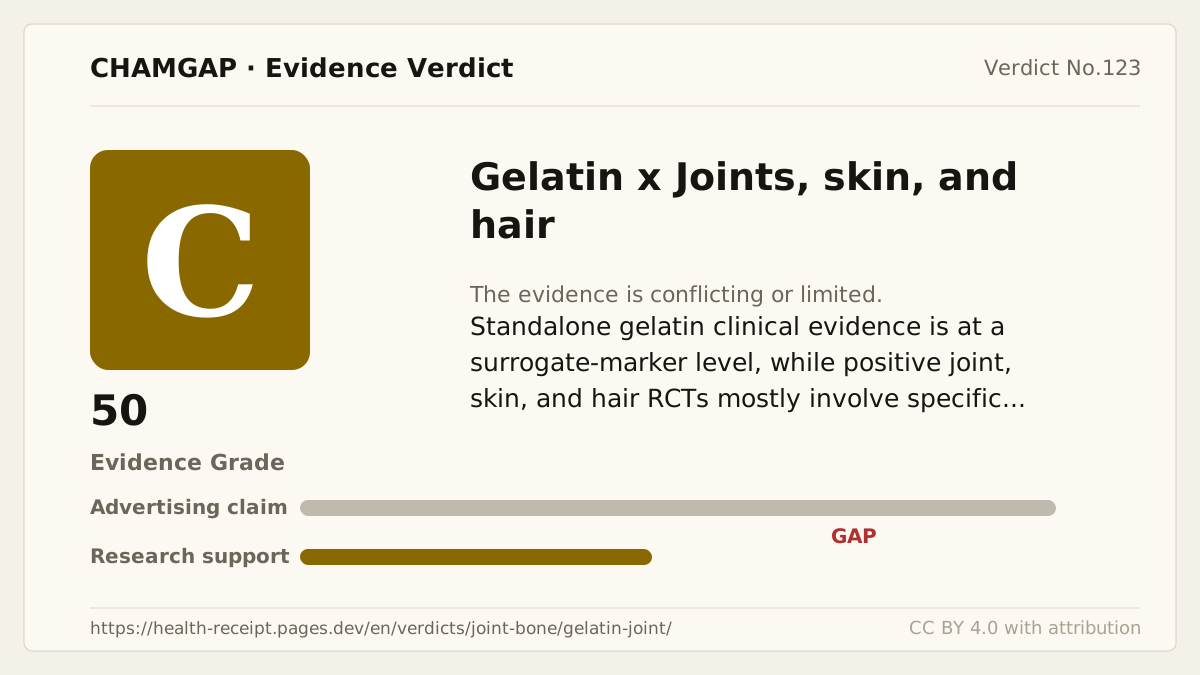
[Chamgap] Gelatin x joints, skin, and hair — Evidence Grade C·50. 10 cited sources checked. Source: https://chamgap.com/en/verdicts/joint-bone/gelatin-joint/ · CC BY 4.0CC BY 4.0 — free to use with attribution; do not distort grades, numbers, or verdict meaning.
What this document does and does not do
Chamgap is an information source. It reports what research has and has not confirmed; it does not tell readers what to take or buy. That decision belongs to readers and, when needed, medical or legal professionals. This verdict reflects literature available up to the search date and may change as new research appears. Nothing here is medical advice.