
Curcumin,
does it really help with Anti-inflammatory and joint health?
research showsThere is human RCT and meta-analytic evidence for short-term relief of pain and functional impairment in knee osteoarthritis. However, it is difficult to extend this evidence to the broad claim of "anti-inflammatory and joint health," meaning systemic anti-inflammatory effects, cartilage protection, and inhibition of disease progression. Inflammatory and structural surrogate markers are inconsistent, and MRI structural improvement was also negative, so the final rating is C.
ads claimAdvertising and informational articles in the Korean market use phrases such as "39- to 85-fold absorption," "water-soluble/high-absorption curcumin," "anti-inflammatory and antioxidant," "improvement of arthritis pain," "helps prevent/improve degenerative arthritis," and "as effective as NSAIDs with fewer side effects." Some Coupang product names directly included efficacy language such as "joint pain relief antioxidant high-potency turmeric curcumin," and a MoreNature article stated that intake of 1 g/day for 8-12 weeks significantly improved joint pain and movement. A Handok press release promoted Theracurmin Super as having 85.2-fold higher bioavailability than ordinary curcumin and predicted improvement effects in an animal osteoarthritis model. Some sales pages use curcumin, absorption-rate, and joint imagery together even though the product is a processed food rather than a health functional food.
Useful facts when choosing a product
- According to Costco product information, the food type is listed as other processed food, with 1 g per stick and turmeric pigment 16.668%, among other ingredients.
- In sales-page search results, the appeal is framed more around pain relief and antioxidant imagery than disease treatment.
- The evidence presented was an MIA rat osteoarthritis animal model, not a human RCT.
- Informational/commercial content citing a 2016 Biomedicine & Pharmacotherapy review.
What the research actually shows
Joint symptoms: RCTs in patients with knee osteoarthritis have repeatedly reported improvements in patient-reported pain and function scores such as VAS, WOMAC, and KOOS, and a 2021 meta-analysis of 16 RCTs/1810 participants reported pain SMD -0.82 and physical function SMD -0.75 versus placebo. However, heterogeneity was high (I2 about 86-90%), durations were generally short at 4-16 weeks, and formulations were not standardized. Anti-inflammatory/structural improvement: surrogate markers such as CRP, cytokines, effusion-synovitis, and cartilage composition are mixed, and in an Ann Intern Med RCT, pain improved but MRI effusion-synovitis and cartilage composition did not. Therefore, joint pain and function are separated as B, whereas general anti-inflammatory or cartilage-regeneration/disease-modifying claims are C or lower.
Why this is classified as C (48)
Human RCTs and meta-analyses assessing pain and function in patients with knee osteoarthritis show signals of short-term symptom relief. Considered in isolation, this component could be viewed as B-level evidence. However, the evaluated claim is the broad claim of "anti-inflammatory and joint health." For systemic anti-inflammatory, cartilage-protective, structural-improvement, and disease-modifying effects, surrogate markers such as CRP, cytokines, effusion-synovitis, and cartilage composition do not align with one another, and MRI structural measures also did not improve. Differences in absorption by formulation and controversy over low bioavailability also make it difficult to generalize across products. When the composite claim is separated, the evidence for short-term OA pain is acknowledged, but C 48 points is appropriate for the broad anti-inflammatory and joint-health claim.
Counterpoint. This does not mean that curcumin has no evidence for joints. Improvements in knee osteoarthritis pain and function versus placebo have been repeated in several RCTs, and the short-term symptom-relief signal should be acknowledged. However, broad advertising claims such as "reduces inflammation to protect joints," "protects cartilage," or "slows progression" have not yet been established at the same level. Low bioavailability and differences among high-absorption formulations also make it difficult to generalize actual product effects broadly.
Rejudgment record. Re-adjudication (downgraded B -> C) — Short-term relief of knee OA pain and function has RCT evidence, but the broad "anti-inflammatory and joint health" claim has inconsistent surrogate markers and negative structural-improvement findings. When the composite claim (3) is separated, the broad claim is C. OA pain is explicitly described in the verdict as having B-level evidence. Consistent with the blinded C rating.
Cross-check — Codex and Claude
Evidence Table
| Study | Design | Sample | Funding | Endpoint | Result | Weight |
|---|---|---|---|---|---|---|
| Wang Z, Singh A, Jones G et al. 2021 | Meta-analysis/RCT | 1810 | Liver/pain | A meta-analysis of 16 RCTs/1810 participants showed improvements in pain and function versus placebo, but heterogeneity and moderate risk of bias were substantial. | Core | |
| Wang Z, Jones G, Winzenberg T et al. 2020 | RCT | 70 | Possibly manufacturer/industry related | Pain | In a 70-person, 12-week RCT, pain improved more than with placebo, but MRI effusion-synovitis and cartilage composition did not improve. | Core |
| Henrotin Y, Malaise M, Wittoek R et al. 2019 | Double-blind RCT | 150 | Possibly manufacturer/industry related | Liver/pain | In a 150-person, 90-day RCT, VAS pain decreased more than with placebo, but the co-primary biomarker sColl2-1 did not differ between groups. | Core |
| Lopresti AL, Smith SJ, Jackson-Michel S, Fairchild T 2022 | Double-blind RCT | 101 | Possibly manufacturer/industry related | In a 101-person, 8-week RCT, the primary endpoint KOOS pain and some functional tests improved more than with placebo, and Dolcas Biotech provided funding and capsules. | Core | |
| Panahi Y, Rahimnia AR, Sharafi M, Alishiri G, Saburi A, Sahebkar A 2014 | Double-blind RCT | 40 | Possibly manufacturer/industry related | In a 40-person pilot RCT, 1500 mg/day curcuminoids improved WOMAC, VAS, and LPFI versus placebo, but the sample was small. | Supporting | |
| Paultre K, Cade W, Hernandez D, Reynolds J, Greif D, Best TM 2021 | Systematic review | Pain | A systematic review of 10 studies concluded that pain and function may improve versus placebo, but dose and formulation were unclear. | Supporting | ||
| Zhao D, Liang X, Zhao L et al. 2024 | Meta-analysis | 2175 | A network meta-analysis of 23 studies/2175 participants reported that curcumin alone or in combination improved VAS and WOMAC and had fewer adverse events than NSAIDs. | Supporting | ||
| NCCIH | Liver/joint/absorption | NCCIH notes that many studies exist for osteoarthritis and other uses, but firm conclusions are lacking, and high-absorption curcumin formulations may carry a risk of liver injury. | Supporting | |||
| LiverTox | Liver | LiverTox summarizes cases of liver injury associated particularly with high-bioavailability curcumin products such as piperine-containing or nano-formulated products. | Supporting | |||
| Handok 2024 | Preclinical | Joint | A domestic press release promoted Theracurmin Super's 85.2-fold bioavailability and improvement signals in an animal osteoarthritis model. | Supporting | ||
| MoreNature | Joint/pain | A commercial informational article emphasized 1 g/day for 8-12 weeks, improvement in joint pain and movement, NSAID-like effects, and fewer side effects. | Supporting | |||
| Costco Korea | Gastrointestinal | On a domestic sales page, the Theracurmin product is labeled as other processed food, with ingredients such as turmeric pigment 16.668% disclosed. | Supporting |
Receipt — 12 References
Of 12 cited sources, 1 had limited original-page access (blocked or summary-only) and were verified via index/summary, marked partial; the rest were verified at the original page. As of 2026-07-07.
Reviewed and approved: Chamgap Editorial Team · Approval date: 2026-07-07 · Corrections: none
Cite this verdict
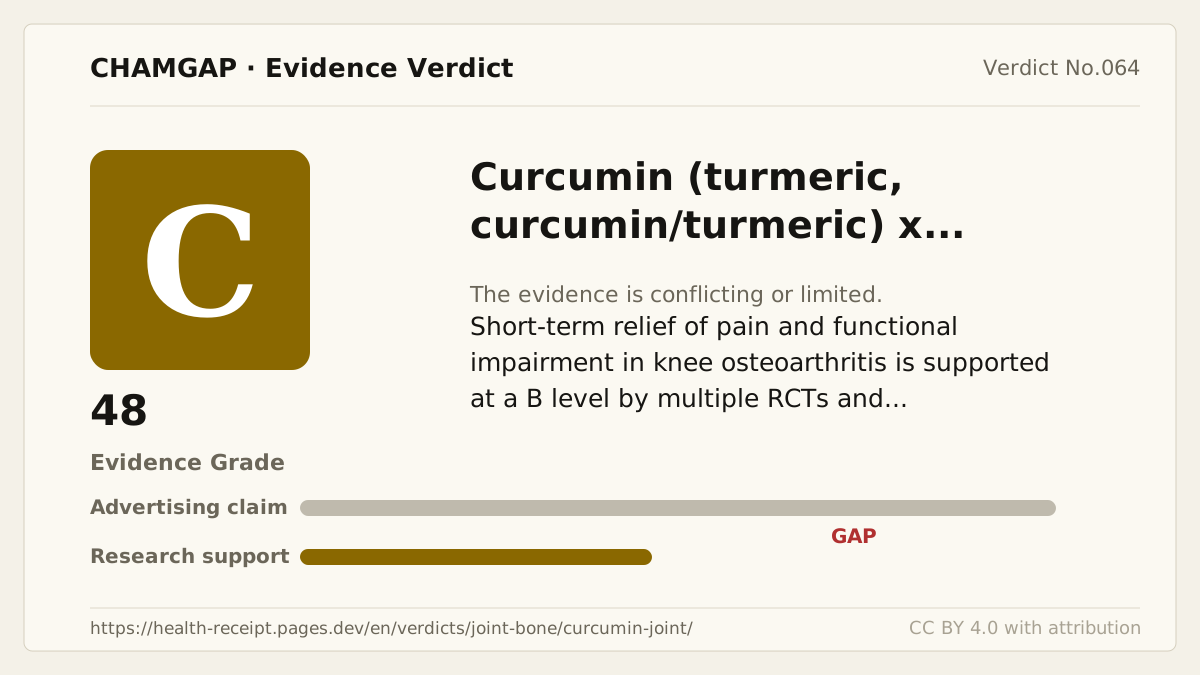
[Chamgap] Curcumin (turmeric, curcumin/turmeric) × anti-inflammatory and joint health — Evidence Grade C·48. 12 cited sources checked. Source: https://chamgap.com/en/verdicts/joint-bone/curcumin-joint/ · CC BY 4.0CC BY 4.0 — free to use with attribution; do not distort grades, numbers, or verdict meaning.
What this document does and does not do
Chamgap is an information source. It reports what research has and has not confirmed; it does not tell readers what to take or buy. That decision belongs to readers and, when needed, medical or legal professionals. This verdict reflects literature available up to the search date and may change as new research appears. Nothing here is medical advice.