
Undenatured type II collagen,
does it really help with Joint pain, function, and flexibility?
research showsUC-II has human RCTs examining pain/function scores (WOMAC/VAS) in knee osteoarthritis and knee discomfort/range of motion (ROM) after activity in healthy people, and limited meta-analysis also points toward improvement in pain and WOMAC. Therefore, the signal for supporting joint symptoms and function itself can be acknowledged. However, positive studies are generally small and short-term, and many key UC-II studies involve funding from raw-material companies such as InterHealth/Lonza or participation by raw-material company authors. Large replication evidence from independent researchers and proof of cartilage regeneration in humans are insufficient, so the final assessment is C (48 points).
ads claimIn the Korean market, phrases such as “undenatured type II collagen,” “UC-II joint health,” “joint comfort, function, and flexibility,” “one 40 mg capsule per day,” “the main structural protein of cartilage,” and “immune tolerance/works with the immune system” are repeated. The iHerb Korean NOW Foods product page lists UC-II 40 mg and Aquamin and says “comfortable joint movement and healthy joint function and flexibility.” Gmarket overseas direct-purchase product names put “UC-II joint health undenatured type II collagen” at the front. Some informational posts use broader expressions such as pain relief, exercise ability, and promotion of cartilage regeneration, but the direct endpoints of human RCTs are mainly WOMAC/VAS/ROM, and structural cartilage regeneration is not an established conclusion in humans.
Useful facts when choosing a product
- The most common UC-II dose in clinical studies is raw material 40 mg/day, and depending on the study, undenatured type II collagen content is labeled as 1.2 mg or about 10 mg.
- UC-II is usually described as undenatured/native type II collagen obtained from chicken sternum cartilage. It should not be treated as the same raw material as hydrolyzed collagen peptides.
- Some finished products are sold in combination with Aquamin, calcium, Boswellia, hydrolyzed collagen, and others, so evidence for UC-II alone and evidence for combination products must be separated.
- Advertising expressions about “cartilage regeneration” often come from mechanism, animal, or biomarker explanations, and it is difficult to regard them as supported by key RCT evidence proving structural regeneration in humans.
What the research actually shows
Representative RCTs include Crowley 2009, a 90-day comparison trial in knee osteoarthritis (n=52), Lugo 2016, a multicenter 180-day placebo/glucosamine-chondroitin controlled trial (n=191), and 2013 and 2022 RCTs of activity-related knee discomfort in healthy people. In the 2016 study, the primary endpoint was change in total WOMAC, and UC-II 40 mg/day was significantly lower than placebo and glucosamine plus chondroitin. In the 2022 healthy-person study, ROM flexion improved by 3.23 degrees with UC-II versus 0.21 degrees with placebo (p=0.025), but this was a post-activity discomfort model rather than clinical disease. A 2023 limited meta-analysis reviewed 8 RCTs and reported significance in placebo-controlled data for WOMAC MD -8.91 and VAS MD -1.65, but LFI was not significant and the number of studies was small. A 2025 PRISMA-based qualitative review also included 8 clinical studies and concluded that it is promising in the short and medium term, while larger long-term RCTs are needed.
Why this is classified as C (48)
There are several human RCTs, and the primary endpoints are not only surrogate markers. In particular, the 2016 multicenter RCT used total WOMAC, a patient-centered symptom/function indicator, as the primary endpoint and was significant versus placebo. A limited meta-analysis also points toward WOMAC/VAS improvement. However, the positive RCTs are difficult to regard as all large independent replication studies, sample sizes and follow-up periods are limited, and many key UC-II studies were funded by ingredient suppliers or included ingredient-supplier authors. The healthy-person activity-discomfort studies use ROM/exercise-induced pain models, making them difficult to expand to general arthritis treatment claims, and cartilage regeneration or inhibition of structural progression has not been established in humans. Therefore, symptom/function improvement signals are acknowledged, but the evidence level is judged as C (48 points), the maximum under 2-b.
Counterpoint. It is not lowered to D. Unlike chondroitin 045, where independent large RCTs clearly and repeatedly showed null results, the UC-II side has consistent improvement signals in pain, function, and range-of-motion markers even though studies are small. However, those signals are centered on short-term symptom markers, and long-term structural outcomes such as cartilage regeneration on X-ray/MRI, preservation of joint space, or prevention of surgery have not been established. Because a 2025 UC-II plus hydrolyzed collagen combination RCT did not show additional benefit versus placebo, it is also inappropriate to strengthen combination-product advertising with evidence for UC-II alone.
Rejudgment record. reassessment (downgraded B -> C) — There are symptom/function signals, but positive studies are small, short-term, industry-funded, and lack independent replication -> maximum C under 2-b. Consistent with blind C.
Cross-check — Codex and Claude
Evidence Table
| Study | Design | Sample | Funding | Endpoint | Result | Weight |
|---|---|---|---|---|---|---|
| Crowley DC et al. 2009 | not specified | 52 | possible manufacturer/industry involvement | ALT | Knee OA 52 people, UC-II 40 mg/day versus glucosamine+chondroitin for 90 days; WOMAC -33% vs -14%, VAS -40% vs -15.4%; supported by InterHealth Research Center. | core |
| Lugo JP et al. 2013 | double-blind RCT | 55 | possible manufacturer/industry involvement | ALT/pain | Healthy people with activity-induced knee discomfort, 55 people, UC-II 40 mg/day versus placebo for 120 days; some knee extension/stepmill pain markers improved. | core |
| Lugo JP, Saiyed ZM, Lane NE 2016 | not specified | 191 | possible manufacturer/industry involvement | ALT | Knee OA 191 people, UC-II 40 mg/day versus GC versus placebo for 180 days; primary endpoint total WOMAC change was significant versus placebo and GC. | core |
| Schön C et al. 2022 | not specified | 96 | possible manufacturer/industry involvement | not specified | Healthy people with activity-related knee discomfort, 96 people, 24-week RDBPC; ROM flexion +3.23 degrees vs +0.21 degrees (p=0.025). | core |
| Luo C et al. 2022 | not specified | possible manufacturer/industry involvement | not specified | Native CT-II (not UC-II brand) knee OA RDBPC; 12-week WOMAC total/pain improved versus placebo. | supporting | |
| Kumar P et al. 2023 | meta-analysis/RCT | not reported | not specified | Reviewed 8 RCTs; placebo-controlled meta-analysis showed significant WOMAC MD -8.91 and VAS MD -1.65, while LFI was not significant. | supporting | |
| Gupta A, Maffulli N 2025 | RCT | not reported | not specified | PRISMA-based qualitative review; reviewed 12 studies (including 8 clinical studies) and suggested short- and medium-term safety and promise for 40 mg/day. | supporting | |
| Yuenyongviwat V et al. 2025 | RCT | not reported | moisture/gut | UC-II plus hydrolyzed collagen combination knee OA RDB trial; reported no additional benefit versus placebo. | supporting |
Receipt — 8 References
Of 8 cited sources, 2 had limited original-page access (blocked or summary-only) and were verified via index/summary, marked partial; the rest were verified at the original page. As of 2026-07-07.
Reviewed and approved: Chamgap Editorial Team · Approval date: 2026-07-07 · Corrections: none
Cite this verdict
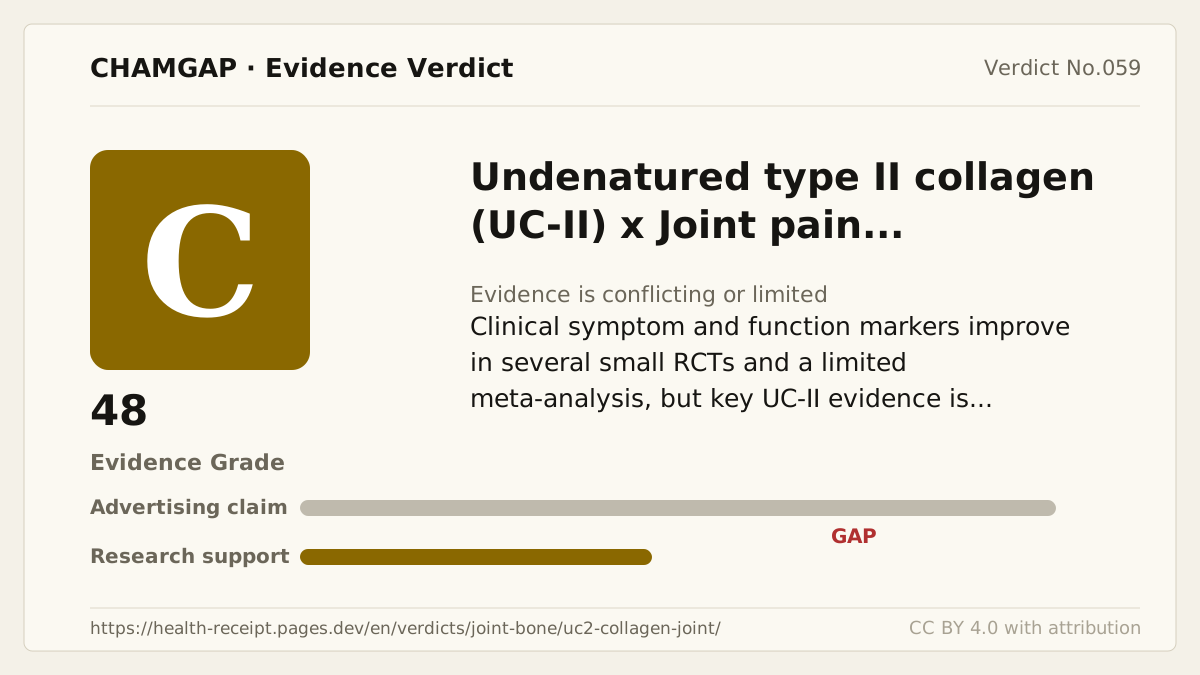
[Chamgap] Undenatured type II collagen x joint pain, function, and flexibility — Evidence Grade C·48. 8 cited sources checked. Source: https://chamgap.com/en/verdicts/joint-bone/uc2-collagen-joint/ · CC BY 4.0CC BY 4.0 — free to use with attribution; do not distort grades, numbers, or verdict meaning.
What this document does and does not do
Chamgap is an information source. It reports what research has and has not confirmed; it does not tell readers what to take or buy. That decision belongs to readers and, when needed, medical or legal professionals. This verdict reflects literature available up to the search date and may change as new research appears. Nothing here is medical advice.