
MSM,
does it really help with joint pain and function improvement?
research showsFor MSM (methylsulfonylmethane) and joint pain/function, several small, short-term, usually 12-week clinical trials in knee osteoarthritis patients exist, but improvement in the core endpoint, 'pain,' has not been confirmed in independent higher-level evidence. In individual trials, significant markers were often secondary or composite markers such as physical function or total symptom score rather than pain itself, and pain was often nonsignificant (Debbi 2011 pain p=0.08, Toguchi 2023 pain subscale p=0.073). The 2011 meta-analysis pooling these trials, funded by charitable foundations rather than industry, reported that pain reduction was neither statistically nor clinically significant ('not clinically effective'), and the 2008 systematic review described the evidence as 'positive but not definitive.' In contrast, individual positive trials reporting pain reduction had manufacturer product provision (Kim's OptiMSM commercial ingredient, Debbi's Taam Teva) or all authors affiliated with an ingredient company (Toguchi's Chlorella Industry), making them hard to treat as independent evidence. Thus human trials exist, but pain effect is not confirmed in the no-conflict layer. Advertising/listing phrases such as 'joint pain reduction' may exceed this evidence state. Independent evidence supporting use for pain treatment was not confirmed in this verification.
ads claimThe five domestic sales products checked are all labeled as 'health functional foods' within the confirmed scope, and listings generally appear to use the known MFDS generic functionality wording, 'MSM: may help joint and cartilage health' (Phytonutri, Daiso Mall, Nutrione, etc.). Where content is visible, daily dose is 1,500mg (Esther Formula/Ye Esther, Life & Bio Phytonutri), within the publicly known MFDS recognized daily intake range of 1,500-2,000mg; however, the MFDS primary source was not directly checked and remains a follow-up item. Some products such as BioOn and Daiso Mall do not clearly state daily mg in listings and require confirmation. Caution: the Daiso Mall listing (manufactured by Chong Kun Dang Healthcare) uses wording such as 'may help reduce joint pain and improve physical joint function,' which may suggest pain treatment/function improvement beyond the widely known recognized wording ('may help joint and cartilage health'); whether it is within approved labeling/advertising scope requires comparison with the original recognition content (D2, outside this verification). Phrases such as '99.9% pure OptiMSM' are raw-material purity specifications, not efficacy evidence (E1). The nuance of 'joint pain/function improvement' in ads differs from the nonsignificant results in conflict-free higher-level evidence.
Useful facts when choosing a product
- Within the confirmed scope, five domestic products appear in listings as health functional foods (individual product labels and wording are outside citation literature and require follow-up source comparison).
- MSM is known as an MFDS generic functional ingredient, with recognized wording 'may help joint and cartilage health' and public daily intake 1,500-2,000mg. The MFDS primary source for exact wording, daily intake, and review evidence could not be directly compared due to access error and needs rechecking.
- Products with visible content: Esther Formula (Ye Esther) MSM 1,500mg/day (2 tablets/day), Life & Bio (Phytonutri) MSM 1,500mg/day (2 capsules/day, 60 capsules for 30 days), within the known recognized intake range.
- Products without clear daily mg in listings: BioOn Mall, Daiso Mall (manufactured by Chong Kun Dang Healthcare, 60 tablets/30 days), and Nutrione require daily-content confirmation.
- Daiso Mall wording 'may help reduce joint pain and improve physical joint function' may exceed the widely known recognized wording 'may help joint/cartilage health'; approval status requires comparison with original recognition content (D2).
- Esther Formula's '99.9% pure OptiMSM' is an ingredient-purity specification, not efficacy evidence (E1); OptiMSM is a commercial ingredient also used in Kim 2006 and carries industry relevance.
- Dose fit caution: many trials reporting pain improvement used 3-6g, exceeding the known recognized upper range of 2g (Kim 6g/day, Debbi 3.375g/day). Confirmed domestic products at 1,500mg/day are within the recognized range but differ from high-dose trials (D1).
What the research actually shows
Several small, short-term RCTs in knee osteoarthritis patients and higher evidence combining them exist. Individual RCTs: Kim 2006 (n=50, 6g/day, 12 weeks) found WOMAC pain and physical function significantly lower than placebo (P<0.05), but the authors called it a pilot and noted small/short-term limitations; Debbi 2011 reanalysis judged the between-group difference about 7.3mm (~12%) as not clinically significant. Debbi 2011 (n=49, 3.375g/day, 12 weeks) found only WOMAC physical function (p=0.04) and total score (p=0.03) significant, while prespecified core markers pain (p=0.08) and stiffness (p=0.08) were nonsignificant, effect size 0.28 (small-to-moderate). Usha 2004 (n=118, 1.5g/day, 12 weeks) found MSM-alone pain index significantly reduced, but glucosamine and combination groups were mixed in presentation, complicating MSM-alone interpretation. Toguchi 2023 (n=88 randomized, 2g/day, 12 weeks) studied mild general adults with knee discomfort rather than OA patients; only JKOM total score was significant (p=0.046), while pain subscale was nonsignificant (p=0.073), so the population differs from OA pain treatment. Higher evidence: Brien 2008 systematic review concluded 'positive but not definitive evidence' and 'No definitive conclusion can currently be drawn.' Brien 2011 meta-analysis, funded by charitable foundations, not industry, found pooled pain effect VAS 6.34mm reduction (95%CI -0.49~13.17), nonsignificant and below MCID 17.5mm, concluding 'DMSO and MSM are not clinically effective in the reduction of pain' (though it combined DMSO and MSM and MSM-only pooled power was effectively small/single-trial level). Individual positive pain trials all have industry links through manufacturer product provision or ingredient-company author affiliation, and the conflict-free integrated evidence does not confirm the core endpoint pain.
Why this is classified as C (50)
Why it is C: MSM produced a positive signal for function, but not pain, among its co-primary endpoints, and allocation and sample-size flaws overlap, supporting only a limited C grade. · Endpoint: WOMAC pain and function and VAS pain are patient symptom and function scales rather than hard endpoints, so this axis is P. · Replication and independence: There is one same-unit WOMAC confirmatory trial, giving R1. The hospital orthopedic research fund was supplemented by Taam Teva’s donation of MSM and placebo, giving I1. · Effect: The between-group function difference was 14.6 mm (95% CI 4.3–25.0; P=0.04), but co-primary pain was null at 12.4 mm (0.0–24.8; P=0.08), giving E+ with the co-primary split flag. · Design: Enrollment below 200 (50 participants) and the paper’s admission that allocation followed clinic arrival order are two flaws, giving B2. Why it is not A or B: Failure of co-primary pain, arrival-order allocation, a small sample, and company product provision do not provide strong, low-bias replicated evidence. Why it is not D or F: Significant improvement in co-primary function and other signals prevent treating the evidence as unconfirmed or repeatedly refuted. → Under the Chapter 2 ceiling rules, B2 and the co-primary split cap the grade at C; with one strength axis in the Chapter 3 baseline table, the result is C with 50 points.
Counterpoint. There is room to see it higher, C: RCTs from different teams/countries (U.S., Israel, India, Japan) repeatedly show directionally better signals than placebo, and several secondary/composite markers such as WOMAC physical function/total score and JKOM total score significantly improved. Brien 2011 combined DMSO and MSM, so its disproving power for pure MSM pain data is limited, and domestic generic functionality recognition exists. From this view, C is possible. Basis for D: the methodology prioritizes the conflict-of-interest-zero layer, and that layer, charitable-foundation-funded meta-analysis/systematic review, does not confirm the core pain endpoint. Positive pain trials all carry conflicts such as manufacturer provision or ingredient-company authors, so they are not independent replication. Regulatory recognition is neutral metadata. Concentration of individual positives in industry-related layers and nonconfirmation of the core endpoint in independent layers support D.
| Endpoint | P | Patient-reported treatment goal - the symptom is the goal |
| Replication | R1 | Single confirmatory trial |
| Independence | I1 | Mixed funding sources |
| Effect size | E+ | Meets the clinically important threshold |
The scoring table and the verdict agree (C).
Cross-check — Codex and Claude
Evidence Table
| Study | Design | Sample | Funding | Endpoint | Result | Weight |
|---|---|---|---|---|---|---|
| Kim LS, Axelrod LJ, Howard P et al. 2006 | double-blind randomized controlled trial | 50 | possible manufacturer or industry involvement | liver / pain | Knee OA patients n=50 (40-76 years), MSM 3g twice daily (6g/day) for 12 weeks, randomized double-blind placebo-controlled pilot RCT; WOMAC pain and physical function decreased significantly vs placebo (P<0.05), stiffness and total symptom score nonsignificant. PubMed lists only 'Research Support, Non-U.S. Gov't'; specific funding not confirmed in free full text, but the test product was commercial OptiMSM (Cardinal Nutrition). | key |
| Debbi EM, Agar G, Fichman G et al. 2011 | randomized controlled trial | 49 | possible manufacturer or industry involvement | pain | Knee OA patients n=49 (MSM 25/placebo 25, mean age 68), MSM 1.125g three times daily (3.375g/day) for 12 weeks; WOMAC physical function improved 17% (p=0.04) and total score 20% (p=0.03), but pain (21% decrease, p=0.08) and stiffness (p=0.08) were nonsignificant, effect size 0.28. MSM/placebo supplied free by manufacturer Taam Teva; research funds from Assaf Harofeh hospital. | key |
| Usha PR, Naidu MUR 2004 | double-blind randomized controlled trial | 118 | possible manufacturer or industry involvement | pain | Mild-to-moderate knee OA patients n=118 in India, glucosamine 500mg, MSM 500mg, combination, placebo 4 groups, three times daily (MSM 1.5g/day) for 12 weeks; all active groups improved significantly vs placebo and combination was superior for pain/swelling. Funding not stated in abstract/additional search. | key |
| Toguchi A, Noguchi N, Kanno T, Yamada A 2023 | double-blind randomized controlled trial | 80 | possible manufacturer or industry involvement | pain | General adults with mild knee pain, not OA patients (K-L 0-1), n=88 randomized (MSM 44/placebo 44, Japan), MSM 2g/day (200mg x10 tablets) for 12 weeks; only JKOM total significant (difference -2.8, p=0.046, mainly driven by health-status subscale p=0.027), pain subscale nonsignificant p=0.073. Funding Chlorella Industry, all authors affiliated. | key |
| Brien S, Prescott P, Bashir N, Lewith H, Lewith G 2008 | systematic review of randomized controlled trials | 52 | possible manufacturer or industry involvement | gastrointestinal | Systematic review (2 MSM RCTs, total 168 participants, active MSM 52): 'positive but not definitive evidence' that MSM is superior to placebo in mild-to-moderate knee OA, and 'No definitive conclusion can currently be drawn.' | supporting |
| Brien S, Prescott P, Lewith G 2011 | meta-analysis of randomized controlled trials | 161 | possible manufacturer or industry involvement | pain | Meta-analysis (3 RCTs, total 326 participants, active 161): pooled pain effect VAS 6.34mm reduction (95%CI -0.49~13.17), nonsignificant and below MCID (VAS 17.5mm); concluded 'DMSO and MSM are not clinically effective in the reduction of pain.' Funding from charitable foundations, not industry. | supporting |
Receipt — 6 References
Of 6 cited sources, 1 had limited original-page access (blocked or summary-only) and were verified via index/summary, marked partial; the rest were verified at the original page. As of 2026-07-06.
Reviewed and approved: Chamgap Editorial Team · Approval date: 2026-07-06 · Corrections: 1
Correction log — 1
Corrections applied to this verdict, in chronological order. Changes are logged, not erased.
- 2026-08-19 · Methodology v0.7 migration (axes recorded, score derived) — Applied the seven axes and anchor table published in methodology v0.7 to this verdict. It had been graded under the pre-axis method and carried no score. The representative trial was re-established from the source, axes 1-6 recorded, and the score derived from the published anchor table. The old grade was less wrong than assigned before the rule was fully specified; the full rule is in section 2-3 of /methodology/. (grade D→C)
Cite this verdict
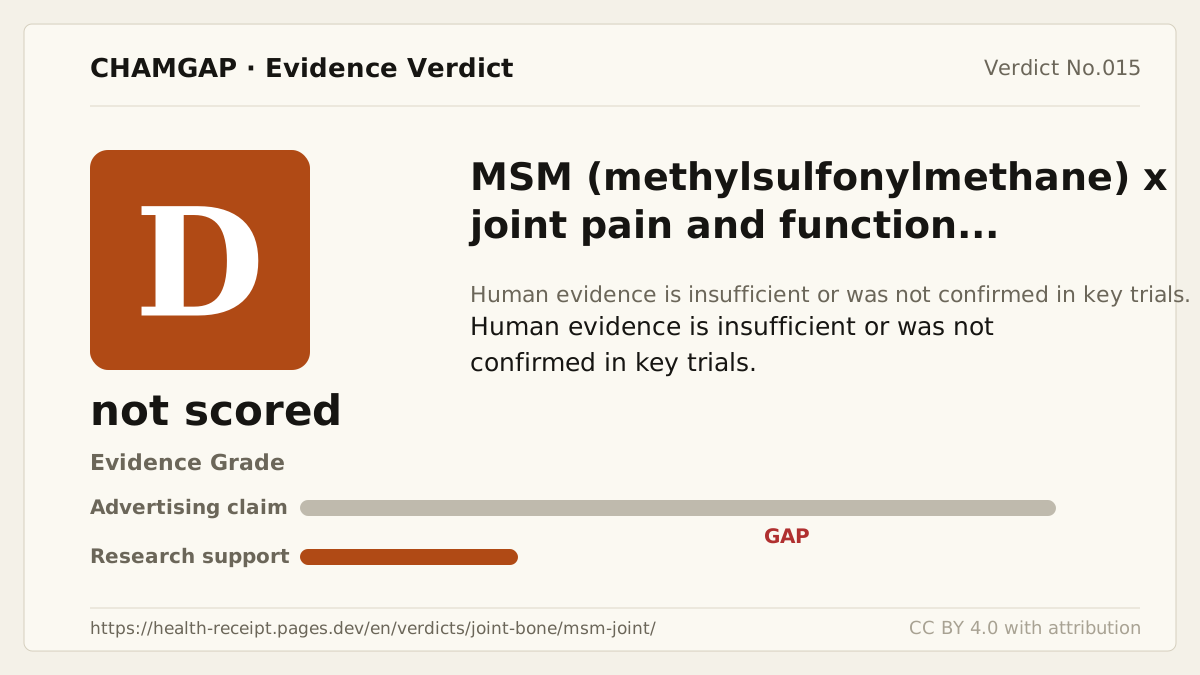
[Chamgap] MSM x joints — Evidence Grade C·50. 6 cited sources checked. Source: https://chamgap.com/en/verdicts/joint-bone/msm-joint/ · CC BY 4.0CC BY 4.0 — free to use with attribution; do not distort grades, numbers, or verdict meaning.
What this document does and does not do
Chamgap is an information source. It reports what research has and has not confirmed; it does not tell readers what to take or buy. That decision belongs to readers and, when needed, medical or legal professionals. This verdict reflects literature available up to the search date and may change as new research appears. Nothing here is medical advice.