
Green-lipped mussel,
does it really help with joint pain relief?
research showsThe claim that green-lipped mussel oil relieves joint pain is not a claim with no human clinical trials at all. However, evidence is not strong or consistent, and most positive studies received funding or study-product support from companies that make or sell the product. In summary: 1) A 2021 systematic review/meta-analysis of studies in osteoarthritis patients found a statistically significant pooled effect that green-lipped mussel products reduced pain (VAS) more than placebo (SMD -0.46). However, this is a moderate size, whether it translates into felt improvement is a separate issue, and heterogeneity was large. 2) A double-blind placebo-controlled trial in 80 moderate-to-severe arthritis patients in 2017 found no benefit of green-lipped mussel oil (600mg/day, 12 weeks) versus placebo for prespecified primary pain markers (WOMAC pain p=0.955, VAS pain p=0.110). This manufacturer-funded trial still reported no clinical benefit. 3) The study often cited for numbers such as '89% pain reduction' (2013) had no placebo control, was partly open-label, and was manufacturer-funded. The authors themselves acknowledged the lack of placebo control, so the number cannot be interpreted directly as effect size. 4) Populations differ: one positive study (2022) involved overweight postmenopausal women with joint discomfort, not patients diagnosed with arthritis. Regarding regulation, based on confirmed public data, the official MFDS individually recognized functionality wording is known as 'may help joint health,' not 'joint pain relief.' This display is permitted for official health functional foods using the specific individually recognized ingredient. New Zealand direct-purchase or ordinary green-lipped mussel oil products that are not individually recognized ingredients are often ordinary foods, and in that case joint-functionality labeling is known not to be permitted (product-specific legality is follow-up). Phrases such as 'joint supplement' and 'knee pain relief' differ from the recognized wording. Overall, the grade is C: human studies suggest possible pain relief, but industry-funding bias, small/moderate effect size, negative placebo-controlled trial results, and population differences make it hard to say the pain-relief effect is established. Safety is generally described as good in trials, with possible allergy in people allergic to shellfish.
ads claimAdvertisements sometimes use stronger and more definitive expressions than the evidence supports. 1) Exceeding expression strength (D2): the target claim and some ads say 'joint pain relief' or 'knee pain relief,' but based on confirmed public data, the official MFDS individually recognized wording is known as 'may help joint health.' 'Pain relief' differs from this scope. Esther Mall (Ye Esther official mall) appears to show the formal wording 'may help joint health' and Lyprinol amount, but the authenticity/currentness of review numbers and posted information is outside this scope; the 'pain relief' framing of the target claim differs from recognized wording. 2) Amount exaggeration (E2): some direct-purchase products' 'green-lipped mussel oil 15,000mg' is, within the confirmed scope, a raw-mussel-equivalent value rather than pure oil amount. Actual oil intake and displayed number do not match. 3) Ordinary-food functionality impression (D2): some cases use phrases such as 'joint supplement' or 'excellent joint supplement' without amount/functionality wording. Without individually recognized ingredient labeling, they are likely ordinary foods, for which joint functionality is known not to be permitted (product legality follow-up). 4) Lack of industry-funding disclosure: ads cite positive studies but often do not also state that most received manufacturer/seller funding or product support and that placebo-controlled primary pain outcomes were negative.
Useful facts when choosing a product
- Based on public data, two MFDS individually recognized ingredients are known: 'Lyprinol-green-lipped mussel extract oil' (No. 2009-49, 200mg/day) and 'green-lipped mussel extract oil complex' (Joint Palpal, No. 2004-8, 620mg/day). Currentness of recognition numbers and daily intakes needs original-source recheck.
- Within the confirmed scope, the official MFDS-recognized wording is known as 'may help joint health,' while 'joint pain relief' and 'knee pain relief' differ from that wording.
- New Zealand direct-purchase/ordinary green-lipped mussel oil that is not one of the individually recognized ingredients is often classified as ordinary food, and joint functionality labeling is known not to be permitted; product classification and legality are follow-up items.
- Direct-purchase product labels such as 'green-lipped mussel oil 15,000mg' appear, within the confirmed scope, to be raw-mussel-equivalent rather than pure oil amount (E2 amount-overstatement caution). Product-specific labeling requires follow-up.
- Applicants for individually recognized ingredients are known to be manufacturers/sellers (Lyprinol line, Joint Palpal line), and the funding/independence of clinical evidence used for recognition was not confirmed in this collection.
- Clinical trials reported no serious safety issues and generally describe safety as good; green-lipped mussel is shellfish, so people with shellfish/seafood allergy may have allergic reactions.
What the research actually shows
The cited literature totals 8 papers: two placebo-controlled RCTs in osteoarthritis patients or related populations (Stebbings 2017 negative; Abshirini 2022 not OA patients), two non-placebo-controlled studies (Zawadzki 2013, Cho 2003), two systematic reviews/meta-analyses (Abshirini 2021, Brien 2008), one narrative omega-3 review (Cordingley 2022), and one full text not confirmed (Gibson 1998). These suggest a possible joint-pain-relief effect but are conflicting and limited. Positive side: Abshirini 2021 (Inflammopharmacology 2021;29(4):925-938, PMID 33738701) reported pooled pain (VAS) SMD -0.46 (95% CI -0.82~-0.10, p=0.01), statistically significant and moderate, in OA patients. But heterogeneity was large (I²=53.7%), authors acknowledged most included studies were pharma-funded, one author belonged to manufacturer/seller Sanford Ltd., and no funding-source subgroup analysis was done (A1/A2 unmet). Negative side: Stebbings 2017 (BMC Complement Altern Med 2017;17:416, PMID 28830491) tested green-lipped mussel lipid extract 600mg/day for 12 weeks in 80 moderate-to-severe OA patients and found no benefit versus placebo for prespecified primary pain markers (WOMAC pain p=0.955, VAS pain p=0.110). Authors concluded it 'did not confer clinical benefit,' even under manufacturer Seperex funding/product support. Context of exaggerated numbers: Zawadzki 2013 (Marine Drugs 2013;11(6):1920-1935, PMID 23739042) reported 'pain 89% down/QoL 91% up' but had no placebo control (fish oil only), stage 2 was open-label, and manufacturer Pharmalink funded it; authors acknowledged no placebo control. Population distinction: Abshirini 2022 (Front Med 2022;9:1063336, PMID 36544504) found VAS pain improvement (-13.2 vs -2.9mm, p=0.04) in overweight postmenopausal women with joint discomfort, not OA patients; cartilage-metabolism and inflammatory cytokines showed no between-group differences. Attribution: Cordingley & Cornish 2022 (Nutrients 2022;14(16):3362, PMID 36014868) states omega-3 evidence in OA is mixed and benefits of green-lipped mussel cannot be attributed to omega-3 content alone because component/dose information is repeatedly incomplete. Older evidence such as Gibson 1998, Cho/Lyprinol 2003, and Brien 2008 is low weight due to non-placebo comparisons, unconfirmed funding/original outcomes, or low-quality excluded trials.
Why this is classified as D (28)
Why it is D: In the representative confirmatory trial directly measuring green-lipped mussel for joint pain, both co-primary pain scales failed to show benefit over placebo, giving E0, while positive evidence is concentrated in manufacturer-linked research. · Endpoint: WOMAC pain and the 100-mm VAS are patient-reported pain scales rather than hard endpoints, so this axis is P. · Replication and independence: There is one same-unit confirmatory trial, giving R1. Seperex Nutritionals sponsored and supplied the product, and a coauthor was company-affiliated, giving I0. · Effect: Main effects were P=0.110 for VAS pain and P=0.955 for WOMAC-A pain, so neither showed superiority, giving E0. Adjusted between-group differences and 95% CIs were unavailable in the retrieved text, so the trial cannot be said to exclude benefit or demonstrate harm. · Design: Enrollment of 80 creates one listed flaw, total sample below 200, giving B1. Why it is not A or B: A null primary pain endpoint in one industry-funded trial, without independent high-quality replication, is not strong or consistent evidence. Distinguishing D from F: D is the final grade, while F is unwarranted because the meta-analysis retains a positive SMD of −0.46 (95% CI −0.82 to −0.10), so the effect has not been repeatedly refuted. → Under the Chapter 2 ceiling rules, R1, I0, and B1 impose B, C, and B ceilings; with zero strength axes in the Chapter 3 baseline table, the result is D with 28 points.
Counterpoint. Room for B: the 2021 meta-analysis found statistically significant pooled pain effect (SMD -0.46, p=0.01), multiple RCTs exist across decades and countries, MFDS is known from public data to recognize two ingredients for joint health, and safety signals are generally good. Regulatory recognition is neutral metadata, not an upward factor. Room for D: the most strictly designed placebo-controlled double-blind RCT (Stebbings 2017) was nonsignificant for primary pain endpoints, positive results mostly concentrate in manufacturer-funded/uncontrolled/unblinded studies, and no funding-source subgroup analysis shows whether effects remain in independent studies. Codex blind and adversarial audits both pointed toward D on this issue. If future conflict-free independent high-quality placebo-controlled trials do not reproduce effects, it can be downgraded to D. Unresolved items include Gibson 1998 original funding/pain markers blocked by 403, funding/COI for Brien 2008 and Cho 2003, and the funding/independence of clinical trials used for Korean recognition; these likely increase bias concerns rather than upgrade the evidence.
| Endpoint | P | Patient-reported treatment goal - the symptom is the goal |
| Replication | R1 | Single confirmatory trial |
| Independence | I0 | Evidence comes only from manufacturer studies |
| Effect size | E0 | Null |
| Precision | C0 | The confidence interval leaves room for benefit |
The scoring table and the verdict agree (D).
Cross-check — Codex and Claude
Evidence Table
| Study | Design | Sample | Funding | Endpoint | Result | Weight |
|---|---|---|---|---|---|---|
| Abshirini M, Coad J, Wolber FM et al. 2021 | meta-analysis | 9 | possible manufacturer or industry involvement | joint / pain | Systematic review/meta-analysis in osteoarthritis patients (9 clinical studies pooled): pain (VAS) pooled effect SMD -0.46 (95% CI -0.82~-0.10, p=0.01), moderate/significant, but heterogeneity large (I²=53.7%, p=0.07). Funding: High Value Nutrition (New Zealand) national project. | key |
| Stebbings S, Gray A, Schneiders AG, Sansom A 2017 | double-blind randomized controlled trial | 80 | possible manufacturer or industry involvement | gastrointestinal / pain | The strictest placebo-controlled double-blind RCT design (80 moderate-to-severe OA patients, BioLex 600mg/day for 12 weeks): primary pain markers negative (WOMAC pain p=0.955, VAS pain p=0.110). Despite manufacturer funding, conclusion was 'no clinical benefit.' | key |
| Zawadzki M, Janosch C, Szechinski J 2013 | randomized controlled trial | 22 | possible manufacturer or industry involvement | pain / cognition | OA patients (stage 1 about 47, stage 2 22) reported 'pain 89% down/QoL 91% up,' but with no placebo control (fish oil only) and stage 2 open-label. Each capsule 150mg contained pure extract PCSO-524 50mg. | key |
| Abshirini M, Coad J, Wolber FM et al. 2022 | double-blind randomized controlled trial | 4 | body weight / liver / gastrointestinal / joint | Placebo-controlled double-blind RCT in overweight/obese postmenopausal women with joint discomfort, not diagnosed OA patients: VAS pain improved (-13.2 vs -2.9mm, p=0.04), but cartilage-metabolism and inflammatory cytokines (COMP etc.) did not differ between groups. | key | |
| Cordingley DM, Cornish SM 2022 | possible manufacturer or industry involvement | Narrative review: human omega-3 evidence in OA is 'mixed' and needs further research; benefits of green-lipped mussel cannot be attributed only to omega-3 content because component/dose information is incomplete and olive oil used as placebo also has anti-inflammatory properties. | supporting | |||
| Brien S, Prescott P, Coghlan B, Bashir N, Lewith G 2008 | systematic review of randomized controlled trials | 2 | possible manufacturer or industry involvement | Review of 4 RCTs; 2 were excluded for unblinded/inadequate statistics. Remaining evidence led to conditional conclusion that GLM 'may be superior' to placebo in mild-to-moderate OA. | supporting | |
| Gibson SLM, Gibson RG 1998 | meta-analysis of randomized controlled trials | possible manufacturer or industry involvement | pain | Lipid extract vs stabilized whole powder comparison, not placebo-controlled; as described in secondary literature (2021 meta-analysis), benefits were reported in RA/OA and significant VAS pain improvement only in powder group. | supporting | |
| Cho SH, Jung YB, Seong SC et al. 2003 | randomized controlled trial | 60 | possible manufacturer or industry involvement | joint / pain | Multicenter trial in 60 knee/hip OA patients: reported 'pain improvement 53% at 4 weeks and 80% at 8 weeks,' but the abstract does not specify randomization, blinding, or placebo control (open-label character). No serious adverse events reported. | supporting |
Receipt — 8 References
Of 8 cited sources, 3 had limited original-page access (blocked or summary-only) and were verified via index/summary, marked partial; the rest were verified at the original page. As of 2026-07-06.
Reviewed and approved: Chamgap Editorial Team · Approval date: 2026-07-06 · Corrections: 1
Correction log — 1
Corrections applied to this verdict, in chronological order. Changes are logged, not erased.
- 2026-08-19 · Methodology v0.7 migration (axes recorded, score derived) — Applied the seven axes and anchor table published in methodology v0.7 to this verdict. It had been graded under the pre-axis method and carried no score. The representative trial was re-established from the source, axes 1-6 recorded, and the score derived from the published anchor table. The old grade was less wrong than assigned before the rule was fully specified; the full rule is in section 2-3 of /methodology/. (grade C→D)
Cite this verdict
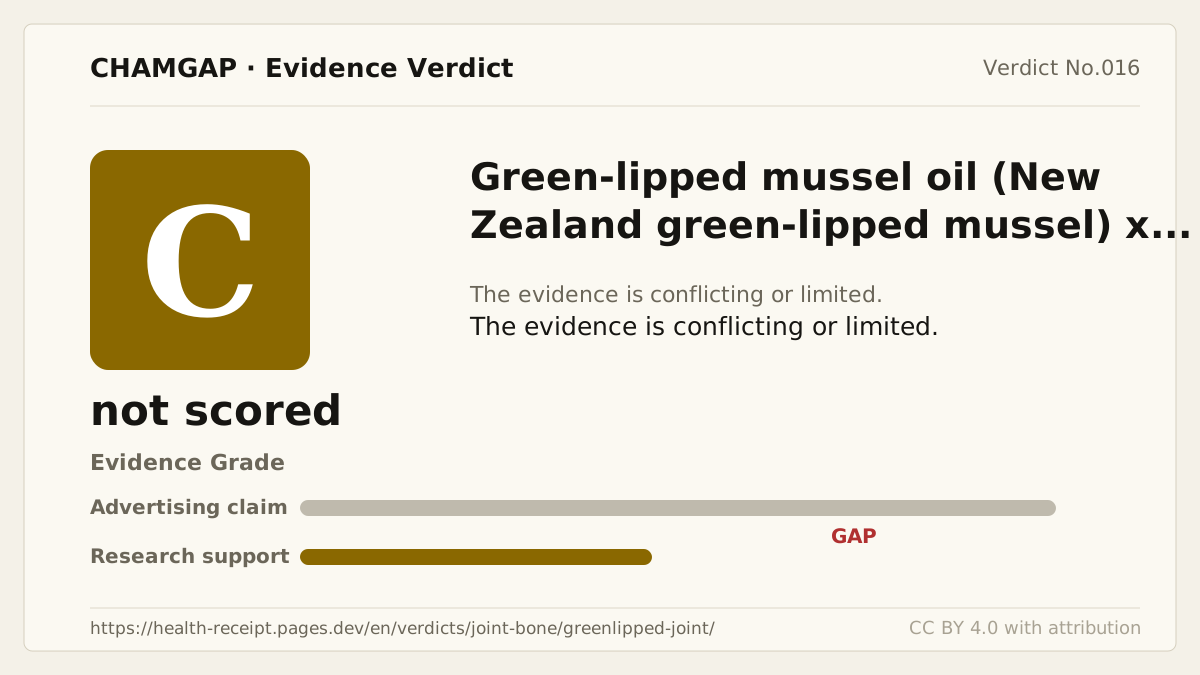
[Chamgap] Green-lipped mussel x joints — Evidence Grade D·28. 8 cited sources checked. Source: https://chamgap.com/en/verdicts/joint-bone/greenlipped-joint/ · CC BY 4.0CC BY 4.0 — free to use with attribution; do not distort grades, numbers, or verdict meaning.
What this document does and does not do
Chamgap is an information source. It reports what research has and has not confirmed; it does not tell readers what to take or buy. That decision belongs to readers and, when needed, medical or legal professionals. This verdict reflects literature available up to the search date and may change as new research appears. Nothing here is medical advice.