
Glucosamine,
does it really help with joint (knee) pain and function improvement?
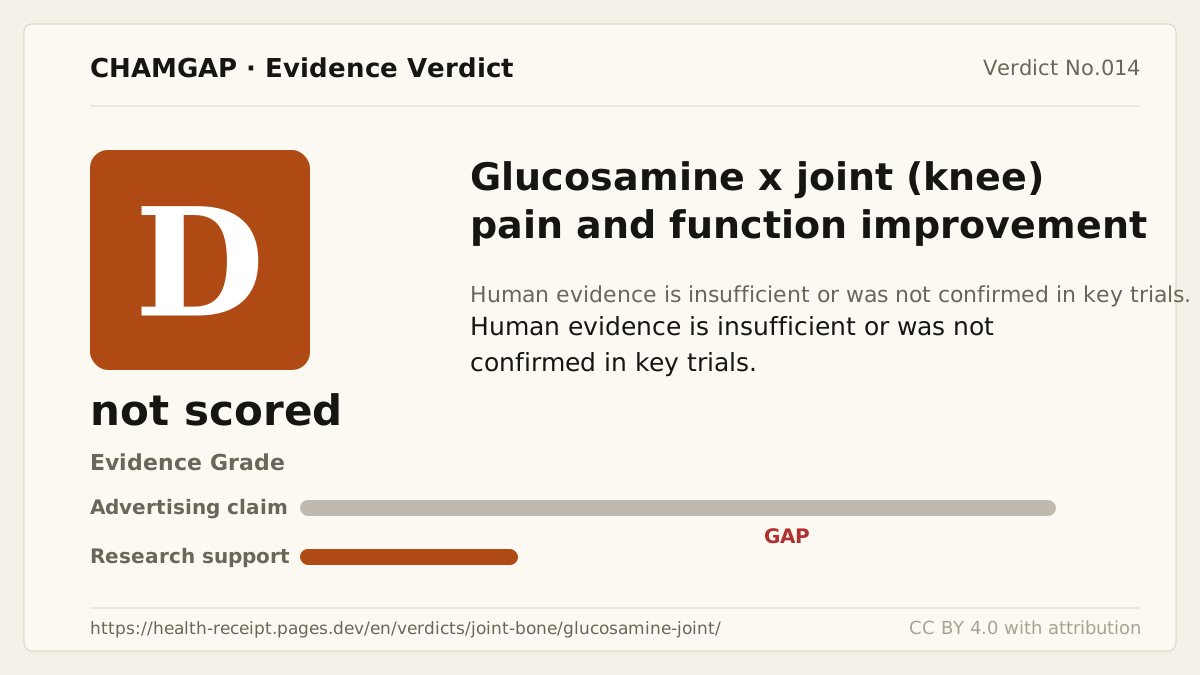
research showsThe claim that glucosamine improves knee joint pain and function is not confirmed in independent, large-scale evidence without conflicts of interest. The direction of evidence differs by funding source and formulation (sulfate vs hydrochloride), and if weight is placed on independent high-quality trials, clinically noticeable improvement did not appear. Manufacturer-funded trials involving the Italian company Rotta were positive, but the large independent NIH GAIT trial in the United States (2006) found no difference from placebo in the prespecified primary endpoint, pain response rate (63.9% vs 60.1%, P=0.30). The independent BMJ meta-analysis by Wandel 2010 found that pain reduction did not reach the minimal clinically important threshold (about -0.9cm/VAS) and that effects were smaller in independent trials. Cochrane review also found that significance disappeared when only trials with adequate allocation concealment or non-Rotta preparations were pooled. In short: (1) based on public regulatory data, Korea MFDS appears to recognize glucosamine as a generic functional ingredient so products made to specification may display 'may help joint and cartilage health' (this verification confirms only the fact of regulatory labeling permission, while exact regulatory wording remains a follow-up item). (2) This recognition does not mean pain/function improvement is clinically established; independent high-quality evidence did not confirm clinical benefit. (3) Many commercial products are not glucosamine alone but combinations with MSM, calcium, plant extracts, etc. (confirmed examples: Costco KS glucosamine HCl+MSM, Hanpoong combination), so advertised improvement cannot easily be attributed to glucosamine alone. (4) Expressions such as 'cartilage regeneration' and 'cure degenerative arthritis' exceed the recognized scope, and public reports confirm unfair-advertising enforcement cases such as Dongjin Pharmaceutical's 'HoKwanWon Premium Gold.' Public reevaluation data add avoidance recommendations for pregnant/lactating women and gastrointestinal adverse-event cautions, so safety is 'caution.'
ads claimAdvertising/sales wording, based on confirmed public data, divides into two layers. [Within regulatory-permitted range: factual labeling] Costco Korea official mall and similar products (KS glucosamine HCl 1500mg + MSM 1500mg) use the known MFDS-recognized phrase 'may help joint and cartilage health' (confirmed as a generic functional ingredient claim). But because the product is a glucosamine HCl + MSM combination, any effect cannot be attributed to glucosamine alone, and the target consumers are framed as 'people who stand while working' or 'people with knee discomfort when climbing stairs.' [Beyond recognized range: caution/enforcement] Hanpoong Pharmaceutical press material uses wording such as 'normalizes cartilage metabolism, prevents cartilage destruction, maintains and improves joint function,' implying cartilage regeneration/disease-progression suppression beyond the 'may help' wording and exceeding verified independent evidence. Public reporting in Young Doctor says Dongjin Pharmaceutical's 'HoKwanWon Premium Gold' was scheduled for administrative action for unfair advertising with drug-like/disease-treatment phrases such as 'solves knee pain/joint pain' and 'joint medicine' (the specific product/report facts are follow-up items outside the academic verification scope). Nutrione magazine and other owned content also strongly appeal to ingredient efficacy. Core mismatch: ads use definitive language such as improvement, protection, maintenance, and enhancement, while the highest independent evidence did not confirm clinical benefit versus placebo. 'Health functional food recognition' and 'clinical effect proof' are not the same.
Useful facts when choosing a product
- Regulatory fact based on public data, original regulation follow-up: glucosamine is confirmed as an MFDS Health Functional Food Code generic functional ingredient. Products using it to specification are classified as health functional foods, and the recognized wording is known to be 'may help joint and cartilage health.'
- Daily intake based on public data: as glucosamine 1.5-2g/day (about 1,500mg recommended). Both glucosamine sulfate and glucosamine hydrochloride (HCl) forms are used.
- Formulation issue in verified academic citations: the negative representative independent GAIT trial (Clegg 2006) used hydrochloride, while the long-term trials reporting joint-space structural signals (Reginster 2001, Pavelka 2002) used Rotta sulfate preparations, making it difficult to treat the two forms as identical.
- Combination products: examples include Costco KS (glucosamine HCl 1500mg + MSM 1500mg) and Hanpoong products (glucosamine + calcium + MSM + vitamins + plant extracts), so the effects of these products are hard to attribute to glucosamine alone.
- Unfair-advertising enforcement based on public reports: Young Doctor reported that Dongjin Pharmaceutical 'HoKwanWon Premium Gold' was cited for drug-like phrases such as 'solves knee pain/joint pain' and 'joint medicine.' Phrases such as cartilage regeneration or cure of degenerative arthritis exceed the recognized scope.
- Safety reevaluation based on public data: MFDS reevaluation reportedly added wording to avoid use in pregnant/lactating women and cautions such as gastrointestinal adverse events, supporting the 'caution' safety judgment.
- International evidence summary: industry-independent large RCTs and meta-analyses (GAIT 2006, Wandel 2010 BMJ, Cochrane 2005 high-quality subgroup, LEGS 2015) did not confirm pain/function improvement versus placebo or found effects below minimal clinical importance; health functional recognition is not the same as confirmed clinical efficacy.
- Safety is reported as similar to placebo in many papers ('as safe as placebo,' Cochrane 2005 RR=0.97). Main issues are avoidance in specific groups such as pregnant/lactating women and mild gastrointestinal adverse events; no serious toxicity signal was confirmed.
What the research actually shows
Across 7 verified papers, prioritizing the conflict-of-interest-zero layer (independent/high-quality evidence) does not confirm glucosamine's knee pain/function improvement. [Independent evidence: primary endpoint null or below noticeable threshold] ① GAIT (Clegg 2006, N Engl J Med, U.S. NIH/NIAMS public funding, 1,583 patients): for the prespecified primary outcome, 20% pain-reduction response at 24 weeks, glucosamine hydrochloride alone and combination therapy did not differ significantly from placebo (63.9% vs 60.1%, P=0.30). Only the exploratory, not prespecified, moderate-to-severe subgroup combination was better (79.2% vs 54.3%), so it cannot be elevated as efficacy evidence. ② Wandel 2010 (BMJ, Swiss National Science Foundation public funding, 10 RCTs, 3,803 participants network meta-analysis): pain -0.4cm, below the prespecified minimal clinically important difference (-0.9cm). Industry-independent trials showed effects on average 0.5cm smaller than commercially funded trials (interaction P=0.02), and independent-trial estimates were minimal to zero. Authors concluded reimbursement/new prescriptions should not be encouraged. ③ Cochrane (Towheed 2005, 20 RCTs, 2,570 participants): overall pooling showed Lequesne pain/function improvement, but WOMAC did not reach significance. When only Rotta preparations were pooled, superiority appeared; when adequately concealed high-quality trials or non-Rotta preparations were pooled, pain/function significance disappeared. ④ LEGS (Fransen 2015, Australian NHMRC public funding, 605 patients): no significant between-group pain difference (p=0.93). Only the combination group showed borderline joint-space structural signal 0.10mm, a surrogate whose perceptibility is unclear. ⑤ Simental-Mendia 2018 meta-analysis: glucosamine alone pain VAS -7.41mm (p=0.04), statistically significant but below pain MCID (roughly 10-20mm), and WOMAC function/total were nonsignificant. [Industry-funded positive surrogate evidence] ⑥ Reginster 2001 (Lancet) and ⑦ Pavelka 2002 (Arch Intern Med): both were 3-year glucosamine sulfate (Rotta) trials reporting delayed joint-space narrowing and symptom improvement, but authors Rovati and Giacovelli were affiliated with manufacturer Rotta Research Laboratorium and study product was supplied by the manufacturer; the primary structural signal was a surrogate marker (joint-space mm). Overall, independent large RCTs were null on primary endpoints, independent meta-analyses/high-quality subgroups did not confirm clinical benefit, and positive findings concentrate in a specific manufacturer sulfate product, industry funding, and surrogate markers.
Why this is classified as D (34)
Basis for D: many human RCTs and meta-analyses exist, but when the conflict-of-interest-zero layer is prioritized, clinically noticeable pain/function improvement is not confirmed. The industry-independent large GAIT RCT (Clegg 2006) found no difference from placebo for the prespecified primary endpoint, pain response (P=0.30). The industry-independent BMJ network meta-analysis (Wandel 2010) found pain reduction below the minimal clinically important difference and smaller effects in independent trials (interaction P=0.02). In Cochrane 2005, significance disappeared in adequately concealed high-quality trials and non-Rotta preparations. Positive findings concentrate in manufacturer Rotta funding, sulfate formulations, industry-affiliated authors, and surrogate markers such as joint-space mm. Meta-analyses with statistical pain signals (Simental-Mendia 2018) still fall below minimal clinical importance and function endpoints are nonsignificant. This matches methodology 2-1② and ①, so D, unconfirmed in independent high-quality evidence, is more accurate than C. It is not F because some statistical and structural borderline signals remain. Safety 'caution' reflects pregnancy/lactation avoidance and gastrointestinal adverse-event cautions from public reevaluation data.
Counterpoint. There is room to see this higher than D, possibly C: strict separation of formulations may change the picture. The negative representative trial GAIT used glucosamine hydrochloride (HCl), while the long-term trials reporting joint-space structural signals (Reginster/Pavelka) used Rotta glucosamine sulfate. If the hypothesis that only sulfate works is true, downgrading sulfate based on hydrochloride null results may be unfair, and the fact that MFDS recognizes functionality and a daily intake, based on public data, shows the regulatory labeling basis is met. Weakness of this upward logic: much of the sulfate-superiority evidence comes from manufacturer Rotta funding and affiliated authors, and Wandel/Cochrane included sulfate yet effects disappeared in the independent/high-quality layer. Regulatory recognition is neutral metadata, not an upward factor. Conversely, F would be too low because statistical pain signals and borderline structural signals remain. Balancing both directions, D, meaning no confirmed independent high-quality clinical benefit, is the evidence-hierarchy midpoint.
| Endpoint | P | Patient-reported treatment goal - the symptom is the goal |
| Replication | R1 | Single confirmatory trial |
| Independence | I1 | Mixed funding sources |
| Effect size | E0 | Null |
| Precision | C0 | The confidence interval leaves room for benefit |
The scoring table and the verdict agree (D).
Cross-check — Codex and Claude
Evidence Table
| Study | Design | Sample | Funding | Endpoint | Result | Weight |
|---|---|---|---|---|---|---|
| Clegg DO, Reda DJ, Harris CL et al. 2006 | double-blind randomized controlled trial | 1,583 | possible manufacturer or industry involvement | joint / pain | Large multicenter double-blind RCT with U.S. NIH/NIAMS public funding (Grant N01AR92236), 1,583 symptomatic knee osteoarthritis patients. For the primary outcome, 20% pain-reduction response at 24 weeks, glucosamine hydrochloride 63.9% vs placebo 60.1% (P=0.30), no significant difference. Only combination therapy in the moderate-to-severe subgroup was 79.2% vs 54.3% (P=0.002), an exploratory non-prespecified analysis. | key |
| Reginster JY, Deroisy R, Rovati LC et al. 2001 | double-blind randomized controlled trial | 212 | possible manufacturer or industry involvement | joint / pain | 212 knee osteoarthritis patients (106 per group), 3-year double-blind RCT, oral glucosamine sulfate (Rotta preparation) 1,500mg/day. Joint-space loss was inhibited versus placebo (-0.31mm vs -0.06mm) and WOMAC symptoms improved. However, authors Rovati and Giacovelli were affiliated with manufacturer Rotta Research Laboratorium. | key |
| Pavelka K, Gatterova J, Olejarova M et al. 2002 | double-blind randomized controlled trial | 202 | possible manufacturer or industry involvement | liver / joint | 202 knee osteoarthritis patients, 3-year double-blind RCT, glucosamine sulfate (Rotta) 1,500mg/day. Joint-space change was inhibited versus placebo (-0.19mm vs 0.04mm, between-group P=0.001), and Lequesne/WOMAC symptoms improved 20-25%. Sister study to Reginster 2001. | key |
| Wandel S, Juni P, Tendal B et al. 2010 | meta-analysis of randomized controlled trials | 3,803 | possible manufacturer or industry involvement | joint / pain | Industry-independent Bayesian network meta-analysis of 10 RCTs and 3,803 participants (knee/hip). Glucosamine pain effect was -0.4cm (95%CrI -0.7~-0.1), below the prespecified MCID (-0.9cm). Industry-independent trials had effects on average 0.5cm smaller than commercially funded trials (interaction P=0.02). Funding: Swiss National Science Foundation (NRP 53). | key |
| Fransen M, Agaliotis M, Nairn L et al. 2015 | double-blind randomized controlled trial | 605 | possible manufacturer or industry involvement | liver / joint / pain | Australian public-funding-centered double-blind RCT, 605 symptomatic knee osteoarthritis patients aged 45-75 followed for 2 years. Pain decreased in all 4 groups but there was no significant between-group difference (p=0.93). Only the combination group had borderline joint-space narrowing effect, 0.10mm (95%CI 0.002~0.20), with unclear perceptibility. | supporting |
| Towheed TE, Maxwell L, Anastassiades TP et al. 2005 | systematic review of randomized controlled trials | 2,570 | pain | Cochrane systematic review, 20 RCTs and 2,570 participants. Overall pooling showed 28% Lequesne pain and 21% function improvement, but WOMAC did not reach significance. Rotta preparations (10 RCTs) were superior, but pain/function significance disappeared when only adequately concealed high-quality trials or non-Rotta preparations were pooled. Safety equivalent to placebo (RR=0.97). | supporting | |
| Simental-Mendia M, Sanchez-Garcia A, Vilchez-Cavazos F et al. 2018 | meta-analysis of randomized controlled trials | 3 | possible manufacturer or industry involvement | pain | Meta-analysis of oral glucosamine/chondroitin. Glucosamine alone pain VAS -7.41mm (p=0.04), chondroitin -8.35mm (p<0.00001), combination -0.28mm (p=0.95, null). WOMAC total and subscales showed no significant improvement. No added benefit of combination. | supporting |
Receipt — 7 References
Of 7 cited sources, 1 had limited original-page access (blocked or summary-only) and were verified via index/summary, marked partial; the rest were verified at the original page. As of 2026-07-06.
Reviewed and approved: Chamgap Editorial Team · Approval date: 2026-07-06 · Corrections: none
Cite this verdict
[Chamgap] Glucosamine x joint pain — Evidence Grade D·34. 7 cited sources checked. Source: https://chamgap.com/en/verdicts/joint-bone/glucosamine-joint/ · CC BY 4.0CC BY 4.0 — free to use with attribution; do not distort grades, numbers, or verdict meaning.
What this document does and does not do
Chamgap is an information source. It reports what research has and has not confirmed; it does not tell readers what to take or buy. That decision belongs to readers and, when needed, medical or legal professionals. This verdict reflects literature available up to the search date and may change as new research appears. Nothing here is medical advice.