
Collagen,
does it really help with joint and bone health?
research showsHuman studies exist suggesting that collagen (hydrolyzed collagen and undenatured UC-II) “may help” joint (mainly knee osteoarthritis) and bone health. Multiple meta-analyses in osteoarthritis patients report statistically significant improvements versus placebo in pain and function indicators, and among them the methodologically strictest independent meta-analysis (Liang 2024) assigned GRADE certainty of “moderate” for the prespecified primary endpoint pain and “high” for function. Within the range of public regulatory materials, the MFDS is confirmed to have individually recognized chicken breast cartilage powder (UC-II) and low-molecular collagen peptide (3~4 g/day) as “may help joint and cartilage health” (individual product recognized wording/numbers are outside the verification scope and require product-by-product label confirmation). However, three facts should be considered together. (1) The effect size is small to moderate (pain SMD about -0.35), and statistical significance does not mean large pain relief that an individual necessarily feels (insufficient comparison with MCID, minimal clinically important difference). (2) Many individual clinical trials with positive results received collagen-manufacturer funding or product support, and a manufacturer-unsponsored independent RCT (Thailand, Yuenyongviwat 2025) did not show collagen combination superiority versus placebo (no between-group difference, p=0.789). This independent trial used lower doses, UC-II 20 mg+hydrolyzed 480 mg, than the standard doses in positive evidence (UC-II 40 mg; hydrolyzed 3~10 g), so independent replication at standard dose is empty within the confirmed scope. (3) “Bone health” evidence is separate from joint evidence; it mainly relies on one manufacturer-sponsored study in a specific population, postmenopausal women with low bone density, measuring a surrogate indicator, bone mineral density (BMD), not fractures, so its layer is shallower than joint evidence. Overall, human evidence in the direction that collagen “may help” joints exists on primary endpoints, but effect size is limited, positive evidence is tilted toward manufacturer funding, and independent trial results conflict. Bone evidence is limited to surrogate indicators and a single manufacturer study. The position reflecting these conflicts and limitations is C (limited/conflicting). This is a borderline zone where the view that the joint endpoint alone approaches B and the view that independent null/manufacturer bias makes it approach D are both valid. In addition, some commercial collagen products are ordinary foods/imported foods that cannot claim functionality, so the function that can be claimed differs depending on whether the product is a domestic health functional food (individual recognition number/logo displayed).
ads claimThe advertisements collected in this verification are confirmed to use expressions that run ahead of the ingredient’s functional evidence (efficacy expansion) or differ from domestic regulatory wording. The following are examples confirmed in this verification, while source metadata such as individual sales-page URLs and collection dates are outside the scope of this judgment (follow-up targets). - A case confirmed as 11st “Fine UC-2” (Trendmaker): the product name/text directly uses the disease name “arthritis” and claims “cartilage health.” If it is an ordinary food, disease-name exposure and functional claims may be a type that raises problems as unfair/exaggerated advertising (disease prevention/treatment claim) under domestic labeling-advertising regulations. - NOW Foods UC-II 40 mg product group (Dr. Joe Store, Blue Orange, Green Organic): overseas direct-purchase/import products that translate U.S. label wording (“joint comfort, flexibility, function improvement”) into Korean. They use expressions different from domestic health-functional-food individual-recognition wording (“may help joint/cartilage health”) and show a pattern (E1) of presenting raw-material specification, such as cartilage being connective tissue, as if it were efficacy evidence. Common issue: within the confirmed scope, advertisements assert/expand effects beyond “may help,” and do not present that effect sizes are small to moderate or that independent trial results conflict. In some cases, labeling did not make clear whether the sold product was a domestic health functional food (individual recognition number/logo) or an ordinary/imported food.
Useful facts when choosing a product
- The target ingredients divide into two types with different evidence and doses: undenatured type II collagen (UC-II) is usually 40 mg/day, while hydrolyzed (low-molecular) collagen peptide is usually around 10 g/day (based on public regulatory materials, MFDS joint individual-recognition dose is 3~4 g/day). They are different ingredients/doses, so evidence for one cannot be directly applied to the other.
- MFDS functionality (based on public materials): chicken breast cartilage powder (UC-II) and low-molecular collagen peptide (3~4 g/day) are each confirmed to have been individually recognized as “may help joint and cartilage health.” However, individual notification numbers/recognition dates and distinction from products recognized only for “skin functionality” are outside this verification scope; actual product recognized wording/number display must be checked.
- Among domestic collagen products, ordinary foods/imported foods that cannot claim functionality are also confirmed (the overall market proportion is outside this verification). MFDS/consumer-agency counts of unfair advertising for oral collagen (e.g., 416 cases), detailed proportions (misleading as health functional food, ingredient-efficacy advertising, exaggerated effects, etc.), and consumer-agency survey figures (“19 of 20 ordinary foods had misleading advertising”) are based on public announcements, but the source data are not included in this citation list and remain follow-up targets.
- Safety: the reviewed trials did not report increased serious adverse events, but Lin 2023 meta-analysis reported adverse-event OR 1.66 (95% CI 0.99~2.78, p=0.05), which is borderline, with reports of gastrointestinal disorders, migraine, and respiratory infections; adverse-event evidence quality was “very low.” This is different from “proven harmless.”
- Effect size is small to moderate (pain SMD about -0.35), and statistical significance does not mean that an individual will necessarily perceive pain relief (insufficient MCID comparison).
- Bone-health evidence is limited to postmenopausal women with low bone density and mainly relies on one manufacturer-sponsored study measuring BMD, a surrogate indicator rather than fractures; it is a separate endpoint from joint evidence.
What the research actually shows
Many human studies exist. Three meta-analyses in osteoarthritis patients and individual RCTs were confirmed. [Joints, osteoarthritis patients] - Liang 2024 (trial sequential meta-analysis of collagen derivatives for osteoarthritis, Osteoarthritis and Cartilage, PMID 38218227): pain SMD -0.35 (95% CI -0.48~-0.22), function SMD -0.31 — small to moderate effects. Trial sequential analysis (TSA) confirmed sufficient power, with GRADE “moderate” for pain and “high” for function. Hydrolyzed collagen (around 10 g/day) and UC-II (around 40 mg/day) were integrated as “derivatives” (not separated by ingredient). Whether subgroup analysis by funding source (manufacturer vs independent) was done was not confirmed in the abstract/public scope. - Lin 2023 (meta-analysis of analgesic efficacy of collagen peptide in knee osteoarthritis, J Orthop Surg Res, PMID 37717022): pain SMD -0.58 (significant versus placebo), but all four included trials were rated “high risk of bias” by ROB 2.0. - García-Coronado 2019 (meta-analysis of collagen supplementation for osteoarthritis symptoms, Int Orthop, PMID 30368550): WOMAC total and VAS significantly decreased, but pain subscore and functional limitation were meaningless; results diverged by indicator. - Lugo 2016 (UC-II 40 mg/day, 180-day multicenter RCT, Nutrition Journal, PMC4731911): total WOMAC significantly improved versus placebo (p=0.002) and glucosamine+chondroitin (p=0.04). Manufacturer (InterHealth) sponsorship and author affiliation. - Carrillo-Norte 2024 (hydrolyzed collagen 10 g/day, 6-month RCT, Contemp Clin Trials Commun, PMC11745964): pain VAS -43.6% vs placebo -6.8%, function (Lequesne) -38.8% vs -0.3%, both significant. Manufacturer sponsorship, and test product was the funder’s product. [Joints, healthy people] - Lugo 2013 (UC-II 40 mg healthy-volunteer RCT, J Int Soc Sports Nutr, PMC4015808): primary outcome was knee extension angle (surrogate) rather than pain and was significant, but 6-minute walk and KOOS questionnaire were meaningless between groups. Manufacturer sponsorship and author affiliation. [Bone — separated from joints] - König 2018 (specific collagen peptide 5 g/day, 12-month RCT, Nutrients, PMC5793325): in postmenopausal women with low bone density, lumbar spine BMD improved in the treatment group while the control group declined (p=0.030), and femoral neck was significant (p=0.003). What was measured was BMD (surrogate), not fractures, and the study was partially funded by manufacturer GELITA AG and used the manufacturer’s product. This is a single endpoint separate from joint evidence. [Disconfirmation case/independent trial] - Yuenyongviwat 2025 (UC-II 20 mg + hydrolyzed 480 mg, 12-week RCT, Scientific Reports, PMID 40897777): in a manufacturer-unsponsored independent trial (Thai medical association funding), pain (VNRS) and all KOOS indicators showed no significant between-group difference, failing to prove superiority versus placebo. However, the dose was lower than standard doses in positive evidence, so it is not directly equivalent to whether independent replication occurs at standard dose.
Why this is classified as C (50)
C (limited/conflicting) judgment, type borderline. In the evidence hierarchy, many human RCTs and meta-analyses exist, and the methodologically strictest independent meta-analysis (Liang 2024) reported significant improvement versus placebo on the prespecified primary endpoints pain and function, with GRADE “moderate” for pain and “high” for function. This is a signal above D, approaching B (from the chapter 2-1 item ① perspective, the primary endpoint is not a surrogate, so the “C upper bound” trigger for surrogate-only significance does not apply). However, factors preventing upgrade to B/A are: (1) effect sizes are small to moderate (SMD about -0.31 to -0.35), so perceptible improvement may be limited and MCID comparison is insufficient; (2) many positive-result RCTs (Lugo 2016 and 2013, Carrillo-Norte 2024, König 2018) received manufacturer funding or test-product provision; (3) bone evidence depends on one manufacturer-sponsored study in deficient postmenopausal women measuring BMD, a surrogate rather than fractures (separately stated from joints under chapter 2-1 item ③); and (4) Lin 2023 rated all four included studies as “high risk of bias,” while García-Coronado 2019 produced divergent results by indicator. Meanwhile, to finalize as D (chapter 2-1 item ②), one would need “zero-conflict independent RCT null” or “disappearance of significance in high-quality groups,” but the only independent null RCT (Yuenyongviwat 2025) used lower-than-standard doses and is hard to treat as null under the same conditions, and Liang 2024’s funding-source subgroup analysis is unconfirmed, so disappearance of significance is also not established. Because both the decisive blow for downgrade (D) and the signal for maintaining C or above fail to reach certainty, the grade is fixed at C.
Counterpoint. Both sides of the counterargument to this C judgment are valid. Upward direction: the methodologically strictest independent meta-analysis (Liang 2024) confirmed sufficient information size for conclusions through trial sequential analysis and assigned GRADE “high” to function; even considering manufacturer funding in individual trials, this increases the likelihood that collagen derivatives’ improvement of osteoarthritis pain/function is not accidental. Taking this argument strongly brings the grade close to B. Downward direction: the only independent RCT (Yuenyongviwat 2025) was null, positive results are tilted toward industry funding, and bone evidence is limited to a surrogate indicator and a single deficient population; weighing these heavily supports C-lower to D. However, because that independent null used low dose and Liang 2024’s funding-source subgroup analysis is unconfirmed, neither side reaches certainty under the methodology text. The funding-source (manufacturer vs independent) subgroup analysis results in the paid full text of Liang 2024 remain the key variable that would move the grade up to B or down to D.
| Endpoint | P | Patient-reported treatment goal - the symptom is the goal |
| Replication | R1 | Single confirmatory trial |
| Independence | I0 | Evidence comes only from manufacturer studies |
| Effect size | E+ | Meets the clinically important threshold |
The scoring table and the verdict agree (C).
Cross-check — Codex and Claude
Evidence Table
| Study | Design | Sample | Funding | Endpoint | Result | Weight |
|---|---|---|---|---|---|---|
| Liang CW, Cheng HY, Lee YH, Liao CD, Huang SW 2024 | meta-analysis and RCTs | 2,856 | manufacturer/industry involvement possible | hydration, liver, joint, and pain | Trial sequential meta-analysis of collagen derivatives (hydrolyzed + UC-II integrated) in osteoarthritis patients (35 total RCTs; primary pain analysis 25 RCTs/2,856 participants): pain SMD -0.35 (95% CI -0.48~-0.22, GRADE moderate), function SMD -0.31 (95% CI -0.41~-0.22, GRADE high), with sufficient power confirmed by TSA. Funding source not stated in abstract/PubMed scope. | core |
| Lin CR, Tsai SHL, Huang KY et al. 2023 | meta-analysis and RCTs | 507 | mixed/partly industry-related | respiratory, gastrointestinal, joint, and pain | Meta-analysis of collagen peptide in knee osteoarthritis (4 RCTs/507 participants): pain SMD -0.58 (95% CI -0.98~-0.18, p=0.004), significant versus placebo, but all four included studies were ROB 2.0 “high risk of bias”; adverse events OR 1.66 (95% CI 0.99~2.78, p=0.05) was borderline; authors declared no financial/commercial relationships. | core |
| García-Coronado JM, Martínez-Olvera L, Elizondo-Omaña RE et al. 2019 | meta-analysis and RCTs | 4 | manufacturer/industry involvement possible | joint and pain | Meta-analysis of collagen supplementation in osteoarthritis: total WOMAC (p=0.002), stiffness subscore (p=0.01), and VAS (p<0.001) significantly decreased, but pain subscore (p=0.75) and functional limitation (p=0.81) were meaningless; conclusions diverged by indicator. | core |
| Lugo JP, Saiyed ZM, Lane NE 2016 | double-blind randomized controlled trial | 191 | manufacturer/industry involvement possible | ALT | Multicenter RCT of UC-II 40 mg/day for 180 days (191 participants, 3 arms): total WOMAC significantly improved versus placebo (-551 vs -414, p=0.002) and glucosamine+chondroitin (-551 vs -454, p=0.04), and all three subscales improved versus placebo. | core |
| Carrillo-Norte JA, Gervasini-Rodríguez G, Santiago-Triviño MÁ et al. 2024 | double-blind randomized controlled trial | 120 | manufacturer/industry involvement possible | hydration, joint, and pain | Six-month RCT of hydrolyzed collagen 10 g/day (COLLinstant®, plus vitamin C) (120 participants, knee OA grade II-III): pain VAS -43.6% vs placebo -6.8% (p<0.001), function (Lequesne) -38.8% vs -0.3% (p<0.001); both indicators were significant versus placebo. | supporting |
| Yuenyongviwat V, Anusitviwat C, Tuntarattanapong P, Hongnaparak T, Iamthanaporn K 2025 | randomized controlled trial | 34 | manufacturer/industry involvement possible | hydration, liver, joint, and pain | [Disconfirmation case/manufacturer-unsponsored independent trial] UC-II 20 mg + hydrolyzed collagen 480 mg, 12-week RCT (68 participants, 34 per group): no significant between-group difference on pain (VNRS) or any KOOS indicator (both groups improved, but no between-group difference); superiority versus placebo failed to be proven. | supporting |
| Lugo JP, Saiyed ZM, Lau FC et al. 2013 | double-blind randomized controlled trial | 55 | manufacturer/industry involvement possible | liver, ALT, gastrointestinal, and joint | [Population=healthy volunteers, not osteoarthritis patients] UC-II 40 mg, 120-day RCT (55 participants): the primary outcome, knee extension angle (ROM surrogate), was significant (81.0° vs 74.0°, p=0.011), but 6-minute walk and KOOS questionnaire showed no meaningful between-group difference (p>0.05). | supporting |
| König D, Oesser S, Scharla S, Zdzieblik D, Gollhofer A 2018 | randomized controlled trial | 131 | manufacturer/industry involvement possible | bone mineral density and fracture | [Representative bone trial, deficient population] Specific collagen peptide (FORTIBONE®) 5 g/day, 12-month RCT in postmenopausal women with low bone density (131 participants): lumbar BMD improved in the treatment group versus control decline (p=0.030, about 3.0% relative gap), and femoral neck was significant (p=0.003, about 6.7% relative gap). What was measured was BMD, not fractures. | supporting |
Receipt — 8 References
Of 8 cited sources, 1 had limited original-page access (blocked or summary-only) and were verified via index/summary, marked partial; the rest were verified at the original page. As of 2026-07-06.
Reviewed and approved: Chamgap Editorial Team · Approval date: 2026-07-06 · Corrections: none
Cite this verdict
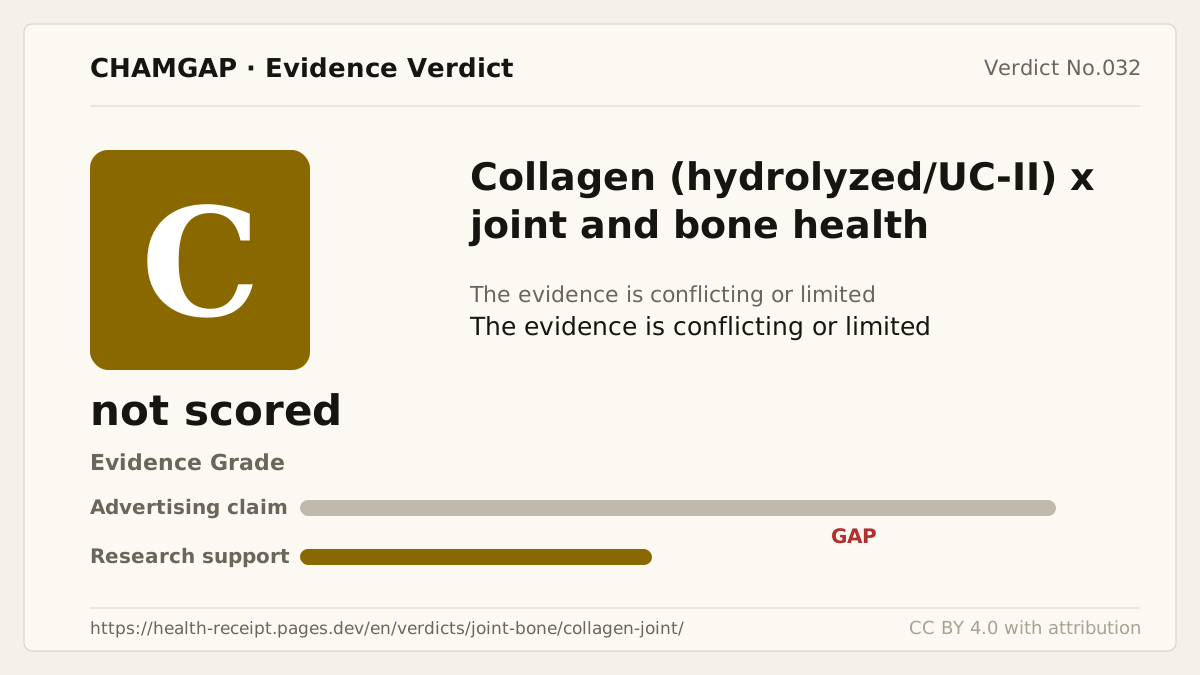
[Chamgap] Collagen x joints and bone — Evidence Grade C·50. 8 cited sources checked. Source: https://chamgap.com/en/verdicts/joint-bone/collagen-joint/ · CC BY 4.0CC BY 4.0 — free to use with attribution; do not distort grades, numbers, or verdict meaning.
What this document does and does not do
Chamgap is an information source. It reports what research has and has not confirmed; it does not tell readers what to take or buy. That decision belongs to readers and, when needed, medical or legal professionals. This verdict reflects literature available up to the search date and may change as new research appears. Nothing here is medical advice.