
Chondroitin,
does it really help with Claims for joint and cartilage health, improvement of osteoarthritis pain and function, and maintenance of joint space?
research showsThe evidence that chondroitin improves joint pain has not been confirmed by the standard of an independent large RCT. In the NIH-funded GAIT, chondroitin alone did not significantly outperform placebo for the 24-week primary pain response, and positive signals from joint space width, specific pharmaceutical-grade products, and manufacturer-sponsored studies do not overturn the overall judgment. Claims about general joint health, cartilage regeneration/restoration, and superior absorption by source material go beyond the clinically proven range.
ads claimKorean advertisements and informational articles repeatedly mention 'helps joint and cartilage health,' 'pain improvement,' 'walking time improvement,' 'maintenance of the width between joints,' 'improvement of morning stiffness,' and 'improved evaluation of knee and hand pain.' Product lines emphasize 1,200 mg, bovine-derived, shark-derived, or sturgeon-derived sources, type 6/CS6, low molecular weight/absorption rate, and similarity to human cartilage. Some market language extends to 'cartilage regeneration,' 'cartilage restoration,' and 'improvement of degenerative arthritis,' but this is broader than the confirmed clinical effect. As of 2024 reports, concerns were also confirmed that general-food products could be mistaken for health functional foods and that detections of unfair advertising were increasing.
Useful facts when choosing a product
- Food Safety Korea's ingredient-specific information presents the functional content of Juyeong NS chondroitin sulfate (No. 2020-1) as 'may help joint and cartilage health' and presents the daily intake as chondroitin 1,200 mg/day.
- Food Safety Korea precautions include caution for infants and young children, children, pregnant and lactating women, people with allergic constitution, before and after surgery, users of anticoagulants, antiplatelet agents, or NSAIDs, and patients with asthma.
- In the domestic market, health functional foods and general foods are mixed, and the possibility of consumer misunderstanding due to dosage forms such as tablets, capsules, and films and product names has been reported.
- Differences claimed in advertisements, such as bovine, shark, or sturgeon origin, type 6/CS6, low molecular weight, and absorption rate, lack evidence directly verifying superiority in perceived pain and function improvement.
- Products that also contain secondary ingredients such as vitamin D, collagen, hyaluronic acid, and Boswellia make combination claims, so they should be separated from the effect of chondroitin alone.
What the research actually shows
The study populations were mostly patients with knee or hip osteoarthritis. The key negative evidence is the NIH-funded GAIT (Clegg 2006, 1,583 participants, 24 weeks), in which chondroitin sulfate 1,200 mg/day alone was not significant versus placebo for the primary pain response (placebo 60.1%, chondroitin 65.4%, p=0.17). The Reichenbach 2007 meta-analysis also found that the pain effect size almost disappeared to -0.03 when limited to large ITT trials. Cochrane 2015 reported a small short-term pain improvement across 43 RCTs and 9,110 participants, but sensitivity to study quality, heterogeneity, and funding source was large. CONCEPT (Reginster 2017, 604 participants, 6 months) found that pharmaceutical-grade chondroitin 800 mg/day lowered VAS pain and the Lequesne index more than placebo, but it was a specific-preparation, manufacturer-sponsored study. Mazières 2007 was partly positive for pain, but function was not significant and the two primary criteria were not both met. Maintenance of joint spacing is a structural surrogate marker such as minimum joint space width on X-ray, and it does not directly prove perceived pain or function improvement or cartilage regeneration. Results for combination use with glucosamine should be separated from judgments about chondroitin alone.
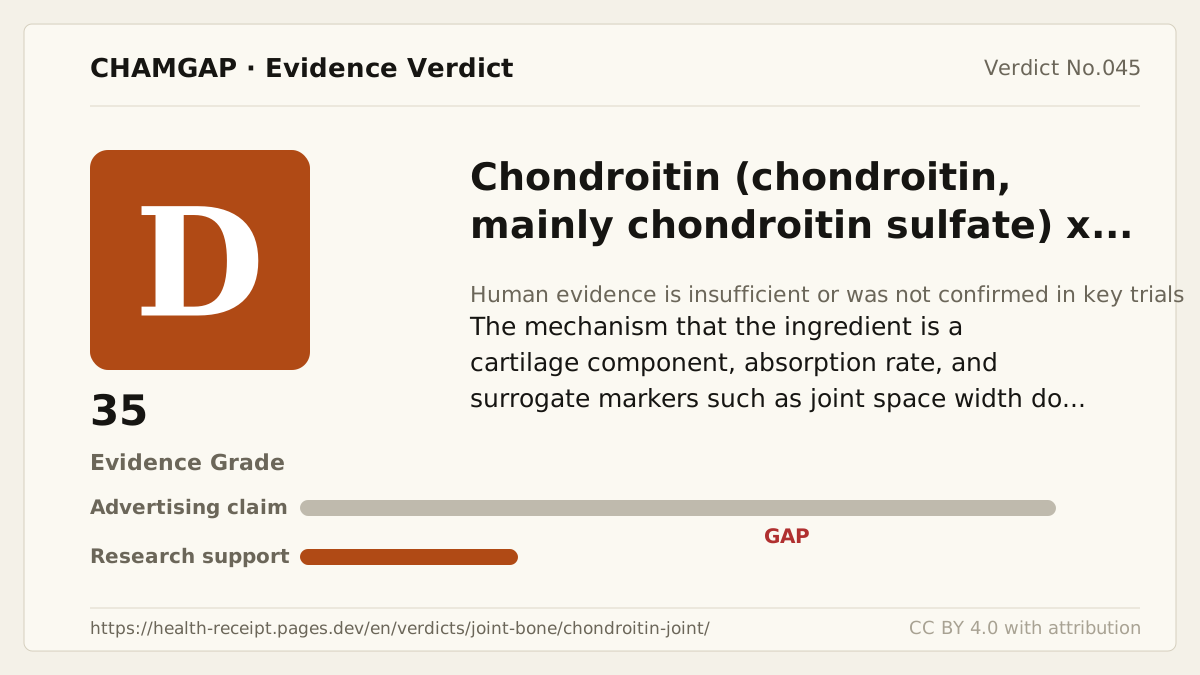
Why this is classified as D (35)
Under criterion 2-1 chapter 2, item 2 of the methodology, if an independent large RCT is negative on the primary clinical endpoint, the verdict is D even if there is positive supporting evidence. GAIT, the independent large RCT for this item, showed no significant difference versus placebo for chondroitin alone on the 24-week primary pain endpoint. The small short-term pain improvement seen in some meta-analyses is sensitive to study quality, heterogeneity, product differences, and manufacturer sponsorship, and joint space width is not a clinical endpoint that directly substitutes for perceived pain and function. Therefore the final grade is D, and the score is 35.
Counterpoint. A counterview is that pharmaceutical-grade chondroitin sulfate RCTs, some subgroups, and European meta-analyses have reported signals of small pain improvement. In particular, CONCEPT was superior to placebo for VAS pain and the Lequesne index, and the overall Cochrane analysis also reported a small short-term pain improvement. However, this signal partly depends on a specific preparation, the European prescription-drug context, manufacturer sponsorship, and subgroup analyses, so it is interpreted separately from the negative primary pain result in the full cohort of the independent large GAIT.
Rejudgment record. reassessment (downgraded C -> D) — Independent large GAIT primary endpoint (pain) negative -> methodology 2-1 chapter item 2 (independent RCT null) = D. Positive evidence is manufacturer-linked and surrogate-marker evidence. Consistent with blind D.
Cross-check — Codex and Claude
Evidence Table
| Study | Design | Sample | Funding | Endpoint | Result | Weight |
|---|---|---|---|---|---|---|
| Study 1 | not specified | not reported | joint/cartilage | The official functionality is 'may help joint and cartilage health,' with an intake amount of 1,200 mg/day and precautions including anticoagulants and asthma. | core | |
| Study 2 | not specified | not reported | gut | Reported an increase in chondroitin production, a 77.6% share of general foods, and increases in functionality misrecognition and detections of unfair advertising. | core | |
| Study 3 | not specified | not reported | gut/joint/pain | Confirmed claims in domestic informational advertising articles about improvements in pain, walking, width between joints, morning stiffness, and hand and knee pain evaluations. | core | |
| Singh JA, Noorbaloochi S, MacDonald R, Maxwell LJ 2015 | RCT | 9,110 | not reported | pain | In a review of 43 RCTs and 9,110 participants, short-term pain improvement appeared small, but sensitivity to study quality, heterogeneity, and funding source was large. | core |
| Clegg DO et al. 2006 | not specified | 1,583 | not reported | pain | In the NIH-funded GAIT RCT of 1,583 participants, chondroitin alone did not significantly improve the 24-week primary pain response compared with placebo. | supporting |
| Reichenbach S et al. 2007 | meta-analysis | not reported | pain | In a meta-analysis of 20 trials, when limited to large ITT trials, the pain effect size was -0.03, indicating almost no clinical effect. | supporting | |
| Mazières B, Hucher M, Zaïm M, Garnero P 2007 | not specified | 307 | not reported | pain | In a 307-participant, 24-week RCT, pain was modestly significant, but function was not significant and the two primary criteria were not both met. | supporting |
| Reginster J-Y, Dudler J, Blicharski T, Pavelka K 2017 | not specified | 604 | possible manufacturer/industry involvement | pain | In a 604-participant RCT, pharmaceutical-grade chondroitin 800 mg/day was superior to placebo for 6-month VAS pain and the Lequesne index. | supporting |
| NCCIH 2023 | RCT | not reported | joint | The NIH-affiliated NCCIH summarizes that evidence for knee osteoarthritis symptoms is uncertain, guideline recommendations diverge, and structural effects are also inconsistent. | supporting |
Receipt — 9 References
Of 9 cited sources, 4 had limited original-page access (blocked or summary-only) and were verified via index/summary, marked partial; the rest were verified at the original page. As of 2026-07-07.
Reviewed and approved: Chamgap Editorial Team · Approval date: 2026-07-07 · Corrections: none
Cite this verdict
[Chamgap] Chondroitin x claims for joint and cartilage health, improvement of osteoarthritis pain and function, and maintenance of joint space — Evidence Grade D·35. 9 cited sources checked. Source: https://chamgap.com/en/verdicts/joint-bone/chondroitin-joint/ · CC BY 4.0CC BY 4.0 — free to use with attribution; do not distort grades, numbers, or verdict meaning.
What this document does and does not do
Chamgap is an information source. It reports what research has and has not confirmed; it does not tell readers what to take or buy. That decision belongs to readers and, when needed, medical or legal professionals. This verdict reflects literature available up to the search date and may change as new research appears. Nothing here is medical advice.