
Calcium,
does it really help with Bone health, maintenance of bone mineral density, and fracture prevention?
research showsCalcium is a nutrient required for the structure of bones and teeth, and there is RCT evidence that supplements slightly increase bone mineral density. However, bone mineral density is a surrogate marker, and for the clinical endpoint of fracture, the effect of calcium-only supplements is not consistent. Evidence for blanket calcium supplementation to prevent fractures in community-dwelling adults and older adults is weak, and even calcium plus vitamin D is assessed in recent meta-analyses as having small absolute effects and limited clinically meaningful preventive benefit.
ads claimIn the Korean market, claims such as "formation of bones and teeth," "reduction of osteoporosis risk," "bone health," "promotion of calcium absorption," and "synergy with vitamin D, K, manganese, and magnesium" are commonly bundled. Actual products are often combinations such as fish-bone calcium plus vitamin D/K/manganese/poly-gamma-glutamic acid rather than calcium alone. Informational articles and hospital/media content tend to mention recommended intake from diet plus supplements, BMD testing, exercise, and correction of deficiency, while also addressing concerns about kidney stones and vascular calcification with high-dose calcium.
Useful facts when choosing a product
- Food Safety Korea health-functional-food wording for calcium includes "needed for formation of bones and teeth" and "helps reduce the risk of osteoporosis," but regulatory wording and evidence grading are not identical.
- Calcium products seen on Korean product pages are often combination functional products containing vitamin D, vitamin K, manganese, magnesium, poly-gamma-glutamic acid, and other ingredients rather than calcium alone.
- The advertised "calcium mg" may refer to raw-material amount or elemental calcium. Calcium carbonate, calcium citrate, fish-bone calcium, and other forms differ in actual elemental calcium content and dosing conditions.
- The BMD effect of calcium supplements is usually small and noncumulative, and it is difficult to translate directly into fracture-prevention effects.
- People with already high total calcium intake, kidney-stone history, hypercalcemia, chronic kidney disease, or certain medication use may face greater safety issues with supplements.
What the research actually shows
When separated by effect, for "bone/BMD," meta-analyses of RCTs in adults aged 50 years or older show that calcium supplements increase BMD at several sites by about 0.7-1.8%. However, this is a surrogate marker for fracture prevention and is capped at C by the boundary rule. For "fracture prevention," most calcium-only RCTs are not significant or are uncertain in ITT analyses, and meta-analyses in community-dwelling older adults did not significantly connect calcium, vitamin D, or the combination with fracture reduction. Large independent RCTs such as WHI (36,282 participants) and RECORD (5,292 participants) failed to significantly reduce primary or major fracture endpoints even with calcium plus vitamin D. Conversely, in groups closer to nursing-home residence, advanced age, and low calcium/low vitamin D status, the Chapuy study and some Cochrane summaries suggest small or moderate benefit from calcium plus vitamin D. Therefore, the evidence is too narrow to extend to the general supplement-advertising claim of "fracture prevention."
Why this is classified as C (45)
There are many RCTs and meta-analyses, but calcium alone does not show consistently positive results for the key clinical endpoint of fracture prevention. Bone/BMD improvement is observed, but because it is a surrogate marker it corresponds at most to C. Calcium plus vitamin D has positive signals in some high-risk or institutionalized groups, and a 2019 meta-analysis reported small fracture reduction, but large RCTs such as WHI and RECORD and 2017/2026 meta-analyses do not support clinically meaningful fracture prevention in general community populations. Because some positive meta-analyses also have conflicts of interest, the overall rating is C 45.
Counterpoint. Situations with higher risk and greater likelihood of deficiency, such as vitamin D deficiency, low dietary calcium intake, nursing-home residence, or adjunctive use with osteoporosis medication, differ from the "universal fracture prevention" claim in ordinary health-functional-food advertising. In these subgroups, the absolute effect of calcium plus vitamin D supplementation may be larger.
Rejudgment record. Convergent — Draft = blinded C. Bone density (a surrogate marker) rises slightly, but fracture prevention is uncertain in general community populations.
Cross-check — Codex and Claude
Evidence Table
| Study | Design | Sample | Funding | Endpoint | Result | Weight |
|---|---|---|---|---|---|---|
| Study 1 | Food Safety Korea presents calcium-permitted functionality as being needed for bone and tooth formation and helping reduce osteoporosis risk. | Core | ||||
| Study 2 | Liver/gastrointestinal | Korean product advertising combines calcium, vitamin D, manganese, vitamin K, and other ingredients with wording on bone formation and reduced osteoporosis risk. | Core | |||
| Study 3 | 122 | Bone density/fracture | Informational content links calcium with bone and tooth formation, reduced osteoporosis risk, and supplement forms. | Core | ||
| Study 4 | Gastrointestinal | A Korean informational article discusses interest in calcium supplements among middle-aged and older adults and cautions such as kidney stones with high-dose intake. | Core | |||
| Massé O et al. 2026 | Meta-analysis/RCT | 153,902 | Possibly manufacturer/industry related | Fracture | In a meta-analysis of 69 RCTs and 153,902 participants, calcium alone had all-fracture RR 0.91 (95% CI 0.81-1.01), and combination therapy RR 0.91 (0.84-0.99), but the conclusion was that clinical benefit was small or absent by absolute effect. | Supporting |
| Tai V et al. 2015 | Meta-analysis/RCT | Fracture | A 59-RCT meta-analysis found that calcium supplements increased BMD by about 0.7-1.8%, but the effect was small, noncumulative, and difficult to interpret as fracture reduction. | Supporting | ||
| Bolland MJ et al. 2015 | Systematic review/RCT | 44,505 | Fracture | Across calcium-supplement RCTs, total fracture RR was 0.89 overall, but in 4 low-risk-of-bias RCTs with 44,505 participants there was no effect at any fracture site. | Supporting | |
| Zhao JG et al. 2017 | Meta-analysis/RCT | 51,145 | Joint/fracture | In 33 RCTs and 51,145 community-dwelling older adults, calcium, vitamin D, and the combination were not significantly associated with reductions in hip, nonvertebral, vertebral, or total fractures. | Supporting | |
| Jackson RD et al. 2006 | 36,282 | Joint/fracture | In WHI, calcium 1000 mg plus vitamin D3 400 IU increased hip BMD by 1.06%, but hip fracture HR 0.88 (0.72-1.08) and total fracture HR 0.96 (0.91-1.02) were not significant. | Supporting | ||
| Grant AM et al. 2005 | 5,292 | Fracture | In RECORD, among 5,292 people aged >=70 years after low-trauma fracture, calcium assignment HR 0.94 (0.81-1.09), vitamin D HR 1.02 (0.88-1.19), and combination versus placebo were not significant. | Supporting | ||
| Prince RL et al. 2006 | RCT | 1,460 | Fracture | In a 5-year RCT of 1,460 women older than 70 years, calcium carbonate 600 mg twice daily had ITT fracture HR 0.87 (0.67-1.12), not significant; only the high-adherence subgroup was positive. | Supporting | |
| Reid IR et al. 2006 | RCT | 1,471 | Fracture | In 1,471 healthy postmenopausal women, calcium citrate 1 g/day for 5 years improved BMD by 1.2-1.8%, but all symptomatic fractures HR 0.90 (0.71-1.16) was uncertain. | Supporting | |
| Avenell A, Mak Jenson CS, O'Connell D 2014 | Liver/joint/fracture | A Cochrane summary found vitamin D alone unlikely to prevent fractures, while vitamin D plus calcium may slightly reduce hip and other fractures. | Supporting | |||
| Yao P et al. 2019 | Meta-analysis/RCT | 49,282 | Joint/fracture | In a 6-RCT, 49,282-participant meta-analysis, calcium plus vitamin D slightly reduced all fractures RR 0.94 (0.89-0.99) and hip fractures RR 0.84 (0.72-0.97), but bias concerns and population differences were noted. | Supporting | |
| Weaver CM et al. 2016 | Meta-analysis/RCT | ALT/joint/fracture | An 8-RCT meta-analysis reported total fracture SRRE 0.85 and hip fracture SRRE 0.70 for calcium plus vitamin D, but use of WHI adherence/nonpersonal-supplement subgroup analyses was central. | Supporting |
Receipt — 15 References
Of 15 cited sources, 2 had limited original-page access (blocked or summary-only) and were verified via index/summary, marked partial; the rest were verified at the original page. As of 2026-07-07.
Reviewed and approved: Chamgap Editorial Team · Approval date: 2026-07-07 · Corrections: none
Cite this verdict
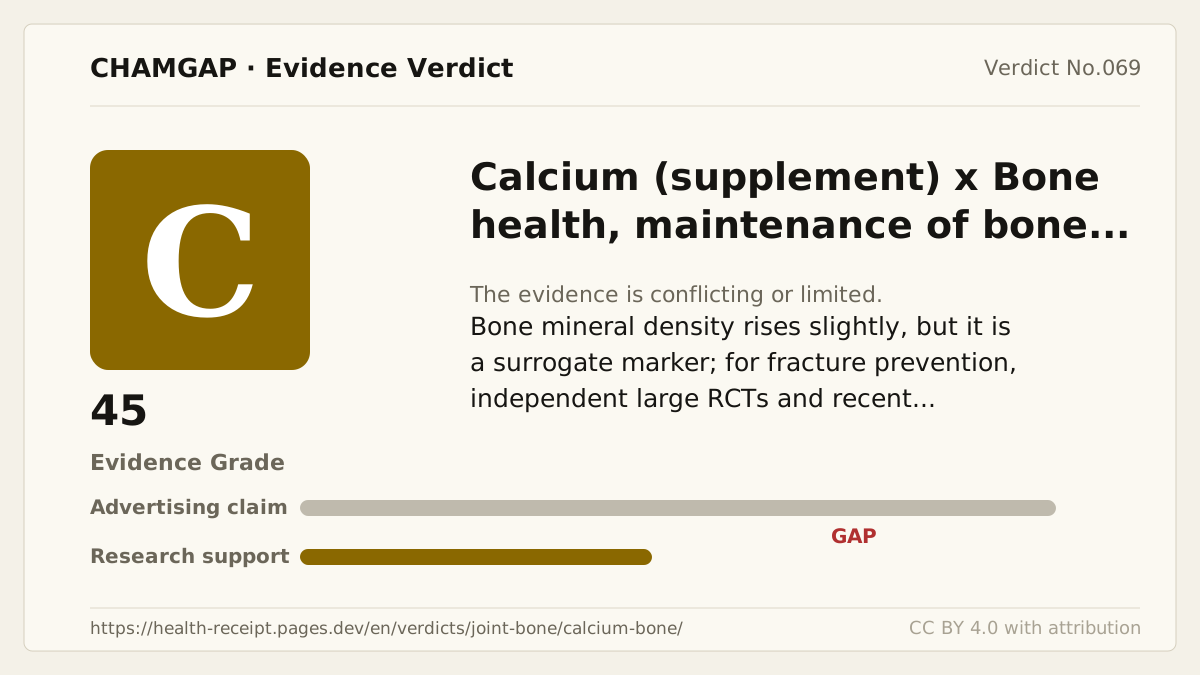
[Chamgap] Calcium (supplement) × bone health, maintenance of bone mineral density, and fracture prevention — Evidence Grade C·45. 15 cited sources checked. Source: https://chamgap.com/en/verdicts/joint-bone/calcium-bone/ · CC BY 4.0CC BY 4.0 — free to use with attribution; do not distort grades, numbers, or verdict meaning.
What this document does and does not do
Chamgap is an information source. It reports what research has and has not confirmed; it does not tell readers what to take or buy. That decision belongs to readers and, when needed, medical or legal professionals. This verdict reflects literature available up to the search date and may change as new research appears. Nothing here is medical advice.