
Boswellia,
does it really help with joint inflammation and pain relief?
research showsSeveral human clinical trials (RCTs) report that Boswellia serrata improved pain, function, and stiffness more than placebo in knee osteoarthritis patients, and two meta-analyses also found statistically significant improvements in pain and function. Directionally, the signal is positive. However, this judgment is C, not B. The reasons are threefold. (1) Certainty of evidence is low: the representative meta-analysis (Bannuru 2018) rated the evidence 'Very Low' in its own GRADE assessment and explicitly stated that current evidence is not sufficient in size or quality to make clinical recommendations. (2) Independence is weak: most individual RCTs received funding, author affiliation, or study-product provision from product manufacturers such as Laila Impex, Sami-Sabinsa/Sabinsa, and Phytoveda, and no replication by an independent institution unrelated to manufacturers was found within the confirmed scope. (3) Large effect sizes and low quality coexist: numeric improvements are large, but heterogeneity is very high and trials are small, so statistical numbers do not necessarily mean established effect or felt benefit. Regarding regulatory status, public data indicate that MFDS recognizes Boswellia extract as an individually recognized functional ingredient with wording known as 'may help joint health,' but exact recognition number, specifications (marker content), and daily intake are follow-up items outside this academic verification. The functionality label applies only to health functional foods meeting specifications, and ordinary foods claiming the same efficacy are in a different labeling/advertising layer. Reports say the MFDS found some ordinary foods with no detectable marker components, but sample number/detection-rate figures are outside this verification. In short, it is a promising ingredient, but evidence quality and independence are insufficient to say the effect is established; product category (health functional food/ordinary food) and marker labeling are distinguishable public information.
ads claimWithin the confirmed scope, many ads broadly express pain/inflammation relief. The individual product/wording comparisons below rely on materials outside the academic verification scope, so exact labels and numbers require follow-up. A FlowerMUSA/FromBio-type expression is known as 'helps reduce joint pain, improve activity disability, and reduce swelling,' which states specific symptom improvement beyond general recognized functionality. Esther Formula/Ye Esther Mall-type labeling is known as Boswellia extract 500mg with AKBA+KBA sum 42mg, apparently consistent with public individually recognized specifications, but the specification numbers themselves are outside this verification. Chong Kun Dang promotional blog-type wording such as 'natural anti-inflammatory ingredient,' 'COX-2 inhibition,' and 'pain reduction/physical function improvement' combines mechanism claims with symptom improvement; mechanism statements are a different evidence layer from confirmed efficacy. Nutrione/Boswellia 1000 product-name '1000' usually indicates total extract mg, not pure marker components AKBA/KBA. Overall, cases were observed where 'pain/inflammation relief' wording is broader than the functionality-recognition wording, and the recognized expression applies only to individually recognized health functional foods meeting specifications.
Useful facts when choosing a product
- Regulatory status based on public data, outside this academic verification: Boswellia extract is known as an MFDS individually recognized functional ingredient, with recognized wording 'may help joint health.' Exact recognition number, AKBA+KBA marker specification, and daily intake require follow-up confirmation.
- Health functional food vs ordinary food: 'joint health' functionality labeling is for health functional foods meeting specifications, while ordinary foods claiming the same efficacy are in a different labeling/advertising layer. Reports say MFDS found cases of no marker components in some ordinary foods, but sample number/detection-rate figures are outside this verification.
- Standardization/content labeling: mg numbers in product names, such as 'Boswellia 1000,' usually indicate total extract amount and differ from pure marker component (AKBA/KBA) content. Exact individual label contents are public-checkable information.
- Human evidence is all in osteoarthritis patients, mainly mild-to-moderate knee OA, and is not evidence for prevention in healthy adults. Within the confirmed scope, ads with 'pain/inflammation relief' broader than recognized wording were observed.
- Independence limitation: most positive individual RCTs had manufacturer funding, affiliation, or product provision (Laila Impex, Sami-Sabinsa/Sabinsa, Phytoveda), and independent replication was not found within the confirmed scope. Representative meta-analysis GRADE is 'very low.'
- Safety: reported trials found no significant adverse-event difference versus placebo (Yu 2020 RR 0.63, mostly mild), but trials reporting adverse events were limited.
What the research actually shows
Human studies focus on osteoarthritis patients, mainly mild-to-moderate knee OA, with little in healthy adults or other joint diseases. Direction is consistently positive. [Two meta-analyses] Bannuru 2018 (Seminars in Arthritis and Rheumatism, PMID 29622343): 4 Boswellia RCTs, 216 participants, pain SMD -2.04 (95% CI -2.81,-1.27), function SMD -1.52 (-2.24,-0.79). However, GRADE was 'very low,' heterogeneity I2=79-80%, and authors explicitly stated that size/quality was insufficient for clinical recommendation. Yu 2020 (BMC Complementary Medicine and Therapies, PMID 32680575): 7 RCTs, 545 participants, VAS (WMD -8.33), WOMAC pain/stiffness/function, and Lequesne all improved significantly, but the authors rated included RCT quality as medium-to-low and recommended cautious interpretation. [Individual RCTs] Sengupta 2008 (5-Loxin, standardized to AKBA 30%, 100/250mg, n=75): 250mg group VAS improved 65.9%, WOMAC pain 52%, synovial MMP-3 decreased 46.4% (MMP-3 is biochemical surrogate). Majeed 2019 (Boswellin pilot, n=42 completed): WOMAC, VAS, and hs-CRP significantly improved. Majeed 2024 (Boswellin Super 300/600mg, 3-arm): VAS decreased 45-62%, WOMAC BSE-300 improved 73.6%, little difference between doses. Vaidya 2025 (RestorCel, Boswellia + celery-seed combination): WOMAC decreased 64%, VAS 67.7%, inflammatory/cartilage markers improved. However, because this is a celery-seed combination, improvement cannot be attributed to Boswellia alone and it is not counted as Boswellia-alone positive evidence. [Core limitation] In Bannuru, 6/11 included trials (55%) involved industry, and whether effects remain in funding-source independent/high-quality subgroup cannot be verified. Individual positive RCTs are mostly manufacturer-linked (Sengupta, Majeed), so the primary trial pools of the two meta-analyses overlap substantially or come from the same manufacturer lines; independent institutional replication was not found. The Cochrane review (Wang 2022, DOI 10.1002/14651858.CD014969) is a protocol based on confirmed materials and has no own conclusion/GRADE. Overall, human evidence exists, so proof has not failed, but certainty is low and independent replication is lacking.
Why this is classified as C (50)
C judgment by evidence hierarchy: human RCTs and meta-analyses exist, target population is patients, and direction is consistently positive, so it is not D/F failed proof or disproval. Three reasons it cannot be raised to B or higher: (1) certainty: representative meta-analysis Bannuru 2018 rated GRADE 'very low' and concluded evidence was insufficient in size/quality for clinical recommendation, with heterogeneity I2 79-80%. (2) independence: most individual RCTs had manufacturer funding, affiliation, or product provision (Sengupta=Laila Impex, Majeed 2019/2024=Sami-Sabinsa/Sabinsa, Vaidya=Phytoveda); 55% of Bannuru included trials had industry involvement; no verification that effects remain in funding-source independent/high-quality subsets; no independent institutional replication found. (3) effect size vs quality: large SMD/WMD coexists with very low GRADE, small trials, and high heterogeneity, so statistical significance does not equal established felt benefit. This is conflicting/limited evidence = C. It does not literally meet D triggers in 2-1② (null independent RCT or high-quality subgroup disappearance), so it stays C with a boundary note. Safety is good because reported trials did not show significant adverse-event differences (Yu 2020 RR 0.63), although adverse-event reporting was limited.
Counterpoint. Argument for B: two meta-analyses (Bannuru 2018, Yu 2020) showed pain/function improvement across different trial sets, effect sizes are large (SMD -2.04, VAS reductions 45-67%), and multiple RCTs showed significant improvement versus placebo. The evidence is randomized/double-blind RCTs, not observational, and the target group (knee OA patients) is clear. This supports B. But this argument is blocked by three points: (a) large effect sizes combined with small studies, high heterogeneity, and manufacturer funding fit small-study effect/sponsorship bias; Bannuru itself rated GRADE 'very low'; (b) the two meta-analyses' primary trials substantially overlap or are from the same manufacturer lines, so they are hard to view as independent replication; (c) no completed Cochrane evidence synthesis is confirmed within scope. Conversely, the argument cannot be completely dismissed because no independent RCT is proven null, so the evidence is not disproved but independently unconfirmed. This axis, absence of independent null and absence of independent confirmation, is the boundary between C and D.
| Endpoint | P | Patient-reported treatment goal - the symptom is the goal |
| Replication | R1 | Single confirmatory trial |
| Independence | I0 | Evidence comes only from manufacturer studies |
| Effect size | E+ | Meets the clinically important threshold |
The scoring table and the verdict agree (C).
Cross-check — Codex and Claude
Evidence Table
| Study | Design | Sample | Funding | Endpoint | Result | Weight |
|---|---|---|---|---|---|---|
| Bannuru RR, Osani MC, Al-Eid F, Wang C 2018 | meta-analysis of randomized controlled trials | 216 | possible manufacturer or industry involvement | joint / pain | Meta-analysis in knee osteoarthritis patients (4 Boswellia RCTs, 216 participants): pain SMD -2.04 (95% CI -2.81,-1.27), function SMD -1.52 (-2.24,-0.79), significant versus placebo, but evidence certainty was GRADE 'very low' due to high risk of bias and high heterogeneity, insufficient for clinical recommendation. Review itself had NCCIH public funding and no conflicts. | key |
| Yu G, Xiang W, Zhang T et al. 2020 | meta-analysis of randomized controlled trials | 545 | possible manufacturer or industry involvement | joint / pain | Meta-analysis of 7 RCTs and 545 osteoarthritis patients: VAS WMD -8.33 (-11.19,-5.46), WOMAC pain/stiffness/function all improved significantly (P<0.001~0.0007). However, the authors rated included RCT quality as medium-to-low and recommended cautious interpretation. Review declared no funding/conflicts. | key |
| Sengupta K, Alluri KV, Satish AR et al. 2008 | double-blind randomized controlled trial | 75 | possible manufacturer or industry involvement | joint / pain | 75 knee OA patients (70 completed) in double-blind RCT: 5-Loxin (AKBA-standardized) 250mg/day at day 90 improved VAS 65.9% and WOMAC pain 52%, and synovial MMP-3 decreased 46.4%. Small single trial. | key |
| Majeed M, Majeed S, Narayanan NK, Nagabhushanam K 2019 | double-blind randomized controlled trial | 42 | possible manufacturer or industry involvement | joint | Pilot RCT in mild-to-moderate knee OA patients (48 enrolled, 42 completed): Boswellin at day 120 improved WOMAC (42.3 vs placebo 55.5), VAS (3.7 vs 6.3), and hs-CRP significantly versus placebo (P<0.001). Small pilot. | key |
| Majeed A, Majeed S, Satish G et al. 2024 | double-blind randomized controlled trial | 4 | mixed or partly industry-related | liver / joint | Three-arm RCT in mild knee OA: Boswellin Super 150/300mg twice daily (300/600mg/day); at day 90 VAS decreased 45.3-61.9% and WOMAC total improved 68.5-73.6%, with little difference between doses. Single manufacturer-led trial. | supporting |
| Vaidya N, Agarwal R, Dipankar DG et al. 2025 | double-blind randomized controlled trial | 62 | possible manufacturer or industry involvement | joint / cartilage | RCT in mild-to-moderate knee OA patients (62 participants, 31 per group): RestorCel (Boswellia 300mg + celery seed 250mg combination) at day 90 reduced WOMAC 64% and VAS 67.7%, with inflammatory/cartilage markers improved. Not Boswellia alone. | supporting |
| Wang Z, Singh A, Jones G et al. 2022 | systematic review | 6 | possible manufacturer or industry involvement | Cochrane protocol, not completed systematic review; RoB1 and GRADE assessment were planned, with no own efficacy conclusion or evidence grade. As of 2022, highest-hierarchy independent synthesis incomplete. | supporting |
Receipt — 7 References
All 7 cited sources were verified for existence at the original page (as of 2026-07-06).
Reviewed and approved: Chamgap Editorial Team · Approval date: 2026-07-06 · Corrections: none
Cite this verdict
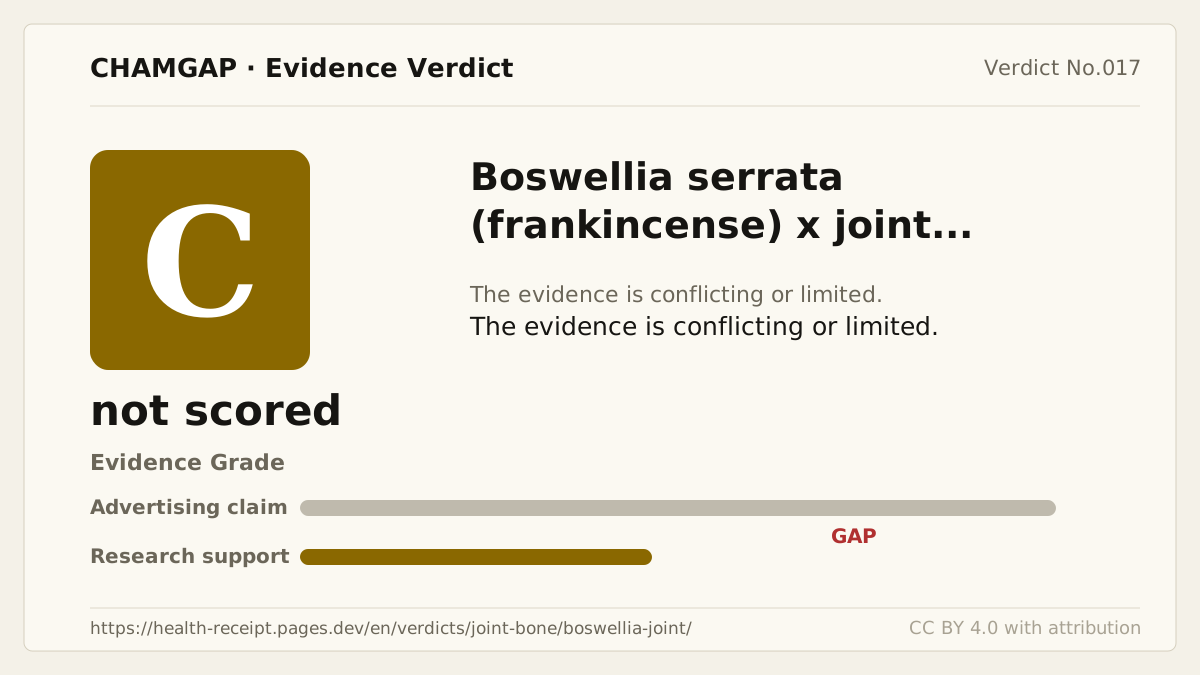
[Chamgap] Boswellia x joint inflammation — Evidence Grade C·50. 7 cited sources checked. Source: https://chamgap.com/en/verdicts/joint-bone/boswellia-joint/ · CC BY 4.0CC BY 4.0 — free to use with attribution; do not distort grades, numbers, or verdict meaning.
What this document does and does not do
Chamgap is an information source. It reports what research has and has not confirmed; it does not tell readers what to take or buy. That decision belongs to readers and, when needed, medical or legal professionals. This verdict reflects literature available up to the search date and may change as new research appears. Nothing here is medical advice.