
Zinc,
does it really help with immunity and common cold?
research showsZinc is an essential trace nutrient, so correcting deficiency is meaningful, and high-dose lozenges/syrups used shortly after a cold starts may slightly shorten cold duration. However, the claim that daily low-dose tablets or drinks, like ordinary zinc health functional foods in Korea, prevent colds in healthy people or raise perceived immunity has weak direct evidence.
ads claimIn the Korean market, MFDS notified-type expressions “needed for normal immune function” and “needed for normal cell division” are widely used on zinc tablets, jellies, and water products. Informational articles and shopping exposure show expansion into disease/perceived expressions such as “immune strengthening,” “shortening cold duration,” “cold prevention,” and “children/office workers who often catch colds.” Some products emphasize zinc 8.5 mg meeting 100% of daily nutrient reference value, absorption of zinc gluconate, and combinations with ingredients such as vitamin C/D, selenium, and propolis.
Useful facts when choosing a product
- Binggrae “Immune Water Zero” press release: zinc 8.5 mg/350 mL, “may help normal immune function and cell division,” zinc gluconate and 100% daily value emphasized.
- Food Safety Korea health-functional-food product information: zinc functionality is labeled as “needed for normal immune function” and “needed for normal cell division.”
- Holland & Barrett informational article links “zinc good for immune strengthening,” “shortening cold duration,” “anti-inflammatory,” “antioxidant,” and “wound recovery,” and connects to product recommendations.
- Domestic article/shopping search results repeatedly introduce zinc in the context of “immune supplement,” “cold prevention,” and “people who often catch colds.”
What the research actually shows
The latest Cochrane 2024 reviewed 34 standalone zinc RCTs (8,526 participants). For prevention, reduction in risk of getting a cold was minimal or uncertain (RR 0.93, 95% CI 0.85~1.01); when used as treatment after a cold had already started, average duration may shorten by about 2.37 days, but heterogeneity was very high (I2 97%) and certainty of evidence was low. Symptom severity was uncertain. Separate lozenge meta-analyses report larger duration reductions with high-dose 75~80 mg/day or more and formulations that dissolve slowly in the mouth, but results are sensitive to study selection and formulation description, and exposure differs from ordinary low-dose tablets/drinks. Immune-function studies focus on surrogate indicators such as CRP, TNF-alpha, CD4, and T-cell proliferation, mostly in groups likely to be deficient, such as older adults with low zinc.
Why this is classified as C (55)
Cold-duration shortening has human RCTs and meta-analyses, so this is not F or ?. However, the latest overall evidence shows prevention effects are minimal or uncertain, and treatment effects have low certainty, high heterogeneity, and strong formulation dependence. General immune-function claims mostly remain at deficiency correction or surrogate indicators such as immune cells/inflammatory markers, making them close to maximum C under the borderline rule. Because the gap is large between the “cold prevention/immune strengthening” implied by domestic low-dose health-functional-food advertising and the actual positive evidence, which is often “short-term high-dose lozenge use at the start of a cold,” the grade is C 55.
Counterpoint. If limited to high-dose zinc lozenges, positive meta-analyses exist and a perceived clinical endpoint, cold duration, was directly evaluated. Therefore the judgment should not be “zinc has no evidence at all for colds,” but should distinguish limited possibility when formulation, dose, and timing match from ordinary health-functional-food-style claims.
Rejudgment record. Converged — Draft=blind C. Boundary against transferring deficiency-correction/lozenge evidence to ordinary low-dose use.
Cross-check — Codex and Claude
Evidence Table
| Study | Design | Sample | Funding | Endpoint | Result | Weight |
|---|---|---|---|---|---|---|
| Nault D et al. 2024 | randomized controlled trial | 34 | common cold and liver | 34 standalone zinc RCTs (8,526 participants): prevention showed little difference, while treatment may shorten cold duration by about 2.37 days, but certainty was low. | core | |
| NIH Office of Dietary Supplements | not specified | common cold and liver | ODS summarizes cold studies as mixed; lozenges/syrup used early may reduce duration but not severity; adult UL 40 mg/day. | core | ||
| Hemila H 2017 | meta-analysis of RCTs | 7 | common cold and liver | Seven high-dose lozenge RCTs (575 participants) found 33% shortening of cold duration; author reported no conflicts/funding. | core | |
| Hemila H, Chalker E 2015 | meta-analysis of RCTs | 3 | common cold and liver | Three zinc acetate lozenge RCTs (80~92 mg/day, 199 participants) found 42% shortening of total cold duration and shorter duration of several symptoms. | core | |
| Turner RB, Cetnarowski WE 2000 | not specified | 281 | common cold and liver | In experimental cold (273 participants), zinc gluconate duration was 2.5 days vs placebo 3.5 days; in natural cold (281 participants), there was no effect on duration or severity. | supporting | |
| Macknin ML et al. 1998 | randomized controlled trial | 249 | RCT in 249 children/adolescents: median symptom resolution 9 days vs 9 days (P=.71), adverse events were more common in the zinc group. | supporting | ||
| Caruso TJ, Prober CG, Gwaltney JM Jr 2007 | randomized controlled trial | 4 | common cold | Structured review of 14 natural-cold RCTs: among 4 studies satisfying all 11 design criteria, 3 showed no effect; concluded lozenge effect was not established. | supporting | |
| Jafari A et al. 2020 | meta-analysis of RCTs | 35 | immunity | Meta-analysis of 35 adult RCTs (1,995 participants) reported changes in immune/inflammatory markers such as CRP, hs-CRP, TNF-alpha, IL-6, and CD4. | supporting | |
| Barnett JB et al. 2016 | double-blind randomized controlled trial | 31 | manufacturer/industry involvement possible | RCT in 31 low-zinc nursing-home older adults: 30 mg/day for 3 months increased serum zinc by 16% and increased T-cell count/proliferation; primary endpoint was serum zinc. | supporting | |
| Study 10 | preclinical study | immunity and gastrointestinal | Domestic product press release used zinc 8.5 mg, zinc gluconate, and “normal immune function” and cell-division wording as advertising points. | supporting | ||
| Study 11 | preclinical study | immunity | Zinc functionality displayed as “needed for normal immune function” and “needed for normal cell division.” | supporting | ||
| Holland & Barrett Korea | preclinical study | immunity, common cold, liver, and recovery | Informational article introduced zinc together with immune-cell function, shortened cold duration, anti-inflammatory/antioxidant effects, and wound recovery, linking to product recommendations. | supporting |
Receipt — 12 References
Of 12 cited sources, 2 had limited original-page access (blocked or summary-only) and were verified via index/summary, marked partial; the rest were verified at the original page. As of 2026-07-07.
Reviewed and approved: Chamgap Editorial Team · Approval date: 2026-07-07 · Corrections: none
Cite this verdict
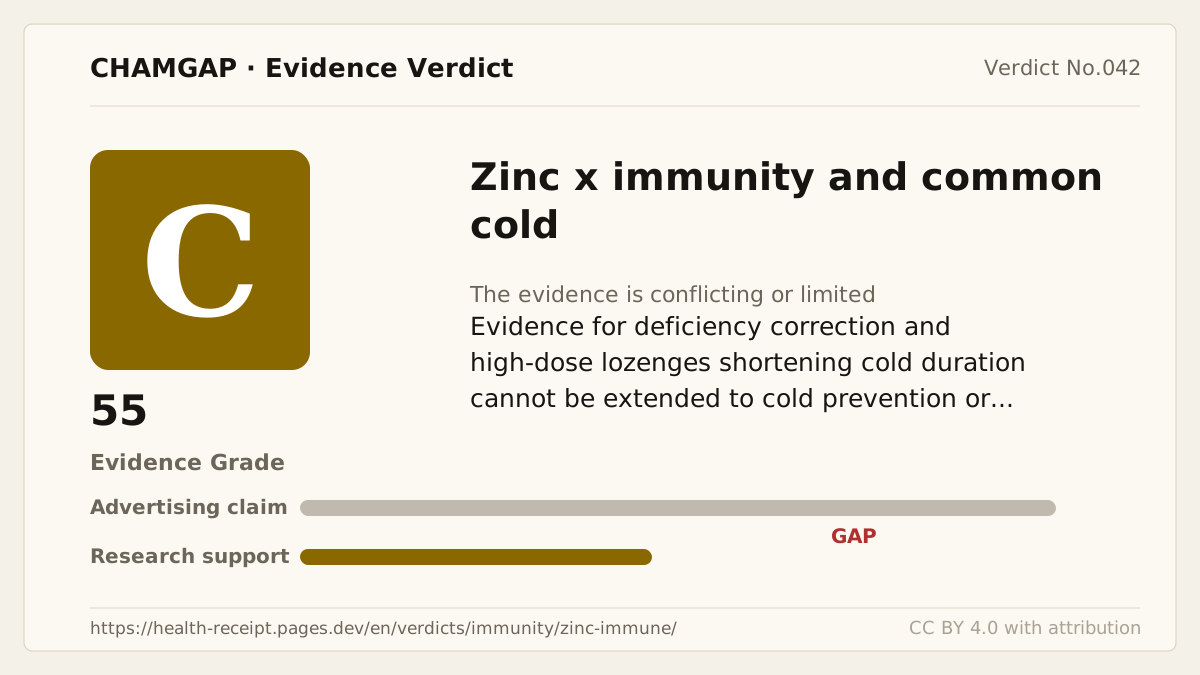
[Chamgap] Zinc x immunity and common cold — Evidence Grade C·55. 12 cited sources checked. Source: https://chamgap.com/en/verdicts/immunity/zinc-immune/ · CC BY 4.0CC BY 4.0 — free to use with attribution; do not distort grades, numbers, or verdict meaning.
What this document does and does not do
Chamgap is an information source. It reports what research has and has not confirmed; it does not tell readers what to take or buy. That decision belongs to readers and, when needed, medical or legal professionals. This verdict reflects literature available up to the search date and may change as new research appears. Nothing here is medical advice.