
Reishi mushroom,
does it really help with Immune function?
research showsHuman RCTs show that beta-glucan or extracts derived from Reishi mushroom can change immune surrogate markers such as T cells, NK cells, and IgA. However, clinically direct immune benefits such as reduced colds/infections, vaccine response, or cancer survival remain weakly established.
ads claimIn the Korean market, phrases such as "rich in beta-glucan, strengthening immunity," "NK cell activation," "anticancer/cancer-cell inhibition," "seasonal immune management," and "family immunity" are repeated. Shopping-mall product names often attach combination formulas with yeast, shiitake, mushroom mycelium, zinc, propolis, and wording such as HACCP, MFDS certification, and high content, rather than Reishi alone. Informational articles often connect the immune effects of mushroom beta-glucans in general to Reishi mushroom, or discuss domestic health-functional-food labeling history for Reishi fruiting-body extract, mainly blood-flow related, together with immune claims.
Useful facts when choosing a product
- Research materials are not identical: the 2023 adult RCT used purified Reishi beta-glucan/Immulink MBG 200 mg/day; the 2018 children's RCT used Ganogen beta-glucan 350 mg in yogurt; the 2024 older-women trial used Reishi dry extract 2000 mg/day.
- Even when Korean product names say "Reishi mushroom beta-glucan," actual formulas often combine yeast beta-glucan, shiitake mycelium, Reishi mycelium, zinc, and other ingredients, making direct matching to Reishi-alone evidence difficult.
- MFDS recognition is separate from this evidence grade. In Food Safety Korea immune-function ingredient lists, Phellinus linteus extract and red ginseng appear, but Reishi mushroom was not confirmed as a representative immune-function ingredient.
- Cancer adjunct-therapy studies are a separate effect from the general public's "immunity" claim. Claims about cancer treatment response or survival require separate effect-specific adjudication.
What the research actually shows
A healthy-adult RCT (84 days, Reishi beta-glucan 200 mg/day) reported significant increases versus placebo in CD3, CD4, CD8, NK cell number and cytotoxicity, and IgA. A children's yogurt RCT (12 weeks, 350 mg, ages 3-5) increased CD8 T cells among primary endpoints, but NK cells were not significant, while total lymphocytes, CD3, and CD4 increased in secondary indicators. A small 2024 double-blind trial in older women reported laboratory-marker changes such as T-lymphocyte function and gene expression. A Cochrane review of adjunct therapy in cancer patients included 5 RCTs and 373 participants, but study quality was low, survival was not measured, T-cell markers increased by about 2-4%, and NK activity was uncertain. Thus, there is evidence that immune-cell markers can move, but it is insufficient to extend to infection prevention, recovery, or cancer-prognosis improvement expected by general consumers.
Why this is classified as C (56)
Several human RCTs exist, so this is not "?" or F. However, positive results center on surrogate markers such as CD3/CD4/CD8, NK cell number/activity, IgA, and gene expression, and direct clinical endpoints such as reduced infections in healthy people have not been tested. A Cochrane review in cancer patients also notes low study quality, small samples, China-centered populations, no survival measurement, and uncertain NK activity. The key 2023 adult RCT had sponsor funding (SBG Biomedical Research) and commercial links to the ingredient manufacturer, and the children's RCT also had links to PROGAL BT, the product producer. Under boundary rule 1, the maximum is C, and consistency across several RCT surrogate markers supports the upper C range (56 points).
Counterpoint. The purified Reishi beta-glucan adult RCT and the children's yogurt RCT both used randomized, double-blind, placebo-controlled designs, and some immune-cell markers were statistically significant versus placebo. Therefore, it is difficult to say there is no human evidence at all.
Rejudgment record. Convergent — Immune-cell surrogate markers move, but infection reduction and cancer clinical endpoints are absent.
Cross-check — Codex and Claude
Evidence Table
| Study | Design | Sample | Funding | Endpoint | Result | Weight |
|---|---|---|---|---|---|---|
| Chen SN, Nan FH, Liu MW et al. 2023 | RCT | Possibly manufacturer/industry related | Immune/liver | In a healthy-adult RCT, Reishi beta-glucan 200 mg/day for 84 days increased CD3/CD4/CD8, NK cell number/cytotoxicity, and IgA versus placebo, but all were immune surrogate markers. | Supporting | |
| Duque Henao SL, Urrego SA, Cano AM, Higuita EA 2018 | RCT | 60 | In a yogurt RCT in children aged 3-5, CD8 T cells increased but NK cells were not significant, and infection prevention remained a future research question. | Supporting | ||
| Iser-Bem PN, Lobato TB, Alecrim-Zeza AL et al. 2024 | Double-blind | 60, | Possibly manufacturer/industry related | In a small double-blind trial in older women (n=60, final 39), 2000 mg/day for 8 weeks reportedly modulated T-lymphocyte function and gene expression as surrogate outcomes. | Supporting | |
| Zhang Y, Lin Z, Hu Y, Wang F 2008 | 40 | Immune | In a 40-man football-player RCT during living-high/training-low, CD4/CD8 ratio changes were assessed; the high-dose group showed only trends and no clinical immune outcomes. | Core | ||
| Jin X, Ruiz Beguerie J, Sze DYM, Chan GCF 2016 | RCT | 373 | Immune/liver | A review of 5 RCTs and 373 participants in cancer adjunct therapy found T-cell markers increased by 2-4%, but study quality was low, survival was not measured, and NK activity was uncertain. | Supporting | |
| Wicks SM, Tong R, Wang CZ et al. 2007 | Double-blind RCT | 16 | In a safety RCT giving healthy volunteers 4 g/day for 10 days, CD4/CD8/CD19 did not change, CD56 increase was nonsignificant, and there were no clinically important adverse events. | Supporting | ||
| LiverTox | Liver | LiverTox summarizes Reishi-related liver-toxicity cases, including fatal fulminant hepatitis, and small safety studies supporting rare liver-safety caution. | Supporting | |||
| Study 8 | Immune | Food Safety Korea lists notified ingredients related to immune function such as Phellinus linteus extract and red ginseng, but Reishi mushroom was not presented as a representative immune ingredient. | Supporting | |||
| Study 9 | Immune/gastrointestinal | A Korean informational article explains immune claims for mushroom beta-glucans while separately mentioning functional labeling for Reishi fruiting-body extract. | Supporting | |||
| Study 10 | Preclinical | Immune/gastrointestinal | A domestic article confirmed advertising/informational expressions such as "rich in beta-glucan," "immune enhancement," and "inhibition of cancer-cell proliferation." | Supporting | ||
| Study 11 | Immune/gastrointestinal | Product names show sales patterns combining Reishi, shiitake, yeast, mycelium, immunity, HACCP, and MFDS certification wording. | Supporting |
Receipt — 11 References
Of 11 cited sources, 1 had limited original-page access (blocked or summary-only) and were verified via index/summary, marked partial; the rest were verified at the original page. As of 2026-07-07.
Reviewed and approved: Chamgap Editorial Team · Approval date: 2026-07-07 · Corrections: none
Cite this verdict
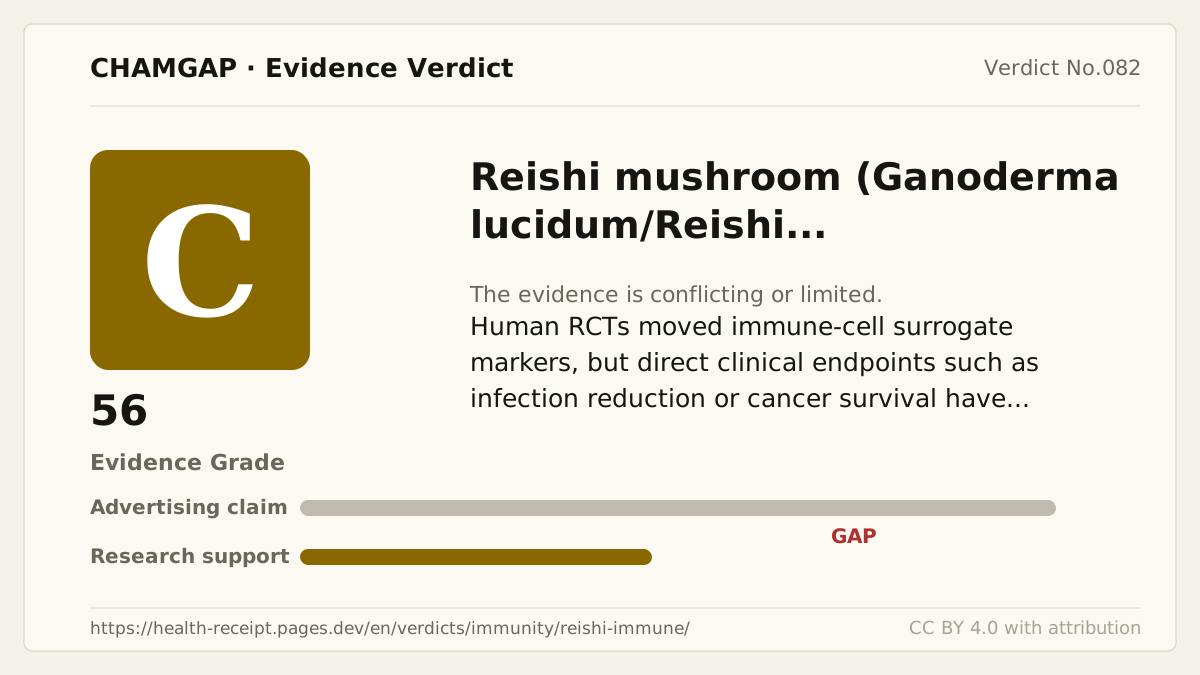
[Chamgap] Reishi mushroom × immune function — Evidence Grade C·56. 11 cited sources checked. Source: https://chamgap.com/en/verdicts/immunity/reishi-immune/ · CC BY 4.0CC BY 4.0 — free to use with attribution; do not distort grades, numbers, or verdict meaning.
What this document does and does not do
Chamgap is an information source. It reports what research has and has not confirmed; it does not tell readers what to take or buy. That decision belongs to readers and, when needed, medical or legal professionals. This verdict reflects literature available up to the search date and may change as new research appears. Nothing here is medical advice.