
Lactoferrin,
does it really help with Immune function, iron, and gut health?
research showsLactoferrin is an iron-binding protein derived from milk and colostrum, and there is a biological rationale linking it to immune, iron, and gut functions. However, the three effects are not stably proven together in the manner of general adult supplement advertising. The iron evidence is strongest for anemia, especially iron-deficiency anemia in pregnancy, but it is a treatment-comparison context. Immune evidence mixes respiratory symptoms and infection studies, with weak consistency for adult clinical outcomes. Gut-health evidence is mainly combination-product or microbiome surrogate evidence, making it difficult to generalize to standalone lactoferrin for general gut health.
ads claimIn the Korean market, lactoferrin is described as a colostrum-/milk-derived 'natural immunity' ingredient, and repeated wording groups together immune strengthening, antibacterial/antiviral effects, respiratory health, beneficial gut bacteria/gut health, iron metabolism/iron absorption support, and sometimes body-fat/visceral-fat reduction. Coupang product descriptions present 'supports immune function, iron metabolism, and gut health' in one sentence, while Ople, HiDoc, and hospital-style informational articles introduce the mechanism of depriving bacteria of iron, meta-analysis of reduced respiratory infections, and growth of beneficial bacteria/improved gut environment as if they were evidence. Many products are 250-300 mg capsules/tablets, enteric-coated formulations, or combinations with colostrum, probiotics, vitamin C, glutathione, or moro orange.
Useful facts when choosing a product
- Domestic and overseas direct-purchase products usually emphasize bovine lactoferrin 250-300 mg per capsule or tablet.
- Formulations differ, including enteric coating, tablets dissolved in the mouth, and ordinary capsules, and RCT formulations are not always the same as marketed product formulations.
- Many products are combinations with probiotics, vitamins, glutathione, moro orange, and similar ingredients, so they must be distinguished from standalone lactoferrin evidence.
- Lactoferrin itself is not a meaningful iron source. The iron evidence mainly concerns Hb/ferritin improvement in iron-deficiency anemia or tolerability compared with iron salts.
- Because it is a milk-protein-derived ingredient, people with milk allergy, infants/young children, pregnant women, and people being treated for anemia cannot be directly extrapolated from general supplement evidence.
What the research actually shows
By effect, the iron evidence is closest to B. RCTs and meta-analyses exist in pregnant women or people with low hemoglobin, and lactoferrin showed similar or, in some studies, greater Hb improvement than ferrous sulfate and fewer gastrointestinal adverse effects. However, one key positive RCT is marked as a Retracted Publication on PubMed, and the latest meta-analysis has very high heterogeneity. For immunity/respiratory infection, an RCT meta-analysis shows a reduction signal, but infants, children, adults, and hospitalized patients are mixed, and in the 2022 meta-analysis adult RTI incidence was nonsignificant with OR 1.00. A 2023 adult RCT was positive for a primary symptom-score endpoint but had manufacturer funding, and a 2026 older-adult RCT found no difference in primary IFN-gamma release and only some secondary immune/inflammatory markers were positive. Gut-health evidence centers on an LF+Lactobacillus combination constipation RCT and microbiome-marker studies, while a Peruvian infant cohort analysis found no effect on microbial diversity or composition. Therefore, the overall bundled consumer claim is graded C.
Why this is classified as C (55)
The compound-claim principle was applied. Evidence related to iron-deficiency anemia has RCTs and meta-analyses and gives a B-level signal, but a retracted RCT is included among the positive evidence and extrapolation to general 'iron metabolism support' is large. For immunity, respiratory infection meta-analyses are positive, but adult analyses are inconsistent and some recent RCTs have null primary immune markers or manufacturer funding. Gut health centers on combination products and microbiome surrogate markers, with insufficient independent replication. The maximum appropriate grade for the overall consumer claim is C.
Counterpoint. Positive studies exist in narrower settings such as infant formula/pediatric infections, iron-deficiency anemia in pregnancy, and selected high-risk neonatal populations. In particular, a tolerability advantage in anemic patients who do not tolerate iron salts well is repeatedly observed. This should be treated separately from the general health-supplement bundle of 'immune, iron, and gut' claims.
Rejudgment record. Convergent — Lactoferrin has only surrogate-marker signals for immunity, iron, and gut; clinical endpoints and independent replication are insufficient
Cross-check — Codex and Claude
Evidence Table
| Study | Design | Sample | Funding | Endpoint | Result | Weight |
|---|---|---|---|---|---|---|
| Ali AS et al. 2021 | Meta-analysis of RCTs | 1194 | Possible manufacturer/industry involvement | In a meta-analysis of 6 of 9 RCTs, the odds of RTI occurrence were lower (OR 0.57, 95% CI 0.44-0.74, n=1194). | Core | |
| Berthon BS et al. 2022 | Meta-analysis | Review of 25 human studies: RTI outcomes decreased in 6/10 studies, but adult RTI occurrence was nonsignificant with OR 1.00 (95% CI 0.76-1.32). | Core | |||
| Oda H et al. 2023 | RCT | 157 | respiratory | 157 healthy adults randomized, 200 mg/day for 12 weeks; total respiratory/systemic symptom scores were lower than placebo and pDC CD86/HLA-DR were higher. | Core | |
| Berthon BS et al. 2026 | RCT | 103 | Possible manufacturer/industry involvement | immunity | 103 healthy people aged 50 or older, 200 or 600 mg/day for 4 weeks; primary RV-16/H1N1-induced IFN-gamma did not differ, and only some secondary cytokine/immune-cell markers changed. | Supporting |
| Griffiths J et al. 2019 | RCT | 2203 | Possible manufacturer/industry involvement | immunity | Large independent RCT in 2203 extremely preterm infants: late-onset infection 28.9% vs 30.7%, adjusted RR 0.95 (95% CI 0.86-1.04), primary endpoint negative. | Supporting |
| Pammi M, Suresh G 2020 | RCT | 5425 | The 2020 Cochrane update reported low-certainty evidence across 12 RCTs and 5425 people that late-onset sepsis was reduced, RR 0.82 (95% CI 0.74-0.91). | Supporting | ||
| Hashim HA et al. 2017 | Meta-analysis of RCTs | 600 | Mixed; some industry-related involvement | pregnancy | 4 RCTs in 600 pregnant women with IDA; 4-week Hb change favored lactoferrin (MD 0.77 g/dL, 95% CI 0.04-1.55), but the mild-anemia subgroup was not significant. | Supporting |
| Christofi MD et al. 2024 | Meta-analysis of RCTs | Review of 19 RCTs; in a meta-analysis of 7 ferrous-sulfate comparisons, Hb increased more in the lactoferrin group (SMD -0.81, 95% CI -1.21 to -0.42), but heterogeneity was I2 95.8%. | Supporting | |||
| Nappi C et al. 2009 | Double-blind RCT | 100 | Possible manufacturer/industry involvement | liver/gut/gastrointestinal/pregnancy | Double-blind RCT in 100 pregnant women with IDA; Hb, ferritin, and serum iron increased in both groups, there was no between-group efficacy difference, and gastrointestinal symptom scores were higher in the ferrous sulfate group. | Supporting |
| Rezk M et al. 2015 | 200 | pregnancy | Pregnant-women RCT with 200 participants reported Hb increase of 2.26 g/dL for lactoferrin vs 1.11 g/dL for ferrous sulfate, but PubMed marks it as a Retracted Publication. | Supporting | ||
| Suzuki N et al. 2013 | RCT | 32 | bowel movements/gut/gastrointestinal | Crossover RCT in 32 Japanese women prone to constipation; an LF 100 mg/tablet + heat-killed Lactobacillus combination increased defecation days and fecal bifidobacteria. | Supporting | |
| Gonzalez L et al. 2023 | Cohort study | 60 | gut/gastrointestinal | Fecal 16S analysis in 60 infants aged 12-18 months; 6 months of lactoferrin did not change microbial diversity or composition versus placebo. | Supporting |
Receipt — 12 References
Of 12 cited sources, 2 had limited original-page access (blocked or summary-only) and were verified via index/summary, marked partial; the rest were verified at the original page. As of 2026-07-07.
Reviewed and approved: Chamgap Editorial Team · Approval date: 2026-07-07 · Corrections: none
Cite this verdict
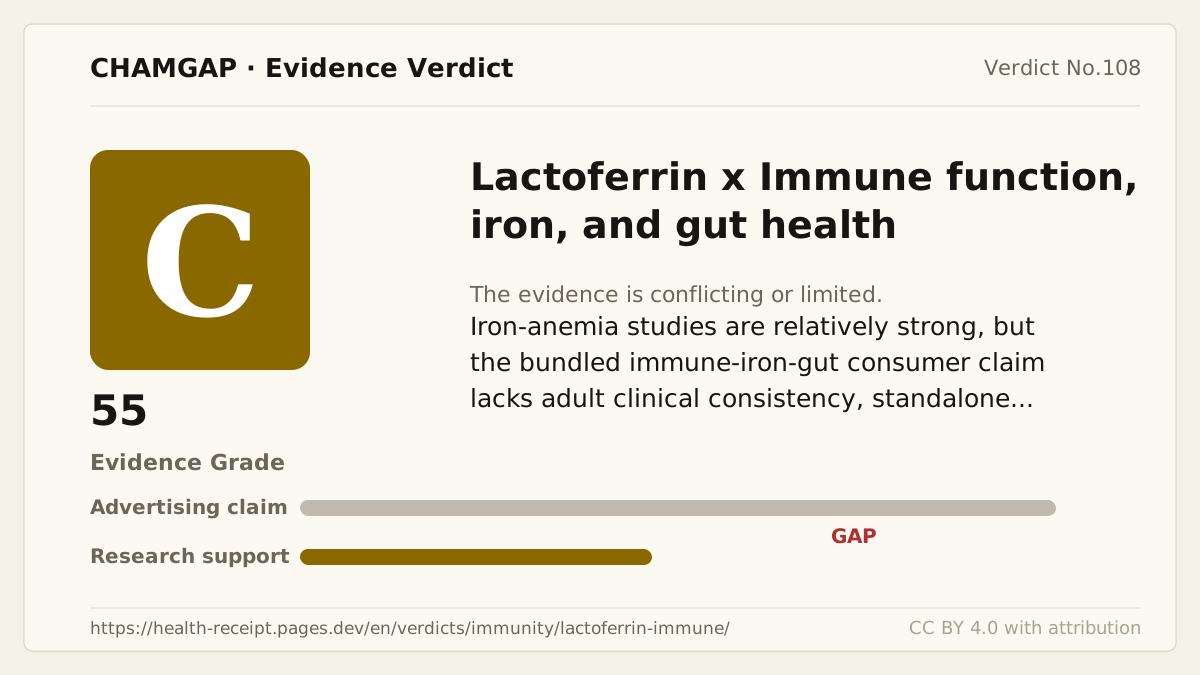
[Chamgap] Lactoferrin x immune function, iron, and gut health — Evidence Grade C·55. 12 cited sources checked. Source: https://chamgap.com/en/verdicts/immunity/lactoferrin-immune/ · CC BY 4.0CC BY 4.0 — free to use with attribution; do not distort grades, numbers, or verdict meaning.
What this document does and does not do
Chamgap is an information source. It reports what research has and has not confirmed; it does not tell readers what to take or buy. That decision belongs to readers and, when needed, medical or legal professionals. This verdict reflects literature available up to the search date and may change as new research appears. Nothing here is medical advice.