
Colostrum,
does it really help with immunity and gut?
research showsColostrum supplements are not 'without evidence,' because human RCT meta-analyses report fewer days or episodes of upper respiratory infection/cold-like symptoms. However, the studies are mostly small studies in specific groups such as athletes, students, and children, and the main outcomes are often self-reported symptoms. Gut-health claims are narrower. There are infectious-diarrhea RCT meta-analyses and athlete gut-permeability data, but formulation, participants, and disease context differ too much to transfer them directly to 'improved gut health' or 'strengthened gut barrier' in general adults.
ads claimIn the Korean market, colostrum protein, New Zealand colostrum, and goat milk/colostrum mixed products are advertised with phrases such as 'contains immune factor IgG,' 'highly concentrated immune support,' 'activates and balances immune response,' 'gut health support,' 'immune and gut health support,' and 'skin, hair, and recovery.' Informational articles and shopping detail pages connect IgG, IgA, lactoferrin, PRP, growth factors, oligosaccharides, and lysozyme to immunity and gut-barrier protection. Some wording expands beyond study results on reduced upper respiratory infections to broader 'immune enhancement' and general gut-health improvement.
Useful facts when choosing a product
- Commercial colostrum products are mixed across powder, capsule, chewable, and jelly forms, and often put IgG 30-40% or 'contains immune factor IgG' at the forefront.
- Study doses range widely from about 0.5-1 g/day to 10-60 g/day. Product content, collection timing, heat treatment, and IgG standardization affect generalizability of results.
- General bovine colostrum, hyperimmune bovine colostrum, and colostrum-derived immunoglobulin may look like the same product group but are difficult to treat as clinically identical.
- People with milk-protein allergy or lactose sensitivity may have adverse effects, and milk allergy was usually an exclusion criterion in RCTs.
- MFDS recognition status was treated separately in calculating this evidence grade.
What the research actually shows
For immunity, there is a relatively consistent positive signal for prevention of upper respiratory infection/upper respiratory symptoms (URTI/URS). A 2016 RCT meta-analysis reported URS days rate ratio 0.56 (95% CI 0.43-0.72) and URS episodes 0.62 (0.40-0.99) across 5 RCTs and 152 exercise-trained adults. A 2022 updated meta-analysis reported reduced URTI risk, RR 0.64 (95% CI 0.498-0.822, p<0.001), across 7 RCTs and 445 randomized participants. However, no large independent RCT or Cochrane review was identified, and many studies rely on self-reported symptoms, athletes, and small designs. For the gut, a pediatric infectious-diarrhea meta-analysis (5 RCTs, 324 participants) showed positive results such as stool frequency -1.42/day and diarrhea occurrence OR 0.29, but hyperimmune colostrum/immunoglobulin products are mixed in. Athlete 'leaky gut' data center on surrogate markers such as gut permeability, I-FABP, and zonulin.
Why this is classified as C (56)
When the combined claim is separated, reduced upper respiratory infection/upper respiratory symptoms has B-minus-level positive evidence, but samples are small, many outcomes are self-reported, and there is no large independent RCT. Gut health has some positive RCT meta-analysis evidence in disease contexts such as infectious diarrhea, but general 'gut health/gut barrier strengthening' claims are mainly surrogate markers such as gut permeability and mixed formulations, corresponding to C at most. Korean advertising's broad 'immune and gut' claim combines subclaims widely, so the overall judgment is lowered to C.
Counterpoint. Colostrum should not simply be called evidence-poor. RCT meta-analyses of upper respiratory symptoms show a consistent direction of effect, and pediatric infectious-diarrhea data include clinical outcomes. However, the evidence is closer to 'reduced days of cold-like symptoms' or 'adjunct in pediatric infectious diarrhea,' not proof of overall 'immune strengthening and gut-health improvement' for general consumers.
Rejudgment record. Convergent — Small meta-analyses are positive for reduced upper-respiratory-infection symptoms, but extension to gut and immunity overall is insufficient
Cross-check — Codex and Claude
Evidence Table
| Study | Design | Sample | Funding | Endpoint | Result | Weight |
|---|---|---|---|---|---|---|
| Hałasa M, Baśkiewicz-Hałasa M, Jamioł-Milc D, Maciejewska-Markiewicz D, Skonieczna-Żydecka K 2022 | meta-analysis of RCTs | 445 | possible manufacturer/industry involvement | not specified | Across 7 RCTs and 445 randomized participants, self-reported URTI risk decreased, RR 0.64 (95% CI 0.498-0.822, p<0.001). | core |
| Jones AW, March DS, Curtis F, Bridle C 2016 | meta-analysis of RCTs | 152 | possible manufacturer/industry involvement | gastrointestinal | In 5 RCTs and 152 exercise-trained adults, URS days rate ratio was 0.56 (95% CI 0.43-0.72) and episodes were 0.62 (0.40-0.99). | core |
| Baśkiewicz-Hałasa M, Stachowska E, Grochans E, Maciejewska-Markiewicz D, Bühner L, Skonieczna-Żydecka K, Hałasa M 2023 | RCT | 158 | not reported | not specified | In a medical/health-science student RCT, the overall comparison was not significant, but a high-exposure medical-student subgroup showed significant interaction for URTI symptom days and severity. | core |
| Hałasa M, Skonieczna-Żydecka K, Machaliński B, Bühner L, Baśkiewicz-Hałasa M 2023 | not specified | 57 | possible manufacturer/industry involvement | not specified | In an RCT analysis of 57 preschool children, URTI symptom-day frequency decreased by 31%, symptom severity by 37%, and two-stage URTI episodes by 50%. | core |
| Dziewiecka H, Buttar HS, Kasperska A, Ostapiuk-Karolczuk J, Domagalska M, Cichoń J, Skarpańska-Stejnborn A 2022 | systematic review | not reported | gastrointestinal | A review of athlete gut-permeability studies reported improvement signals in many studies, but outcomes were mainly surrogate markers such as sugar absorption, I-FABP, and zonulin. | supportive | |
| Li J, Xu YW, Jiang JJ, Song QK 2019 | meta-analysis of RCTs | 324 | not reported | gastrointestinal | Meta-analysis of 5 pediatric infectious-diarrhea RCTs, 324 participants, reported stool frequency -1.42/day, diarrhea occurrence OR 0.29, and pathogen detection OR 0.23. | supportive |
Receipt — 6 References
Of 6 cited sources, 1 had limited original-page access (blocked or summary-only) and were verified via index/summary, marked partial; the rest were verified at the original page. As of 2026-07-07.
Reviewed and approved: Chamgap Editorial Team · Approval date: 2026-07-07 · Corrections: none
Cite this verdict
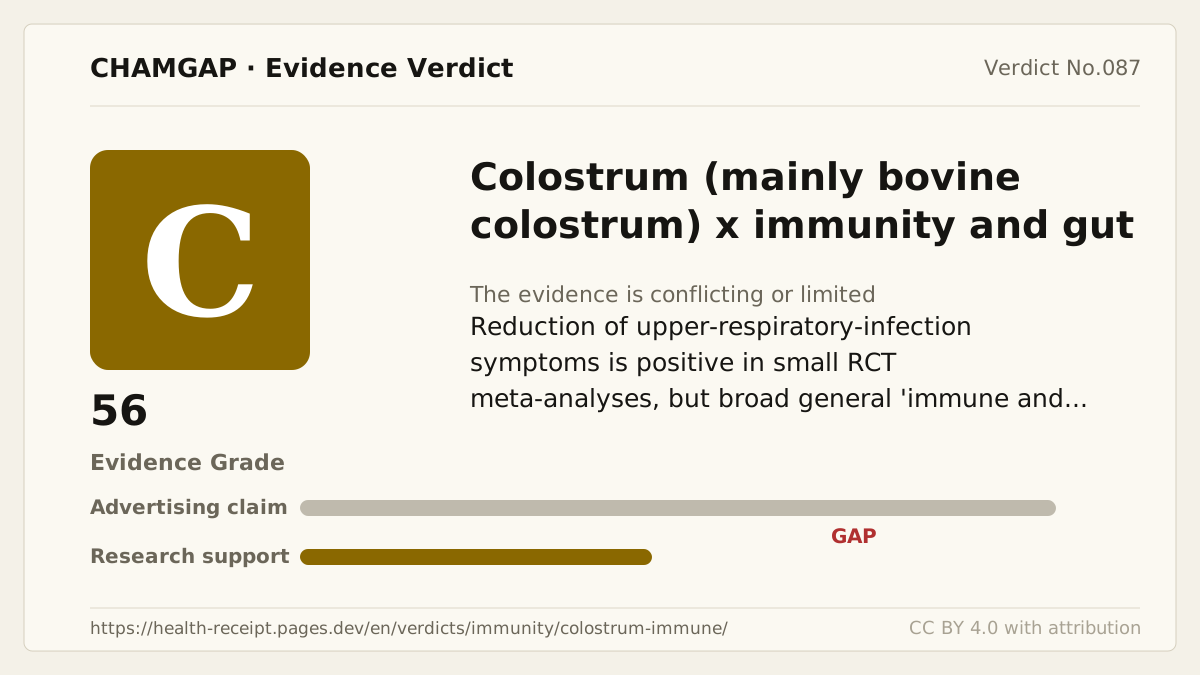
[Chamgap] Colostrum × immunity and gut — Evidence Grade C·56. 6 cited sources checked. Source: https://chamgap.com/en/verdicts/immunity/colostrum-immune/ · CC BY 4.0CC BY 4.0 — free to use with attribution; do not distort grades, numbers, or verdict meaning.
What this document does and does not do
Chamgap is an information source. It reports what research has and has not confirmed; it does not tell readers what to take or buy. That decision belongs to readers and, when needed, medical or legal professionals. This verdict reflects literature available up to the search date and may change as new research appears. Nothing here is medical advice.