
Vitamin D,
does it really help with immunity and prevention of acute respiratory infections?
research showsWhether vitamin D helps immunity and prevention of acute respiratory infections is currently supported by conflicting evidence. The 2017 individual participant data meta-analysis reported a small overall preventive effect (adjusted OR 0.88) and a larger effect when daily/weekly dosing was used in people with severe baseline deficiency (<25 nmol/L, OR 0.30). However, later large randomized controlled trials (the VITAL-derived older-adult trial, the test-and-treat CORONAVIT trial, and the Finnish military recruit trial) did not show infection-prevention effects even when supplementing general adults as well as suboptimal/deficient people. In the latest 2025 meta-analysis reflecting these trials, the small positive effect from 2021 (OR 0.92) lost statistical significance (OR 0.94, 95% CI 0.88~1.00, p=0.057). Also, the functionalities MFDS recognizes for vitamin D are only bone formation/maintenance, calcium/phosphorus absorption, and reduced osteoporosis risk; 'immunity/infection prevention' is outside the recognized scope.
ads claimCollected ads appeal to 'immunity,' 'immune health,' 'immune vitamin,' 'helps overcome infectious diseases such as cold and flu,' and 'promotes T-cell/macrophage activation' in product names and health-information content (Ople.com health information, 11st iHerb official store Life Extension 5000IU and Doctor's Best 5000IU, Gmarket CGN 5000IU). Gaps with the evidence: (a) these appeals are not MFDS-recognized vitamin D functionalities (bone/calcium/osteoporosis), but are exposed as overseas direct-purchase original product names, marketing wording, or health-information statements, not based on Korean functionality labeling standards. (b) Ads describe it as if anyone who takes it will have better immunity, but the latest and strictest evidence (2025 meta-analysis, VITAL, CORONAVIT) did not confirm infection-prevention effects even in sufficient general adults or suboptimal/deficient people. (c) Many ads use high-dose 5000IU, exceeding the Korean adult upper intake level (about 4000IU/100µg) and greatly differing from the MFDS recommended daily intake (1.5-10µg).
Useful facts when choosing a product
- The MFDS-recognized functionalities for vitamin D are only bone formation/maintenance, calcium/phosphorus absorption/use, and reduced osteoporosis risk; 'immunity/infection prevention' is outside the recognized scope. Even official domestic health functional foods have no basis to label immune functionality.
- Many collected advertised products are high-dose 5000IU, which exceeds the Korean adult upper intake level (about 100µg/4000IU). Such high-dose overseas direct-purchase products are overseas supplements that have not gone through Korean health functional food certification.
- In the 2017 IPD meta-analysis, the condition with clear effect was daily or weekly dosing in severe deficiency (<25 nmol/L), while monthly to quarterly large intermittent bolus dosing had no significant effect. Dosing pattern and baseline deficiency status determine results.
- Some trial drugs were supplied by vitamin D manufacturers, for example Pharmavite in VITAL, but those trial results were negative, so in this case manufacturer supply cannot be viewed as biasing results positively, though it still needs notation.
What the research actually shows
Six verified papers by evidence hierarchy. (1) 2017 IPD meta-analysis (Martineau, BMJ, PMID 28202713): overall adjusted OR 0.88 (0.81~0.96), OR 0.30 (0.17~0.53) with daily/weekly dosing in severe baseline deficiency 25(OH)D<25 nmol/L, bolus dosing ineffective. Funding was UK NIHR HTA (non-manufacturer), but individual product suppliers for the 25 included trials could not be checked at this level (A1 partial flag). (2) 2021 aggregate meta-analysis (Jolliffe, Lancet D&E, PMID 33798465): overall OR 0.92 (0.86~0.99), significant but absolute difference about 1%p, very small effect size (B1 flag). No subgroup defined by baseline 25(OH)D was significant, conflicting with 2017 IPD. Funding None. (3) 2025 stratified meta-analysis (Jolliffe, Lancet D&E, PMID 39993397): after adding 6 large negative RCTs, OR 0.94 (0.88~1.00, p=0.057), significance disappeared. No evidence of effect modification by age, baseline concentration, dosing frequency, or dose. Actual clinical endpoint ARI occurrence, funding None, making it the latest decisive evidence. (4) VITAL-derived older-adult RCT (Camargo, CID, PMID 38113446): D3 2000 IU daily still had null upper respiratory infection OR 0.96 (0.86~1.06, p=0.38), and the severe-deficiency subgroup (<12 ng/mL, 2.4% of total) was also nonsignificant, OR 0.60 (0.28~1.30). A1: manufacturer Pharmavite supplied study drug. (5) CORONAVIT test-and-treat RCT (Jolliffe, BMJ, PMID 36215226): giving 800/3,200 IU to suboptimal people (<75 nmol/L) did not reduce infection risk (OR 1.26/1.09, numerically worse), core counterevidence to the 'deficiency correction' logic. (6) Finnish military recruit RCT (Laaksi, OFID, 2024): 800 IU supplementation was ineffective for ARI and cathelicidin; observationally baseline deficiency was associated with infection (>=2 ARIs OR 2.11), but supplementation did not reverse this, raising questions about causality.
Why this is classified as D (34)
Why it is D: Although this was a large trial of actual acute respiratory infection events, the vitamin D offer groups failed to show preventive benefit on the primary endpoint, giving E0, and positive evidence is not consistent. · Endpoint: A swab-confirmed or doctor-confirmed acute respiratory infection is an actual clinical event, so it is H. · Replication and independence: There is one confirmatory trial, giving R1. Funding from Barts Charity was combined with funding and trial-capsule provision from several vitamin D companies, giving mixed-funding I1. · Effect: Low dose produced 5.7% versus 4.6%, OR 1.26 (95% CI 0.96–1.66; P=0.10), and high dose produced 5.0% versus 4.6%, OR 1.09 (0.82–1.46; P=0.55). Prevention benefit was not shown, but both intervals still allow benefit; E0 is not a finding of harm. · Design: The open-label, no-placebo, no-offer control creates one listed flaw, giving B1. Why it is not A or B: Despite the strength of a large hard-endpoint trial, its primary endpoint was null and it remains a single no-placebo confirmation rather than strong replicated positive evidence. Distinguishing D from F: D is the final grade, while F is unwarranted because the intervals and earlier deficiency data leave room for a small benefit rather than repeated refutation or harm. → Under the Chapter 2 ceiling rules, R1 and B1 each impose a B ceiling; even with two strength axes in the Chapter 3 baseline table, E0 yields D with 34 points.
Counterpoint. Higher-grade view, B: the 2017 IPD meta-analysis is among the highest-level meta-analysis designs, and in severely deficient people the large effect size OR 0.30 plus biological plausibility, such as induction of antimicrobial peptides including cathelicidin, support a real effect in the narrow context of deficiency correction. Rebuttal: (1) that subgroup effect has post hoc/multiple-comparison features, was not reproduced as a baseline-concentration subgroup effect in the 2021 aggregate meta-analysis, and disappeared in all stratified effects in the 2025 update. (2) CORONAVIT, designed directly around deficiency correction, showed no preventive effect in community suboptimal adults, numerically OR>1, and the Finnish trial found that an observational deficiency-infection association was not reversed by supplementation, weakening causal direction. Thus, the observational fact that deficiency is associated with infection risk does not mean supplementation prevents infection; this causal break is the core counterevidence.
| Endpoint | H | Hard endpoint - actual events such as death |
| Replication | R1 | Single confirmatory trial |
| Independence | I1 | Mixed funding sources |
| Effect size | E0 | Null |
| Precision | C0 | The confidence interval leaves room for benefit |
The scoring table and the verdict agree (D).
Cross-check — Codex and Claude
Evidence Table
| Study | Design | Sample | Funding | Endpoint | Result | Weight |
|---|---|---|---|---|---|---|
| Study 1 | meta-analysis | 23 | possible manufacturer or industry involvement | liver | IPD meta-analysis mixing general and patient populations aged 0-95. D3/D2 dosing from daily to bolus. Overall adjusted OR 0.88 (0.81~0.96), severe deficiency <25nmol/L daily/weekly OR 0.30 (0.17~0.53), bolus ineffective. Funding UK NIHR HTA (non-manufacturer). | key |
| Study 2 | meta-analysis of randomized controlled trials | 75,541 | possible manufacturer or industry involvement | 46 RCTs and 75,541 participants, mainly general population. Overall OR 0.92 (0.86~0.99), significant but absolute difference about 1%p. No significant effect in any baseline 25(OH)D subgroup (conflicts with 2017 IPD). Funding None. | key | |
| Study 3 | meta-analysis of randomized controlled trials | 45 | possible manufacturer or industry involvement | gastrointestinal | Latest update of the 2021 analysis. Addition of large negative RCTs led to OR 0.94 (0.88~1.00, p=0.057), losing significance. No effect modification in any strata (age, baseline concentration, dosing frequency, dose). Actual ARI clinical marker. Funding None. | key |
| Study 4 | randomized controlled trial | possible manufacturer or industry involvement | Healthy older adults not selected for deficiency (men >=50, women >=55, mean 68). D3 2000IU daily for several years. Upper respiratory infection OR 0.96 (0.86~1.06, p=0.38), null. Severe deficiency subgroup (<12ng/mL, 2.4% total) also nonsignificant, OR 0.60 (0.28~1.30). | key | ||
| Study 5 | randomized controlled trial | possible manufacturer or industry involvement | Test-and-treat pragmatic trial in adults 16+ with suboptimal 25(OH)D <75nmol/L. 800IU/day or 3,200IU/day for 6 months. Infection did not significantly decrease (OR 1.26/1.09, numerically worse), and COVID-19 was also null, core counterevidence to 'deficiency correction.' | supporting | ||
| Study 6 | randomized controlled trial | possible manufacturer or industry involvement | liver | Finnish military recruits (men 19±1 years, baseline about 55-57nmol/L). D3 20µg (800IU) daily in winter. RCT arm supplementation was null for ARI and cathelicidin. Observational arm associated baseline deficiency with >=2 ARI risk (OR 2.11) and low cathelicidin (OR 0.49). No industry funding. | supporting |
Receipt — 6 References
All 6 cited sources were verified for existence at the original page (as of 2026-07-06).
Reviewed and approved: Chamgap Editorial Team · Approval date: 2026-07-06 · Corrections: 1
Correction log — 1
Corrections applied to this verdict, in chronological order. Changes are logged, not erased.
- 2026-08-19 · Methodology v0.7 migration (axes recorded, score derived) — Applied the seven axes and anchor table published in methodology v0.7 to this verdict. It had been graded under the pre-axis method and carried no score. The representative trial was re-established from the source, axes 1-6 recorded, and the score derived from the published anchor table. The old grade was less wrong than assigned before the rule was fully specified; the full rule is in section 2-3 of /methodology/. (grade C→D)
Cite this verdict
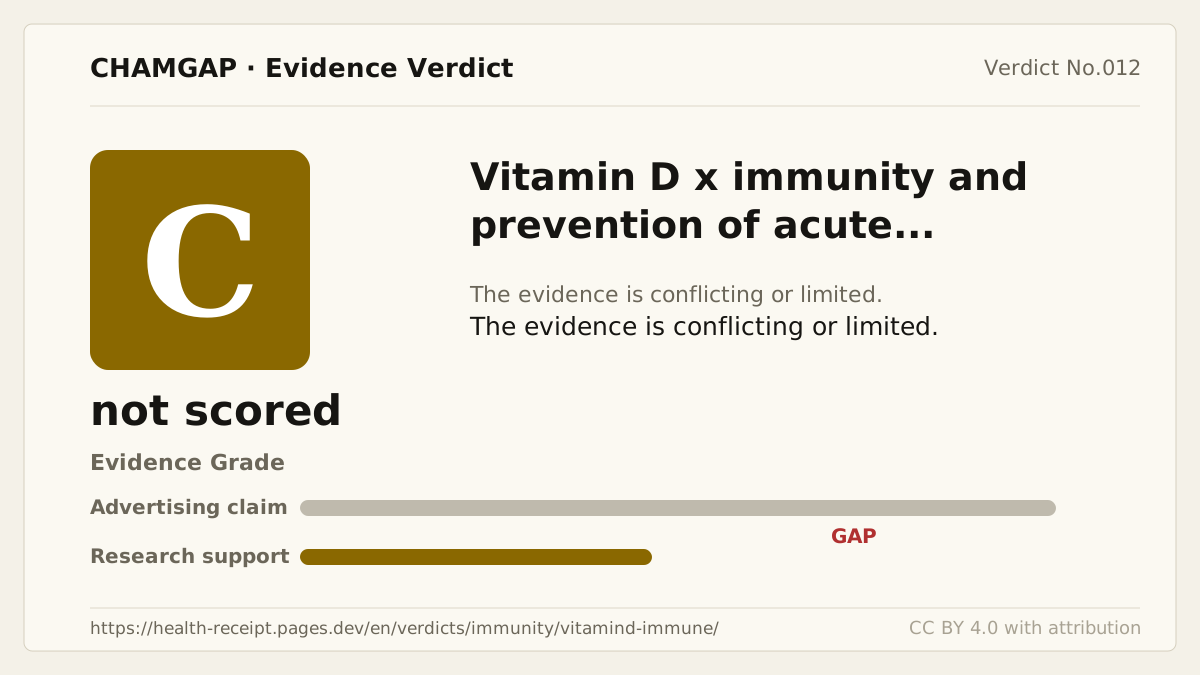
[Chamgap] Vitamin D x immunity and cold prevention — Evidence Grade D·34. 6 cited sources checked. Source: https://chamgap.com/en/verdicts/immunity/vitamind-immune/ · CC BY 4.0CC BY 4.0 — free to use with attribution; do not distort grades, numbers, or verdict meaning.
What this document does and does not do
Chamgap is an information source. It reports what research has and has not confirmed; it does not tell readers what to take or buy. That decision belongs to readers and, when needed, medical or legal professionals. This verdict reflects literature available up to the search date and may change as new research appears. Nothing here is medical advice.