
High-dose vitamin C,
does it really help with cold prevention and anticancer claims (cold occurrence prevention, cold treatment/duration shortening, cancer prevention, cancer treatment/adjuvant therapy separated by efficacy)?
research showsCold prevention had RR 0.97 (95% CI 0.94 to 1.00) and total cancer incidence had RR 1.11 (95% CI 0.95 to 1.30), but the compound claim spanning cold duration and oral and intravenous cancer treatment has neither a single repeated refutation nor a pooled confidence interval. Because the confidence intervals do not exclude clinically meaningful benefit, the grade is D with 30 points, not F.
ads claimKorean-language searches show four strands of claims. First, shopping malls/product names emphasize high content at about 3,000 mg per packet, as in “Vitamin C 3000” and “Megadose C,” and attach expressions such as “antioxidant” and “immune care.” Second, informational/ingredient-company content cites cold military-training RCTs or cell experiments to explain cold prevention or reduced cancer-cell survival. Third, some articles/interviews present bowel-tolerance dosing, increasing from 3,000 mg to 6,000-12,000 mg, and antiviral/anticancer/anti-inflammatory expressions in parallel. Fourth, some hospital/clinic pages describe high-dose vitamin C IV infusion as “a treatment that directly kills cancer cells.” Advertising/informational claims often place oral supplements, liposomal products, IV infusion, cell experiments, and special stress subgroups in the same context, but they must be separated in clinical-evidence judgment.
Useful facts when choosing a product
- Domestic shopping searches confirm products in 3,000 mg units, such as “megadose vitamin C 3000 mg” and “Korea Eundan Megadose C Vitamin C 3000.” Product names/detail exposure center on antioxidant and immune-care expressions.
- General oral megadose content sometimes introduces starting at 3,000 mg and increasing to 6,000 mg or 12,000 mg. These doses exceed the adult UL of 2,000 mg/day.
- High-dose IV vitamin C differs from oral supplements in blood concentration, and hospital/clinic advertisements use it to explain cancer adjuvant treatment or cancer-cell killing. In evidence judgment it was treated as a separate category from oral supplements.
- Informational posts and testimonial-style content on liposomal/liquid products show perceived expressions such as “caught fewer colds,” but testimonials or product form cannot replace RCT evidence for cold prevention.
What the research actually shows
Colds: Cochrane review analyzed placebo-controlled RCTs of vitamin C 0.2 g/day or more. In 29 comparisons and 11,306 people in the general community, cold occurrence risk did not significantly decrease (RR 0.97, 95% CI 0.94-1.00). In short, intense physical-stress subgroups such as marathon runners, skiers, and cold military training, RR was lower at 0.48 (95% CI 0.35-0.64), but this is a different condition from general cold-prevention claims. Continuous intake shortened cold duration by 8% in adults and 14% in children, but that is a different endpoint from occurrence prevention. A high-dose treatment RCT after symptom onset (Audera 2001, 400 recruited, 184 cold episodes recorded) found that 1 g or 3 g/day did not reduce duration or severity versus low-dose control. Cancer prevention: in a factorial RCT of 7,627 women, vitamin C 500 mg/day had total cancer incidence RR 1.11 (95% CI 0.95-1.30) and cancer mortality RR 1.28 (95% CI 0.95-1.73), with no prevention benefit. A meta-analysis of RCTs of vitamin C supplements for cancer prevention also concluded there was no prevention evidence in 7 RCTs. Cancer treatment: two Mayo Clinic oral 10 g/day RCTs showed no symptom, performance-status, or survival benefit in advanced cancer/colorectal cancer patients. High-dose IV can produce millimolar blood concentrations unlike oral intake, but NCI PDQ summarizes early studies as having low design rigor. A 2024 double-blind placebo-controlled phase 2 RCT in mCRPC (47 participants) found docetaxel+IVC did not improve PSA50, toxicity, rPFS, or OS. By contrast, a 2024 phase 2 RCT in metastatic pancreatic cancer (36 randomized, 34 treated) reported that adding 75 g IV ascorbate three times weekly to gemcitabine+nab-paclitaxel produced OS 16.0 vs 8.3 months (HR 0.46; 90% CI 0.23-0.92). This is an early signal in a specific cancer/specific combination therapy, not something that can be generalized to oral megadose or cancer treatment overall.
Why this is classified as D (30)
Cold prevention had RR 0.97 (95% CI 0.94 to 1.00) and total cancer incidence had RR 1.11 (95% CI 0.95 to 1.30), but the compound claim spanning cold duration and oral and intravenous cancer treatment has neither a single repeated refutation nor a pooled confidence interval. Because the confidence intervals do not exclude clinically meaningful benefit, the grade is D with 30 points, not F.
Counterpoint. Vitamin C is an essential nutrient needed for deficiency prevention, normal immune function, and collagen synthesis. In special conditions such as cold exposure or intense exercise, there is a signal of reduced cold occurrence, and continuous intake may slightly shorten cold duration. High-dose intravenous ascorbate has different pharmacokinetics from oral intake, and research continues in specific cancer adjuvant settings; the small positive phase 2 result in metastatic pancreatic cancer is worth checking for later large-scale replication. This counterargument must be read together with the fact that deficiency correction, special subgroups, and IV adjuvant therapy cannot be equated with oral megadose cold prevention or cancer prevention/treatment claims in the general population.
Rejudgment record. Converged — Cold prevention had RR 0.97 (95% CI 0.94 to 1.00) and total cancer incidence had RR 1.11 (95% CI 0.95 to 1.30), but the compound claim spanning cold duration and oral and intravenous cancer treatment has neither a single repeated refutation nor a pooled confidence interval. Because the confidence intervals do not exclude clinically meaningful benefit, the grade is D with 30 points, not F.
Sub-claim grades by effect
This ingredient is marketed for several effects. A single overall grade blends strong and weak claims together, so each effect is graded separately here. The overall grade reflects the strongest disconfirming or core claim.
| Effect (sub-claim) | Grade | Basis |
|---|---|---|
| Cold prevention (general) | D | General-population RCT meta shows near-zero change in incidence (RR 0.97) |
| Cold duration | D | Small consistent statistical effect on duration with continuous use (not a prevention claim) |
| Cancer prevention | D | No preventive effect in RCTs/meta-analyses |
| IV high-dose cancer adjuvant | D | Small positive vs negative phase-2 trials coexist -> at most C for broad anticancer claims |
Cross-check — Codex and Claude
Evidence Table
| Study | Design | Sample | Funding | Endpoint | Result | Weight |
|---|---|---|---|---|---|---|
| Hemila H, Chalker E 2013 | not specified | common cold, liver, and stress | General-community cold occurrence RR 0.97 (95% CI 0.94-1.00), extreme physical-stress subgroup RR 0.48, continuous-intake duration shortening adults 8%/children 14%. | core | ||
| Audera C, Patulny RV, Sander BH, Douglas RM 2001 | randomized controlled trial | 400 | common cold and liver | 400 recruited, 184 cold episodes recorded; after symptom onset, 1 g/3 g/day or Bio-C had no significant benefit over control for duration or severity. | core | |
| Lin J, Cook NR, Albert C et al. 2009 | randomized controlled trial | 7,627 | manufacturer/industry involvement possible | 7,627 women, mean 9.4 years; vitamin C 500 mg/day showed no prevention benefit, with total cancer incidence RR 1.11 and cancer mortality RR 1.28. | core | |
| Lee B, Oh SW, Myung SK 2015 | meta-analysis of RCTs | 7 | manufacturer/industry involvement possible | Meta-analysis of 7 cancer-prevention RCTs concluded there was no evidence that vitamin C supplements prevent cancer. | core | |
| Creagan ET, Moertel CG, O'Fallon JR et al. 1979 | double-blind trial | 150 | Double-blind controlled trial in 150 patients with advanced cancer; no benefit of high-dose oral vitamin C in symptoms, performance status, or survival; survival curves overlapped. | supporting | ||
| Moertel CG, Fleming TR, Creagan ET et al. 1985 | double-blind randomized controlled trial | 100 | liver and gastrointestinal | Randomized double-blind trial in 100 advanced colorectal cancer patients without prior chemotherapy; oral vitamin C 10 g/day did not improve time to progression or survival. | supporting | |
| Jacobs C, Hutton B, Ng T, Shorr R, Clemons M 2015 | systematic review | Systematic review of oral/IV ascorbate in cancer patients concluded there was no high-quality evidence supporting enhanced antitumor effects or reduced toxicity. | supporting | |||
| National Cancer Institute | randomized controlled trial | 2 | manufacturer/industry involvement possible | Summarizes that two oral 10 g/day RCTs were negative; IV can raise blood concentrations but early studies have limitations, and positive/negative phase 2 RCTs coexist in 2024. | supporting | |
| Paller CJ, Zahurak ML, Mandl A et al. 2024 | randomized controlled trial | 47 | manufacturer/industry involvement possible | gastrointestinal | mCRPC 47 participants, docetaxel+IVC 1 g/kg vs placebo; PSA50 41% vs 33% (P=0.44), rPFS 10.1 vs 10.0 months, no basis for routine use. | supporting |
| Bodeker KL, Smith BJ, Berg DJ et al. 2024 | randomized controlled trial | 34 | gastrointestinal | Metastatic pancreatic cancer, 36 randomized and 34 treated; adding 75 g IV ascorbate three times weekly resulted in OS 16.0 vs 8.3 months and PFS 6.2 vs 3.9 months. | supporting | |
| NIH Office of Dietary Supplements | not specified | gastrointestinal | Adult UL 2,000 mg/day; high doses raise issues of diarrhea, abdominal pain, nausea, kidney stones/oxalate, iron overload in hemochromatosis, and interactions with cancer therapy. | supporting | ||
| dsm-firmenich Korea | not specified | common cold and gastrointestinal | Domestic informational/ingredient-company content explaining vitamin C megadose positively for cold prevention by citing cold military-training studies. | supporting | ||
| dsm-firmenich Korea | preclinical study | gastrointestinal | Presents increasing megadose from 3,000 mg to 6,000/12,000 mg and cell-experiment-based explanations of reduced cancer-cell survival. | supporting | ||
| Study 14 | not specified | gastrointestinal | Domestic article interview includes broad expressions that high-dose vitamin C has antiviral, anticancer, and anti-inflammatory actions. | supporting | ||
| Study 15 | not specified | gastrointestinal and antioxidant | Domestic shopping search exposes product names such as “Vitamin C 3000” and “antioxidant health functional food.” | supporting | ||
| Study 16 | preclinical study | gastrointestinal | Domestic hospital page describes high-dose vitamin C IV infusion as a treatment that directly kills cancer cells. | supporting |
Receipt — 16 References
Of 16 cited sources, 6 had limited original-page access (blocked or summary-only) and were verified via index/summary, marked partial; the rest were verified at the original page. As of 2026-07-07.
Reviewed and approved: Chamgap Editorial Team · Approval date: 2026-07-07 · Corrections: none
Cite this verdict
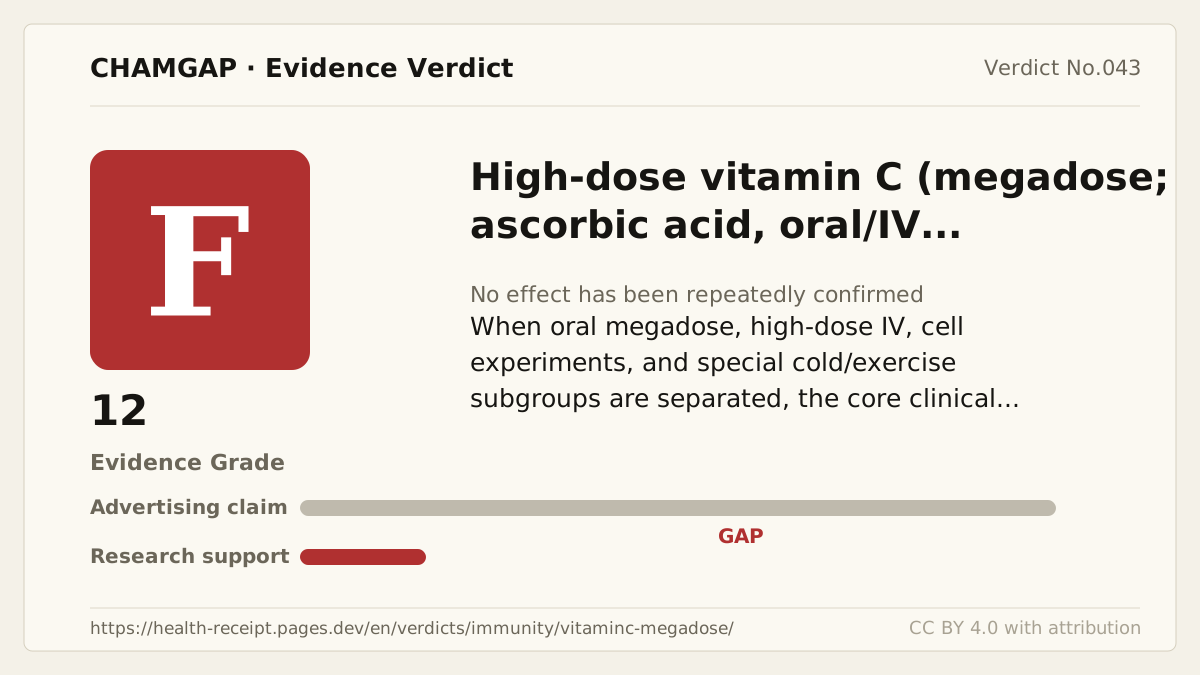
[Chamgap] High-dose vitamin C x cold prevention and anticancer claims (cold occurrence prevention, cold treatment/duration shortening, cancer prevention, cancer treatment/adjuvant therapy separated by efficacy) — Evidence Grade D·30. 16 cited sources checked. Source: https://chamgap.com/en/verdicts/immunity/vitaminc-megadose/ · CC BY 4.0CC BY 4.0 — free to use with attribution; do not distort grades, numbers, or verdict meaning.
What this document does and does not do
Chamgap is an information source. It reports what research has and has not confirmed; it does not tell readers what to take or buy. That decision belongs to readers and, when needed, medical or legal professionals. This verdict reflects literature available up to the search date and may change as new research appears. Nothing here is medical advice.