
Spirulina and chlorella,
does it really help with Detoxification and immunity?
research showsThe evidence is weak for viewing them as producing the 'removal of toxins from the body' or 'immune strengthening that makes infections less likely' that ordinary consumers expect. Human studies exist, but detoxification is centered on special contaminant exposure or surrogate markers such as concentrations in breast milk, urine, or hair, and immunity shows mixed results on laboratory markers such as NK cells, cytokines, and vaccine antibodies.
ads claimKorean market advertisements and informational content link spirulina and chlorella to 'fine-dust/heavy-metal excretion,' 'detoxification through chlorophyll and antioxidants,' 'liver detox/liver function improvement,' 'detoxification of radioactive substances,' 'increase in immune cells,' 'defense against viruses and colds,' and 'immune enhancement.' Articles and shopping-mall information mention MFDS functionalities (spirulina: skin health, antioxidant action, improvement of blood cholesterol; chlorella: skin health, antioxidant action, immune enhancement, etc.), while articles were also confirmed that took issue with expressions outside the regulatory scope, such as fine-dust excretion or disease prevention. Regulatory recognition was considered separately from the evidence grade of this verdict.
Useful facts when choosing a product
- The two ingredients are usually sold as tablets, powders, or capsules, and both single-ingredient products and mixed green-food products exist.
- Spirulina studies are divided into spirulina alone, spirulina extract plus zinc, and studies in athletes or older adults, making product generalization difficult.
- Chlorella immunity studies differ by raw material, extract, and dose across studies, and some positive studies have manufacturer- or ingredient-supplier-related funding/authors.
- The heavy-metal and fine-dust excretion that is central to detox advertising has not been proven as a clinical endpoint in generally healthy people; the main evidence consists of specific toxic exposure, animal experiments, and breast-milk/urine/hair concentration markers.
- For algal raw materials, possible contamination with heavy metals or cyanobacterial toxins is discussed depending on cultivation and processing quality, so raw-material testing and checking drug interactions are important.
What the research actually shows
Detoxification: In a 41-patient RCT of chronic arsenic poisoning, spirulina extract 250 mg plus zinc 2 mg given twice daily for 16 weeks was reported to produce a temporary increase in urinary arsenic, a 47.1% decrease in hair arsenic, and improvements in melanosis/keratosis scores. However, this was not spirulina alone but concomitant zinc use, and it was a special poisoning situation in which all participants were provided arsenic-safe drinking water. A 2020 review also summarized that human clinical studies are limited to arsenic and that there are no clinical studies for cadmium, lead, or mercury. For chlorella, a small non-randomized study in Japan reported that among 35 pregnant women, the 18-person intake group had lower breast-milk dioxin TEQ and higher IgA, but these were exposure/immune surrogate markers, not clinical outcomes. Immunity: A 124-person influenza-vaccine RCT of a chlorella-derived extract showed no improvement in the fourfold antibody rise rate or GMT in the overall population, with positivity only in part of the 50-55-year-old subgroup. Another chlorella RCT (51 healthy Koreans) showed increases in NK-cell activity and IFN-gamma, IL-1beta, and IL-12, but it had no clinical endpoint such as infection rate and involved Daesang-related funding/authors. An elderly spirulina RCT (78 participants) changed IL-2/IL-6, antioxidant, and lipid markers, and an athlete RCT (39 participants) centered on surrogate markers of leukocyte/monocyte proportions. A 2022 systematic literature review on spirulina, exercise, and immunity concluded that evidence for immune benefit was insufficient and inconsistent.
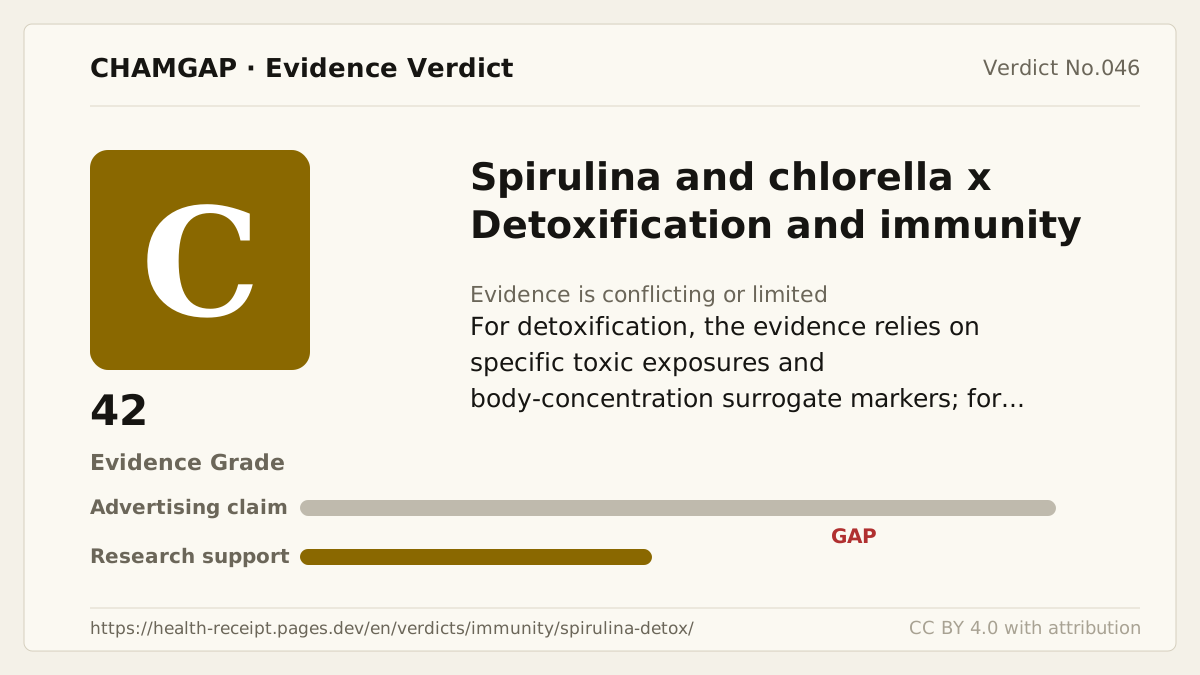
Why this is classified as C (42)
If the combination claim is separated by efficacy, detoxification has an arsenic poisoning RCT, but it used spirulina plus zinc in a special patient group, and the chlorella dioxin study was non-randomized, small, and based on exposure surrogate markers, making it difficult to extend to ordinary consumers' 'detox' claims. Human RCTs exist for immunity, but most are surrogate markers such as NK cells, cytokines, leukocyte fractions, and vaccine antibodies, and an influenza-vaccine RCT was null in the overall population. Because independent replication of positive results and clinical endpoints are insufficient, the boundary rules cap the verdict at C.
Counterpoint. There are positive signals for treatment support in areas with specific arsenic exposure and for some immune surrogate markers. In addition, in Korea there is a context in which immunity-related functional labeling for chlorella is permitted. However, this does not mean broad detoxification or infection-prevention effects for ordinary people have been established.
Rejudgment record. convergent — Draft = blind C. Detoxification relies on exposure surrogate markers, and immunity relies on NK/vaccine surrogate markers.
Cross-check — Codex and Claude
Evidence Table
| Study | Design | Sample | Funding | Endpoint | Result | Weight |
|---|---|---|---|---|---|---|
| Misbahuddin M et al. 2006 | RCT | 41 | possible manufacturer/industry involvement | skin | In a 41-person RCT of chronic arsenic poisoning, spirulina extract plus zinc reported a 47.1% decrease in hair arsenic and improvement in skin scores, but it is not evidence for general detoxification with spirulina alone. | core |
| Bhattacharya S 2020 | meta-analysis/preclinical | not reported | not specified | The review mentioned 58 preclinical studies and 5 arsenic-related clinical studies, but summarized that there were no human clinical studies for cadmium, lead, or mercury. | supporting | |
| Nakano S et al. 2007 | RCT | 18 | possible manufacturer/industry involvement | immunity | Among 35 pregnant women, 18 who consumed chlorella had lower breast-milk dioxin TEQ and higher IgA, but this was a non-randomized, small study of exposure/immune surrogate markers. | core |
| Halperin SA et al. 2003 | double-blind RCT | 124 | possible manufacturer/industry involvement | not specified | In a 124-person RCT of adults aged 50 or older, a chlorella-derived extract did not increase influenza-vaccine antibody responses in the overall population, and only part of the 50-55-year-old subgroup was positive. | core |
| Kwak JH et al. 2012 | preclinical | 51 | mixed/partly industry-related | not specified | In a 51-person RCT of healthy Koreans, NK-cell activity and some cytokines increased after 5 g/day chlorella for 8 weeks, but there were no clinical infection outcomes. | supporting |
| Park HJ et al. 2008 | double-blind RCT | 78 | possible manufacturer/industry involvement | antioxidant | In a 78-person RCT of adults aged 60-87, spirulina 8 g/day for 16 weeks affected IL-2, IL-6, antioxidant, and lipid markers, but it was centered on surrogate markers. | supporting |
| Zhang Y et al. 2022 | preclinical | 39 | possible manufacturer/industry involvement | not specified | In a 39-person RCT of college soccer players, spirulina 3 g/day for 8 weeks showed a signal of suppressing changes in leukocytes and monocytes, but this was a cell-fraction surrogate marker, not disease prevention. | supporting |
| Calella P et al. 2022 | systematic review of RCTs | possible manufacturer/industry involvement | immunity | A systematic literature review of 13 RCTs in exercise and sports contexts concluded that evidence for immune benefits of spirulina was insufficient and inconsistent. | supporting | |
| Spirulina and Chlorella Dietary Supplements-Are They a Source of Heavy Metals? | not specified | not reported | not specified | Because spirulina and chlorella can bioaccumulate heavy metals such as lead and cadmium, quality and contamination testing are important for safety assessment. | supporting |
Receipt — 9 References
Of 9 cited sources, 5 had limited original-page access (blocked or summary-only) and were verified via index/summary, marked partial; the rest were verified at the original page. As of 2026-07-07.
Reviewed and approved: Chamgap Editorial Team · Approval date: 2026-07-07 · Corrections: none
Cite this verdict
[Chamgap] Spirulina and chlorella x detoxification and immunity — Evidence Grade C·42. 9 cited sources checked. Source: https://chamgap.com/en/verdicts/immunity/spirulina-detox/ · CC BY 4.0CC BY 4.0 — free to use with attribution; do not distort grades, numbers, or verdict meaning.
What this document does and does not do
Chamgap is an information source. It reports what research has and has not confirmed; it does not tell readers what to take or buy. That decision belongs to readers and, when needed, medical or legal professionals. This verdict reflects literature available up to the search date and may change as new research appears. Nothing here is medical advice.