
Red ginseng,
does it really help with immune enhancement?
research showsThe claim that red ginseng (ginsenosides) intake enhances immunity falls within the scope of the generic functionality for red ginseng recognized by the Ministry of Food and Drug Safety (daily ginsenosides Rg1+Rb1+Rg3 3-80mg). Human randomized controlled trials (RCTs) and meta-analyses actually exist, and results reporting fewer upper respiratory infections (meta-analysis RR=0.69, Korean RCT incidence 24.5% vs 44.9%) have also been reported. However, these positive results are hard to regard as proof of a red-ginseng-only effect because the samples are small (single center, 12 weeks), the authors themselves state that risk of bias is high and publication bias cannot be ruled out, or red ginseng (Panax ginseng) is mixed with American ginseng (P. quinquefolius). Trials conducted by researchers affiliated with manufacturers such as Korea Ginseng Corporation generally improved only surrogate markers such as blood immune-cell counts and immunoglobulins, while patient-noticeable markers such as cold occurrence and cytokines did not differ from placebo. In short, this is a regulator-recognized functionality, but the evidence for independently and broadly replicated clinical benefit is still limited.
ads claimAdvertisements use the MFDS-recognized phrase 'may help enhance immunity,' and that expression itself is permitted in labeling and advertising for products that meet the specification (at least 3mg ginsenosides per day) and are certified as health functional foods. However, there is a gap between the advertising nuance of 'immunity up' and the evidence. In the verified trials, what actually improved was mostly surrogate markers such as blood immune-cell counts and immunoglobulins, while patient-noticeable benefits such as catching fewer colds or having shorter symptoms were significant only in some small, industry-linked trials, with insufficient independent, large-scale replication. In particular, Atomy's ingredient-introduction page uses expressions such as 'anti-proliferation/anti-metastasis for breast, prostate, and skin cancer,' which are anticancer claims rather than the MFDS-recognized immunity functionality and may raise regulatory-violation concerns. Also, the mg amount shown by sellers, for example 'ginsenosides 7mg,' generally means the sum of marker components Rg1+Rb1+Rg3, not the total extract amount, so the distinction is needed [E2].
Useful facts when choosing a product
- A functionality label for 'immune enhancement' is legal only for products that have health functional food certification (logo mark) plus GMP and meet at least 3mg per day of ginsenosides Rg1+Rb1+Rg3. Immune claims by red ginseng drinks, red ginseng teas, or red ginseng processed foods that do not meet the specification and are ordinary foods may violate labeling and advertising rules, so checking the package for 'health functional food' labeling and the functionality wording distinguishes them.
- The 'ginsenosides O mg' written on a product is generally the sum of marker components Rg1+Rb1+Rg3 and is different from the total amount of extract (red ginseng concentrate). When comparing advertised doses, it is accurate to look at both this marker-component sum and the daily intake standard (3-80mg).
- Red ginseng (Panax ginseng) and American ginseng (Panax quinquefolius, including COLD-fX) are separate ingredients with different ginsenoside profiles. A considerable share of overseas ginseng research and advertising is on American ginseng, so it cannot be directly transferred as evidence for red ginseng products.
- Many verified trials were conducted with funding or product provision from manufacturers such as Korea Ginseng Corporation, and the markers that actually improved were mostly surrogate markers such as blood immune cells and immunoglobulins. It is useful to know that patient-noticeable benefits such as 'catching fewer colds' have not yet been independently and broadly replicated.
What the research actually shows
After checking 7 verified studies against the original texts, the evidence is conflicting and limited. (1) The most independent evidence, the meta-analysis by Antonelli 2020, PMID 32951718, with no funding and no conflicts of interest, significantly lowered upper respiratory infection occurrence (RR=0.69, 95%CI 0.52-0.90), but the authors explicitly stated that most trials had high to unclear risk of bias and publication bias could not be ruled out, and red ginseng and American ginseng were mixed [E-species], so it cannot be directly connected to a red-ginseng-only effect. (2) The Korean RCT that assessed a clinical endpoint, incidence, Lee 2012, PMC3524425, 100 healthy adults aged 30-70, red ginseng 3g/day for 12 weeks, found significantly lower ARI occurrence, 24.5% vs 44.9% (P=0.034), but symptom duration (P=0.475) was not significantly different and it had industry-linked and government food-functionality program funding involving Jinan Red Ginseng Institute, CheonJiYang, and others [A1]. (3) Manufacturer-run studies from Korea Ginseng Corporation, Hyun 2021, PMID 33437171, and Yang 2024, PMID 39263305, significantly increased only surrogate markers such as T cells, B cells, IgA, and monocytes [B1], while cold occurrence (11 vs 10 cases) and cytokines did not differ from placebo. In both studies, despite declarations of 'no conflicts of interest,' many authors were affiliated with the manufacturer and the test product was CheongKwanJang [A1]. (4) The ginseng polysaccharide (Ginsan/Y-75) RCT, Cho 2014, PMC4196019, improved the surrogate marker NK activity, but its component and specification differ from ginsenoside specifications [E2]. (5) The American ginseng (P. quinquefolius) extract RCT, McElhaney 2011, PMC3447298, was negative for the primary endpoint (P=0.89) and was not red ginseng [E-species]. (6) The observational study in pediatric cancer patients, Lee 2012, PMC3659604, showed cytokines decreasing instead, which is opposite in direction to 'immune enhancement' and involved a patient group [B2].
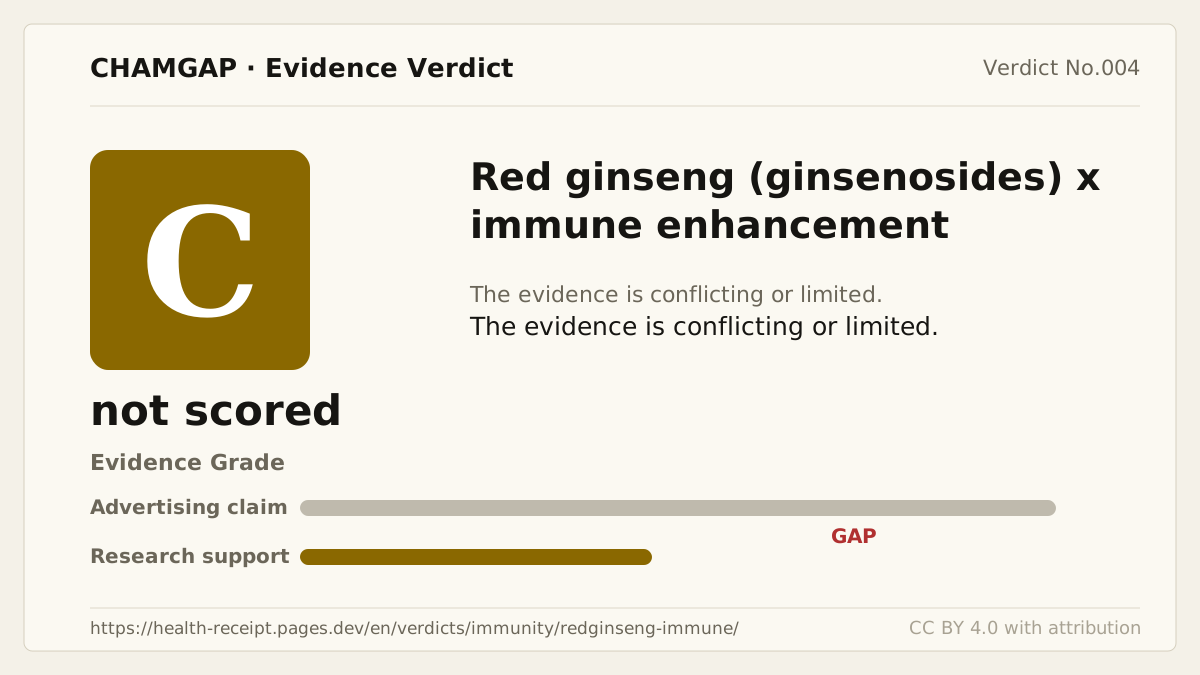
Why this is classified as C (54)
Why it is C: the evidence is conflicting and limited. Why it is not A to B, meaning strong and independent: the evidence that showed positive clinical outcomes, namely infection occurrence, consists only of (a) a meta-analysis whose authors themselves stated that risk of bias was high and publication bias could not be ruled out, and (b) a single-center, small-scale (n=100), industry-linked Korean RCT. The cleanest large manufacturer trials improved only surrogate markers, while patient-noticeable endpoints such as cold occurrence and cytokines did not differ from placebo. There is also substantial mixing of species and components, including American ginseng and polysaccharides, and funding is heavily concentrated among manufacturers. Why it is not D to F, meaning observation-only or negative: several randomized, double-blind, placebo-controlled human RCTs do in fact exist, at least one trial showed a significant benefit on a clinical endpoint, and above all it falls within the regulatory scope in which MFDS formally recognizes 'immune enhancement' as a generic red ginseng function (passes D2). Regulatory recognition plus actual RCTs, but uncertainty about independence, replication, and patient-noticeable benefit, makes C fit the evidence hierarchy.
Counterpoint. Opposing upward view, B: one could argue for B because the MFDS formally recognizes 'immune enhancement' as a generic functionality, an independent meta-analysis found a significant reduction in upper respiratory infection occurrence (RR=0.69), and a Korean RCT also found significantly lower incidence. Rebuttal: regulatory recognition is not an evidence grade but permission for labeling, and much of the recognition evidence depends on manufacturer-funded, small trials like those checked here. The meta-analysis itself explicitly states high risk of bias, inability to rule out publication bias, and inability to draw firm conclusions, and it mixed red ginseng with American ginseng. In other words, both pillars for upgrading carry methodological weakness and conflicts of interest, so upgrading to B is difficult. Opposing downward view, D: one could argue for D because manufacturer trials show only surrogate markers, and a patented extract RCT in the same genus, American ginseng, had a negative primary endpoint (P=0.89), so real benefit is unproven. Rebuttal: human RCTs using red ginseng (Panax ginseng) itself include a case showing significant benefit on a clinical endpoint and the claim is within the regulatory-recognized scope, so C, meaning conflicting and limited, is more accurate than D, meaning observation-only or failed proof.
| Endpoint | H | Hard endpoint - actual events such as death |
| Replication | R1 | Single confirmatory trial |
| Independence | I0 | Evidence comes only from manufacturer studies |
| Effect size | E+ | Meets the clinically important threshold |
The scoring table and the verdict agree (C).
Cross-check — Codex and Claude
Evidence Table
| Study | Design | Sample | Funding | Endpoint | Result | Weight |
|---|---|---|---|---|---|---|
| Antonelli M, Donelli D, Firenzuoli F 2020 | meta-analysis | possible manufacturer or industry involvement | Meta-analysis mainly in healthy adults: upper respiratory infection occurrence was significantly reduced, RR=0.69 (95%CI 0.52-0.90), with no funding and no conflicts of interest (independent). | key | ||
| Study 2 | double-blind randomized controlled trial | 100 | possible manufacturer or industry involvement | liver | 100 healthy adults aged 30-70, red ginseng 3g/day for 12 weeks: ARI occurrence was significantly lower at 24.5% vs placebo 44.9% (P=0.034), but symptom duration (P=0.475) showed no significant difference. | key |
| Hyun SH, Ahn H-Y, Kim H-J, Kim SW, So S-H, In G, Park C-K, Han C-K 2021 | double-blind randomized controlled trial | 100 | possible manufacturer or industry involvement | colds / gastrointestinal | 100 healthy adults, red ginseng extract 2g/day for 8 weeks: T cells (CD3, CD4, CD8), B cells, and WBC increased significantly (surrogate markers), but cold occurrence (11 vs 10) and cytokines did not differ from placebo. | supporting |
| Yang Y, Li J, Zhou S, Ni D, Yang C, Zhang X, Tan J, Yan J, Wang N 2024 | double-blind randomized controlled trial | 9 | possible manufacturer or industry involvement | immunity / gastrointestinal | 119 subhealthy adults with low immunity, CheongKwanJang red ginseng capsules 6 capsules daily for 180 days: immune health score, IgA, and monocytes improved significantly (surrogate markers), while clinical indicators such as infection occurrence were outside the scope. | key |
| Cho Y-J, Son H-J, Kim K-S 2014 | double-blind randomized controlled trial | ALT / gastrointestinal | Healthy adults aged 50-75 (97% female), ginseng acidic polysaccharide Ginsan (Y-75) 6g/day for 14 weeks: surrogate markers such as NK-cell activity rose, +40.2% (P<=0.0001). | supporting | ||
| McElhaney JE, Simor AE, McNeil S, Predy GN 2011 | possible manufacturer or industry involvement | gastrointestinal | Adults aged 65 or older after influenza vaccination, American ginseng extract CVT-E002 (COLD-fX) 400/800mg for 6 months: the primary endpoint, confirmed upper respiratory infection, did not differ from placebo (P=0.89, negative). | supporting | ||
| Lee JM, Hah JO, Kim HS 2012 | randomized controlled trial | 11 | immunity | Children with advanced cancer (2 months-15 years) after chemotherapy/transplant, red ginseng 60mg/kg/day for 1 year (nonrandomized, 19 vs 11): IL-2, IL-10, IL-12, TNF-alpha, and IFN-gamma instead 'decreased more rapidly' (anti-inflammatory direction). | supporting |
Receipt — 7 References
All 7 cited sources were verified for existence at the original page (as of 2026-07-06).
Reviewed and approved: Chamgap Editorial Team · Approval date: 2026-07-06 · Corrections: none
Cite this verdict
[Chamgap] Red ginseng x immunity — Evidence Grade C·54. 7 cited sources checked. Source: https://chamgap.com/en/verdicts/immunity/redginseng-immune/ · CC BY 4.0CC BY 4.0 — free to use with attribution; do not distort grades, numbers, or verdict meaning.
What this document does and does not do
Chamgap is an information source. It reports what research has and has not confirmed; it does not tell readers what to take or buy. That decision belongs to readers and, when needed, medical or legal professionals. This verdict reflects literature available up to the search date and may change as new research appears. Nothing here is medical advice.