
Quercetin,
does it really help with Allergy, antioxidant, and immune effects?
research showsQuercetin has some human RCT signals for allergy symptoms, especially Japanese cedar pollinosis and rhinoconjunctivitis. However, studies are small and concentrated in specific formulations and specific seasonal allergies, while antioxidant and immune claims rely mainly on blood markers or subgroup findings. Broad generalization in the style of overall advertising is difficult.
ads claimDomestic market/informational articles and overseas direct-purchase sales copy present quercetin together as a 'natural antihistamine,' 'seasonal/pollen/rhinitis relief,' 'powerful antioxidant,' 'improves immune function,' and 'antiviral/virus defense.' On Coupang and similar sales pages, quercetin phytosome and bromelain combination products are introduced with allergy and swelling-help wording, while iHerb and health-information content explain antioxidant and immune enhancement together with allergy relief. Some social-media and shopping content gives a broad efficacy impression with phrases such as 'stronger antioxidant than vitamin C' and 'relieves allergic rhinitis.'
Useful facts when choosing a product
- Marketed products are often combined with bromelain, vitamin C, zinc, vitamin D, perilla extract, and similar ingredients rather than quercetin alone, making combination-product evidence difficult to read as the effect of quercetin alone.
- Positive allergy RCT signals concentrate on absorption-enhanced formulations such as EMIQ (enzymatically modified isoquercitrin) or quercetin phytosome, so they cannot be assumed to be identical to ordinary quercetin powder products.
- Quercetin intake from foods and high-content supplement intake of 500-1000 mg/day differ in exposure amount and potential interactions.
What the research actually shows
Allergy: RCTs of EMIQ (a quercetin glycoside) and quercetin phytosome improved some symptom scores, such as eye itching, sneezing, runny nose, sleep, and QOL. However, sample sizes were only about 20-66 people, and the 2022 phytosome study was conducted at the expense of Indena Japan/Indena S.p.A. A 2025 meta-analysis of multiple polyphenols for allergic rhinitis reported improvement in total nasal symptom scores, but it was not a quercetin-alone meta-analysis; it covered polyphenols overall, and certainty of evidence was low to very low. Antioxidant: in an RCT meta-analysis, FRAP increased but TAC and MDA were not significant, making this closer to surrogate-marker evidence than clinical-symptom improvement evidence. Immunity/colds: in a community RCT with N=1002, overall URTI incidence and symptoms did not differ significantly from placebo, and reductions in severity and sick days were observed only in some older active subgroups at 1000 mg/day. A separate RCT in women also found no effect on NK-cell activity, granulocyte oxidative burst/phagocytosis, or IL-6/TNF-alpha.
Why this is classified as C (48)
Separated by claim, allergy evidence is positive because small human RCTs show subjective symptom/QOL signals, but large independent replication and consistent quercetin-only meta-analytic evidence are lacking. Antioxidant evidence centers on surrogate markers such as FRAP and is capped at C; immune/cold claims showed no overall effect in a large RCT and immune-cell function markers were null. Therefore the overall advertised 'allergy, antioxidant, and immune' evidence is graded C.
Counterpoint. For allergic rhinitis/pollinosis specifically, quercetin is not completely unsupported. However, positive studies are small and sensitive to formulation, population, and funding, so extending the same strength to general immune enhancement or antioxidant health effects is weak.
Rejudgment record. Draft=blinded convergent — Allergy-symptom RCT signals exist, but they are small and formulation-specific; antioxidant evidence is surrogate-marker evidence, and overall results of a large immunity RCT are null, so the whole compound claim is C
Cross-check — Codex and Claude
Evidence Table
| Study | Design | Sample | Funding | Endpoint | Result | Weight |
|---|---|---|---|---|---|---|
| Yamada S, Shirai M, Inaba Y, Takara T 2022 | Double-blind RCT | Quercetin phytosome 200 mg/day, 4 weeks, randomized double-blind placebo-controlled; some JRQLQ symptoms/QOL improved, funded by Indena. | Core | |||
| Kawai M, Hirano T, Arimitsu J et al. 2009 | Double-blind RCT | 20 | liver | EMIQ 100 mg, 8 weeks, N=20; overall-period eye symptoms and eye-itching scores improved, while IgE and most cytokines were not significant. | Core | |
| Hirano T, Kawai M, Arimitsu J et al. 2009 | 24 | Possible manufacturer/industry involvement | EMIQ 100 mg/day, 8 weeks, N=24; eye symptom+medication scores improved, but nasal symptoms did not differ significantly. | Core | ||
| Lai YR, Liao YH, Huang L et al. 2025 | Meta-analysis of RCTs | 823 | Polyphenol RCT meta-analysis in allergic rhinitis, 13 trials, N=823; nasal-symptom improvement signal, but certainty low to very low and QOL not significant. | Core | ||
| Heinz SA, Henson DA, Austin MD, Jin F, Nieman DC 2010 | RCT | 1002 | immunity/gut/gastrointestinal | Quercetin 500/1000 mg/day, 12 weeks, N=1002; overall URTI outcomes did not differ significantly, and sick days/severity decreased only in some active subgroups aged 40 or older. | Supporting | |
| Heinz SA, Henson DA, Nieman DC, Austin MD, Jin F 2010 | 120, | immunity | Women N=120, 500/1000 mg/day for 12 weeks; blood quercetin increased, but NKCA, GOBA, phagocytosis, and IL-6/TNF-alpha did not change. | Supporting | ||
| Ahmadi Vasmehjani A, Yaghoubi F, Darabi Z, Abdollahi N, Sangsefidi ZS, Hosseinzadeh M 2022 | Meta-analysis of RCTs | 668 | antioxidant | 8 RCTs, N=668; FRAP increased but TAC and MDA were not significant, so this remained surrogate-marker evidence rather than antioxidant clinical-effect evidence. | Supporting |
Receipt — 7 References
Of 7 cited sources, 2 had limited original-page access (blocked or summary-only) and were verified via index/summary, marked partial; the rest were verified at the original page. As of 2026-07-07.
Reviewed and approved: Chamgap Editorial Team · Approval date: 2026-07-07 · Corrections: none
Cite this verdict
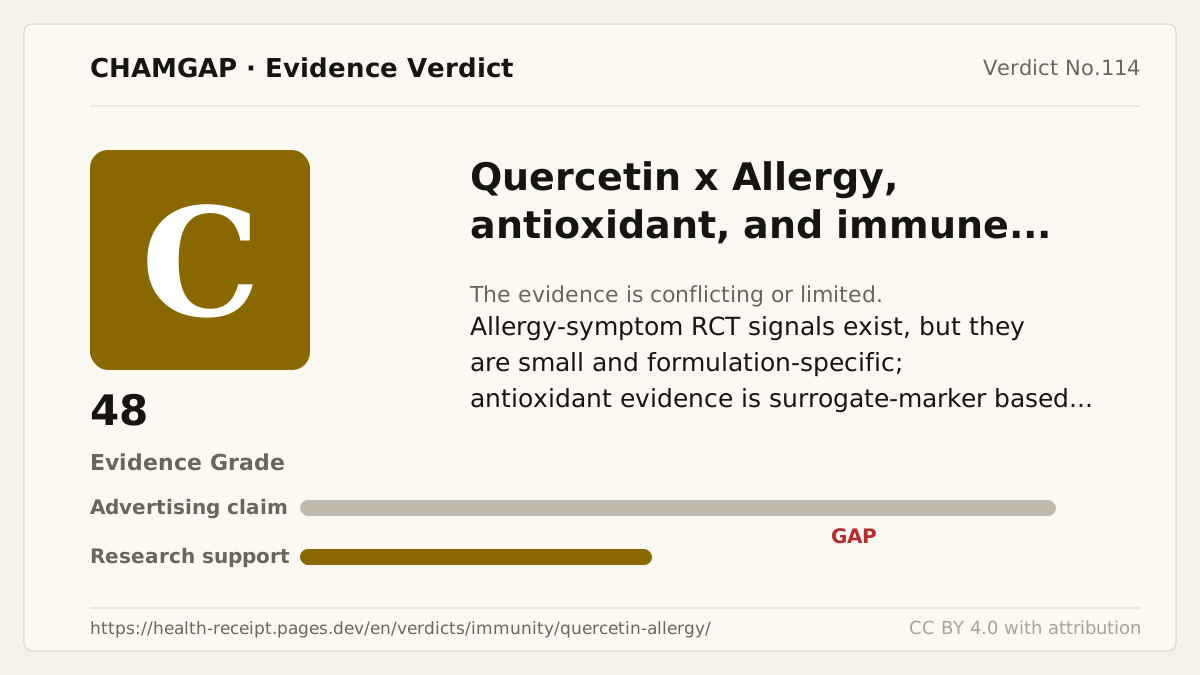
[Chamgap] Quercetin x allergy, antioxidant, and immune effects — Evidence Grade C·48. 7 cited sources checked. Source: https://chamgap.com/en/verdicts/immunity/quercetin-allergy/ · CC BY 4.0CC BY 4.0 — free to use with attribution; do not distort grades, numbers, or verdict meaning.
What this document does and does not do
Chamgap is an information source. It reports what research has and has not confirmed; it does not tell readers what to take or buy. That decision belongs to readers and, when needed, medical or legal professionals. This verdict reflects literature available up to the search date and may change as new research appears. Nothing here is medical advice.