
Propolis,
does it really help with immunity/oral: general immune-function/cold-prevention claims and oral antibacterial/gum/plaque claims evaluated separately?
research showsPropolis is difficult to regard as a general “immune-strengthening” ingredient. On the oral side, small RCT signals show reduced plaque/gingivitis indicators with formulations that directly contact the mouth, such as mouthwash, gel, and spray, but formulations, origin, and dose are heterogeneous, and it is hard to extend this to long-term prevention of dental disease or the effect of capsule intake.
ads claimKorean market searches showed expressions together such as “natural antibiotic,” “immune management,” “cold prevention,” “sore throat/throat care,” “oral antibacterial,” “gum/oral trouble,” “antioxidant,” and “energy enhancement.” Product-name/platform searches often found products with zinc, vitamin C, vitamin E, manuka honey, etc. added to propolis and labeled “immune function,” rather than propolis alone. A Korea Economic Daily report on a consumer-agency survey mentioned that 22 of 40 overseas-purchase-agent propolis products were advertised with “cold prevention” or “immune strengthening.” Government/informational articles repeatedly explain that currently recognized functionality in the Health Functional Food Code is limited to antioxidant activity and antibacterial action in the mouth, with the condition that oral antibacterial action requires a form that can directly contact the oral cavity. A 2025 Rural Development Administration press release introduced research on relieving immune hypersensitivity, but in this judgment it was separated from clinical evidence whose existence and numbers were confirmed in public papers.
Useful facts when choosing a product
- The chemical composition of propolis varies by production region, botanical source, and collection season, so names such as “Brazilian green,” “red,” or “Australian” alone cannot be assumed equivalent to clinical-trial products.
- Domestic products are sold as capsules, tablets, liquids, sprays, candies, chewables, etc.; for oral antibacterial claims, whether the formulation directly contacts the oral mucosa is key.
- Immune-related product names often include zinc, vitamin C, vitamin E, probiotics, red ginseng, etc., so whether advertising wording “immune function” comes from propolis itself must be separated.
- Because propolis is a honeybee-derived material, people with history of allergy to bees, honey, pollen, or resin components should consider possible contact stomatitis, dermatitis, gastrointestinal symptoms, and rare systemic allergy.
What the research actually shows
For immunity, standalone propolis human evidence is weak. A 2024 Heliyon pilot RCT gave Chinese propolis 600 mg/day for 12 weeks to community-dwelling adults aged 60~80, but aside from a transient IgG increase at 6 weeks, there were no significant between-group differences in serum antibodies, IL-1β/IL-4/IFN-γ, lymphocyte transformation, or neutrophil phagocytosis. It had no placebo in the control group, small sample size, and support from a health-functional-food company foundation. A 2004 pediatric respiratory-infection prevention RCT used an echinacea+propolis+vitamin C combination, so positive results cannot be attributed to propolis alone. Oral evidence consists of RCTs and systematic reviews centered on direct-contact formulations. A 2020 BMC Oral Health review of 9 clinical trials and 333 participants found overall plaque/gingivitis improvement signals, but most studies had high risk of bias and heterogeneity was too large for meta-analysis. A 2025 BDJ Open review of 10 RCTs and 453 participants also showed possibility but concluded low certainty with 4 high-risk and 2 some-concern studies. A 2021 periodontal disease meta-analysis reported probing pocket depth -0.67 mm (95% CI -0.84 to -0.50), but only 3 studies were quantitatively synthesized and one study had 95% weight, so stability is low.
Why this is classified as C (52)
The compound-claim separation rule was applied. Direct-contact oral formulations have human RCTs and reviews, so they are not ? or F, and some results touch actual clinical indicators such as gingivitis and plaque. However, the trials are small and short, product standardization is weak, and high risk of bias and limits to quantitative synthesis recur. For immune enhancement, cold prevention, or systemic immune improvement by capsule intake, core immune markers in standalone propolis RCTs are mostly negative, and positive respiratory-infection data are combination products that cannot be attributed to propolis. Therefore the broad market claim “immune/oral” overall is limited to C (40~59).
Counterpoint. If narrowed only to “short-term improvement in plaque/gingivitis indicators” with standardized mouthwash/gel formulations used directly in the mouth, the evidence looks better. There is also an RCT in which a propolis-containing combination product reduced pediatric respiratory infections, but that result cannot separate the effects of echinacea and vitamin C.
Rejudgment record. Converged — Draft=blind C. Boundary against transferring local oral indicators to general immunity.
Cross-check — Codex and Claude
Evidence Table
| Study | Design | Sample | Funding | Endpoint | Result | Weight |
|---|---|---|---|---|---|---|
| Pu L, Wang Y, Pang W et al. 2024 | randomized controlled trial | 62 | manufacturer/industry involvement possible | immunity, liver, and ALT | Randomized study in 62 older adults: after 600 mg/day for 12 weeks, no significant between-group immune-marker differences except a transient IgG increase at 6 weeks. | core |
| Cohen HA, Varsano I, Kahan E, Sarrell EM, Uziel Y 2004 | not specified | 430 | manufacturer/industry involvement possible | respiratory | RCT in 430 children: the combination product reduced respiratory-infection episodes/illness days, but attribution to propolis alone is impossible. | core |
| Halboub E, Al-Maweri SA, Al-Wesabi M et al. 2020 | meta-analysis | 333 | Review of 9 clinical trials and 333 participants found possible plaque/gingivitis improvement with propolis mouthwash, but most studies had high risk of bias. | core | ||
| Ballouk MAH, Altinawi M, Al-Kafri A et al. 2025 | meta-analysis of RCTs | 453 | Review of 10 RCTs and 453 participants showed plaque/gingival inflammation improvement signals, but concluded low certainty/high heterogeneity. | core | ||
| Gunjal S, Pateel DGS 2024 | randomized controlled trial | 45 | In a 45-person Latin-square crossover RCT, propolis mouthwash lowered GI and PI more than chlorhexidine and placebo after 21 days. | supporting | ||
| Bretz WA, Paulino N, Nör JE, Moreira A 2014 | randomized controlled trial | mixed/partly industry-related | In a 21-pair twin induced-gingivitis RCT, 2% typified propolis rinse did not differ from NaF+CPC positive control on PBS/G-parameter. | supporting | ||
| López-Valverde N, Pardal-Peláez B, López-Valverde A et al. 2021 | meta-analysis | Periodontal disease review/meta-analysis reported PPD -0.67 mm versus placebo, but quantitative synthesis included only 3 studies and one study had 95% weight. | supporting | |||
| Study 8 | not specified | antioxidant | Domestic informational report explained that current Food Code recognized functionalities are two: antioxidant activity and oral antibacterial action. | supporting | ||
| Study 9 | not specified | immunity, common cold, and gastrointestinal | Consumer-agency survey report stating that 22 of 40 overseas-purchase-agent propolis products were advertised with cold prevention or immune strengthening. | supporting |
Receipt — 9 References
Of 9 cited sources, 1 had limited original-page access (blocked or summary-only) and were verified via index/summary, marked partial; the rest were verified at the original page. As of 2026-07-07.
Reviewed and approved: Chamgap Editorial Team · Approval date: 2026-07-07 · Corrections: none
Cite this verdict
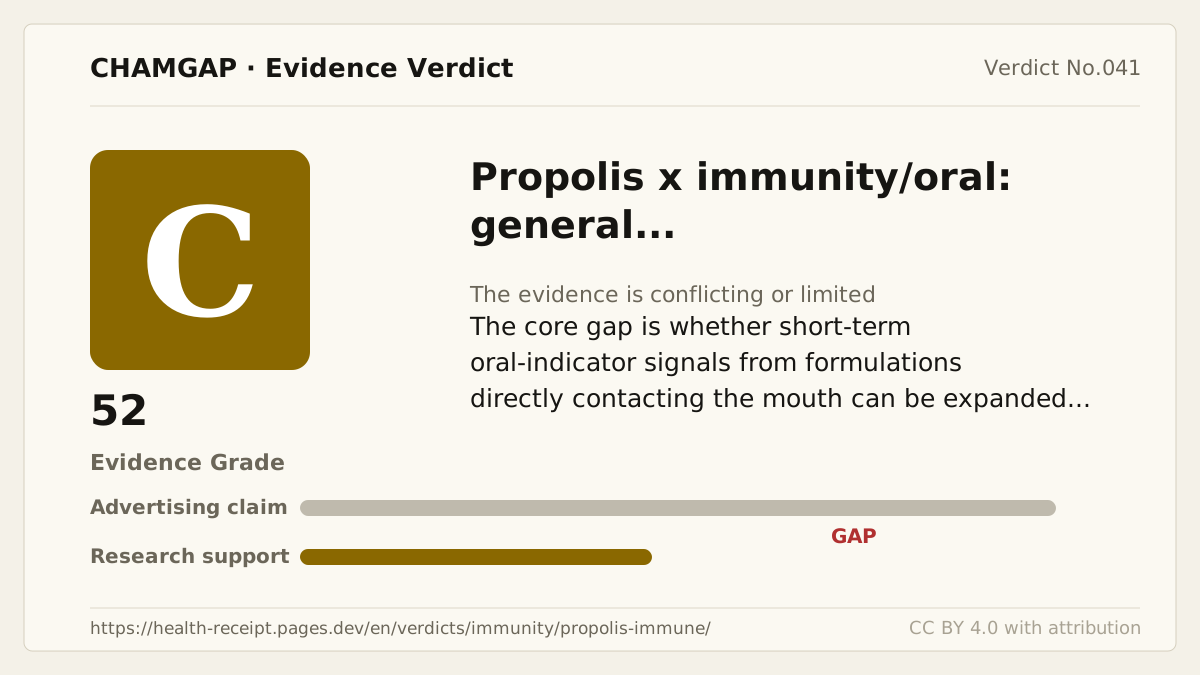
[Chamgap] Propolis x immunity/oral: general immune-function/cold-prevention claims and oral antibacterial/gum/plaque claims evaluated separately — Evidence Grade C·52. 9 cited sources checked. Source: https://chamgap.com/en/verdicts/immunity/propolis-immune/ · CC BY 4.0CC BY 4.0 — free to use with attribution; do not distort grades, numbers, or verdict meaning.
What this document does and does not do
Chamgap is an information source. It reports what research has and has not confirmed; it does not tell readers what to take or buy. That decision belongs to readers and, when needed, medical or legal professionals. This verdict reflects literature available up to the search date and may change as new research appears. Nothing here is medical advice.