
Fucoidan,
does it really help with immune and anticancer claims?
research showsLooking only at human evidence, it is insufficient to say that fucoidan clearly produces immune or anticancer effects. In an adjunctive-therapy RCT in metastatic colorectal cancer, disease control rate (DCR) improved, but survival, progression-free survival, objective response rate, and quality of life were not significant, and immune claims are centered on surrogate markers such as NK-cell activity. Ordinary sea mustard/kelp food intake and high-concentration fucoidan supplements are difficult to group under the same evidence.
ads claimKorean advertising and informational articles repeatedly describe fucoidan as an ingredient that 'awakens immune cells,' 'anticancer adjunct,' 'blocks viruses,' 'induces cancer-cell suicide,' 'inhibits metastasis,' 'inhibits angiogenesis,' 'reduces side effects of anticancer therapy,' and 'supports immunity in cancer patients.' Some articles present product-selection logic, saying sea mustard and kelp contain little fucoidan so extracted products are more appropriate, together with gram-level daily intakes. Advertising wording tends to expand cell/animal mechanisms and small adjunctive-therapy studies into broad anticancer and immune effects.
Useful facts when choosing a product
- Fucoidan is not a single substance but a polysaccharide family whose composition differs by seaweed source, molecular weight, degree of sulfation, and extraction method.
- Clinical-trial products are specific-source and specific-molecular-weight products such as Okinawa mozuku, Sargassum hemiphyllum, and Cladosiphon okamuranus. It is difficult to generalize them to all ordinary sea mustard/kelp foods or all supplements.
- Identified cancer-related RCTs are generally adjunctive designs added to existing chemotherapy or radiation therapy. They are hard to view as human RCT evidence that fucoidan alone treats or prevents cancer.
- In key positive RCTs, products were supplied by manufacturers or industry-collaboration funding was included. No independent large replication RCT was identified.
- Short clinical trials did not show clear serious fucoidan-related adverse events, but safety is set to 'caution' because of concomitant use during cancer treatment, differences in product composition, possible anticoagulant effects, and variation in iodine and contaminants in seaweed-derived products.
What the research actually shows
Human studies exist, but they are small and differ substantially by product. A 2022 systematic review of fucoidan as adjunctive therapy in cancer patients included only 4 studies, total 118 participants, 1 RCT and 3 quasi-experimental studies, could not perform meta-analysis because of heterogeneity, and concluded that clinical results were inconsistent. The key RCT was a study in 54 metastatic colorectal cancer patients adding low-molecular-weight fucoidan 4 g twice daily to FOLFIRI+bevacizumab; the primary endpoint DCR was 92.8% vs 69.2% (p=0.026), but ORR, PFS, OS, adverse events, and QOL were not significant. A 2023 locally advanced rectal cancer RCT had QOL as its primary endpoint, FACT-C improvement was not significant under the adjusted criterion, and only some adverse-effect measures such as fatigue and skin itching were lower. For immunity, a pilot RCT in 40 healthy adults observed increased NK-cell activity, but this was centered on a male subgroup and on surrogate markers rather than clinical endpoints such as infection, cancer occurrence, or treatment response.
Why this is classified as C (50)
When the combined claim is separated by effect, immunity is centered on surrogate markers such as NK-cell activity and cytokines, so boundary rule 1 makes the maximum C. For anticancer effects, human RCTs exist, but samples are small, core positive results are auxiliary markers such as DCR or QOL/fatigue, and harder clinical endpoints such as OS/PFS/ORR were not significant. In addition, independent replication is insufficient, and some key trials had product provision or industry-collaboration funding, making it difficult to raise the grade to B.
Counterpoint. This is not a claim with no evidence at all. DCR was significantly higher in a metastatic colorectal cancer RCT, a rectal-cancer CCRT adjunctive trial showed lower fatigue and some skin symptoms, and a healthy-adult pilot RCT showed an NK-activity signal. However, sample size, independence, and endpoint strength are insufficient to generalize these signals to broad 'immune enhancement' or 'anticancer effect.'
Rejudgment record. Draft and blinded review converged — Human RCTs exist, but positive signals are centered on surrogate/auxiliary endpoints such as NK activity, DCR, QOL, and fatigue, and there is no large independent replication, so C.
Cross-check — Codex and Claude
Evidence Table
| Study | Design | Sample | Funding | Endpoint | Result | Weight |
|---|---|---|---|---|---|---|
| Wu C-J, Yeh T-P, Wang Y-J, Hu H-F, Tsay S-L, Liu L-C 2022 | meta-analysis | 118 | not reported | not specified | Systematic review including only 4 adjunctive-therapy studies in cancer patients, total 118 participants; meta-analysis could not be performed because of heterogeneity, and clinical effects were concluded to be inconsistent. | core |
| Tsai H-L, Tai C-J, Huang C-W, Chang F-R, Wang J-Y 2017 | double-blind RCT | 54 | possible manufacturer/industry involvement | gastrointestinal | RCT in 54 metastatic colorectal cancer patients; DCR was 92.8% vs 69.2% (p=0.026), but OS, PFS, ORR, AEs, and QOL were not significant. | core |
| Tsai H-L, Yeh Y-S, Chen P-J et al. 2023 | double-blind RCT | 87 | possible manufacturer/industry involvement | skin/gastrointestinal | RCT of 87 participants using adjunctive therapy during CCRT for locally advanced rectal cancer; the primary endpoint was QOL, FACT-C improvement was not significant, and only some fatigue and skin-symptom indicators were lower. | core |
| Tomori M, Nagamine T, Miyamoto T, Iha M 2021 | double-blind RCT | 40 | possible manufacturer/industry involvement | not specified | Pilot RCT in 40 healthy adults; after 3 g/day fucoidan for 12 weeks, increased NK-cell activity was observed, but it was centered on a male subgroup and surrogate markers. | supportive |
| Ikeguchi M, Yamamoto M, Arai Y et al. 2011 | RCT | 10 | possible manufacturer/industry involvement | liver/gastrointestinal | Small randomized study comparing 10 fucoidan-group and 10 control-group participants among 20 people with unresectable advanced/recurrent colorectal cancer; fatigue and chemotherapy-duration signals existed, but survival difference was not significant. | supportive |
| Antitumor activity of fucoidan: a systematic review and meta-analysis 2022 | meta-analysis/preclinical | not reported | not specified | The antitumor meta-analysis is mainly animal-model evidence and does not directly prove anticancer clinical effects in humans. | supportive |
Receipt — 6 References
Of 6 cited sources, 2 had limited original-page access (blocked or summary-only) and were verified via index/summary, marked partial; the rest were verified at the original page. As of 2026-07-07.
Reviewed and approved: Chamgap Editorial Team · Approval date: 2026-07-07 · Corrections: none
Cite this verdict
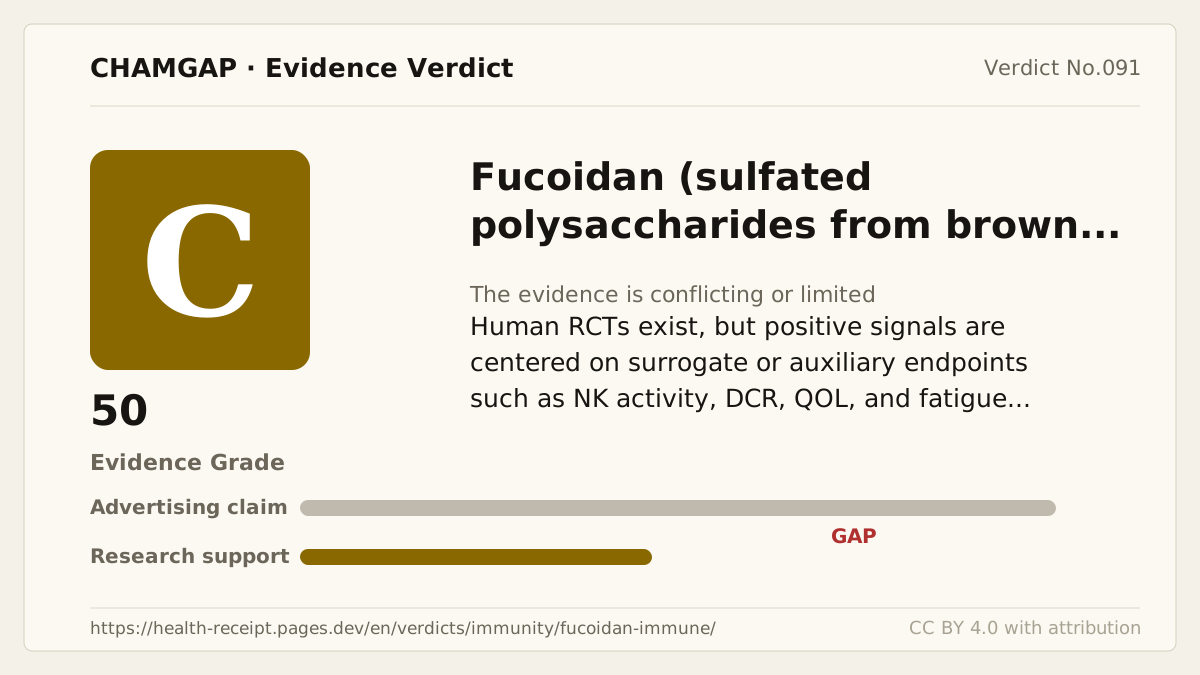
[Chamgap] Fucoidan (sulfated polysaccharides from brown algae such as sea mustard and kelp) × immune and anticancer claims — Evidence Grade C·50. 6 cited sources checked. Source: https://chamgap.com/en/verdicts/immunity/fucoidan-immune/ · CC BY 4.0CC BY 4.0 — free to use with attribution; do not distort grades, numbers, or verdict meaning.
What this document does and does not do
Chamgap is an information source. It reports what research has and has not confirmed; it does not tell readers what to take or buy. That decision belongs to readers and, when needed, medical or legal professionals. This verdict reflects literature available up to the search date and may change as new research appears. Nothing here is medical advice.