
Chaga mushroom,
does it really help with Immune-function enhancement and anticancer/cancer-prevention or adjunct claims?
research showsChaga mushroom is promoted in the Korean market for immune enhancement, antioxidant effects, anticancer support, and prevention of cancer metastasis, but I did not identify independent clinical-trial evidence in humans showing improved cancer incidence, recurrence, tumor response, or survival. For immunity, healthy-adult RCT data did not show significant NK cell activity, and the apparently positive URTI study is a small manufacturer report centered on subjective symptoms, so it is difficult to regard it as definitive evidence.
ads claimKorean articles and advertising content repeatedly emphasize beta-glucan, polyphenols, SOD, and chromogen complex and use phrases such as "immune enhancement," "cancer prevention," "anticancer," "inhibition of cancer-cell proliferation/metastasis," and "recovery after anticancer treatment/physical recovery." Some report-style content is jointly planned with companies and states that Chaga may help cancer prevention, while informational articles also convey antioxidant and immune imagery while noting that it is a food, not a cancer treatment.
Useful facts when choosing a product
- Major forms include tea, powder, extract powder, and capsules; wild Russian/Siberian origin, low-temperature extraction, and beta-glucan/polyphenol/SOD/chromogen-complex content are often presented as quality signals.
- Food Safety Korea immune-function ingredient pages show items such as Phellinus linteus extract, beta-glucan powder, yeast beta-glucan, and shiitake mycelium AHCC, but on the checked page I did not confirm a notified immune ingredient labeled as Chaga mushroom alone. Regulatory recognition and evidence grade were judged separately.
- Directly transferring general mushroom beta-glucan theory or clinical evidence from other mushroom ingredients to Chaga alone or a specific product has a high extrapolation risk.
- Chaga has kidney-risk case concerns and animal evidence related to oxalic acid/oxalate, so safety uncertainty is greater in kidney disease or stone history and in users of anticoagulants/antiplatelets or glucose-lowering drugs.
What the research actually shows
Human research is limited. Yonei 2007 randomized 60 healthy adults for 8 weeks to control, Charga 5 mL, or Charga 15 mL; some oxidative-stress, blood-pressure, and symptom markers changed, but the immune benchmark NK cell activity did not change significantly. The Feno-Chaga study in 40 long-distance runners reported a 51% reduction in self-reported URTI symptoms and 10% mood improvement after 4 weeks, but it is a company PDF/press release and the original paper, registration, and detailed statistics are difficult to verify. Anticancer evidence is centered on cell/animal studies such as HT-29, HepG2, and B16-F10, and clinical endpoints in cancer patients were not identified. Reviews also summarize Chaga bioactivity as largely in vitro/in vivo data and state that additional clinical trials are needed.
Why this is classified as C (42)
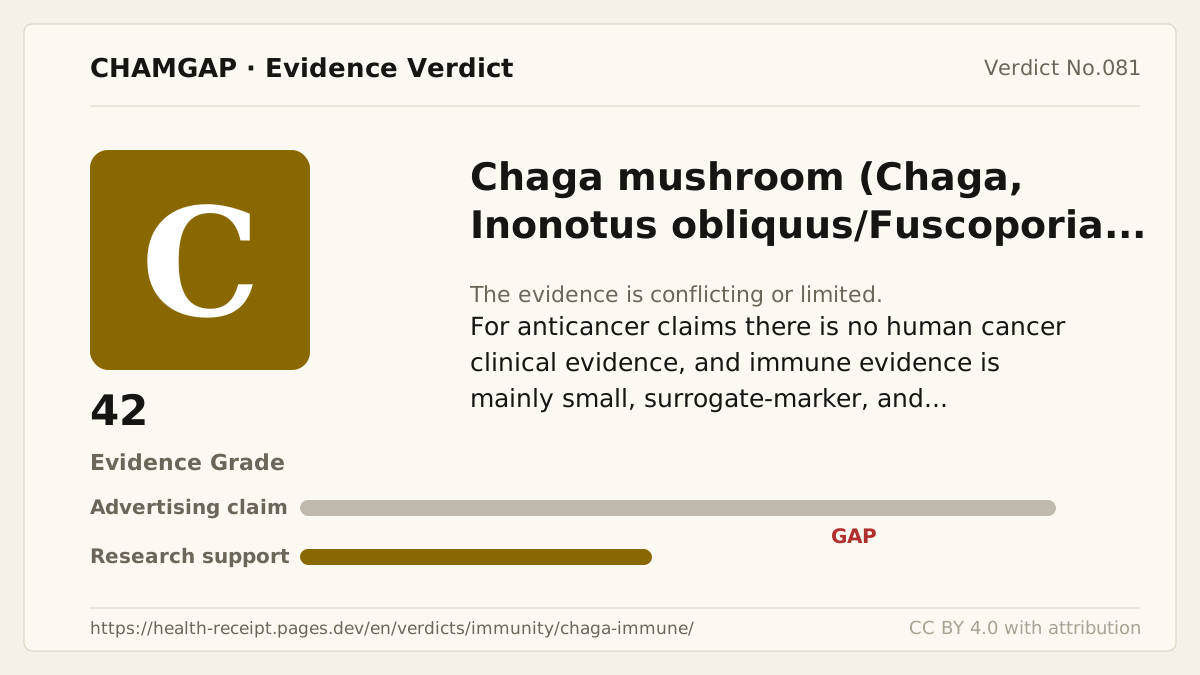
Boundary rules 1 and 3 were applied. For immune claims, human studies exist, but primary clinical endpoints are unclear or centered on surrogate markers and self-report, and independent replication is lacking. For anticancer claims, cell and animal models show signals, but there are no independent RCTs in cancer patients or data on survival, recurrence, or tumor response. A positive manufacturer report alone cannot support B, and because human proof is insufficient and surrogate-marker-centered, the rating is C, at the lower end, 42 points.
Counterpoint. Polysaccharides, triterpenes, and polyphenols in Chaga extracts show biological signals such as immunomodulation, antioxidant effects, and inhibition of cancer-cell proliferation in cell and animal models. Thus, a preclinical hypothesis exists, but current data are insufficient to say that immune enhancement or anticancer effects are clinically proven in humans.
Rejudgment record. Convergent — No human anticancer clinical evidence; immune evidence is also small, surrogate-marker, and manufacturer-linked.
Cross-check — Codex and Claude
Evidence Table
| Study | Design | Sample | Funding | Endpoint | Result | Weight |
|---|---|---|---|---|---|---|
| Yonei Y, Takahashi Y, Matsushita K, Watanabe M, Yoshioka T 2007 | Double-blind preclinical | 60 | In a double-blind 8-week RCT of 60 healthy adults, some markers changed, but NK cell activity did not change significantly and the conclusion did not clearly identify a preferred dose. | Supporting | ||
| Eevia Health Oyj 2021 | 40 | Possibly manufacturer/industry related | Gastrointestinal | In 40 long-distance runners, 4 weeks of Feno-Chaga reportedly reduced self-reported URTI symptoms by 51%, improved global mood by 10%, increased S. thermophilus by 61%, and reduced cortisol by 30%. | Core | |
| Najafzadeh M, Reynolds PD, Baumgartner A, Jerwood D, Anderson D 2007 | 20 | Gastrointestinal | Lymphocytes from 20 IBD patients and 20 healthy people were treated ex vivo, with H2O2-induced DNA damage reportedly reduced by 54.9% in patients and 34.9% in controls. | Core | ||
| Youn MJ et al. 2009 | Preclinical | In B16-F10 melanoma cells and BALB/c mouse models, the water extract showed cell-cycle arrest, apoptosis, and tumor-mass inhibition. | Supporting | |||
| Lee HS, Kim EJ, Kim SH 2015 | Preclinical | Possibly manufacturer/industry related | Gastrointestinal | In HT-29 colon cancer cells, 2.5-10 ug/mL ethanol extract reduced cell number/DNA synthesis and induced G1 arrest. | Supporting | |
| Fordjour E et al. 2023 | Meta-analysis/preclinical | Gastrointestinal/antioxidant | A review summarized antioxidant, anti-inflammatory, antiviral, and antitumor signals of Chaga, but stated that many traditional claims are based on in vitro/in vivo evidence and that more clinical/translational research is needed. | Supporting | ||
| Memorial Sloan Kettering Cancer Center | Preclinical | Immune/gastrointestinal | MSKCC summarizes that anticancer and immune effects are preclinical-centered and that safety and efficacy have not been evaluated in clinical trials; it also notes oxalate nephropathy and possible anticoagulant interactions. | Supporting | ||
| Lee S et al. 2026 | Preclinical | Stress | In rats receiving high-dose Chaga mushroom powder, proteinuria, oxalate crystal deposition, oxidative stress, and apoptosis markers increased. | Supporting | ||
| YTN 2015 | Immune/gastrointestinal | A jointly planned company-style article confirmed market wording around beta-glucan, immune enhancement, cancer prevention, and cancer-treatment usefulness. | Supporting | |||
| Study 10 | Preclinical | Immune/gastrointestinal | An informational article described Chaga beta-glucan/polyphenols as producing immune activation, anticancer effects, cell healing, and metastasis-prevention effects. | Supporting | ||
| Study 11 | Immune | Food Safety Korea immune-function ingredient lists include Phellinus linteus extract, beta-glucan powder, yeast beta-glucan, and shiitake mycelium AHCC, but Chaga mushroom alone was not confirmed. | Supporting |
Receipt — 11 References
Of 11 cited sources, 1 had limited original-page access (blocked or summary-only) and were verified via index/summary, marked partial; the rest were verified at the original page. As of 2026-07-07.
Reviewed and approved: Chamgap Editorial Team · Approval date: 2026-07-07 · Corrections: none
Cite this verdict
[Chamgap] Chaga mushroom × immune-function enhancement and anticancer/cancer-prevention or adjunct claims — Evidence Grade C·42. 11 cited sources checked. Source: https://chamgap.com/en/verdicts/immunity/chaga-immune/ · CC BY 4.0CC BY 4.0 — free to use with attribution; do not distort grades, numbers, or verdict meaning.
What this document does and does not do
Chamgap is an information source. It reports what research has and has not confirmed; it does not tell readers what to take or buy. That decision belongs to readers and, when needed, medical or legal professionals. This verdict reflects literature available up to the search date and may change as new research appears. Nothing here is medical advice.