
Nattokinase,
does it really help with Blood clots and blood circulation?
research showsHuman studies show signals that it may slightly lower blood pressure or move coagulation and peripheral-blood-flow surrogate markers. However, data clinically proving the removal of blood clots, prevention of vascular blockage, or improvement of blood-circulation diseases commonly claimed in advertising are insufficient, and in a long-term independent RCT, primary indicators related to atherothrombotic prevention were null.
ads claimKorean market advertisements and informational posts tend to use broad phrases including “dissolving blood clots,” “cleaning blood vessels,” “improving blood flow,” “inhibiting platelet aggregation,” “simultaneously improving blood pressure and blood flow,” “preventing cardiovascular disease,” and “improving cholesterol and triglycerides.” Some articles and product promotions introduce natto culture powder/NSK-SD as an MFDS individually recognized functional ingredient and present both “blood-flow improvement through inhibition of platelet aggregation” and “blood-pressure control.” Online health-information posts also include disease-treatment/prevention-like expressions such as preventing thrombus formation, treating vascular occlusion, and preventing hypertension.
Useful facts when choosing a product
- The common standardized unit in domestic advertising is FU (fibrinolytic unit), and many human studies used 2,000 FU/day or a single 2,000 FU dose.
- Natto culture powder/nattokinase raw materials from which vitamin K2 has been removed, such as NSK-SD, appear repeatedly.
- Even when advertised as blood-flow improvement, study endpoints are usually surrogate markers such as blood pressure, coagulation factors, platelet function analyzer, skin blood flow, and CIMT, not actual thrombotic events, myocardial infarction, stroke, or DVT.
- Nattokinase-only studies and combination products such as red yeast rice or fucoidan products should be distinguished. Positive combination-product results cannot be directly converted into effects of nattokinase alone.
- Caution is needed in users of antiplatelet or anticoagulant drugs, people with bleeding tendency, and perioperative situations because of theoretical bleeding risk and case reports.
What the research actually shows
The studies split by efficacy. For blood pressure, two 8-week RCTs and a 2023 RCT meta-analysis observed reductions of about 3-6 mmHg in SBP and about 2-3 mmHg in DBP, but this is a blood-pressure surrogate marker separate from blood-clot/blood-circulation claims. For thrombosis/coagulation, surrogate-marker changes such as fibrinogen, factor VII/VIII, D-dimer, aPTT, and C-EPI closure time were reported in Hsia 2009 open-label self-controlled study, Kurosawa 2015 12-person single-dose crossover RCT, and Yoo 2019 RCT analyzing 76 people. For direct blood flow, Watanabe 2018 15-person analyzed single-dose crossover study and Nara 2023 9-person crossover study showed short-term peripheral surrogate markers such as finger skin blood flow/skin-temperature recovery. Conversely, the largest long-term RCT, NAPS (Hodis 2021, 265 people, median 3 years), found no significant effect on CIMT and carotid arterial stiffness progression, blood pressure, or laboratory measurements. In Cochrane searches, CENTRAL trial records related to nattokinase were identified, but no Cochrane review on improvement of blood clots or blood flow by this ingredient was identified.
Why this is classified as D (34)
Under boundary rule 1, the primary endpoints of positive studies are almost all surrogate markers, so the maximum is C. Boundary rules 2 and 2b were then applied. The long-term, large NAPS RCT was null on key primary indicators of atherothrombotic prevention (CIMT/CAS), blood pressure, and laboratory markers, and positive peripheral-blood-flow studies were very small and single-dose measurements, with some tied to manufacturer funding or product provision. Therefore, the broad advertising claim of blood clots and blood circulation is judged D.
Counterpoint. It is not completely without evidence. Blood pressure reduction shows a consistent small effect in meta-analysis, and single-dose/short-term studies show signals in fibrinolysis/anticoagulation markers, finger peripheral blood flow, and recovery of skin temperature. However, these signals have not yet been connected to prevention or treatment of disease-related thrombosis or to clinically meaningful improvement in blood circulation.
Rejudgment record. convergent — Draft = blind D. Only coagulation/peripheral-blood-flow surrogate-marker signals; thrombotic/blood-flow clinical endpoints are null or absent.
Cross-check — Codex and Claude
Evidence Table
| Study | Design | Sample | Funding | Endpoint | Result | Weight |
|---|---|---|---|---|---|---|
| Kim JY et al. 2008 | RCT | 73 | not reported | blood pressure/thrombosis | 86 randomized, 73 completed; after 2,000 FU/day for 8 weeks, net change SBP -5.55 mmHg and DBP -2.84 mmHg. | core |
| Jensen GS et al. 2016 | not specified | 74 | possible manufacturer/industry involvement | blood pressure | 79 randomized, 74 completed; 100 mg/day for 8 weeks, DBP changed from 87 to 84 mmHg and was significant versus placebo, while vWF was trend-level in the female subgroup. | supporting |
| Hsia CH et al. 2009 | RCT | 45 | not reported | not specified | 45-person open-label self-controlled study; after 4,000 FU/day for 2 months, fibrinogen, factor VII, and factor VIII decreased. | core |
| Kurosawa Y et al. 2015 | double-blind | 12 | possible manufacturer/industry involvement | not specified | 12 healthy men in a double-blind placebo-controlled crossover; after a single 2,000 FU dose, D-dimer/FDP rose and factor VIII/aPTT/antithrombin changed, all within normal ranges. | core |
| Yoo HJ et al. 2019 | not specified | 76 | possible manufacturer/industry involvement | ALT/cholesterol | 100 people with hypercholesterolemia randomized, 76 analyzed; after 2,000 FU/day for 8 weeks, C-EPI CT (P=0.001) and aPTT (P=0.016) changed more than placebo. | supporting |
| Watanabe N et al. 2018 | not specified | 15 | possible manufacturer/industry involvement | skin | Healthy-adult crossover, analyzed n=15; after a single 2,000 FU dose, finger skin blood-flow change was significant versus placebo at 180 minutes (P=0.026), and change rates were significant at 120/180 minutes. | supporting |
| Nara N et al. 2023 | double-blind | 9 | not reported | skin/recovery | Nine healthy men in a double-blind placebo-controlled crossover; after a single 2,000 FU dose, treatment interaction P<0.05 for recovery of skin temperature in some hand regions after cold-water immersion. | supporting |
| Hodis HN et al. 2021 | RCT | 265 | not reported | liver/ALT/blood pressure | 265 people, median 3 years, 2,000 FU/day; no difference between nattokinase and placebo in annual changes in CIMT and carotid arterial stiffness, blood pressure, or laboratory measurements. | supporting |
| Li X et al. 2023 | meta-analysis/RCT | 6 | not reported | not specified | Six RCTs, 546 participants; SBP MD -3.45 mmHg, DBP MD -2.32 mmHg, triglycerides null, and low-dose lipid markers were also observed in an unfavorable direction. | supporting |
| Liu M et al. 2024 | RCT | 178 | possible manufacturer/industry involvement | gut | Stable CAD, 178 people, 4-arm RCT; lipid, DBP, thromboxane B2, and antithrombin III markers improved more in the NK+RYR combination group, but it is difficult to isolate the effect of NK alone. | supporting |
| Chang YY et al. 2008 | not specified | not reported | not specified | Case report of acute cerebellar hemorrhage after nattokinase 400 mg/day for 7 days in a patient taking aspirin. | supporting | |
| Ramachandran L et al. 2021 | not specified | not reported | not specified | Case report of hemoperitoneum and death in an elderly woman, with possible association with nattokinase use raised. | supporting |
Receipt — 12 References
Of 12 cited sources, 2 had limited original-page access (blocked or summary-only) and were verified via index/summary, marked partial; the rest were verified at the original page. As of 2026-07-07.
Reviewed and approved: Chamgap Editorial Team · Approval date: 2026-07-07 · Corrections: none
Cite this verdict
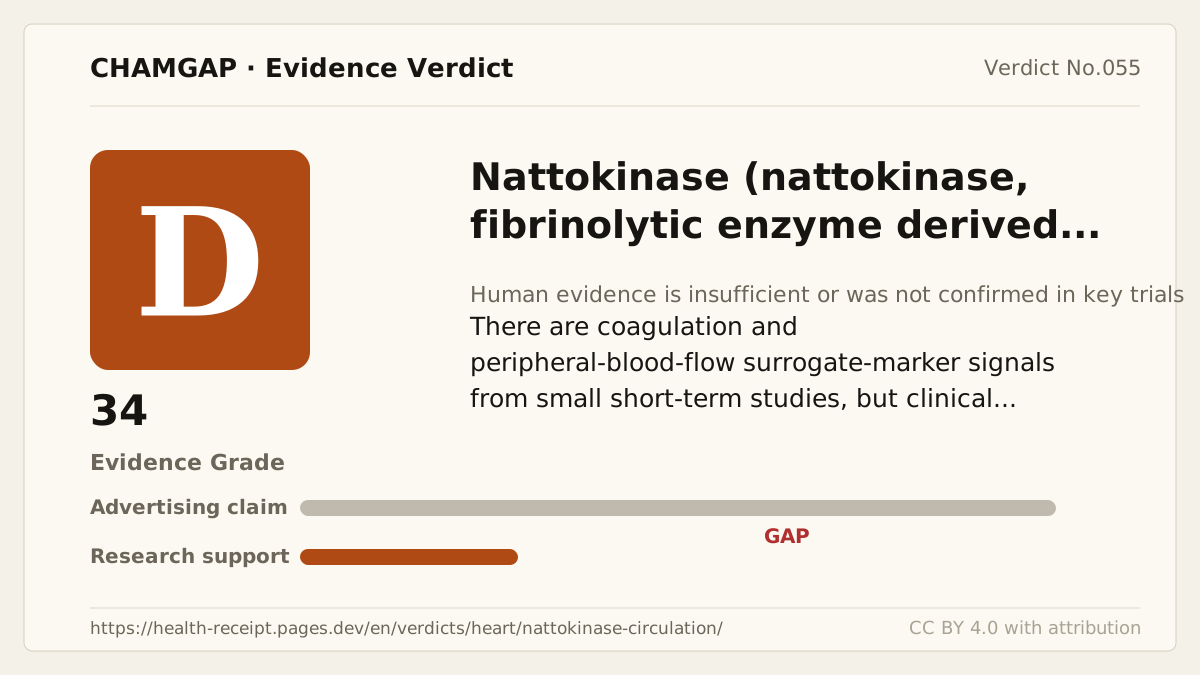
[Chamgap] Nattokinase x blood clots and blood circulation — Evidence Grade D·34. 12 cited sources checked. Source: https://chamgap.com/en/verdicts/heart/nattokinase-circulation/ · CC BY 4.0CC BY 4.0 — free to use with attribution; do not distort grades, numbers, or verdict meaning.
What this document does and does not do
Chamgap is an information source. It reports what research has and has not confirmed; it does not tell readers what to take or buy. That decision belongs to readers and, when needed, medical or legal professionals. This verdict reflects literature available up to the search date and may change as new research appears. Nothing here is medical advice.