
Oat beta-glucan,
does it really help with Blood cholesterol improvement (LDL-C and total cholesterol)?
research showsFor oat beta-glucan consumed at about 3 g/day or more in forms that preserve viscosity and molecular weight, human RCTs and meta-analyses repeatedly show small reductions in LDL-C and total cholesterol. The confirmed effect is improvement in blood lipid markers, not direct proof from large RCTs that cardiovascular events such as myocardial infarction or death are reduced. Tablet forms or low-viscosity/low-molecular-weight formulations may have reduced or absent effects.
ads claimDomestic market advertisements and informational articles tend to group together 'helps improve blood cholesterol,' 'LDL cholesterol drops,' 'vascular/heart health,' 'suppresses postprandial blood-glucose rise,' and 'weight, satiety, immunity.' Health functional foods and articles emphasize convenience, such as 3 g or 6-8 g of oat dietary fiber in one sachet or stick and 'one pack a day.' Oat dietary fiber appears as a listed functional ingredient for cholesterol improvement in Food Safety Korea's raw-material list, but this verdict evaluated only the human-trial evidence separately from regulatory recognition.
Useful facts when choosing a product
- The intake most repeatedly confirmed in clinical studies is about 3 g/day or more of oat beta-glucan, and trial duration was mainly 2-12 weeks.
- Effects concentrate on LDL-C and total cholesterol, while changes in HDL-C and triglycerides are generally not significant.
- Molecular weight, solubility, viscosity, and the food matrix determine the effect. High-molecular-weight formulations that preserve viscosity have many positive results, while a tablet-form trial had negative results.
- A domestic product's label of 'oat dietary fiber g' and actual 'beta-glucan g' may not mean the same thing, so product-specific functional-ingredient content needs to be checked.
- Products mixed with chromium, protein, plant sterols, or other plant extracts make it difficult to attribute any observed LDL change to oat beta-glucan alone.
What the research actually shows
Search results show many human RCTs for this ingredient x effect and systematic reviews/meta-analyses consistently report reductions in LDL-C and total cholesterol. Whitehead 2014 found that at least 3 g/day of oat beta-glucan produced LDL-C -0.25 mmol/L and total cholesterol -0.30 mmol/L across 28 RCTs. Ho 2016 found that a median 3.5 g/day produced LDL-C -0.19 mmol/L, non-HDL-C -0.20 mmol/L, and apoB -0.03 g/L across 58 RCTs (n=3974), although heterogeneity was large. Yu 2022 reported total cholesterol -0.24 mmol/L and LDL-C -0.27 mmol/L across 13 RCTs (n=927) in adults with hypercholesterolemia, while TG/HDL-C were not significant. At the RCT level, Wolever 2010, a multicenter double-blind trial (n=345), found LDL-C reductions of about 0.19-0.26 mmol/L with high-/medium-molecular-weight 3-4 g/day oat beta-glucan, and Wolever 2021, a beverage trial (n=191), found an LDL-C difference of 0.207 mmol/L. Conversely, the tablet-form trial by Rioux-Labrecque 2023 (n=263) did not meet the 12-week LDL-C primary endpoint at 1.5/3/6 g/day. Combination-product trials (for example, with plant sterols) were separated from the main-effect evidence for this verdict. During the search, no large independent RCT of cardiovascular events for standalone oat beta-glucan or separate Cochrane Review was identified, although some meta-analyses included Cochrane CENTRAL as a search source.
Why this is classified as A (88)
A. Many human RCTs exist, and 2014, 2016, 2022, and 2023 meta-analyses repeatedly confirm reductions in LDL-C/total cholesterol. Positive evidence is not entirely manufacturer-funded, and public/academic funding or no-conflict meta-analyses also exist. The score is not near 100 because the effect size is generally small, trials are short, direct cardiovascular event evidence beyond lipid markers is lacking, some key RCTs/meta-analyses include industry funding or ingredient-company data, and a 2023 tablet-form RCT was negative.
Counterpoint. The evidence for improving cholesterol levels themselves is strong, but saying it 'prevents heart disease' is an inference through LDL-C as a risk marker. Also, a 2023 tablet-form RCT found no LDL-C reduction even at 3-6 g/day, so beta-glucan content alone does not guarantee efficacy. Gastrointestinal symptoms such as bloating, gas, and diarrhea can increase depending on dose and formulation.
Rejudgment record. Convergent — Oat beta-glucan 3 g/day has consistent RCT and meta-analytic evidence for lowering LDL and total cholesterol, with health claims by multiple regulators. Safety good. Highest score in this batch
Cross-check — Codex and Claude
Evidence Table
| Study | Design | Sample | Funding | Endpoint | Result | Weight |
|---|---|---|---|---|---|---|
| Yu J et al. 2022 | Meta-analysis of RCTs | 927 | Mixed; some industry-related involvement | LDL-C/cholesterol | Meta-analysis of 13 RCTs (n=927) in adults with hypercholesterolemia: total cholesterol -0.24 mmol/L, LDL-C -0.27 mmol/L, with no change in TG/HDL-C. | Core |
| Whitehead A, Beck EJ, Tosh SM, Wolever TMS 2014 | Meta-analysis of RCTs | Possible manufacturer/industry involvement | liver/LDL-C/cholesterol | Across 28 RCTs, at least 3 g/day oat beta-glucan showed LDL-C -0.25 mmol/L and total cholesterol -0.30 mmol/L. | Core | |
| Ho HVT et al. 2016 | Meta-analysis of RCTs | 3974 | Possible manufacturer/industry involvement | LDL-C | Across 58 RCTs (n=3974), median 3.5 g/day showed LDL-C -0.19 mmol/L, non-HDL-C -0.20 mmol/L, and apoB -0.03 g/L. | Core |
| Costa de Miranda R et al. 2023 | Meta-analysis of RCTs | 1494 | Mixed; some industry-related involvement | In 28 blinded RCTs (n=1494), both whole oats and isolated beta-glucan improved lipid profiles, with no change in HDL-C. | Core | |
| Wolever TMS et al. 2010 | Double-blind RCT | 345 | Possible manufacturer/industry involvement | LDL-C | In a multicenter double-blind RCT (n=345 completed), high-/medium-molecular-weight 3-4 g/day oat beta-glucan cereal lowered LDL-C by 0.19-0.26 mmol/L, while low molecular weight was not significant. | Supporting |
| Wolever TMS et al. 2021 | Double-blind RCT | 191 | Possible manufacturer/industry involvement | LDL-C/gut/gastrointestinal | In a double-blind RCT (n=191 analyzed), a high-molecular-weight oat beta-glucan beverage 3 g/day for 4 weeks lowered LDL-C by 0.207 mmol/L versus control. | Supporting |
| Cicero AFG et al. 2020 | Double-blind RCT | 83 | Mixed; some industry-related involvement | LDL-C | In a crossover double-blind RCT (n=83), LDL-C decreased by an average of 0.59 mmol/L after 3 g/day oat beta-glucan for 8 weeks. | Supporting |
| Rioux-Labrecque V et al. 2023 | RCT | 263 | Possible manufacturer/industry involvement | LDL-C | In a tablet-form beta-glucan RCT (n=263), 1.5/3/6 g/day all failed to show significance versus placebo for the 12-week LDL-C primary endpoint and other lipid markers. | Supporting |
Receipt — 8 References
All 8 cited sources were verified for existence at the original page (as of 2026-07-07).
Reviewed and approved: Chamgap Editorial Team · Approval date: 2026-07-07 · Corrections: none
Cite this verdict
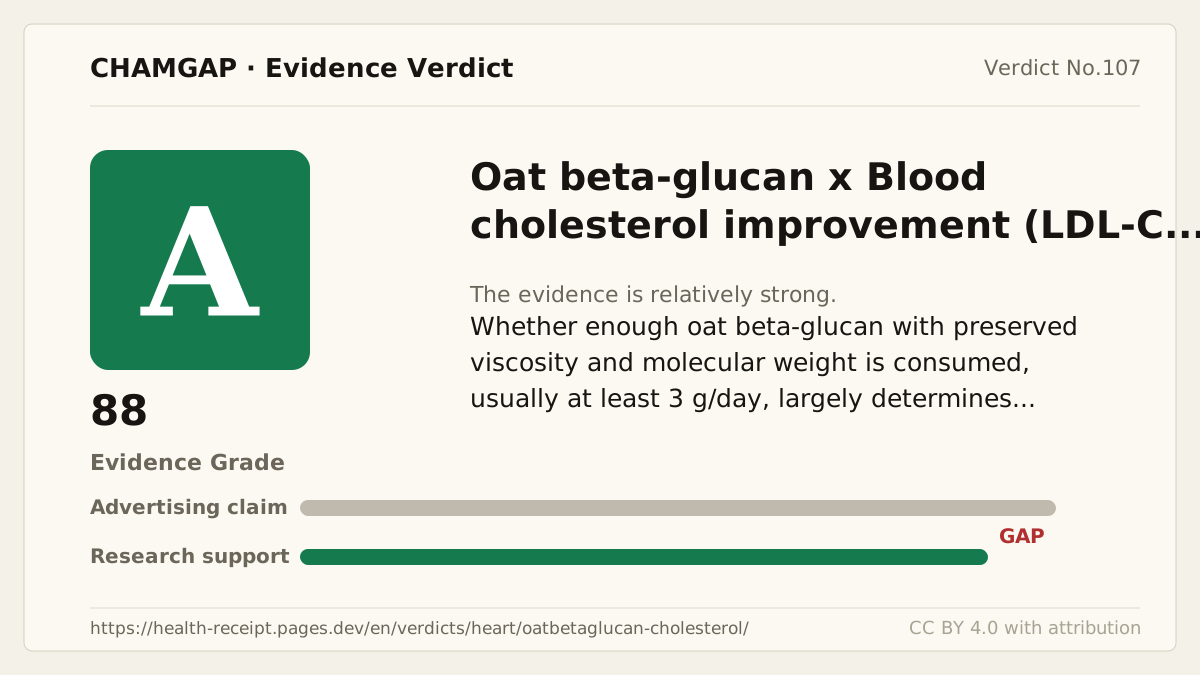
[Chamgap] Oat beta-glucan x blood cholesterol improvement (LDL-C and total cholesterol) — Evidence Grade A·88. 8 cited sources checked. Source: https://chamgap.com/en/verdicts/heart/oatbetaglucan-cholesterol/ · CC BY 4.0CC BY 4.0 — free to use with attribution; do not distort grades, numbers, or verdict meaning.
What this document does and does not do
Chamgap is an information source. It reports what research has and has not confirmed; it does not tell readers what to take or buy. That decision belongs to readers and, when needed, medical or legal professionals. This verdict reflects literature available up to the search date and may change as new research appears. Nothing here is medical advice.