
Garlic,
does it really help with Blood pressure and cholesterol?
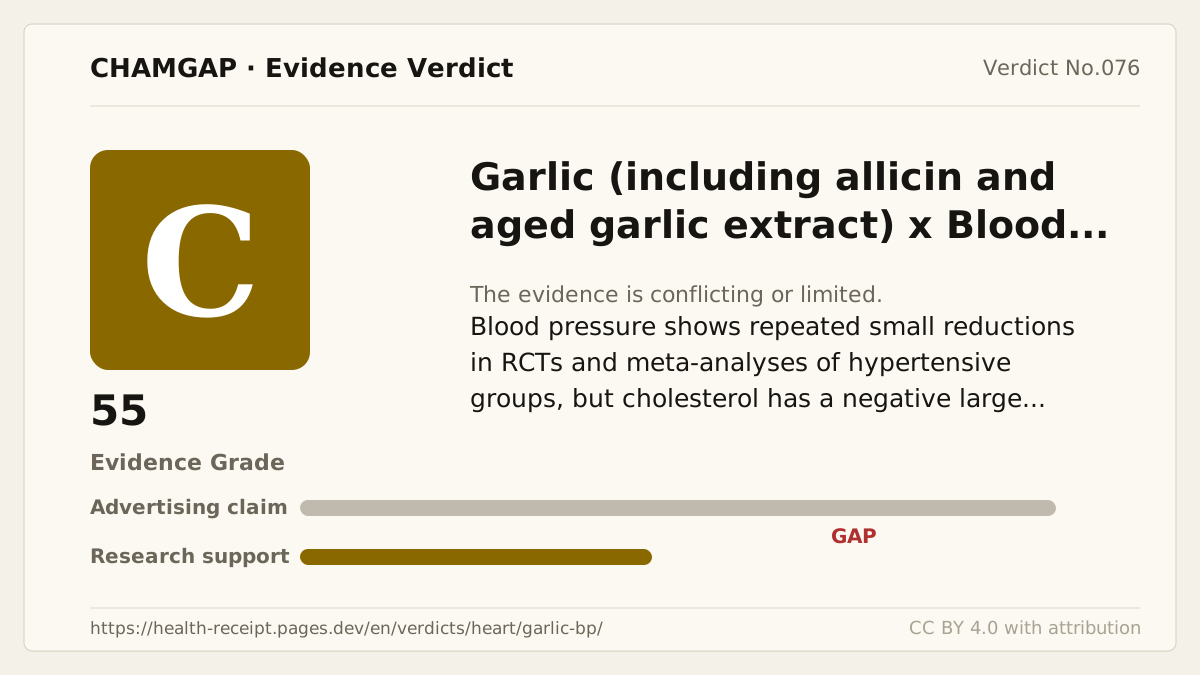
research showsGarlic and aged garlic extract repeatedly show RCT and meta-analytic signals of lowering blood pressure by a few mmHg in people with hypertension. However, the outcomes are mainly surrogate markers such as blood pressure and lipids, and many studies are small or involve specific aged garlic extract products and manufacturer funding. For cholesterol, older small studies and meta-analyses show signals of lower total cholesterol and LDL, but in an independent 192-person 6-month RCT, raw garlic, garlic powder, and aged garlic extract all had no meaningful effect on LDL or other lipids. Therefore, the draft judgment is "some evidence for blood pressure, limited expectations for cholesterol."
ads claimIn Korean market and informational content, garlic powder wording such as "may help improve blood cholesterol" and later added functionality wording "may help regulate blood pressure" are repeatedly cited. General health articles and SNS/video content use explanations involving allicin, ACE inhibition, nitric oxide, LDL reduction, and HDL increase to make broad claims that garlic "lowers blood pressure and cholesterol." Some content implies treatment substitution, such as "why you do not need hypertension drugs," but the evidence literature is mostly adjunctive marker-change research.
Useful facts when choosing a product
- In the Korean notified-functionality context, garlic powder uses alliin as a marker compound and wording about helping improve blood cholesterol; policy materials present a daily powder intake condition of 0.6-1.0 g.
- A 2022 Ministry of Agriculture, Food and Rural Affairs material explains that a blood-pressure regulation item was added to garlic functionality. Regulatory recognition is treated separately from the evidence grade here.
- Aged garlic extract (AGE/Kyolic) differs in composition from raw-garlic allicin products, and major RCTs usually used AGE 1.2 g/day and S-allylcysteine 1.2 mg/day.
- The 2007 large lipid RCT directly compared raw garlic equivalent to 4 g, Garlicin powder, and Kyolic aged extract, but found no significant effect on LDL-C or other lipids.
- Garlic supplements are generally tolerated, but odor, gastrointestinal discomfort, reflux, and belching are reported; possible interactions should be considered with anticoagulants/antiplatelets, perioperative periods, and blood-pressure medications.
What the research actually shows
Blood pressure: a 2008 BMC meta-analysis reported reductions of about SBP 8.4 mmHg and DBP 7.3 mmHg in the hypertensive subgroup among 11 RCTs. A 2015 Am J Hypertens meta-analysis of 9 double-blind RCTs and 482 participants also reported SBP -9.1 mmHg and DBP -3.8 mmHg, but concluded heterogeneity was high and study quality was moderate. A Cochrane review judged evidence for prevention of cardiovascular events and mortality in hypertensive patients insufficient, with only 2 eligible RCTs and 87 participants. Aged garlic extract RCTs over 12 weeks and 49-88 participants showed SBP reductions of about 5-10 mmHg, but Wakunaga/Kyolic products and manufacturer support recur. Cholesterol: a 2007 JAMA Internal Medicine RCT randomized 192 adults with LDL 130-190 mg/dL to raw garlic, Garlicin, Kyolic, or placebo for 6 months and found no significant effect on the primary endpoint LDL-C. Some meta-analyses report reductions in total cholesterol and LDL, but effect size and robustness are unstable.
Why this is classified as C (55)
For blood pressure alone, repeated RCTs and meta-analyses show a signal close to B, but the primary endpoint is the surrogate marker of blood pressure, and Cochrane judged evidence on long-term cardiovascular events and mortality to be insufficient. Positive aged garlic extract RCTs are small and repeatedly involve the same researchers, products, and manufacturer support. For cholesterol, meta-analyses show positive signals, but the most rigorous 192-person 6-month RCT was negative, so the composite claim cannot be upgraded. Reflecting surrogate-marker focus and imbalance in the composite claim, the rating is C, 55 points.
Counterpoint. If the claim is narrowed to "some garlic/AGE preparations may lower blood pressure readings in people with hypertension," human RCT and meta-analytic evidence does exist. However, extending this to "definitely lowers blood pressure and cholesterol to prevent cardiovascular disease" goes beyond current evidence.
Rejudgment record. Convergent — Small blood-pressure-lowering signals recur in hypertensive groups, but cholesterol evidence is weak and outcomes are surrogate markers with varied formulations.
Cross-check — Codex and Claude
Evidence Table
| Study | Design | Sample | Funding | Endpoint | Result | Weight |
|---|---|---|---|---|---|---|
| Ried K, Frank OR, Stocks NP, Fakler P, Sullivan T 2008 | Meta-analysis/RCT | Possibly manufacturer/industry related | Blood pressure/gastrointestinal | An 11-RCT meta-analysis found overall SBP -4.6 mmHg and hypertensive-subgroup signals of SBP -8.4 mmHg and DBP -7.3 mmHg. | Core | |
| Rohner A, Ried K, Sobenin IA, Bucher HC, Nordmann AJ 2015 | Double-blind systematic review/RCT | 482 | Possibly manufacturer/industry related | Gastrointestinal | In 9 double-blind RCTs and 482 participants, SBP was -9.1 mmHg and DBP -3.8 mmHg, but heterogeneity was high and the evidence was not strong. | Core |
| Stabler SN, Tejani AM, Huynh F, Fowkes C 2012 | RCT | 87 | Blood pressure | The review evaluated prevention of cardiovascular morbidity and mortality in hypertensive patients, but only 2 RCTs with 87 participants were eligible and clinical outcomes were not reported, so evidence was insufficient. | Core | |
| Ried K, Travica N, Sali A 2016 | Double-blind RCT | 88 | Possibly manufacturer/industry related | Liver | In a 12-week double-blind RCT of 88 people, AGE 1.2 g/day produced an office SBP between-group difference of -5.0 mmHg (p=0.02). | Core |
| Ried K, Travica N, Sali A 2018 | Double-blind RCT | 49 | Possibly manufacturer/industry related | Blood pressure | In a 12-week double-blind RCT of 49 people, AGE 1.2 g/day produced placebo-adjusted SBP -10.0±3.6 and DBP -5.4±2.3 mmHg. | Supporting |
| Tang Y, Lei Y, Xu M et al. 2025 | Meta-analysis/RCT | Gastrointestinal | A 2025 meta-analysis of 10 RCTs found SBP -4.21 and DBP -3.13 mmHg; effects were limited and GI discomfort and garlic breath were common adverse events. | Supporting | ||
| Gardner CD, Lawson LD, Block E et al. 2007 | RCT | 192 | Possibly manufacturer/industry related | LDL | In a 6-month RCT of 192 adults with LDL-C 130-190 mg/dL, raw garlic, Garlicin, and Kyolic all had no significant effect on LDL-C or other lipids. | Supporting |
| Stevinson C, Pittler MH, Ernst E 2000 | Meta-analysis/RCT | Possibly manufacturer/industry related | Cholesterol | A signal suggested total cholesterol reduction superior to placebo, but the effect was small and robustness was questioned. | Supporting | |
| Sun YE, Wang W, Qin J 2018 | Meta-analysis | Mixed/partly industry related | LDL/anxiety | A meta-analysis found reductions in TC and LDL and nonsignificant TG; HDL results were unstable in sensitivity analysis. | Supporting | |
| Study 10 | Cholesterol/blood pressure/gastrointestinal | Korean policy material explains that a blood-pressure regulation item was added to garlic functionality and that a previous cholesterol-improvement function existed. | Supporting | |||
| Study 11 | Cholesterol/gastrointestinal | A policy briefing reported recognized functionality for helping improve blood cholesterol under garlic powder 0.6-1.0 g/day conditions. | Supporting | |||
| Study 12 | Cholesterol/blood pressure/gastrointestinal | Public information describes allicin/alliin, blood pressure/cholesterol, and Korean functional-ingredient context. | Supporting | |||
| Study 13 | LDL/cholesterol/blood pressure/gastrointestinal | A public article explains blood-pressure and cholesterol lowering using allicin, ACE, NO, and LDL/HDL logic. | Supporting |
Receipt — 13 References
Of 13 cited sources, 3 had limited original-page access (blocked or summary-only) and were verified via index/summary, marked partial; the rest were verified at the original page. As of 2026-07-07.
Reviewed and approved: Chamgap Editorial Team · Approval date: 2026-07-07 · Corrections: none
Cite this verdict
[Chamgap] Garlic × blood pressure and cholesterol — Evidence Grade C·55. 13 cited sources checked. Source: https://chamgap.com/en/verdicts/heart/garlic-bp/ · CC BY 4.0CC BY 4.0 — free to use with attribution; do not distort grades, numbers, or verdict meaning.
What this document does and does not do
Chamgap is an information source. It reports what research has and has not confirmed; it does not tell readers what to take or buy. That decision belongs to readers and, when needed, medical or legal professionals. This verdict reflects literature available up to the search date and may change as new research appears. Nothing here is medical advice.