
Cinnamon,
does it really help with blood glucose?
research showsCinnamon repeatedly shows signals of slightly lowering fasting or postprandial glucose in short human trials and meta-analyses. However, longer-term outcomes such as HbA1c and diabetes prevention/treatment have not been consistently proven, and formulation, species, and dose differences are large, making effect size difficult to generalize.
ads claimIn the Korean market, cinnamon appears as powders, pills, capsules, and Ceylon cinnamon products together with phrases such as 'blood-glucose management,' 'blood-glucose control,' 'natural insulin,' 'diabetes prevention,' and 'postprandial blood-glucose care.' Coupang search results contained not only cinnamon-alone products but many combinations mixed with banaba leaf extract, chromium, berberine, bitter melon, gymnema, and other ingredients. Informational articles and blogs tended to emphasize insulin sensitivity, cinnamtannin B1, postprandial glucose relief, and the low coumarin content of Ceylon cinnamon.
Useful facts when choosing a product
- Ordinary cinnamon/cinnamon powder is sold as food/spice and also as supplements in capsule, pill, or extract form. Products differ in whether they are labeled general foods or health functional foods.
- To determine whether a domestic product is a health functional food, the package should be checked for the phrase 'health functional food,' certification mark, functional ingredient name, functional content, and intake amount. Cinnamon contained in ordinary food does not automatically mean the product is recognized for blood-glucose functionality.
- Online blood-glucose products are commonly blended with banaba, chromium, berberine, bitter melon, and other ingredients rather than cinnamon alone. Effects advertised for combinations must be separated from cinnamon-alone RCT evidence.
- Cassia cinnamon may have higher coumarin content than Ceylon cinnamon, so species and coumarin control are safety variables for high-dose, long-term products.
What the research actually shows
Single-ingredient cinnamon powder or water-extract RCTs were conducted for about 4 to 16 weeks in people with type 2 diabetes, prediabetes, and obesity/prediabetes. Several meta-analyses repeatedly reported fasting-glucose reductions (for example, a 2019 meta-analysis of 16 RCTs found FBG WMD -0.545 mmol/L; a 2023 umbrella meta-analysis found FPG -10.93 mg/dL). In contrast, Cochrane 2012 found no significant difference in HbA1c, insulin, or postprandial glucose and concluded the evidence was insufficient. A 2017 Korean meta-analysis also found fasting glucose decreased but HbA1c was not significant, the cinnamon-powder fasting-glucose analysis had large heterogeneity, and the effect disappeared when only blinded trials were examined. A 2020 prediabetes RCT (n=54) reported an approximately 5 mg/dL between-group FPG difference after 12 weeks as the primary endpoint, and a small 2024 crossover RCT (n=18) lowered CGM 24-hour glucose and peak. The early famous positive trial (Khan 2003) became subject to an Expression of Concern in Diabetes Care in 2025, which lowers confidence.
Why this is classified as B (66)
B: there are several human RCTs and meta-analyses, and fasting-glucose reduction signals recur. However, most trials are short and small, and cinnamon species, powder/extract form, dose, and background diabetes medications differ greatly. HbA1c, a long-term glycemic marker, is inconsistent across meta-analyses, and clinical outcomes such as diabetes incidence, complications, and quality of life are nearly absent. An early key positive trial received an Expression of Concern in 2025. Therefore the judgment is B, not A.
Counterpoint. Since 2023, umbrella meta-analyses and newer meta-analyses report statistically small reductions even in HbA1c. Small prediabetes RCTs and CGM crossover trials are additional independent positive signals. However, the effect is mainly on glycemic markers, is small, and has short follow-up, so 'may lower blood glucose a little' must be separated from 'prevents or treats diabetes.'
Rejudgment record. Draft and blinded review converged — Fasting glucose repeatedly shows a small decrease in short-term RCTs and meta-analyses, but HbA1c, diabetes prevention, and long-term clinical outcomes are unstable and formulation heterogeneity is large, so it remains B.
Cross-check — Codex and Claude
Evidence Table
| Study | Design | Sample | Funding | Endpoint | Result | Weight |
|---|---|---|---|---|---|---|
| Leach MJ, Kumar S 2012 | RCT | 577 | not reported | glycemia/HbA1c | 10 RCTs (n=577), mainly C. cassia at an average 2 g/day for 4-16 weeks; FBG was uncertain, HbA1c/insulin/postprandial glucose had no significant difference, and there were no clinical-outcome data. | core |
| Allen RW et al. 2013 | meta-analysis of RCTs | not reported | glycemia/HbA1c | Updated meta-analysis of 10 RCTs; concluded that fasting glucose and lipids showed reduction signals, HbA1c was not significant, and heterogeneity was large. | core | |
| Deyno S et al. 2019 | meta-analysis of RCTs | possible manufacturer/industry involvement | HbA1c | 16 RCTs; FBG WMD -0.545 mmol/L and HOMA-IR -0.714 decreased, but HbA1c was not significant and heterogeneity was high. | core | |
| Zarezadeh M et al. 2023 | meta-analysis of RCTs | not reported | HbA1c | Umbrella meta-analysis recombining 11 RCT meta-analyses; reported FPG WMD -10.93 mg/dL and HbA1c WMD -0.10% reductions. | core | |
| Efficacy of cinnamon supplementation on glycolipid metabolism in T2DM diabetes: a meta-analysis and systematic review 2022 | meta-analysis of RCTs | 1,020 | possible manufacturer/industry involvement | HbA1c | 15-16 RCTs, about 1,020 participants; positive findings such as FPG SMD -0.54 and HbA1c SMD -0.63, but HbA1c publication bias and study flaws were reported. | supportive |
| Study 6 | meta-analysis | 709 | possible manufacturer/industry involvement | HbA1c | 14 studies (n=709); cinnamon dry powder FBG -1.55 mmol/L, water extract FBG -0.76 mmol/L, and HbA1c was not significant. | supportive |
| Khan A et al. 2003 | not specified | 60 | not reported | AST | 60 people with T2D, 1/3/6 g/day for 40 days; reported 18-29% reductions in fasting serum glucose, but became subject to a 2025 Expression of Concern. | supportive |
| Vanschoonbeek K et al. 2006 | not specified | possible manufacturer/industry involvement | not specified | In postmenopausal women with T2D, 1.5 g/day for 6 weeks; concluded there was no improvement in insulin sensitivity, OGTT, or lipids. | supportive | |
| Blevins SM et al. 2007 | RCT | possible manufacturer/industry involvement | HbA1c | Independent negative trial in T2D using 1 g/day for about 3 months in an RCT; showed no significant improvement in glucose, lipids, or HbA1c. | supportive | |
| Romeo GR et al. 2020 | RCT | 54 | possible manufacturer/industry involvement | liver/glycemia | Prediabetes 54 participants, 500 mg TID for 12 weeks; primary endpoint FPG between-group difference about 5 mg/dL, OGTT AUC and 2-hour glucose improved, and no SAE occurred. | supportive |
| Zelicha H et al. 2024 | RCT | 18 | not reported | liver/glycemia | Crossover RCT in 18 participants with obesity/prediabetes; 4 g/day for 4 weeks lowered CGM 24-hour glucose and peak, but the sample was very small. | supportive |
| NCCIH | not specified | not reported | liver/gastrointestinal | At spice levels, cinnamon is generally safe, but high-dose/long-term supplement use presents possible gastrointestinal symptoms, allergy, and cassia coumarin-liver issues. | supportive | |
| German Federal Institute for Risk Assessment (BfR) | not specified | not reported | not specified | Explains that coumarin TDI is 0.1 mg/kg/day, and a 60 kg adult can reach the TDI with 2 g/day average-coumarin cassia cinnamon. | supportive |
Receipt — 13 References
Of 13 cited sources, 4 had limited original-page access (blocked or summary-only) and were verified via index/summary, marked partial; the rest were verified at the original page. As of 2026-07-07.
Reviewed and approved: Chamgap Editorial Team · Approval date: 2026-07-07 · Corrections: none
Cite this verdict
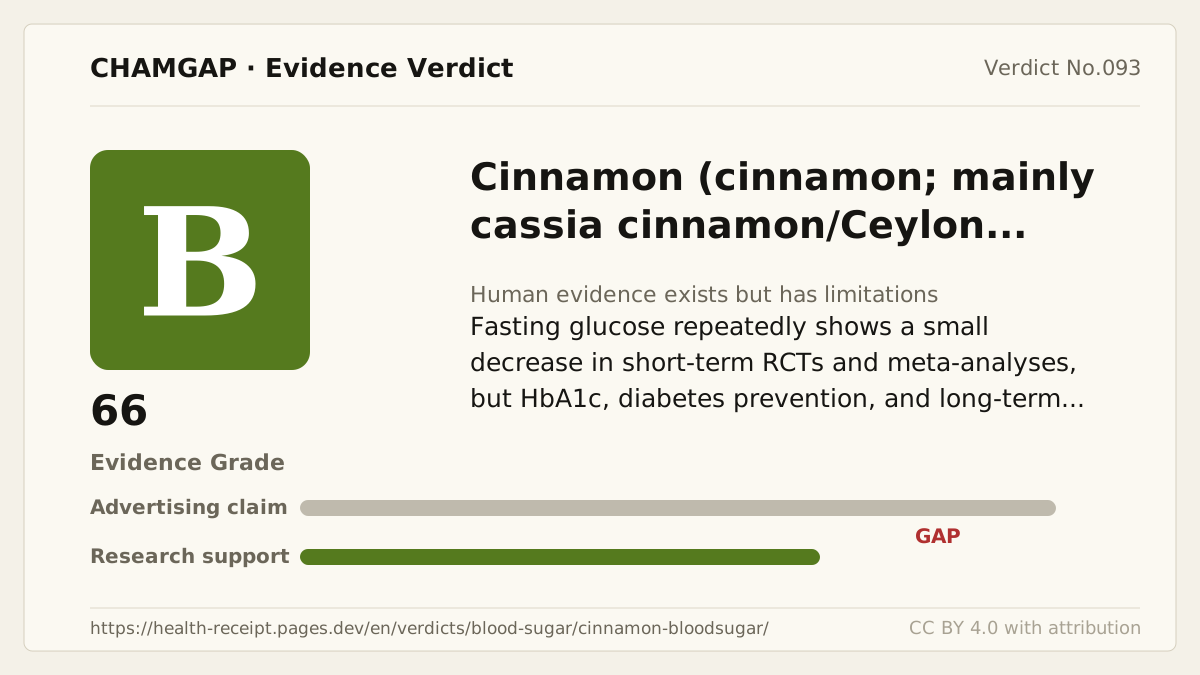
[Chamgap] Cinnamon (cinnamon; mainly cassia cinnamon/Ceylon cinnamon and cinnamon extract) × blood glucose — Evidence Grade B·66. 13 cited sources checked. Source: https://chamgap.com/en/verdicts/blood-sugar/cinnamon-bloodsugar/ · CC BY 4.0CC BY 4.0 — free to use with attribution; do not distort grades, numbers, or verdict meaning.
What this document does and does not do
Chamgap is an information source. It reports what research has and has not confirmed; it does not tell readers what to take or buy. That decision belongs to readers and, when needed, medical or legal professionals. This verdict reflects literature available up to the search date and may change as new research appears. Nothing here is medical advice.