
Bitter melon and Jerusalem artichoke,
does it really help with blood-glucose control?
research showsThe two ingredients must be separated. Bottom line: the level of effect that advertising makes consumers expect from 'blood-glucose control by eating bitter melon/ Jerusalem artichoke' is not supported by human evidence, especially in independent clinical evidence without conflicts. Bitter melon: meta-analyses of human RCTs reach opposite conclusions. Independent meta-analyses without funding/conflict issues did not confirm effects. A 2024 meta-analysis (9 trials, 414 participants, low heterogeneity) reported no difference from placebo for fasting glucose or HbA1c and concluded that current evidence cannot determine bitter melon's metabolic effect; a 2014 meta-analysis also declared no conflicts and called evidence 'inconclusive.' In contrast, a 2025 meta-analysis reporting statistically significant reductions had low to very low GRADE certainty, very high heterogeneity (I²≈87-89%), and publication bias; after correction, HbA1c effect size fell by about 65%. A 2024 Heliyon positive meta-analysis found HbA1c reduction of -0.38%. A 2011 RCT in newly diagnosed diabetes showed partial effect only at high dose 2g/day and still less than active comparator metformin. A manufacturer-funded 2022 RCT (Greenyn) found no significant difference from placebo in prespecified primary analysis and became significant only after post hoc subgrouping. Jerusalem artichoke/inulin: this is a separate ingredient with a different mechanism. Human evidence is only one small acute study measuring one-meal postprandial glucose/GIP, with significant reduction observed at raw tuber 100g or more; no intervention trial on long-term glycemic control (HbA1c) was found. Regulation: based on public data, raw 'bitter melon juice' or 'Jerusalem artichoke juice' ordinary foods have no MFDS blood-glucose functionality. Related functionality labeling is known to be possible only in health functional foods using standardized ingredients such as immature bitter melon ethanol extract powder (individual recognition, postprandial glucose-rise suppression) and inulin/chicory extract (generic ingredient); recognition numbers/doses/currentness are follow-up items. In short, standardized ingredients may have limited 'postprandial glucose-rise suppression' functionality, but this is limited to postprandial surrogate markers; raw juice/powder 'blood-glucose control' claims are not confirmed in independent clinical evidence. Bitter-melon positives concentrate in low-certainty/high-heterogeneity/industry-funded/post hoc analyses; Jerusalem artichoke lacks long-term glycemic evidence.
ads claimAdvertisements tend to erase weak/conflicting/population-limited evidence and appeal to 'blood-glucose control' based only on ingredient names. (1) Atomy 'Blood Sugar Cut Bitter Melon' (health functional food): wording 'may help suppress postprandial blood-glucose rise' is known to be within immature bitter melon ethanol extract powder individual-recognition scope, but it expands the limited surrogate marker 'postprandial glucose-rise suppression' into a broader impression such as 'blood-glucose health/manager.' Postprandial rise suppression and long-term blood-glucose control differ. (2) Yuhan 'Blood Sugar Care Bitter Melon Liver Plus' (pharmacy HFF): similarly known to be based on immature bitter melon individual recognition; article body access 403 prevented exact quotation, so wording recheck is needed. (3) Otirang 'Kim Sohyung Wonbang Good Dang' (ordinary juice): within confirmed scope, described as saying bitter melon polypeptide P/charantin and Jerusalem artichoke inulin are known to help blood-glucose control/absorption control. It is ordinary food with no MFDS blood-glucose functionality granted to that product. Such raw-juice blood-glucose efficacy appeals may raise unfair-advertising concerns, but legality is a follow-up legal/compliance issue. (4) Cham&Deul 'Jerusalem artichoke bitter melon juice' (ordinary juice): sold by grouping two raw ingredients in a blood-glucose context without functional/active content labeling; exact 'blood-glucose' wording could not be directly quoted due to page access limits. Common problems: ordinary juice vs standardized HFF are conflated; bitter melon weak/conflicting evidence and Jerusalem artichoke acute surrogate evidence are lumped together; patient/prediabetes study populations are generalized to ordinary blood-glucose management.
Useful facts when choosing a product
- In bitter melon RCTs, significant effect was observed only at high dose 2g/day, 500mg was null, and 1g had similar change magnitude but did not reach significance; lower doses tended to be weaker, so generalization to low-dose market juices is difficult.
- Regulatory core based on public data: raw bitter melon juice/Jerusalem artichoke juice itself has no MFDS-recognized blood-glucose functionality; only HFFs using standardized immature bitter melon ethanol extract powder and inulin/chicory extract are known to have related functionality labeling. Recognition number/dose/currentness require follow-up.
- Atomy 'Blood Sugar Cut Bitter Melon' is a health functional food using immature bitter melon ethanol extract powder and displaying 'may help suppress postprandial blood-glucose rise.' This is a surrogate postprandial marker and differs from long-term 'blood-glucose control.'
- Yuhan 'Blood Sugar Care Bitter Melon Liver Plus' is presumed to use the same immature bitter melon individual-recognition ingredient; exact ad wording could not be quoted due to 403 access.
- Otirang 'Kim Sohyung Wonbang Good Dang' is described as a health juice (ordinary food) containing Jerusalem artichoke, bitter melon, and banaba leaf, with no MFDS blood-glucose functionality granted to that product; ingredient appeals may raise unfair-advertising concerns, legal judgment requires follow-up.
- Cham&Deul 'Jerusalem artichoke bitter melon juice' appears to group two raw ingredients for blood-glucose appeal without active-content/functionality labeling; exact wording could not be directly checked due to access limits.
- Bitter melon and Jerusalem artichoke (inulin) have different mechanisms; evidence for one should not be transferred to the other.
What the research actually shows
Human clinical evidence is limited for both, and bitter melon is especially conflicting/unstable. Key point: the independent no-conflict layer does not confirm effect. [Bitter melon] Meta-analyses of RCTs in prediabetes/type 2 diabetes patients conflict. Independent layers are negative: (1) 2024 Frontiers in Nutrition (Laczkó-Zöld et al., 9 RCTs, n=414, no funding/conflict issue stated): fasting glucose MD=-0.03 (95%CI -0.38~0.31, I²=34%), HbA1c MD=-0.12 (95%CI -0.35~0.11, I²=56%), both meaningless vs placebo, conclusion 'metabolic effect cannot be determined.' (2) 2014 Nutrition & Diabetes (Yin et al., no COI): HbA1c -0.13% (95%CI -0.41~0.16), meaningless, 'inconclusive.' Positive results concentrate in low certainty/high heterogeneity/industry/post hoc: (3) 2025 Metabolism Open (Mkhize et al.): HbA1c SMD=-0.57 (95%CI -0.83~-0.31, p<0.0001, I²=87%), fasting glucose SMD=-0.46 (95%CI -0.73~-0.18, p=0.0012, I²=89%), but GRADE low to very low and HbA1c publication bias (Egger p=0.0016) with trim-and-fill reducing effect about 65%. (4) 2024 Heliyon (Zhang et al., 8 RCTs, n=423): fasting glucose -0.85mmol/L (95%CI -1.44~-0.26, p=0.005), HbA1c -0.38% (95%CI -0.53~-0.23, p<0.001), but authors call for high-quality studies. (5) Fuangchan 2011: in newly diagnosed type 2 diabetes, only bitter melon 2,000mg/day significantly changed fructosamine -10.2µmol/L, smaller than metformin -16.8; 500mg null and 1,000mg similar but not reported as significant. (6) Yang 2022, manufacturer Greenyn-funded Insumate extract, N=40: primary total analysis failed (fasting glucose p=0.057, HbA1c p=0.060), post hoc subgroup of nonresponders to existing drugs N=29 became significant (p=0.041, p=0.010). [Jerusalem artichoke=inulin] Human evidence is only Takahashi 2022, a small self-controlled crossover (n=10/4/5), measuring acute postprandial glucose/GIP decrease after one dose. Significant decrease required raw tuber >=100g. No chronic HbA1c intervention evidence found. Regulatory evidence is for standardized immature bitter melon extract and generic inulin/chicory, not raw juices; details are follow-up.
Why this is classified as D (28)
Evidence grade D: human RCTs/meta-analyses exist, so this is not literature-insufficient or F, but C is not retained because methodology 2-1② prioritizes independence. The conflict-of-interest-zero layer is null: 2024 Frontiers (no funding/COI issue stated, I²=34%) found fasting glucose and HbA1c both meaningless vs placebo and concluded effects cannot be determined, while 2014 N&D declared no COI and concluded 'inconclusive.' Positive evidence is low/very-low GRADE, high heterogeneity (I² about 87-89%), publication-bias-adjusted effect about 65% smaller, manufacturer-funded primary-analysis failure with post hoc subgroup significance, or small effects. For the compound claim, Jerusalem artichoke has only one acute postprandial surrogate-marker study and no long-term HbA1c intervention evidence. Positive signals often use surrogate markers/post hoc subgroups. Not F because some significant results and regulated ingredients exist. The key is that evidence conflicts, but the no-conflict layer is null.
Counterpoint. Room for C to B in a narrow sense: if the claim is limited to standardized immature bitter melon HFF or standardized inulin HFF and the narrow endpoint 'suppression of postprandial glucose rise,' public data indicate MFDS recognition and some meta-analyses show statistically significant reductions. But this cannot be expanded to raw juices or long-term glycemic control. Room toward F/D: the strictest 2024 Frontiers and 2014 N&D meta-analyses did not confirm effects; positive evidence is low/very-low certainty, publication-bias-corrected effects shrink, and benefits appear only partially at high doses; Jerusalem artichoke has only acute postprandial data. Yet some significant results exist, so F is too low. Unresolved follow-up items include recognition numbers/doses for standardized ingredients and exact product ad wording/classification.
| Endpoint | S | Surrogate marker - laboratory or imaging measures |
| Replication | R1 | Single confirmatory trial |
| Independence | I0 | Evidence comes only from manufacturer studies |
| Effect size | E0 | Null |
| Precision | C0 | The confidence interval leaves room for benefit |
The scoring table and the verdict agree (D).
Cross-check — Codex and Claude
Evidence Table
| Study | Design | Sample | Funding | Endpoint | Result | Weight |
|---|---|---|---|---|---|---|
| Laczkó-Zöld E, Csupor-Löffler B, Kolcsár E-B et al. 2024 | meta-analysis of randomized controlled trials | 9 | possible manufacturer or industry involvement | blood glucose / HbA1c | Bitter melon human RCT meta-analysis, 9 trials (n=414, 4-16 weeks): fasting glucose MD=-0.03 (95%CI -0.38~0.31, I²=34%) and HbA1c MD=-0.12 (95%CI -0.35~0.11, I²=56%), both meaningless vs placebo; conclusion that metabolic effect cannot be determined; no funding/conflict issue stated. | key |
| Mkhize SAL, Phoswa WN, Ngubane PS, Mokgalaboni K 2025 | meta-analysis of randomized controlled trials | possible manufacturer or industry involvement | blood glucose / HbA1c | Bitter melon meta-analysis (HbA1c 20 trials/27 substudies, fasting glucose 23 trials/31 substudies): HbA1c SMD=-0.57 (95%CI -0.83~-0.31, p<0.0001, I²=87%) and fasting glucose SMD=-0.46 (95%CI -0.73~-0.18, p=0.0012, I²=89%) statistically significant, but GRADE low to very low; HbA1c Egger p=0.0016 publication bias and trim-and-fill reduced effect about 65%. | key | |
| Zhang X, Zhao Y, Song Y, Miao M 2024 | meta-analysis of randomized controlled trials | 423, | possible manufacturer or industry involvement | blood glucose / HbA1c | Bitter melon RCT meta-analysis, 8 trials (n=423, type 2 diabetes): fasting glucose -0.85mmol/L (95%CI -1.44~-0.26, p=0.005) and HbA1c -0.38% (95%CI -0.53~-0.23, p<0.001), statistically significant, but authors state high-quality further research is needed and effect size is clinically small. | key |
| Yin RV, Lee NC, Hirpara H, Phung OJ 2014 | meta-analysis | mixed or partly industry-related | blood glucose / HbA1c | Bitter melon meta-analysis: HbA1c weighted mean difference -0.13% (95%CI -0.41~0.16), meaningless; 'evidence for glycemic outcomes is inconclusive'; authors note small sample may be underpowered and declare no conflicts. | key | |
| Fuangchan A, Sonthisombat P, Seubnukarn T et al. 2011 | double-blind randomized controlled trial | 5 | possible manufacturer or industry involvement | gastrointestinal | Newly diagnosed type 2 diabetes, 4-week double-blind active-control RCT. Only bitter melon 2,000mg/day significantly changed fructosamine -10.2µmol/L (weaker than metformin -16.8); 1,000mg (-10.3) and 500mg (-3.5) were meaningless, suggesting high-dose dependence/low-dose null. | supporting |
| Yang Y-S, Wu N-Y, Kornelius E, Huang C-N, Yang N-C 2022 | double-blind randomized controlled trial | 29 | possible manufacturer or industry involvement | blood glucose / HbA1c | Bitter melon extract Insumate® (containing mcIRBP-19) RCT, total N=40: primary total analysis failed (fasting glucose p=0.057, HbA1c p=0.060), and only post hoc subgroup of nonresponders to existing drugs (N=29) was significant (fasting glucose p=0.041, HbA1c p=0.010). | supporting |
| Study 7 | 10 | possible manufacturer or industry involvement | blood glucose / HbA1c / gastrointestinal | Jerusalem artichoke (inulin source) small acute human crossover (n=10/4/5): single intake of raw tuber >=100g before meals significantly reduced postprandial glucose and active GIP (insulin, glucagon, GLP-1 unchanged); not evidence for chronic long-term HbA1c control. | supporting |
Receipt — 7 References
Of 7 cited sources, 1 had limited original-page access (blocked or summary-only) and were verified via index/summary, marked partial; the rest were verified at the original page. As of 2026-07-06.
Reviewed and approved: Chamgap Editorial Team · Approval date: 2026-07-06 · Corrections: none
Cite this verdict
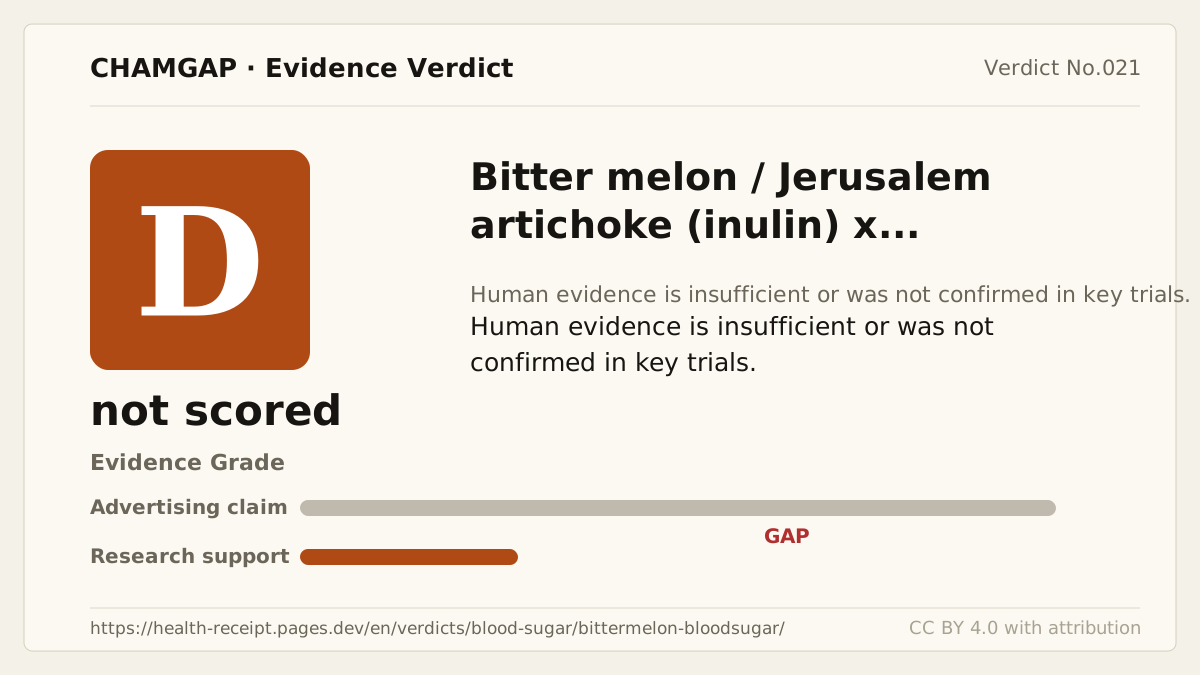
[Chamgap] Bitter melon and Jerusalem artichoke x blood glucose — Evidence Grade D·28. 7 cited sources checked. Source: https://chamgap.com/en/verdicts/blood-sugar/bittermelon-bloodsugar/ · CC BY 4.0CC BY 4.0 — free to use with attribution; do not distort grades, numbers, or verdict meaning.
What this document does and does not do
Chamgap is an information source. It reports what research has and has not confirmed; it does not tell readers what to take or buy. That decision belongs to readers and, when needed, medical or legal professionals. This verdict reflects literature available up to the search date and may change as new research appears. Nothing here is medical advice.