
Chromium,
does it really help with blood-glucose management and dieting/weight loss?
research showsChromium picolinate shows some possibility of improving glycemic markers in some human RCTs and meta-analyses, but results are inconsistent and the effect size and clinical meaning are limited. Weight-loss and appetite-suppression claims are weaker than blood-glucose claims because average changes are small and evidence quality is low.
ads claimKorean advertising and informational content repeats phrases such as 'maintaining normal blood-glucose levels,' 'improving blood-glucose levels,' 'improving glycated hemoglobin,' 'improving insulin sensitivity,' 'supporting carbohydrate metabolism,' 'relieving sugar/carbohydrate cravings,' 'appetite control,' and 'effective for weight loss.' For example, Coupang product names put 'chromium 200 mcg chromium picolinate normal blood-glucose level maintenance support' at the front, and Pillyze shows percentages for improvements in blood-glucose level and glycated hemoglobin in review fields for NOW/Swanson/Solgar chromium products. The Korean BulkSupplements page claims insulin sensitivity, blood glucose, cravings, and appetite together, and informational blog/YouTube-style content bundles blood-glucose stability with dieting support.
Useful facts when choosing a product
- Commercial forms include chromium picolinate, chromium yeast, chromium chloride, and chromium nicotinate, but advertising and dieting claims tend to focus on chromium picolinate.
- Product doses are commonly in the range of 200-1,000 mcg chromium per day, and RCTs also used 200, 400, 500, 600, and 1,000 mcg/day.
- Studies of chromium picolinate+biotin combination products used biotin 2 mg together, making it difficult to separate the effect of chromium alone.
- Blood-glucose management products may be formulated together with banaba leaf, alpha-lipoic acid, biotin, vanadium, and other ingredients, with headline efficacy presented as if it comes from the combination.
- The U.S. NIH ODS summarizes that chromium supplements may slightly lower FPG/HbA1c in people with diabetes, but clinical significance is unclear.
What the research actually shows
Separated by effect, for blood glucose there are RCTs and meta-analyses in type 2 diabetes or people with poor glycemic control, and some analyses reported improvements such as HbA1c about -0.7% and FPG about -19 mg/dL. However, other meta-analyses found only HbA1c significant and FPG not significant, or found no fasting-glucose effect in analyses reflecting changes in the control group. Effects are more unclear in healthy people and in prediabetes/metabolic syndrome. For dieting, Cochrane reviews and obesity/overweight meta-analyses showed small mean differences of about -0.5 to -1.1 kg, but evidence quality was low and clinical relevance was uncertain. No large independent hard-endpoint RCT was identified, and positive studies of a combination product (chromium picolinate+biotin) are difficult to interpret as single-ingredient chromium effects.
Why this is classified as C (46)
Blood glucose: human RCTs and meta-analyses exist, but results conflict, and positive results are centered on markers such as HbA1c/FPG/HOMA-IR with large heterogeneity. In healthy people, prediabetes, metabolic syndrome, and weight loss, independent replication and clinical meaning are weak. Dieting: Cochrane reported an average -1.1 kg across 9 RCTs/622 participants but explicitly noted low evidence quality, uncertain safety, and debate over clinical relevance. Therefore the judgment is C rather than A/B.
Counterpoint. In some type 2 diabetes patients with poor glycemic control, RCTs and meta-analyses show improved HbA1c and FPG, and a larger response has been suggested especially in groups with high baseline HbA1c. However, this signal varies with chromium deficiency status, disease state, concomitant medications, formulation, dose, study funding source, and whether the product is a combination.
Rejudgment record. Draft and blinded review converged — Glycemic markers have some improvement signals but weak consistency and clinical meaning; dieting effects are limited to low-certainty signals of about -0.5 to -1.1 kg on average.
Cross-check — Codex and Claude
Evidence Table
| Study | Design | Sample | Funding | Endpoint | Result | Weight |
|---|---|---|---|---|---|---|
| NIH Office of Dietary Supplements | RCT | not reported | body weight | Summarizes in one place the positive figures from a 1997 RCT, inconsistent follow-up studies, limited evidence in 2016, the small size of weight effects, and safety/interactions. | core | |
| Asbaghi O et al. 2020 | meta-analysis of RCTs | not reported | HbA1c | Across 28 studies, FPG -19.00 mg/dL, HbA1c -0.71%, and HOMA-IR -1.53 were reported, but heterogeneity for FPG/HOMA-IR was very large. | core | |
| Hua Y et al. 2021 | meta-analysis of RCTs | 10 | not reported | HbA1c | Across 10 RCTs/509 participants, only HbA1c was significant, while FPG and lipids were not significant. | core |
| Bailey CH 2014 | RCT | 16 | not reported | glycemia | Across 16 randomized placebo-controlled trials/809 participants, fasting-glucose effect size was 0.02, p=0.787, indicating no effect. | core |
| Costello RB, Dwyer JT, Bailey RL 2016 | systematic review/RCT | 20 | possible manufacturer/industry involvement | HbA1c | A systematic search reviewed 20 T2DM RCTs, but judged evidence strength low because only a few studies assessed achievement of FPG/HbA1c treatment targets. | supportive |
| Tian H et al. 2013 | systematic review/RCT | 9 | not reported | body weight | In 9 overweight/obesity RCTs/622 participants, 12-16 week body weight MD was -1.1 kg, but low evidence quality and uncertain clinical relevance were explicitly stated. | supportive |
| Onakpoya I, Posadzki P, Ernst E 2013 | meta-analysis of RCTs | 11 | not reported | body weight | Among 20 RCTs, 11 were meta-analyzed and found body weight MD -0.50 kg; the effect was small and clinical relevance uncertain. | supportive |
| Pittler MH, Stevinson C, Ernst E 2003 | double-blind/meta-analysis/RCT | 10 | not reported | body weight | Across 10 double-blind placebo-controlled trials, body weight WMD was -1.1 kg, but dependence on a single study and debate over clinical meaning were noted. | supportive |
| Yazaki Y et al. 2010 | not specified | 80 | not reported | body weight | In 80 overweight adults, 1,000 mcg/day for 24 weeks in an RCT had no BMI/weight-loss effect. | supportive |
| Talab AT et al. 2020 | RCT | 41 | mixed/partly industry-related | body weight/LDL | In T2DM, 52 randomized and 41 analyzed; 400 mcg/day for 8 weeks in an RCT did not change FBG, weight, or BMI, and improved only HOMA-IR/LDL. | supportive |
| Albarracin CA, Fuqua BC, Evans JL, Goldfine ID 2008 | not specified | 447 | not reported | HbA1c | Combination of chromium picolinate 600 mcg + biotin 2 mg in a 447-participant/90-day RCT improved HbA1c and FPG, but this is not evidence for chromium alone. | supportive |
| Cochrane Korea consumer summary, Coupang/Pillyze/BulkSupplements Korean search results | not specified | not reported | body weight/appetite/glycemia/HbA1c | Korean market and informational content advertise blood-glucose levels, HbA1c, insulin sensitivity, appetite/cravings, and weight loss together. | supportive |
Receipt — 12 References
All 12 cited sources were verified for existence at the original page (as of 2026-07-07).
Reviewed and approved: Chamgap Editorial Team · Approval date: 2026-07-07 · Corrections: none
Cite this verdict
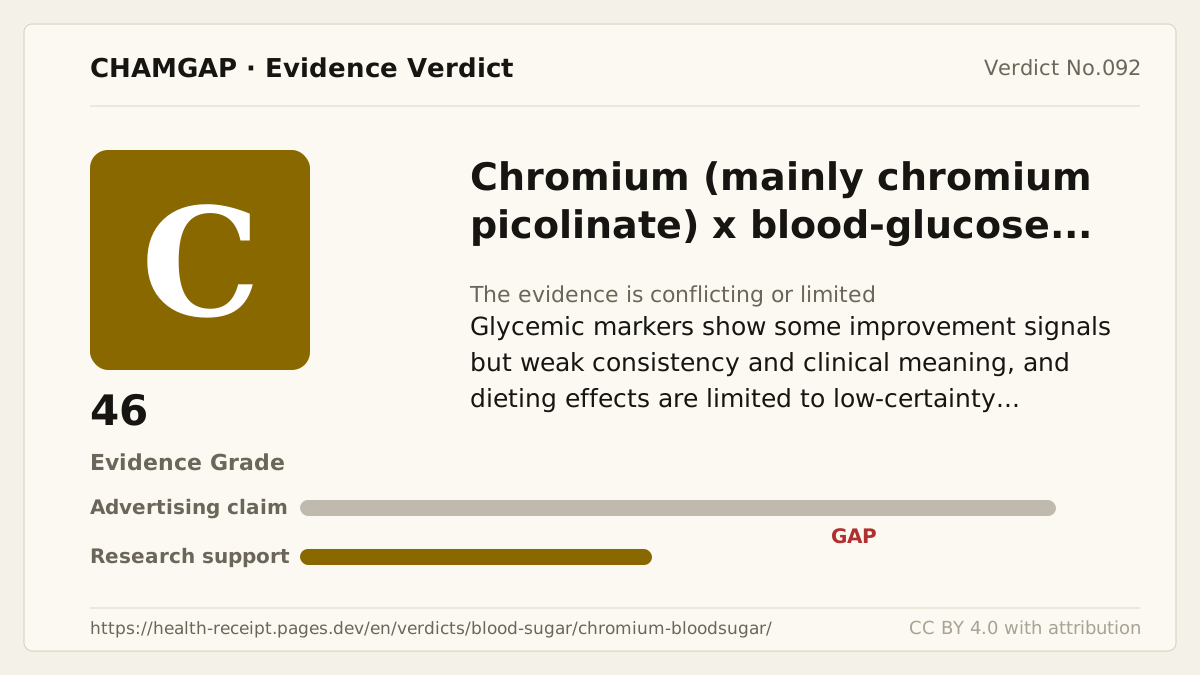
[Chamgap] Chromium (mainly chromium picolinate) × blood-glucose management and dieting/weight loss — Evidence Grade C·46. 12 cited sources checked. Source: https://chamgap.com/en/verdicts/blood-sugar/chromium-bloodsugar/ · CC BY 4.0CC BY 4.0 — free to use with attribution; do not distort grades, numbers, or verdict meaning.
What this document does and does not do
Chamgap is an information source. It reports what research has and has not confirmed; it does not tell readers what to take or buy. That decision belongs to readers and, when needed, medical or legal professionals. This verdict reflects literature available up to the search date and may change as new research appears. Nothing here is medical advice.