
Banaba leaf,
does it really help with postprandial blood-glucose improvement?
research showsBottom line: small human studies repeatedly observe that this ingredient, corosolic acid from banaba leaf extract, lowers the narrow marker 'postprandial blood glucose,' but the evidence is conflicting or limited (grade C). It is true that MFDS recognizes it as a generic functional ingredient that 'may help suppress postprandial blood-glucose rise.' Within the confirmed scope, there are three limitations. ① What was measured is only surrogate markers such as blood glucose for a few hours after an oral glucose tolerance test (OGTT), and no evidence was confirmed for improvement in HbA1c (long-term glucose), diabetes prevention, or complication reduction. ② All confirmed human studies are extremely small (10-31 participants) and short (single dose to 2 weeks); several are manufacturer-funded (Hibi 2022=Kao alone) or from industry-linked authors/same research lines; many participants are already diabetic or high-risk patients, so evidence in healthy general adults is thin. One study (Fukushima) was statistically significant at only one time point, 90 minutes, among several time points, and another (Tsuchibe/Tobe) was a before-after comparison without placebo control, so causality is hard to state. No independent RCT without conflicts of interest was found within scope. ③ One review often cited as evidence (Miura 2012) was officially retracted in 2013 for duplicate publication with another review (Stohs 2012) and cannot be used. The official wording is also limited to 'suppression of postprandial blood-glucose rise,' not broad 'blood-glucose improvement,' and MFDS 2024 reevaluation added cautions to registered products, including 'if you have diabetes, consult a professional before intake.'
ads claimThe 4 collected sales pages (Lifetocol/Oasis Market, Celltrion SkinCure, GNM Natural Quality, Vitamin Village; individual URLs/labels are follow-up items outside this verification) are all labeled as 'health functional foods' within the confirmed scope, and their core wording uses the MFDS generic-recognition phrase 'may help suppress postprandial blood-glucose rise,' which is within regulatory recognition. However, two points were not confirmed. ① Pure corosolic acid content: Celltrion product name '500mg' and GNM/Vitamin Village labels appear to indicate extract/tablet total amount, and pure corosolic acid content was not confirmed on sales pages (extract total vs pure ingredient confusion caution [E2]). Lifetocol claims the MFDS daily maximum based on corosolic acid (Code upper limit about 1.3mg), but measured pure content was not confirmed. ② Claims such as 'up to 35% postprandial glucose reduction' observed in some distribution ads trace back to small, industry-funded, surrogate-marker studies and require separate verification [A1/B1]. Ads easily blur that official wording is 'suppression of rise,' not 'improvement,' and that regulatory recognition is not a guarantee of clinical benefit such as diabetes prevention/treatment.
Useful facts when choosing a product
- MFDS generic (Code-listed) functional ingredient '2-12 banaba leaf extract,' not individually recognized. Recognized wording: 'may help suppress postprandial blood-glucose rise' (note: limited to 'suppression of rise,' not broad 'improvement').
- Label trap: 'extract mg' on products, for example 300-500mg, differs from 'pure corosolic acid mg.' Judy 2003's 1% standardized extract 32-48mg equals only 0.32-0.48mg pure corosolic acid. Purity/standardization (%) is not pure-ingredient amount [E1/E2].
- Marker component/daily intake: about 0.45-1.3mg/day as corosolic acid based on web search; exact Code PDF upper/lower values were not checked against the original (more-check flag).
- MFDS 2024 reevaluation added intake cautions for 9 ingredients including banaba leaf extract: registered products add 'consult a professional before intake if you have diabetes' and 'stop intake if adverse events occur.' Caution with diabetes medications.
- Miura 2012 (Evid Based Complement Alternat Med), often cited by internet/AI, was officially retracted in 2013 for duplicate publication with Stohs 2012 and cannot be used as valid evidence (Wiley title marked '[Retracted]').
- Many confirmed human-study participants already had diabetes, impaired glucose tolerance, impaired fasting glucose, or high-risk status (Fukushima 2006: 26 of 31, Judy 2003: type 2 diabetes), so generalizing to healthy adults' routine intake is weak.
What the research actually shows
Confirmed human evidence consists of 3 small intervention studies (2 placebo-controlled RCTs and 1 dose-response study), 1 uncontrolled observational/before-after study, and 1 review summarizing originals. (1) Hibi 2022 (J Functional Foods, DOI 10.1016/j.jff.2022.105256): double-blind placebo-controlled crossover RCT in middle-aged men with impaired fasting glucose, corosolic acid 1mg/day for 2 weeks, then 75g OGTT; glucose iAUC significantly lower than placebo (p=0.028). However, Crossref funder information shows sole manufacturer Kao Corporation funding [A1], and only acute OGTT response was measured [B1]. (2) Fukushima 2006 (Diabetes Res Clin Pract, PMID 16549220): double-blind crossover RCT, 26 of 31 participants had diabetes/IGT/IFG, single acute corosolic acid 10mg; glucose from 60-120 minutes was lower but statistical significance appeared only at one time point, 90 minutes, with no difference within 30 minutes [B1]. Authors from the recurring corosolic-acid research line (T. Miura etc.) included [A1 partial]. (3) Judy 2003 (J Ethnopharmacol, PMID 12787964): very small dose-response trial in type 2 diabetes patients, 1% standardized banaba extract 32-48mg/day (pure corosolic acid 0.32-0.48mg) for 2 weeks; glucose decreased 20-30% (P<0.001). First author affiliated with industry-linked institute SIBR Inc [A1], and formulation (softgel vs hard capsule) absorption differences drove effect size [D1]. (4) Tsuchibe/Tobe 2006 (Japanese, DOI 10.2740/jisdh.17.255): presumed nondiabetic 12 people, corosolic acid 10mg daily for 2 weeks, suppressed postprandial glucose after starch load, but no placebo control/before-after design [B2]. Stohs 2012 review (PMID 22095937) summarized '10-30% reduction' but 2/3 coauthors were supplement-industry affiliated and inherited the limitations of original studies. Overall, direction is broadly consistent (glucose lowering), but all positive evidence is surrogate-marker, small, short-term, and concentrated in manufacturer/industry-linked or same-line studies, with no conflict-free independent RCT found.
Why this is classified as C (50)
Judged C. Methodologically, C means conflicting or limited evidence (surrogate markers, small samples, mixed funding bias), and this case matches almost literally: all confirmed human studies measure surrogate markers (acute OGTT/postprandial glucose, no HbA1c or clinical outcomes), samples are tiny (n=10-31), periods are very short (single dose to 2 weeks), and manufacturer funding (Hibi 2022=Kao alone), industry-linked authors (Judy=SIBR), and repeated same research lines overlap. The existence of several human RCTs does not exclude C because C is about limitation/bias/conflict, not absence of RCTs. It is not F because bias is not proof of zero effect and glucose-lowering direction is broadly reproduced. Many participants were patients/high-risk groups, so general healthy use is weakly supported, and retracted Miura 2012 was fully excluded. MFDS generic recognition is neutral metadata. It is a C/D boundary because the issue is absence of conflict-free independent RCTs; methodology 2-1② downgrades to D when independent RCTs are null or significance disappears in high-quality groups, but here no independent RCT exists to be null/disappear.
Counterpoint. Supportive side: 'MFDS officially recognizes a generic functionality, human RCTs repeatedly observed glucose lowering, and it is safe; with human RCTs, shouldn't this be B rather than C?' Answer: regulatory recognition is ingredient/label regulation, not a guarantee of effect size or clinical benefit, and C does not mean only observational studies; it means mixed limitations and bias. The confirmed evidence is only n=10-31, industry-funded, surrogate-marker studies, with significance at one time point or no placebo control, fitting C. Skeptical side: 'All positive evidence is manufacturer-funded, small, surrogate-marker, patient-targeted, there is no conflict-free independent RCT, and a representative review was retracted, so shouldn't it be D under independence priority?' Answer: this is a valid direction, but methodology 2-1② literally downgrades to D when independent RCTs are null or high-quality significance disappears. Here there is no independent RCT to be null/disappear, so D would be an extrapolation. The limitations are all stated, and the claim remains borderline C.
| Endpoint | S | Surrogate marker - laboratory or imaging measures |
| Replication | R1 | Single confirmatory trial |
| Independence | I0 | Evidence comes only from manufacturer studies |
| Effect size | E+ | Meets the clinically important threshold |
The scoring table and the verdict agree (C).
Cross-check — Codex and Claude
Evidence Table
| Study | Design | Sample | Funding | Endpoint | Result | Weight |
|---|---|---|---|---|---|---|
| Fukushima M, Matsuyama F, Ueda N et al. 2006 | double-blind randomized controlled trial | 31 | blood glucose / HbA1c | Double-blind crossover RCT, 31 participants (diabetes 19, IGT 7, IFG 1, normal 4), single acute corosolic acid 10mg then 75g OGTT; glucose was lower than placebo at 60-120 minutes, but statistical significance occurred only at the 90-minute time point (no difference within 30 minutes). Funding listed as non-U.S. government research support. | key | |
| Judy WV, Hari SP, Stogsdill WW et al. 2003 | 3 | possible manufacturer or industry involvement | blood glucose / absorption | Small dose-response trial in type 2 diabetes patients; 1% standardized banaba extract 32-48mg (pure corosolic acid 0.32-0.48mg)/day for 2 weeks; softgel formulation reduced glucose 30% and hard capsule 20% (P<0.001), so formulation absorption difference drove effect size. | key | |
| Hibi M, Matsui Y, Niwa S et al. 2022 | double-blind randomized controlled trial | 4 | possible manufacturer or industry involvement | blood glucose / HbA1c / gastrointestinal | Double-blind placebo-controlled crossover RCT in middle-aged men with impaired fasting glucose; corosolic acid 1mg/day for 2 weeks significantly reduced OGTT glucose iAUC versus placebo (p=0.028), measuring only surrogate acute OGTT response. | key |
| Tsuchibe(Tobe) S, Kataumi(Katakai) S, Mori M, Mori H 2006 | 12 | possible manufacturer or industry involvement | body weight / blood glucose | 12 presumed nondiabetic people (7 men, 5 women), capsule containing corosolic acid 10mg daily for 2 weeks; fasting, 30, 60, and 120-minute glucose rises after starch load were significantly suppressed and weight/BMI decreased, but design was before-after without placebo control. | key | |
| Stohs SJ, Miller H, Kaats GR 2012 | 10 | possible manufacturer or industry involvement | ALT / blood glucose / gastrointestinal | Narrative review summarizing that banaba/corosolic acid generally lowers fasting and postprandial glucose by 10-30%, but most cited original studies are small (n=10-31), short-term, poorly standardized, and many uncontrolled. | supporting | |
| Study 6 | possible manufacturer or industry involvement | Existing paper but officially retracted in 2013 for duplicate publication with substantially identical content to Stohs 2012; cannot be used as evidence and is a contamination source often recited by internet/AI. | supporting | |||
| Study 7 | blood glucose | Banaba leaf extract is recognized as a generic (Code-listed) functional ingredient with wording 'may help suppress postprandial blood-glucose rise,' and MFDS 2024 reevaluation added cautions such as professional consultation for people with diabetes. | supporting |
Receipt — 7 References
All 7 cited sources were verified for existence at the original page (as of 2026-07-06).
Reviewed and approved: Chamgap Editorial Team · Approval date: 2026-07-06 · Corrections: none
Cite this verdict
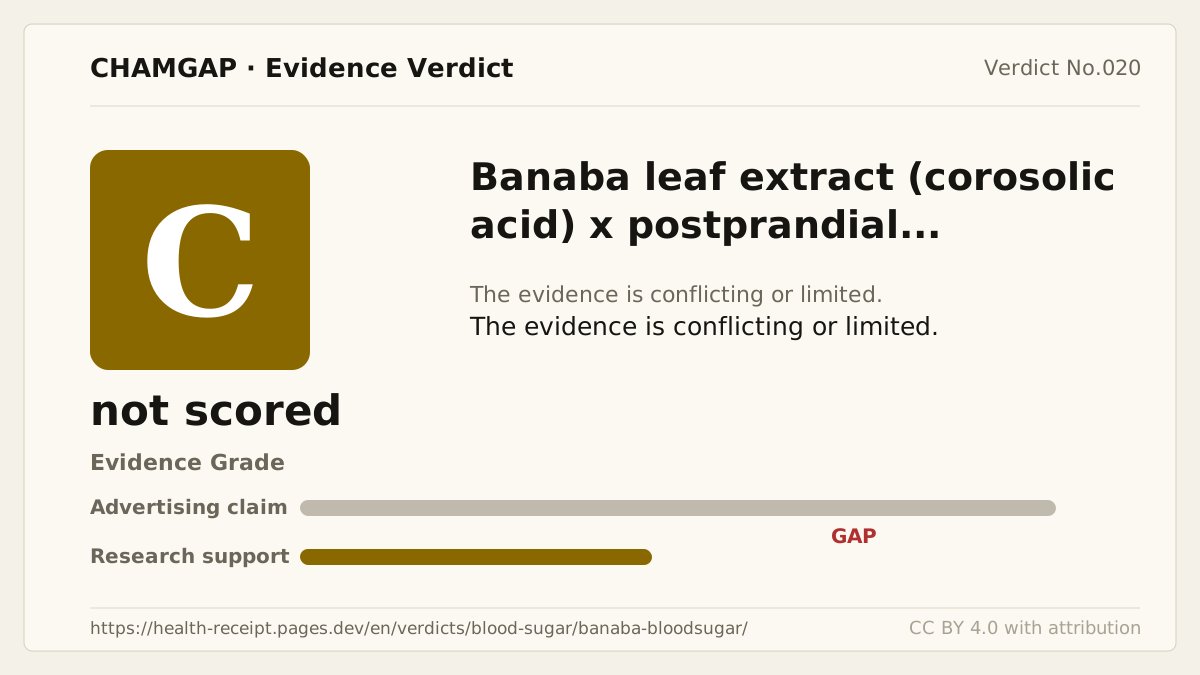
[Chamgap] Banaba leaf (corosolic acid) x blood glucose — Evidence Grade C·50. 7 cited sources checked. Source: https://chamgap.com/en/verdicts/blood-sugar/banaba-bloodsugar/ · CC BY 4.0CC BY 4.0 — free to use with attribution; do not distort grades, numbers, or verdict meaning.
What this document does and does not do
Chamgap is an information source. It reports what research has and has not confirmed; it does not tell readers what to take or buy. That decision belongs to readers and, when needed, medical or legal professionals. This verdict reflects literature available up to the search date and may change as new research appears. Nothing here is medical advice.