
Resveratrol,
does it really help with anti-aging and cardiovascular?
research showsResveratrol is not an ingredient with no human research. Meta-analyses show positive signals in cardiovascular-risk surrogate markers such as endothelial function (FMD), some blood pressure measures, total cholesterol, and CRP/TNF-alpha. However, the core anti-aging advertisement claim that it 'extends lifespan by activating sirtuins' has not been proven in humans with clinical endpoints such as lifespan, rate of aging, or frailty prevention, and a 2025 human RCT meta-analysis also did not show a significant overall effect on SIRT1. Cardiovascular evidence is also centered on short-term biomarkers and functional indicators, not reductions in myocardial infarction, stroke, or death.
ads claimKorean advertising and informational posts show a pattern of introducing resveratrol broadly as 'activating the longevity gene sirtuin,' 'making cells younger,' 'inhibiting aging,' 'extending lifespan,' 'improving vascular health,' 'clearing the blood,' 'vascular health for hypertension/hyperlipidemia patients,' 'stroke prevention,' 'slowing Alzheimer progression,' and even 'anticancer, anti-inflammatory, antiviral.' Some connect animal lifespan studies or cell mechanisms to human anti-aging effects, and some extend FMD, blood pressure, and inflammatory markers into cardiovascular-disease prevention.
Useful facts when choosing a product
- Supplements are usually sold as trans-resveratrol or Polygonum cuspidatum-derived extracts at doses far higher than those in grapes or red wine.
- FMD, ICAM-1, CRP, SIRT1, and oxidative-stress markers are surrogate markers, not clinical events. Translating them directly into lifespan extension or prevention of myocardial infarction and stroke exceeds the evidence.
- Meta-analytic signals mix data from specific risk groups such as type 2 diabetes, metabolic syndrome, obesity, NAFLD, and CKD, so they are difficult to generalize directly to healthy people.
- Whether health-functional-food labeling is possible in Korea must be checked by product-specific recognized ingredient and labeling. This judgment was based on the strength of human clinical evidence, not regulatory recognition status.
- Short-term clinical trials generally show few major safety issues, but high doses may cause gastrointestinal symptoms, possible liver-enzyme abnormalities, and concerns about estrogen-related or anticoagulant interactions, so caution is needed if medications are being taken.
What the research actually shows
Anti-aging: the early evidence began with lifespan/survival signals in yeast, worms, fruit flies, and high-calorie-diet animal models. However, some studies found no lifespan extension in normally fed mice, and no RCT measuring 'lifespan extension' in humans was identified. A 2025 GRADE-evaluated SIRT1 meta-analysis combined data from 11 RCTs from 2011-2023 and 632 adults and reported no significant overall effect on SIRT1 gene expression, protein expression, or serum levels. A 2023 RCT in 97 older adults with type 2 diabetes showed improvement in SIRT1 and oxidative-stress markers in the 1000 mg/day 6-month group, but this is a biomarker result in a specific disease group. Cardiovascular: a 2022 FMD meta-analysis reported FMD WMD improvement of 1.43 percentage points and reduced ICAM-1 across 17 studies and 21 arms, but VCAM-1, fibrinogen, and PAI-1 were not significant. A 2019 MetS-related meta-analysis also found increased FMD but no significant change in SBP/DBP. Blood-pressure meta-analyses report SBP/DBP reductions in high-dose or type 2 diabetes subgroups, but overall results and subgroup results are mixed. Lipid meta-analyses show a signal for reduced total cholesterol, but LDL, HDL, and TG differ across analyses. Inflammation meta-analyses show CRP or TNF-alpha reduction signals, but IL-6 is not consistent.
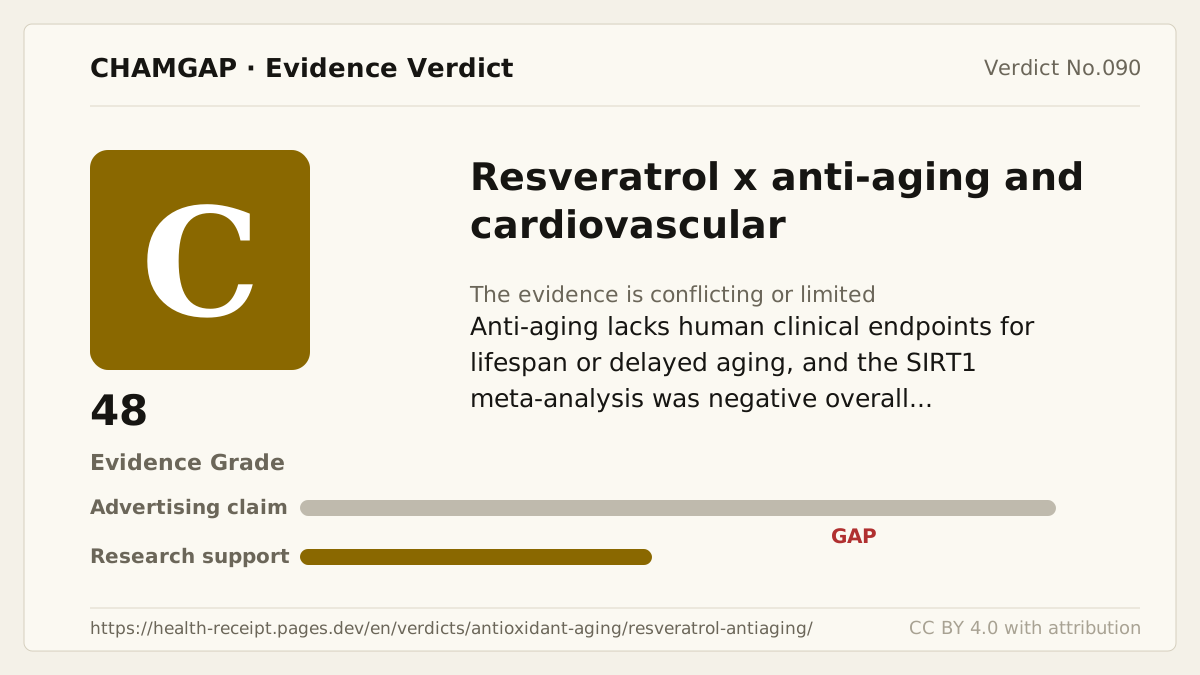
Why this is classified as C (48)
For cardiovascular effects, there are RCTs and several meta-analyses, so this is not '?' or F. However, the main evidence consists of surrogate markers such as FMD, blood pressure, lipids, inflammation, and oxidative stress, and no hard cardiovascular endpoint RCT was identified. For anti-aging, there is no human clinical endpoint for lifespan extension or delayed aging, and a human RCT meta-analysis of SIRT1 was not significant overall. Boundary rule 1 was applied, because evidence limited to surrogate markers is at most C, and under the principle of separating combined claims, the 'anti-aging lifespan' claim pulls the overall judgment down to C 48.
Counterpoint. Resveratrol is difficult to regard as completely unsupported. Human-study signals remain for possible adjunctive biomarker improvement in specific metabolic-risk groups, such as FMD improvement meta-analyses, blood-pressure reductions in type 2 diabetes subgroups, and some improvements in total cholesterol and inflammatory markers. However, those signals are not currently enough to confirm 'lifespan extension' or 'prevention of cardiovascular disease.'
Rejudgment record. Claude confirmed (regenerated without blinded review; resveratrol anti-aging sirtuin evidence is cellular/surrogate and human cardiovascular endpoints are weak, so C) — Anti-aging lacks human lifespan or delayed-aging clinical endpoints and the SIRT1 meta-analysis was negative overall. Cardiovascular evidence has FMD, blood pressure, lipid, and inflammation surrogate-marker signals but not event-prevention evidence, so C is the limit.
Cross-check — Codex and Claude
Evidence Table
| Study | Design | Sample | Funding | Endpoint | Result | Weight |
|---|---|---|---|---|---|---|
| Mansouri F, Feliziani G, Bordoni L, Gabbianelli R 2025 | meta-analysis of RCTs | 632 | not reported | liver/anti-aging | 2025 SIRT1 meta-analysis of 11 RCTs and 632 adults; SIRT1 gene expression, protein expression, and serum levels were all not significant in the overall analysis. | core |
| Garcia-Martinez BI, Ruiz-Ramos M, Pedraza-Chaverri J, Santiago-Osorio E, Mendoza-Nunez VM 2023 | not specified | 97 | not reported | antioxidant | RCT in 97 older adults with type 2 diabetes reported improved SIRT1 and antioxidant markers in the 1000 mg/day for 6 months group, but this was a biomarker study in a specific disease group. | supportive |
| Pearson KJ, Baur JA, Lewis KN et al. 2008 | preclinical | not reported | anti-aging | In mice, some aging-related functional indicators improved, but lifespan did not increase in normally fed ad-libitum animals. | supportive | |
| Mohammadipoor N, Shafiee F, Rostami A et al. 2022 | meta-analysis of RCTs | not reported | not specified | Meta-analysis of 17 studies and 21 arms found FMD improved by 1.43 percentage points and ICAM-1 decreased, but VCAM-1, fibrinogen, and PAI-1 were not significant. | core | |
| Akbari M, Tamtaji OR, Lankarani KB et al. 2019 | meta-analysis of RCTs | not reported | not specified | In an RCT meta-analysis related to metabolic syndrome, FMD significantly increased, but SBP and DBP did not significantly change. | supportive | |
| Liu Y, Ma W, Zhang P, He S, Huang D 2015 | meta-analysis of RCTs | 247 | not reported | not specified | Meta-analysis of 6 studies and 247 participants found no significant overall SBP/DBP effect, with an SBP reduction signal in the subgroup using at least 150 mg/day. | supportive |
| van der Made SM, Plat J, Mensink RP 2017 | RCT | 45 | not reported | body weight | Crossover RCT in 45 overweight/mildly obese adults; trans-resveratrol 150 mg/day for 4 weeks did not improve FMD, arterial stiffness, or inflammatory/endothelial biomarkers. | supportive |
| Akbari M, Tamtaji OR, Lankarani KB et al. 2020 | meta-analysis of RCTs | not reported | ALT/AST/LDL/cholesterol | Meta-analysis of 31 papers found total cholesterol decreased, but TG, LDL-C, HDL-C, ALT, and AST did not significantly change. | supportive | |
| Haghighatdoost F, Hariri M 2019 | meta-analysis of RCTs | not reported | not specified | RCT meta-analysis found possible CRP reduction, but concluded that overall effects on IL-6 and TNF-alpha were not consistent. | supportive | |
| Resveratrol | not specified | not reported | gastrointestinal | Resveratrol generally has few adverse effects, but gastrointestinal discomfort, nausea, headache, fatigue, and possible estrogen- or anticoagulant-related interactions are suggested. | supportive |
Receipt — 10 References
Of 10 cited sources, 1 had limited original-page access (blocked or summary-only) and were verified via index/summary, marked partial; the rest were verified at the original page. As of 2026-07-07.
Reviewed and approved: Chamgap Editorial Team · Approval date: 2026-07-07 · Corrections: none
Cite this verdict
[Chamgap] Resveratrol × anti-aging and cardiovascular — Evidence Grade C·48. 10 cited sources checked. Source: https://chamgap.com/en/verdicts/antioxidant-aging/resveratrol-antiaging/ · CC BY 4.0CC BY 4.0 — free to use with attribution; do not distort grades, numbers, or verdict meaning.
What this document does and does not do
Chamgap is an information source. It reports what research has and has not confirmed; it does not tell readers what to take or buy. That decision belongs to readers and, when needed, medical or legal professionals. This verdict reflects literature available up to the search date and may change as new research appears. Nothing here is medical advice.