
Pycnogenol,
does it really help with Antioxidant, vascular, and skin effects?
research showsHuman trials and meta-analyses exist, but the evidence mainly concerns surrogate markers such as oxidative-stress markers, small blood-pressure changes, endothelial function, and skin hydration/elasticity rather than reductions in actual health events. Skin and vascular claims are 'possible but limited as definitive health effects.'
ads claimIn Korean market advertisements and informational articles, repeated phrases include '20 times vitamin C/50 times vitamin E antioxidant,' 'suppresses reactive oxygen species,' 'inhibits platelet aggregation/improves blood flow/blood circulation,' 'vascular relaxation and blood-pressure management through nitric oxide,' 'collagen and hyaluronic-acid production, skin hydration/elasticity/tone improvement,' and 'edible cosmetics/inner beauty.' Antioxidant, blood-flow-improvement, and skin-health tags were found on the official raw-material company's Korean page, supplement-mall articles, Food & Beverage News functional introductions, and Danawa/iHerb-style product/article exposure. Some products are sold in combinations with CoQ10, citrus bioflavonoids, grape seed, and similar ingredients, so standalone effects need to be distinguished.
Useful facts when choosing a product
- Pycnogenol is Horphag Research's patented raw-material name for French maritime pine (Pinus pinaster Ait. ssp. atlantica) bark, and the raw-material-company review presents standardization to total procyanidins 70+/-5%.
- Pycnogenol study results are difficult to extrapolate unchanged to all pine bark extracts with different raw material species and extraction specifications. Conversely, negative RCTs of other pine bark extracts do not completely nullify Pycnogenol alone.
- The skin RCT dose was 100 mg/day, endothelial/blood-pressure studies generally used 100-200 mg/day, and the 2012 skin single-arm study used 75 mg/day.
- Korean exposed products/articles mix standalone Pycnogenol with combination products such as CoQ10, citrus bioflavonoids, and grape seed extract, so combination-product evidence and standalone evidence must be separated.
- MFDS recognition is a regulatory fact, and this draft's evidence grade was judged separately based on the design and endpoint strength of RCTs and meta-analyses.
What the research actually shows
By effect, antioxidant evidence includes reports of improvements in oxidative markers such as ORAC, 8-oxoG, and F2-isoprostane, but these are not primary endpoints for preventing or treating clinical disease. For vascular effects, blood-pressure meta-analyses report SBP about -2.5 to -3.2 mmHg and DBP about -1.8 to -3.1 mmHg, but some analyses found no significance in well-designed trials, and RCTs in CAD patients and healthy people mainly use surrogate markers such as FMD and forearm blood flow. For skin, a 2021 double-blind crossover RCT (n=76) reported improvements in reduced hydration, TEWL, elasticity, and skin-tone markers, and a 2012 n=20 single-arm study supports this, but these are physiologic/appearance markers rather than skin clinical outcomes. Cochrane-type reviews judged that it is difficult to draw conclusions across chronic diseases.
Why this is classified as C (52)
As a compound claim, each outcome falls within the C range. Antioxidant evidence uses human biomarkers but remains surrogate evidence and is capped at C. Vascular evidence includes RCTs and meta-analyses, but effect sizes are small, key positive trials are small or show industry/ingredient-company involvement, and primary endpoints remain surrogate/risk-factor outcomes such as FMD, blood flow, and blood pressure. Skin evidence includes randomized trials but is short-term physiologic-marker evidence with insufficient independent replication. Given manufacturer funding, ingredient-company involvement, and limited independent replication, this was graded C (52) rather than B.
Counterpoint. Short-term safety, bioavailability/mechanistic data, and consistent directions in small RCTs are not the same as no evidence. Blood-pressure meta-analyses report mean reductions of several mmHg, and a skin RCT reported improvements in TEWL and elasticity. However, evidence that these findings translate into cardiovascular events, anti-aging, disease prevention, or definite skin improvement remains weak.
Rejudgment record. Draft=blinded convergent — Human RCTs and meta-analyses exist, but antioxidant, vascular, and skin claims are all centered on short-term surrogate markers, with limitations in independent replication and funding sources, so C
Cross-check — Codex and Claude
Evidence Table
| Study | Design | Sample | Funding | Endpoint | Result | Weight |
|---|---|---|---|---|---|---|
| Robertson NU, Schoonees A, Brand A, Visser J 2020 | Meta-analysis of RCTs | 1641 | skin/gut/gastrointestinal/antioxidant | 27 RCTs, 1641 people, across 10 chronic diseases were reviewed, but the review judged it difficult to draw definitive conclusions on efficacy and safety. | Core | |
| Pourmasoumi M, Hadi A, Mohammadi H, Rouhani MH 2020 | Meta-analysis of RCTs | 922 | Possible manufacturer/industry involvement | In 12 clinical trials and 922 people, SBP -3.22 mmHg and DBP -1.91 mmHg were reported, but the need for high-quality RCTs was specified. | Core | |
| Zhang Z et al. 2018 | Meta-analysis | 549 | blood pressure | In 9 trials and 549 people, SBP was -3.22 mmHg and DBP -3.11 mmHg, but the authors reported no significance in well-designed trials. | Core | |
| Malekahmadi M et al. 2019 | Meta-analysis of RCTs | 1594 | gut/gastrointestinal | In 24 RCTs and 1594 people, small improvements in cardiometabolic markers were reported, including SBP -2.54 mmHg and DBP -1.76 mmHg. | Core | |
| Enseleit F et al. 2012 | 23 | Possible manufacturer/industry involvement | blood pressure | In a crossover RCT of 23 CAD patients, FMD improved and 15-F2t-isoprostane decreased, but blood pressure, platelets, and inflammatory markers did not change. | Supporting | |
| Nishioka K et al. 2007 | 16 | Possible manufacturer/industry involvement | In 16 healthy men, acetylcholine-induced forearm blood flow increased after 2 weeks of 180 mg/day. | Supporting | ||
| Zhao H, Wu J, Wang N, Grether-Beck S, Krutmann J, Wei L 2021 | 76 | Possible manufacturer/industry involvement | hydration/elasticity/skin | In a crossover RCT of urban outdoor workers (n=76), 100 mg/day improved reduced skin hydration, TEWL, skin darkening, and elasticity markers. | Supporting | |
| Marini A et al. 2012 | RCT | 20 | Possible manufacturer/industry involvement | elasticity/skin | In a 12-week single-arm study of 20 postmenopausal women, skin hydration/elasticity and HAS-1/collagen-related gene expression increased. | Supporting |
| Chovanova Z et al. 2006 | antioxidant | In an ADHD-child RCT, after 1 month of administration, reduced oxidative DNA damage marker 8-oxoG and changes in TAS were reported. | Supporting | |||
| Drieling RL, Gardner CD, Ma J, Ahn DK, Stafford RS 2010 | 130 | blood pressure | In an RCT of 130 adults at CVD risk, another French maritime pine bark extract 200 mg/day had no significant effect on blood pressure, lipids, CRP, and related markers. | Supporting | ||
| LiverTox 2025 | liver/gut/gastrointestinal | Serious hepatotoxicity signals are not clear in clinical trials, but mild adverse reactions such as headache, sleepiness, insomnia, and gastrointestinal symptoms have been reported. | Supporting |
Receipt — 11 References
Of 11 cited sources, 3 had limited original-page access (blocked or summary-only) and were verified via index/summary, marked partial; the rest were verified at the original page. As of 2026-07-07.
Reviewed and approved: Chamgap Editorial Team · Approval date: 2026-07-07 · Corrections: none
Cite this verdict
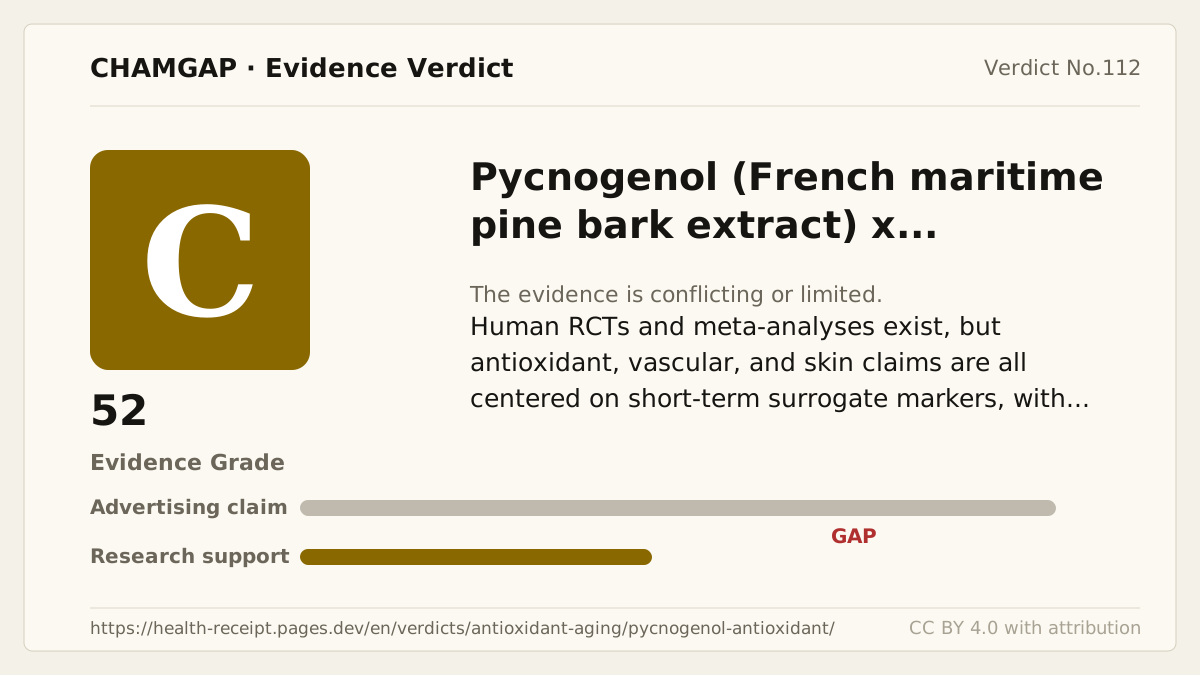
[Chamgap] Pycnogenol x antioxidant, vascular, and skin effects — Evidence Grade C·52. 11 cited sources checked. Source: https://chamgap.com/en/verdicts/antioxidant-aging/pycnogenol-antioxidant/ · CC BY 4.0CC BY 4.0 — free to use with attribution; do not distort grades, numbers, or verdict meaning.
What this document does and does not do
Chamgap is an information source. It reports what research has and has not confirmed; it does not tell readers what to take or buy. That decision belongs to readers and, when needed, medical or legal professionals. This verdict reflects literature available up to the search date and may change as new research appears. Nothing here is medical advice.