
Alpha-lipoic acid,
does it really help with antioxidant, blood glucose, and nerves?
research showsAlpha-lipoic acid repeatedly shows positive signals for short-term symptom scores in diabetic peripheral neuropathy, but evidence for long-term neuroprotection or slowing disease progression is weak. Blood-glucose and antioxidant claims are centered on surrogate markers such as HbA1c, fasting glucose, MDA, and GPx, and results are inconsistent, so they are insufficient to strongly support general antioxidant, blood-glucose, and nerve-health claims.
ads claimIn Korean-market advertising and informational content, alpha-lipoic acid is linked to phrases such as 'nature's perfect antioxidant,' 'powerful antioxidant,' 'key blood-glucose-control ingredient,' 'improves insulin resistance,' 'healthy nerve function,' 'relief of diabetic neuropathy symptoms,' and 'energy, aging, detox, weight management.' iHerb Korean blogs and product pages repeatedly support antioxidant, blood-glucose, and nerve function, and domestic article-style ads put alpha-lipoic acid into blood-glucose management products and emphasize insulin signaling, glucose uptake, and reduced oxidative stress.
Useful facts when choosing a product
- Korean overseas-direct-purchase/online products are often sold as single-ingredient ALA 200 mg, 300 mg, or 600 mg capsules or tablets.
- Some products combine benfotiamine, biotin, CoQ10, banaba leaf extract, B vitamins, and other ingredients and are positioned as 'blood-glucose, nerve, and antioxidant' packages.
- Product-page use wording is generally 'antioxidant support,' 'maintenance of healthy blood-glucose levels,' 'normal insulin response,' 'nerve health,' and 'cellular energy metabolism.'
- Common clinical-trial doses are IV 600 mg/day for 3 weeks, oral 600-1800 mg/day short term, and 600 mg/day in long-term NATHAN 1. Advertising product doses overlap with clinical doses, but the same effects are hard to extrapolate directly to generally healthy, non-diabetic consumers.
- Regulatory recognition status was not used in calculating the evidence grade.
What the research actually shows
Separated by effect, in the nerve area, 3-week IV or 5-week oral RCTs and meta-analyses show improvement in subjective nerve-symptom scores such as TSS. However, the 2024 Cochrane review concluded that across 3 RCTs lasting 6 months or longer and 816 participants, 6-month TSS MD was -0.16 points (95% CI -0.83 to 0.51), indicating little or no symptom effect, and the NATHAN 1 4-year RCT also did not show significance for the primary composite endpoint (P=0.105). In the blood-glucose area, meta-analyses conflict. Some report FBS -6.57 mg/dL, HbA1c -0.35%, or dose-response HbA1c reductions, but a diabetes-management meta-analysis found that in uncomplicated type 2 diabetes, HbA1c, FBG, and PPBG were not better than placebo. In the antioxidant area, biomarker signals such as reduced MDA or increased GPx exist, but these are surrogate markers rather than clinical outcomes, and other antioxidant enzymes and total antioxidant indicators are inconsistent.
Why this is classified as C (48)
Because this is a combined claim, antioxidant, blood glucose, and nerves were separated. Antioxidant and blood-glucose evidence mainly has surrogate markers as primary or major outcomes, so the boundary rule caps them at C. For nerves, human RCTs and meta-analyses mean the literature volume itself is not insufficient, but the evidence centers on short-term symptom scores and a substantial portion of the positive core evidence is connected to industry databases/sponsors. On the more important long-term disease-modification question, Cochrane's analysis of 6-month-or-longer trials and NATHAN 1's primary composite endpoint are not positive. Therefore the overall synthesis is C, with a mid-C score of 48.
Counterpoint. If limited narrowly to short-term relief of diabetic peripheral neuropathy symptoms, evidence is not completely absent. SYDNEY, SYDNEY 2, the 2004 IV meta-analysis, and the 2023 oral meta-analysis reported improvements in sensory symptom scores such as TSS. This is why the judgment is C rather than F or a question mark.
Rejudgment record. Draft and blinded review converged — There are signals for short-term improvement in diabetic nerve symptoms, but long-term neuroprotection and blood-glucose/antioxidant health effects are centered on surrogate markers, inconsistency, and industry-funding flags.
Cross-check — Codex and Claude
Evidence Table
| Study | Design | Sample | Funding | Endpoint | Result | Weight |
|---|---|---|---|---|---|---|
| Baicus C, Purcarea A, von Elm E, Delcea C, Furtunescu FL 2024 | RCT | 816 | not reported | not specified | Three RCTs lasting at least 6 months, 816 participants; 6-month TSS MD -0.16 points (95% CI -0.83 to 0.51), concluding little or no symptom effect. | core |
| Ziegler D, Low PA, Litchy WJ et al. 2011 | not specified | 460 | possible manufacturer/industry involvement | liver | 460 participants, oral ALA 600 mg/day for 4 years; the primary composite endpoint had no significant between-group difference (P=0.105), with only some secondary NIS indicators favorable. | core |
| Ametov AS, Barinov A, Dyck PJ et al. 2003 | not specified | not reported | AST | IV racemic ALA 600 mg/day, 14 treatments; TSS improved by 5.7 points in the ALA group and 1.8 points in placebo (P<0.001). | core | |
| Ziegler D, Ametov A, Barinov A et al. 2006 | not specified | 181 | not reported | ALT | 181 participants, oral ALA 600/1200/1800 mg or placebo for 5 weeks; TSS decreased 4.9/4.5/4.7 points vs placebo 2.9 points, all P<0.05. | core |
| Ziegler D, Nowak H, Kempler P, Vargha P, Low PA 2004 | meta-analysis of RCTs | 1258 | not reported | not specified | Four RCTs from the VIATRIS database, 1,258 participants; after IV 600 mg/day for 3 weeks, relative differences were TSS 24.1%, NIS-LL 16.0%, and response 52.7% vs 36.9%. | supportive |
| Hsieh RY, Huang IC, Chen C, Sung JY 2023 | meta-analysis of RCTs | 1242 | mixed/partly industry-related | gastrointestinal | 10 RCTs, 1,242 participants; TSS, NDS, and global satisfaction were favorable, but VAS, VPT, NIS-LL, and nerve conduction were not favorable. | supportive |
| Ebada MA, Fayed N, Fayed L et al. 2019 | meta-analysis of RCTs | 553 | not reported | glycemia/HbA1c | 10 RCTs, 553 participants; in uncomplicated type 2 diabetes, HbA1c SMD 0.01 (P=0.94) and FBG SMD -0.06 (P=0.78), with no superiority over placebo. | supportive |
| Akbari M, Ostadmohammadi V, Lankarani KB et al. 2018 | meta-analysis of RCTs | not reported | not specified | Metabolic-disease RCT meta-analysis reported improvements in glucose homeostasis and some lipids, but results were heterogeneous by disease group and study. | supportive | |
| Rahimlou M, Asadi M, Jahromi NB, Mansoori A 2019 | meta-analysis | not reported | glycemia/HbA1c | FBS WMD -6.57 mg/dL, HbA1c WMD -0.35%, TNF-alpha/IL-6/CRP decreased; insulin and HOMA-IR had no effect. | supportive | |
| Rezaei Zonooz S, Hasani M, Morvaridzadeh M et al. 2021 | meta-analysis | not reported | stress/anti-aging/antioxidant | Meta-analysis of 15 studies; MDA significantly decreased, but other antioxidant enzymes and oxidative-stress indicators were not significant. | supportive | |
| Fogacci F, Rizzo M, Krogager C et al. 2020 | meta-analysis of RCTs | 4749 | not reported | glycemia | 71 placebo-controlled studies, 4,749 participants; overall treatment-emergent adverse events were not significantly increased, and GI OR was 1.32 (95% CI 0.97-1.78). | supportive |
Receipt — 11 References
Of 11 cited sources, 6 had limited original-page access (blocked or summary-only) and were verified via index/summary, marked partial; the rest were verified at the original page. As of 2026-07-07.
Reviewed and approved: Chamgap Editorial Team · Approval date: 2026-07-07 · Corrections: none
Cite this verdict
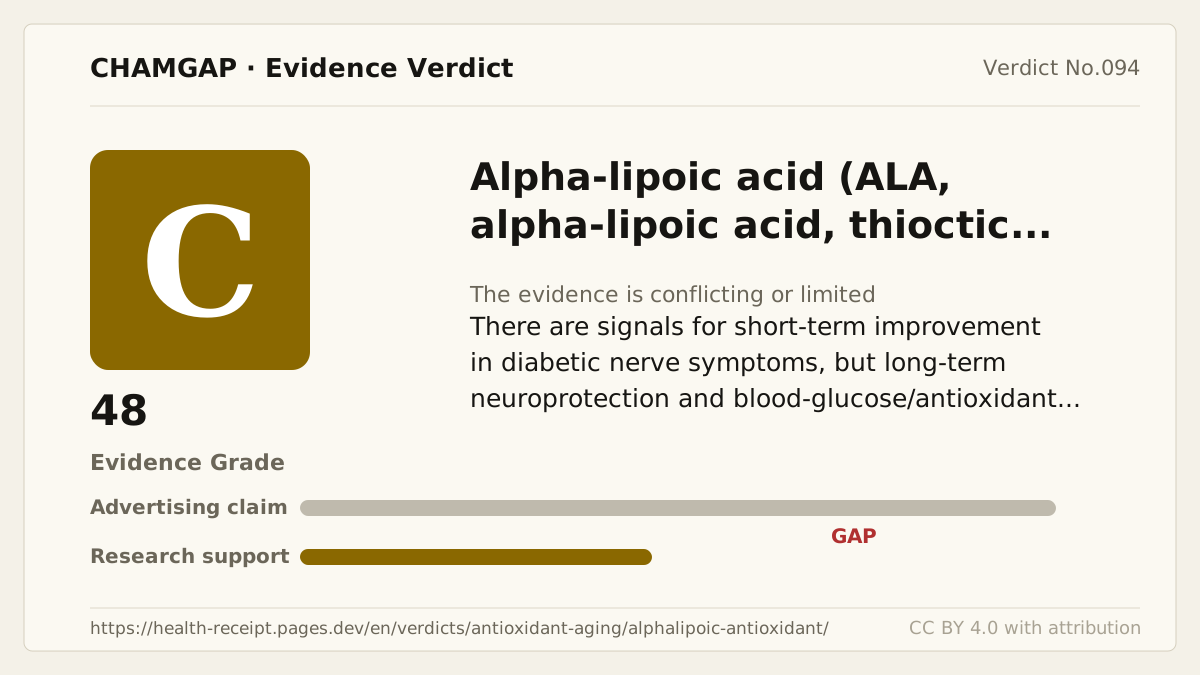
[Chamgap] Alpha-lipoic acid (ALA, alpha-lipoic acid, thioctic acid) × antioxidant, blood glucose, and nerves — Evidence Grade C·48. 11 cited sources checked. Source: https://chamgap.com/en/verdicts/antioxidant-aging/alphalipoic-antioxidant/ · CC BY 4.0CC BY 4.0 — free to use with attribution; do not distort grades, numbers, or verdict meaning.
What this document does and does not do
Chamgap is an information source. It reports what research has and has not confirmed; it does not tell readers what to take or buy. That decision belongs to readers and, when needed, medical or legal professionals. This verdict reflects literature available up to the search date and may change as new research appears. Nothing here is medical advice.