
Grape seed extract,
does it really help with Antioxidant, vascular, and edema effects?
research showsThere are small improvement signals for antioxidant markers and blood pressure in human RCTs and meta-analyses. However, antioxidant evidence is mainly based on surrogate markers such as MDA and oxidized LDL, and vascular evidence is also centered on indicators such as blood pressure, heart rate, and FMD; FMD and systolic blood pressure results were inconsistent. Edema/venous symptoms show signals in small trials and in broader phlebotonics reviews, but large independent placebo RCTs of grape seed extract alone are lacking.
ads claimDomestic shopping malls and informational articles present grape seed extract as 'a powerful antioxidant ingredient,' 'improves blood pressure and blood flow,' 'reduces LDL oxidation,' 'maintains blood circulation/vascular integrity,' and 'relieves leg edema and symptoms of venous insufficiency.' Some articles also use broad disease-prevention expressions such as stronger antioxidant activity than vitamin C/E, stroke and heart-disease prevention, and liver, kidney, and skin protection. Sales products expose 100-300 mg capsules, resveratrol/vitamin C combinations, and grape-seed oil products together, making it easy to mix them with standalone grape seed extract evidence.
Useful facts when choosing a product
- Doses often used in clinical trials range from 150 to 400 mg/day, while product labels commonly show 100 mg, 250 mg, and 300 mg capsules.
- Many raw materials state standardization to 90-95% proanthocyanidin/OPC content, but testing methods and actual composition may differ by product.
- Grape seed oil is not the same as grape seed extract, and evidence based on proanthocyanidin content is difficult to apply unchanged.
- Studies of combinations with vitamin C, resveratrol, bilberry, diosmin/MPFF, and similar ingredients must be separated from evidence for grape seed extract alone.
What the research actually shows
Vascular: the 2022 GSE meta-analysis (19 controlled trials, 1080 people) found significant DBP -2.20 mmHg and HR -1.25 bpm, but SBP and FMD were not significant. The 2016 GSE blood-pressure meta-analysis and some small RCTs reported SBP/DBP reductions, but samples were small and industry funding or product links were common. Antioxidant: the 2021 GSE oxidative-stress/inflammation meta-analysis reported reductions in lipid-peroxidation markers such as MDA and oxidized LDL, but these are laboratory markers, not clinical events. Edema/venous: there are studies of edema during prolonged sitting in healthy women and chronic venous disease, but sample and design limitations are large. The Cochrane phlebotonics review suggests a small reduction in leg edema, but grape seed extract accounts for only one study within the overall evidence. A 2024 Korean multicenter active-control noninferiority RCT reported that Vitis vinifera seed extract was noninferior to MPFF, but it was not placebo-controlled.
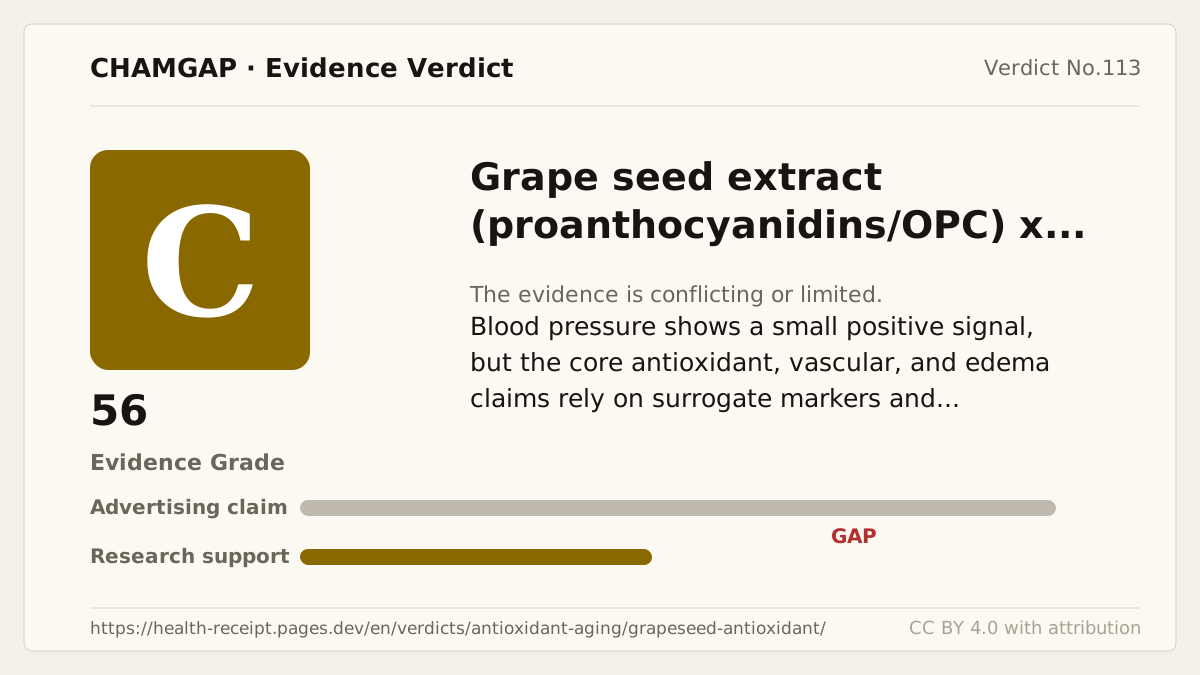
Why this is classified as C (56)
Separated by claim, blood pressure has the strongest positive signal because several human RCTs and meta-analyses exist, but the effect is small and SBP/FMD are inconsistent in recent GSE meta-analysis. Antioxidant evidence, even in humans, is biomarker-centered and capped at C by boundary rule 1. Edema/venous symptoms mix small and older studies, phlebotonics-wide evidence, and active-control noninferiority trials, making them insufficient as large independent placebo evidence for grape seed extract alone. Because positive findings are not entirely null, D/F is not appropriate, but an upper C is.
Counterpoint. The blood-pressure and venous-symptom areas are not evidence-free. A 2016 prehypertension RCT met its SBP primary endpoint, and a 2022 GSE meta-analysis also found reductions in DBP and heart rate. Thus, 'limited evidence with surrogate-marker, small-study, and industry-funding constraints' is more accurate than 'no effect.'
Rejudgment record. Draft=blinded convergent — Blood pressure shows a small positive signal, but the core antioxidant, vascular, and edema claims rely on surrogate markers and small/industry-funded studies, so the overall grade is C
Cross-check — Codex and Claude
Evidence Table
| Study | Design | Sample | Funding | Endpoint | Result | Weight |
|---|---|---|---|---|---|---|
| Foshati S, Nouripour F, Sadeghi E, Amani R 2022 | Meta-analysis | gut/gastrointestinal | In 19 controlled trials, DBP and HR decreased, but SBP and FMD were not significant, showing both the core evidence and limitations of the vascular claim. | Core | ||
| Ren J, An J, Chen M, Haiyue Y, Ma Y 2021 | Meta-analysis of RCTs | 376 | liver/blood pressure | In a meta-analysis of 6 proanthocyanidin RCTs/376 people, significant blood-pressure reductions were reported: SBP -4.598 mmHg and DBP -2.750 mmHg. | Core | |
| Zhang H, Liu S, Li L et al. 2016 | Meta-analysis of RCTs | blood pressure/gut/gastrointestinal | A meta-analysis of 16 GSE blood-pressure RCTs reported SBP/DBP reductions, and the authors also noted the need for large, long-term, multi-dose RCTs. | Core | ||
| Foshati S, Rouhani MH, Amani R 2021 | Meta-analysis | LDL-C/stress | Systematic review of 23 studies and meta-analysis of 19 reported improvements in oxidative-stress markers such as MDA and oxidized LDL. | Core | ||
| Park E, Edirisinghe I, Choy YY et al. 2016 | Double-blind RCT | 29 | Possible manufacturer/industry involvement | In 36 adults with prehypertension (29 completed), a 300 mg/day GSE beverage for 6 weeks lowered SBP by 5.6% and DBP by 4.7%, and SBP was significant versus placebo. | Supporting | |
| Sivaprakasapillai B, Edirisinghe I, Randolph J et al. 2009 | Possible manufacturer/industry involvement | In people with metabolic syndrome, placebo, 150 mg/day, and 300 mg/day GSE were compared over 4 weeks, and reductions in SBP/DBP were reported in the GSE groups. | Supporting | |||
| Odai T, Terauchi M, Kato K, Hirose A, Miyasaka N 2019 | Double-blind RCT | 30 | Possible manufacturer/industry involvement | In a 30-person RCT, GSPE 400 mg/day for 12 weeks lowered SBP by about 13 mmHg, but FMD did not change. | Supporting | |
| Sano A, Tokutake S, Seo A 2013 | Preclinical | Possible manufacturer/industry involvement | hydration/liver/gut/gastrointestinal | In a prolonged-sitting crossover trial in healthy Japanese women, GSE was reported to suppress increases in leg volume, extracellular fluid, and leg water. | Supporting | |
| Martinez-Zapata MJ, Vernooij RWM, Uriona Tuma SM et al. 2020 | Systematic review | liver | The overall phlebotonics evidence has moderate-certainty evidence for a small reduction in lower-limb edema, but grape seed extract studies account for only part of it. | Supporting | ||
| Kim SM, Joh JH, Jung IM et al. 2024 | RCT | 303 | In a Korean 13-hospital RCT of 303 people with chronic venous disease, Vitis vinifera seed extract was noninferior to MPFF for CIVIQ-20 improvement. | Supporting | ||
| National Center for Complementary and Integrative Health 2025 | pregnancy | NCCIH summarizes that GSE is generally tolerable, but safety in pregnancy/lactation is uncertain and caution is needed for drug interactions. | Supporting | |||
| Study 12 | skin/liver/LDL-C/blood pressure | A Korean consumer-facing informational sales page showed broad claims including antioxidant effects, blood-pressure/blood-flow improvement, reduced LDL oxidation, and liver/skin protection. | Supporting |
Receipt — 12 References
Of 12 cited sources, 5 had limited original-page access (blocked or summary-only) and were verified via index/summary, marked partial; the rest were verified at the original page. As of 2026-07-07.
Reviewed and approved: Chamgap Editorial Team · Approval date: 2026-07-07 · Corrections: none
Cite this verdict
[Chamgap] Grape seed extract x antioxidant, vascular, and edema effects — Evidence Grade C·56. 12 cited sources checked. Source: https://chamgap.com/en/verdicts/antioxidant-aging/grapeseed-antioxidant/ · CC BY 4.0CC BY 4.0 — free to use with attribution; do not distort grades, numbers, or verdict meaning.
What this document does and does not do
Chamgap is an information source. It reports what research has and has not confirmed; it does not tell readers what to take or buy. That decision belongs to readers and, when needed, medical or legal professionals. This verdict reflects literature available up to the search date and may change as new research appears. Nothing here is medical advice.