
NMN,
does it really help with anti-aging and NAD+ increase?
research showsMultiple human randomized controlled trials (RCTs) repeatedly confirm that taking NMN raises blood NAD+, and this is also confirmed in an independent meta-analysis without conflicts of interest (Chen 2024). However, this is a surrogate indicator, a “level in the blood,” not evidence that NMN actually entered body cells and produced effects there. The consumer-expected “anti-aging” effect (life-span extension, delayed aging, rejuvenation) has not been confirmed in humans; within the verification scope, there are no human studies confirming real outcomes (hard endpoints) such as life span, disease occurrence, or death. Many trials reporting that anti-aging, muscle function, or aerobic capacity “improved” were funded by manufacturers selling NMN and included employees as authors, while independent synthesis without funding conflicts reported no significant benefit for glucose or lipids (Chen 2024), or that physical-performance improvement was “non-significant” and limited to surrogate indicators (Wen 2024). In other words, efficacy signals are not confirmed at the independent research layer. Based on public materials, as of confirmation on 2026-07-06, the Korean MFDS had no record recognizing NMN as a health-functional-food functional ingredient, so domestic products appear to be distributed as “ordinary foods” (regulatory status is a follow-up target outside this verification scope). In short, the part that “NAD+ rises” is confirmed at the surrogate-indicator level, but the purchasing motivation, “anti-aging effect,” has no hard-endpoint human studies and is not confirmed as significant in independent conflict-free synthesis. In this project’s grading, the upper-level claim (anti-aging) corresponds to D, because it is not confirmed at the independent, high-quality layer. Safety is considered “caution” because long-term data are absent.
ads claimAdvertisements use strong efficacy and rejuvenation language that the included literature does not support. Based on confirmed advertising text, Ople.com (Genex Formulas NMN) promotes it as “the dream rejuvenation drug for anti-aging” and “rejuvenation such as increased life span, stable blood sugar changes, improved vision, increased bone density,” but these are mostly expressions transferring animal (mouse) experimental results to humans, and human life-span extension or rejuvenation was not confirmed within the included evidence. ProHealth Korea (NMN Pro/Uthever) advertises “raises NAD+ to promote brain and heart health, increase energy, and support healthy aging,” and “the first NMN proven to increase NAD+ in a double-blind, placebo-controlled clinical trial”; NAD+ increase itself matches the literature (surrogate indicator), but linking it to “healthy aging” exceeds the confirmed evidence. Rokit Healthcare (ROKITNMN) uses book-citation marketing such as “STAY YOUNGER, FEEL YOUNGER” and “core reverse-aging ingredient mentioned in ‘Lifespan.’” Within the confirmed scope, all three sellers do not clearly present product specifications such as purity and daily dose on landing pages, making E1/E2 comparison difficult (advertising originals/screenshots are follow-up targets outside this verification). Based on public materials, NMN is an ingredient in Korea with no confirmed MFDS recognition record, so if these products are distributed as “ordinary foods,” functional claims such as anti-aging, reverse-aging, rejuvenation, and NAD+ increase are understood to raise potential labeling/advertising regulatory issues (specific violation is for regulatory authorities to judge).
Useful facts when choosing a product
- Korean MFDS recognition record not confirmed: based on public materials, as of confirmation on 2026-07-06, no record was found that NMN is recognized as a health-functional-food functional ingredient, either notified-type or individually recognized, and domestic products appear to be distributed as “ordinary foods (other processed products).” Final regulatory status remains a follow-up target outside this verification.
- International regulatory instability: reports state that in 2022 the U.S. FDA excluded NMN from the definition of dietary supplement, so its regulatory status is known to be unstable internationally as well (primary regulatory document cross-check is a follow-up target).
- Manufacturer funding concentration in positive efficacy results: many included RCTs reporting improvements in muscle function, aerobic capacity, or insulin sensitivity (Yi 2022 Aba/Abinopharm; Igarashi/Fukamizu series Mitsubishi) were manufacturer-funded or employee-author studies (A1).
- Independent synthesis is null: the conflict-free Chen 2024 meta-analysis found no significant benefit for glucose or lipids, and Wen 2024 systematic review found physical performance improvement “non-significant” and limited to surrogate indicators. Efficacy significance is not confirmed at the zero-conflict layer (basis for D under chapter 2-1 item ②).
- Hard endpoints absent: within the included evidence, no human study confirmed delayed aging, life span, disease occurrence, or mortality. Confirmed outcomes are mostly surrogate indicators (blood NAD+, gait speed, 6-minute walk, insulin sensitivity, etc.).
- Product specifications undisclosed: within the confirmed scope, all three advertisements did not clearly present purity or daily dose on landing pages, making E1 (purity vs content) and E2 (actual ingredient amount) comparisons difficult (advertising originals/screenshots are follow-up targets).
- Safety data are short-term only: Fukamizu 2022 confirmed no serious adverse events with 1250 mg/day for 4 weeks, but long-term safety data are absent (basis for safety “caution”).
What the research actually shows
Original-text cross-checking of human RCTs and meta/systematic reviews (based on the seven core citations included in this judgment) summarizes the evidence as “partial confirmation limited to surrogate indicators + anti-aging unproven, efficacy lost at the independent layer.” [NAD+ increase — confirmed as a surrogate indicator] In healthy middle-aged adults (Yi 2022, GeroScience, 300~900 mg, 60 days) and healthy older men (Igarashi 2022, npj Aging, 250 mg, 12 weeks), blood/whole-blood NAD+ significantly increased versus placebo (Yi p≤0.001). The conflict-free Chen 2024 meta-analysis also confirmed NAD+ increase in five trials. However, this is a blood level (surrogate indicator), not cellular uptake or clinical benefit, and Chen 2024 explicitly stated that clinical benefit is unclear. [Anti-aging/functional hard outcomes — unproven] Within the included evidence, no human study examined hard endpoints such as delayed aging, life span, or disease occurrence. Wen 2024 (Cureus systematic review, 10 RCTs, 437 participants) concluded that NMN is associated with “nonsignificant” improvement in muscle strength, that improvements are limited to surrogate indicators such as gait speed and ventilatory threshold, and that hard outcomes such as aging and death are absent. Chen 2024 (Current Diabetes Reports meta-analysis, 8 RCTs, 342 participants) found no significant improvement versus placebo in fasting glucose, insulin, HbA1c, or lipids (borderline HOMA-IR p=0.06 disappeared in sensitivity analysis). In Liao 2021 (RCT in runners), the core indicator VO2max also showed no between-group difference, with only surrogate indicators improved. [Independence contrast] Positive efficacy signals (muscle function, aerobic capacity, insulin sensitivity) are concentrated in manufacturer-funded/employee-author studies (Yi=Aba/Abinopharm, Igarashi/Fukamizu=Mitsubishi), and in independent conflict-free syntheses (Chen 2024, Wen 2024) they are confirmed as null or non-significant. [Patient-population study] Yoshino 2021 (Science, PMID 33888596) showed improved muscle insulin sensitivity in postmenopausal women with prediabetes and overweight/obesity (patient group, n=25), but this is not an anti-aging study in healthy general adults, and body weight, liver fat, blood pressure, and lipids did not differ between groups. [Safety] Fukamizu 2022 (Scientific Reports) found no serious adverse events with 1250 mg/day for 4 weeks (but did not measure efficacy or NAD+, and was only 4 weeks). Overall: NAD+ rise is replicated as a surrogate indicator, but human clinical evidence for “anti-aging help” lacks hard endpoints and is not confirmed in independent synthesis.
Why this is classified as D
Basis for D judgment (applying chapter 2-1 items ② and ③): The judgment claim is the compound claim “anti-aging + NAD+ increase.” (1) “NAD+ increase” is a real effect replicated in multiple RCTs and an independent conflict-free meta-analysis (Chen 2024), but it is a surrogate indicator (blood level), and cellular uptake/clinical benefit is unknown (under ①, this endpoint alone is maximum C). (2) The upper endpoint driving consumer purchase, “anti-aging/function improvement,” lacks human studies on hard endpoints, and significance is not confirmed in independent zero-conflict synthesis (Chen 2024 glucose/lipids null; Wen 2024 physical performance “non-significant”). Positive efficacy results (muscle function, aerobic capacity, insulin sensitivity) are concentrated in manufacturer-funded/employee-author studies and disappear at the independent layer. Chapter 2-1 item ② requires reading the “zero-conflict layer” first rather than the “entire evidence pool,” so the anti-aging endpoint corresponds to D due to absence of independent confirmation. Under ③, because the compound claim includes an endpoint with no evidence (anti-aging hard outcomes), a half-grade downgrade is considered, and the overall grade is set to D based on the upper-level sales claim while separately stating confirmation of the NAD+ surrogate. Why not C: C is a state of conflicting/limited directions, but here the upper endpoint (anti-aging) has an independent/high-quality layer, and that layer fails to confirm efficacy (meeting ②’s D condition). Why not F: anti-aging has not been actively disproven; it is unconfirmed at the independent layer, while the NAD+ surrogate is replicated. Regulatory status (no confirmed MFDS recognition record, domestic ordinary-food distribution) is supplementary context based on public materials and is not an upward grading factor (chapter 2-1 item ④). Safety “caution” reflects that short-term trials found no serious adverse events (Fukamizu 2022, 1250 mg for 4 weeks) but long-term safety data are absent.
Counterpoint. Reason to view it higher than D (C): if “blood NAD+ increase” is narrowly separated out, placebo-controlled RCTs in healthy people confirm dose-dependent and replicated increases at p≤0.001, and an independent meta-analysis without conflicts of interest (Chen 2024) also confirmed increases in five trials; for this specific subordinate surrogate endpoint, the evidence can be defended as relatively solid and graded C. Editorial judgment point: whether the overall grade should be based on the most robust subordinate endpoint (NAD+ surrogate=C) or on the upper endpoint that drives consumer purchase (anti-aging=independently unconfirmed=D). This judgment aligns to D based on the upper endpoint under Methodology chapter 2-1 item ② (zero-conflict layer first) and ③ (reflect endpoints with no evidence in compound claims). Additionally, relationships of some authors, such as Klein with pharmaceutical companies (Janssen, Merck) and Kong’s journal editor status, remain circumstances requiring caution in evidence interpretation as non-financial/financial conflicts of interest.
Cross-check — Codex and Claude
Evidence Table
| Study | Design | Sample | Funding | Endpoint | Result | Weight |
|---|---|---|---|---|---|---|
| Study 1 | double-blind randomized controlled trial | 25 | manufacturer/industry involvement possible | body weight, liver, blood pressure, and anti-aging | Randomized, double-blind, placebo-controlled trial of NMN 250 mg/day for 10 weeks in postmenopausal women with prediabetes and overweight/obesity (patient group, n=25; NMN 13, placebo 12). Muscle insulin sensitivity (surrogate indicator) significantly improved, but body weight, liver fat, blood pressure, and lipids did not change. Funding was U.S. NIH (non-industry). | core |
| Study 2 | double-blind randomized controlled trial | 80, | manufacturer/industry involvement possible | NAD | In healthy middle-aged adults (n=80, age 40~65, two institutions in India), NMN 300, 600, or 900 mg/day for 60 days significantly increased blood NAD+ versus placebo (p≤0.001, highest at 600 and 900 mg) and significantly improved 6-minute walk, but both are surrogate indicators. | core |
| Study 3 | not specified | 20 | manufacturer/industry involvement possible | NAD, anti-aging, and muscle | In healthy older Japanese men (>=65 years, 42 enrolled/20 completed), NMN 250 mg/day for 12 weeks significantly increased whole-blood NAD+ and NAD metabolites, but muscle-function results were mixed (only gait speed and left grip strength “nominally” improved; muscle mass and right grip strength unchanged). | core |
| Liao B, Zhao Y, Wang D, Zhang X, Hao X, Hu M 2021 | double-blind randomized controlled trial | 48, | manufacturer/industry involvement possible | liver, NAD, and absorption | In amateur runners (n=48, 40 men/8 women), NMN 300, 600, or 1200 mg/day plus exercise for 6 weeks; the core indicator VO2max showed no between-group difference, only ventilatory-threshold (VT)-related surrogate indicators improved dose-dependently, and NAD+ was not measured. | core |
| Fukamizu Y, Uchida Y, Shigekawa A, Sato T, Kosaka H, Sakurai T 2022 | double-blind randomized controlled trial | 5 | manufacturer/industry involvement possible | gastrointestinal and NAD | Randomized, double-blind, placebo-controlled safety trial in healthy adults (n=31, age 20~65): beta-NMN 1250 mg/day for 4 weeks plus 2-week observation. No serious adverse events, but NAD+ and NMN metabolites were not measured, so it provides no efficacy evidence. | supporting |
| Chen F, Zhou D, Kong APS, Yim NT, Dai S, Chen YN, Hui LL 2024 | meta-analysis and RCTs | 8 | manufacturer/industry involvement possible | glycemia, HbA1c, and NAD | Meta-analysis of 8 adult RCTs, 342 participants. Short-term NMN had no significant benefit for fasting glucose, insulin, HbA1c, or lipids (HOMA-IR -0.27, p=0.06 disappeared in sensitivity analysis); NAD+ increased in five trials, but cellular/clinical benefit was unclear. It noted that human doses are much lower than animal effective doses. | supporting |
| Study 7 | systematic review and RCTs | 10 | manufacturer/industry involvement possible | gastrointestinal, NAD, anti-aging, and muscle strength | Systematic review of 10 RCTs, 437 participants. NMN was associated with “nonsignificant” improvement in muscle strength such as grip strength; improvements were limited to surrogate indicators (ventilatory threshold, 6-minute walk, gait speed), body composition did not change, and hard outcomes such as aging and mortality were absent. | supporting |
Receipt — 7 References
All 7 cited sources were verified for existence at the original page (as of 2026-07-06).
Reviewed and approved: Chamgap Editorial Team · Approval date: 2026-07-06 · Corrections: none
Cite this verdict
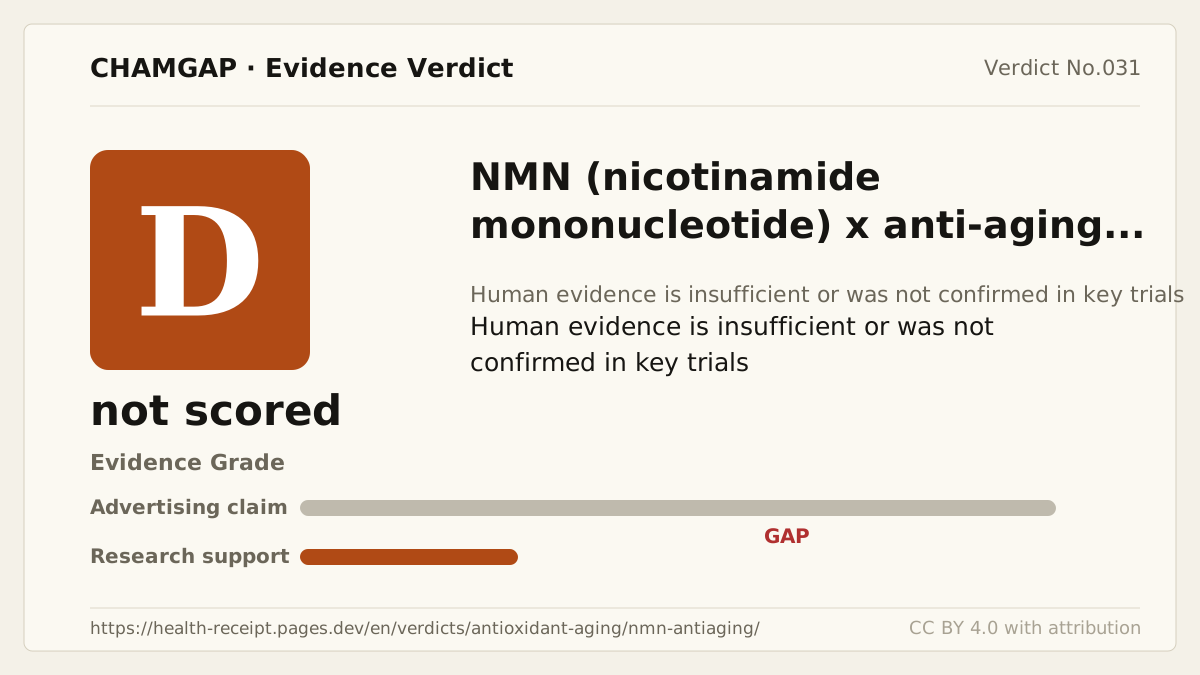
[Chamgap] NMN x anti-aging — Evidence Grade D. 7 cited sources checked. Source: https://chamgap.com/en/verdicts/antioxidant-aging/nmn-antiaging/ · CC BY 4.0CC BY 4.0 — free to use with attribution; do not distort grades, numbers, or verdict meaning.
What this document does and does not do
Chamgap is an information source. It reports what research has and has not confirmed; it does not tell readers what to take or buy. That decision belongs to readers and, when needed, medical or legal professionals. This verdict reflects literature available up to the search date and may change as new research appears. Nothing here is medical advice.