
Spinach extract,
does it really help with appetite suppression and weight management?
research showsFor the claim that spinach extract (thylakoids) “suppresses appetite and manages body weight,” the answer changes when endpoints are separated. Signals that it “may affect short-term appetite and satiety” have been observed with generally consistent direction across several human trials, but the core of the claim, “weight management,” has not yet been proven. Because the evidence is in this conflicting and limited state, the grade is C. However, this case remains a borderline case for editorial judgment on whether it should be D or C, because positive results are concentrated in two research groups and independent replication is lacking without an independent null trial. Four key facts are conveyed within the confirmed scope. ①Within the scope of this verification, this ingredient is not confirmed as a functional ingredient recognized by the Korean MFDS (neither “spinach extract” nor “thylakoid” was confirmed in notified-type or individually recognized lists). “Appetite suppression” is not an approved functional expression in Korea. ②Studies with positive results are effectively concentrated in two research groups (the Lund University Erlanson-Albertsson group in Sweden and the Farhangi group at Tabriz University of Medical Sciences in Iran), and for the Iranian group’s PCOS trials, comparison of the two cited papers (PMID 32782010 and 37968684) confirms circumstances suggesting repeated publication of the same/sister cohort with the same design, “48 participants, 5 g/day, 12 weeks” (counting secondary analyses as independent RCTs inflates the evidence). Some Lund studies had samples supplied by the manufacturer (Greenleaf Medical AB), and conflict-of-interest history is noted in the cited bibliography. ③In meta-analysis, improvements in hunger and satiety are statistically significant, but the sizes are -2.4 mm (hunger) and +4.6 mm (satiety) on a 100 mm scale, a level that is hard to feel clinically, and all are subjective indicators. ④The most comprehensive systematic review (2019) explicitly states that although thylakoids “may reduce appetite and perhaps food intake in the short term,” body-weight and anthropometric results are mixed (controversial), and “the evidence is insufficient to support the role of thylakoids in obesity prevention and treatment.” In other words, a “possible short-term effect on appetite” is observed, but this is not yet “proof of weight-management effect.” The repeatedly advertised “95% appetite suppression and 43% body-weight reduction” differs greatly from the original paper’s numbers (based on the original paper, the net increment versus placebo was about 1.5 kg, with dietary restriction in both groups). For safety, because this is a food-derived ingredient, no major adverse reactions were confirmed in short-term trials, but it is not confirmed as an official Korean health functional food and long-term safety data are limited, so safety is kept at “caution.”
ads claimWithin the confirmed scope, the numbers in publicly exposed Korean materials (observed through Policy Briefing korea.kr, Real Foods, Health Chosun reposts, etc.) differ greatly from the original paper data. Representative examples: “suppresses appetite by 95%,” “reduces body weight by 43%.” On comparison, the “43%” appears to have turned the relative additional loss in Montelius 2014, thylakoid group 5.0 kg vs placebo group 3.5 kg (1.5/3.5≈43%), into “body weight decreased by 43%”; by the original paper, the net increment versus placebo is about 1.5 kg, and both groups combined dietary restriction. The “95%” appears to have turned the subjective response proportion in an acute trial, in which 95% of participants “reported” reduced hedonic-food craving, into “95% appetite suppression.” Real Foods is observed to have also included a rebuttal (“the research extract isolated only thylakoids, so it is hard for ordinary people to see the same effect”). The ingredient brand (Appethyl/Greenleaf) presents 5 g/day as the minimum effective dose in public materials, the same value as the Lund group (manufacturer-linked) trial design, so the source of the advertising numbers overlaps with conflicted original sources (advertising/article original URLs are not included in the present citation list and remain follow-up confirmation targets).
Useful facts when choosing a product
- Research doses are generally 5 g/day (long-term) to single-dose 5 g (acute), with long-term studies in the range of 3.7~7.4 g/day; the ingredient brand (Appethyl) also presents 5 g/day as the minimum effective dose in public materials.
- Trials that found weight-loss effects combined dietary restriction, such as a 500 kcal/day deficit. A randomized placebo-controlled design can estimate additional effect versus placebo, but much of the loss is mixed with dietary restriction, making it hard to separate the thylakoid-only contribution.
- Within the scope of this verification, no official Korean health functional food presenting “spinach extract (thylakoids)” as an individual ingredient was confirmed. Spinach extract powders and similar items are observed to circulate as ordinary foods, and if they claim appetite suppression or weight-loss efficacy, the possibility of unfair advertising under the Food Labeling and Advertising Act may be raised (whether an individual case is illegal is outside the scope of this verification).
- Positive results mainly concern overweight women or women with obesity and PCOS; evidence for generalizing to men, normal-weight people, or the general public was not confirmed.
- The advertising claim “43% body-weight reduction” appears to originate from relative additional-loss framing versus placebo (1.5 kg/3.5 kg), and by the original paper the net increment versus placebo is about 1.5 kg.
What the research actually shows
Human RCTs exist, but most are small, concentrated in specific research groups, and centered on surrogate indicators. Summary of eight verified studies: ▲Systematic review (Amirinejad 2019, PMID 32550209, 8 clinical studies) concluded that thylakoids “may reduce appetite and perhaps food intake in the short term,” but only two studies measured body weight, results were mixed, and evidence for obesity prevention/treatment was insufficient; it was not a meta-analysis. ▲Dose-response meta-analysis (Nikrad 2025, PMID 38518202, 5 RCTs) found hunger -2.415 mm and satiety +4.602 mm (both on 100 mm VAS, P<0.001), statistically significant but with tiny effect size [B1]. Body weight was not the endpoint. Author Farhangi overlaps with the group’s own PCOS trials [A2]. ▲Lund group RCTs (Montelius 2014 PMID 24993695: net increment versus placebo about 1.5 kg; Stenblom 2015 PMID 25895695 acute; Rebello 2015 PMID 26029978 acute; Köhnke 2009 PMID 19308799 CCK mechanism n=11) involved manufacturer sample provision and conflict-of-interest history, with insufficient independent replication [A1]. In some cases, actual energy-intake reduction was confirmed not significant. ▲Tabriz PCOS RCTs (Tabrizi 2020 PMID 32782010: -6.97 vs -3.19 kg; Nikrad 2023 PMID 37968684) combined a low-calorie diet (500 kcal deficit), so an additional effect versus placebo can be estimated, but much of the loss is mixed with dietary restriction; generalization is limited to PCOS patients [B4], and citation comparison confirms circumstances suggesting the two papers repeatedly published the same/sister cohort with the same design of 48 participants, 5 g, and 12 weeks [A2]. Summary: a “short-term appetite-effect signal” is observed with generally consistent direction, but “independent, replicated, perceptible proof of weight-management effect” is not met; this is a conflicting state divided by endpoint, and the remaining limitation is structural absence of independent replication without an independent null RCT among the positive evidence.
Why this is classified as C (50)
Basis for grade C (conflicting/limited, borderline): The Methodology chapter 2-1 rule for scoring compound claims by endpoint is applied. When the two endpoints, “appetite suppression + weight management,” are separated, the direction of the evidence diverges. [Appetite/satiety (surrogate indicators)] Short-term appetite suppression and increased satiety are observed with generally consistent direction in a systematic review (Amirinejad 2019, PMC7270222) and a dose-response meta-analysis (Nikrad 2025, PMID 38518202: fasting WMD -2.415 mm, satiety +4.602 mm, P<0.001), and CCK and GLP-1 mechanisms (Köhnke 2009) report related signals; this differs from the D floor where only purely observational studies exist. [Body weight (the explicit endpoint of the claim)] However, the representative systematic review (2019) explicitly states “controversial” and “insufficient evidence,” all trials showing weight loss combined low-calorie diets (Montelius 2014 net increment about 1.5 kg; Tabrizi 2020 low-calorie diet), positive results are concentrated in the Lund and Tabriz groups, and citation comparison confirms cohort overlap in the Iranian trial (A2), so independent replication is structurally lacking. Under chapter 2-1 item ①, the weight endpoint falls short of proof on the primary endpoint, so the upper bound is C. The D trigger condition in chapter 2-1 item ② is the “existence of an independent null RCT” or “disappearance of significance in high-quality groups,” but this case does not have an independent null RCT; rather, independent RCTs themselves are absent. This state of “absence of independent RCTs; all positives concentrated in manufacturers/specific groups” is explicitly designated by the methodology as a borderline case (isomorphic to 029 and 030), and because there is no explicit textual basis for forced downgrade to D, the current C is retained and marked as borderline. Why not A/B: the effect remains on surrogate/subjective indicators, the perceptible size is tiny, and for the core endpoint of body weight, representative literature explicitly states failure of proof while problems of independent replication and funding bias overlap. Why not F: this is not disconfirmation, because directionally consistent short-term signals are observed.
Counterpoint. The downgrade (D) argument is also recorded: the claim explicitly includes “weight management,” and for that endpoint the representative systematic review explicitly states “insufficient evidence”; positive weight-loss trials all combine low-calorie diets, are concentrated in a small number of groups, and have cohort overlap, so “independent, replicated, perceptible proof” is structurally lacking. From this view, “even if there is a short-term appetite signal, the actually claimed effect (body weight) falls short of proof,” making D more coherent (both Codex passes presented this direction as D). Conversely, there is also an upgrade (B) argument: appetite and satiety effects are statistically significant (P<0.001) in multiple RCTs and meta-analyses, and CCK and GLP-1 mechanisms are reported, so it could be viewed as “human evidence exists but has limitations (B).” However, the upgrade evidence simultaneously carries three weaknesses: (a) surrogate/subjective indicators, (b) imperceptible effect size, and (c) lack of independent replication (cohort overlap and manufacturer linkage), so it does not reach B. The reason for judging C is that coexistence of an observed signal in one endpoint (appetite) and failure to prove the other endpoint (body weight) is the actual form of this evidence, a “conflicting/limited” state; downgrade to D remains an editorial decision on whether to explicitly codify “absence of independent RCTs.”
| Endpoint | S | Surrogate marker - laboratory or imaging measures |
| Replication | R1 | Single confirmatory trial |
| Independence | I1 | Mixed funding sources |
| Effect size | E+ | Meets the clinically important threshold |
The scoring table and the verdict agree (C).
Cross-check — Codex and Claude
Evidence Table
| Study | Design | Sample | Funding | Endpoint | Result | Weight |
|---|---|---|---|---|---|---|
| Amirinejad A, Heshmati J, Shidfar F 2019 | systematic review | 2 | manufacturer/industry involvement possible | body weight, appetite, and gastrointestinal | A systematic review that qualitatively synthesized eight clinical studies (not a meta-analysis). It stated that “thylakoid-enriched meals can reduce appetite and perhaps food intake in the short term,” but only two studies measured body weight and results were mixed; it explicitly stated that “the evidence is insufficient to support the role of thylakoids in obesity prevention and treatment.” Funding and conflicts of interest were not clearly disclosed in the original text. | core |
| Nikrad N, Ghaffari Sarghein M, Abbasalizad Farhangi M 2025 | meta-analysis and RCTs | 5 | manufacturer/industry involvement possible | body weight, appetite, and satiety | Dose-response meta-analysis integrating five RCTs. When combined with meals, hunger WMD was -2.415 mm (95% CI -3.544~-1.287) and satiety WMD was +4.602 mm (95% CI 2.356~6.848), both P<0.001. The results are statistically significant, but the perceptible size is tiny, only a few mm on a 100 mm VAS, and the primary endpoint is not body weight but subjective appetite indicators. | core |
| Montelius C, Erlandsson D, Vitija E, Stenblom E-L, Egecioglu E, Erlanson-Albertsson C 2014 | randomized controlled trial | manufacturer/industry involvement possible | body weight and liver | A 12-week RCT in overweight women. Weight loss was 5.0±2.3 kg in the thylakoid group vs 3.5±2.3 kg in the placebo group, between-group p<0.01; the net increment versus placebo was about 1.5 kg. Both groups combined dietary restriction. The advertising claim “43% body-weight reduction” misreads this 1.5/3.5≈43% (relative additional loss) as an absolute reduction rate. | core | |
| Rebello CJ, Chu J, Beyl R, Edwall D, Erlanson-Albertsson C, Greenway FL 2015 | double-blind randomized controlled trial | 59 | manufacturer/industry involvement possible | body weight and liver | Acute double-blind crossover RCT in 60 overweight/obese participants (VAS analysis n=59). Hunger and 2-hour food craving decreased versus placebo (both p<0.01), but actual evening energy intake showed no significant difference (trend toward reduction in men, p=0.08). Funding was NIH (T35 DK093428, U54 GM104940). | core |
| Köhnke R, Lindbo A, Larsson T, Lindqvist A, Rayner M, Emek SC, Albertsson P-A, Rehfeld JF, Landin-Olsson M, Erlanson-Albertsson C 2009 | not specified | 11 | manufacturer/industry involvement possible | body weight and appetite | Acute intervention in 11 healthy normal-weight participants. Adding thylakoids to a fatty meal increased CCK and decreased insulin (original source for the satiety-hormone mechanism). It measured only pure hormonal surrogate indicators and did not directly evaluate appetite or body-weight endpoints. | supporting |
| Pourteymour Fard Tabrizi F, Abbasalizad Farhangi M, Vaezi M, Hemmati S 2020 | double-blind randomized controlled trial | 44 | A 12-week RCT in 48 registered women with obesity and PCOS (44 completed: thylakoid 21/placebo 23), 5 g/day plus low-calorie diet. Weight loss was -6.97±0.52 kg in the thylakoid group vs -3.19±0.72 kg in the placebo group (P<0.001). Much of the weight loss is mixed with the effect of the low-calorie diet. | supporting | ||
| Nikrad N, Farhangi MA, Pourteymour Fard Tabrizi F, Vaezi M, Mahmoudpour A, Mesgari-Abbasi M 2023 | double-blind randomized controlled trial | 48 | liver, stress, and antioxidant | A 12-week RCT in women with obesity and PCOS (the same 48 randomized participants, 21/23 completed), 5 g/day plus low-calorie diet (TEE-500 kcal). LPS decreased and BDNF increased (both P<0.001), but oxidative-stress indicators (MDA, catalase, total antioxidant capacity) showed no between-group difference (P>0.05). | supporting |
Receipt — 7 References
Of 7 cited sources, 1 had limited original-page access (blocked or summary-only) and were verified via index/summary, marked partial; the rest were verified at the original page. As of 2026-07-06.
Reviewed and approved: Chamgap Editorial Team · Approval date: 2026-07-06 · Corrections: none
Cite this verdict
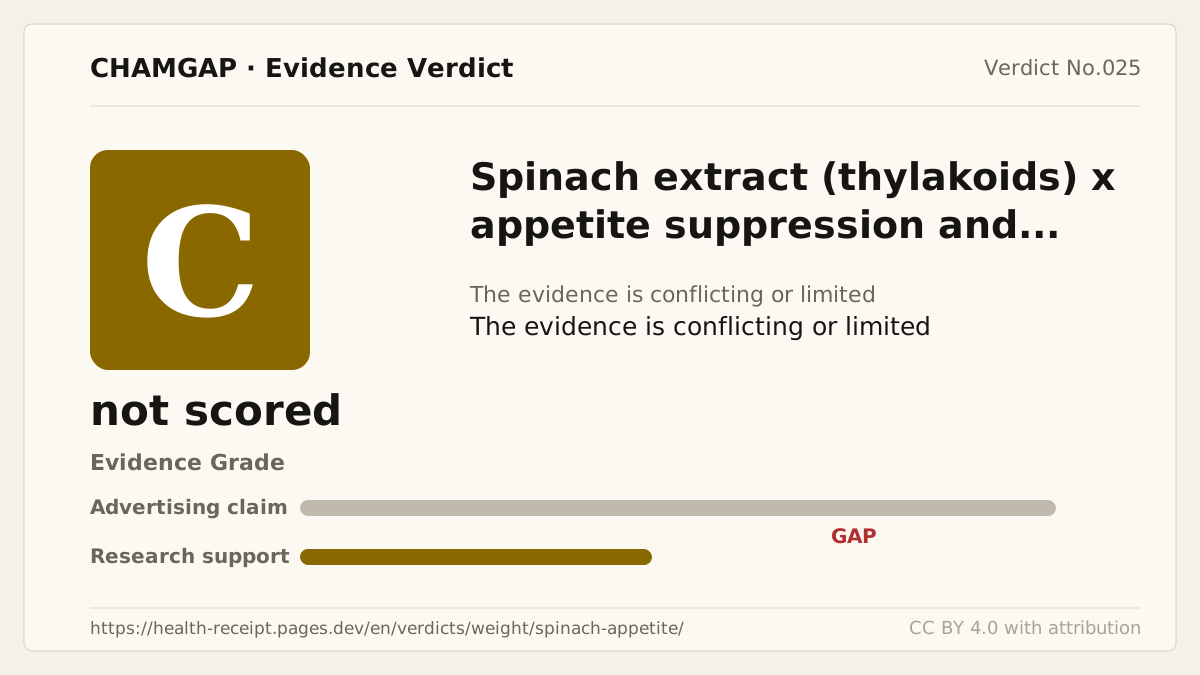
[Chamgap] Spinach extract (thylakoids) x appetite suppression — Evidence Grade C·50. 7 cited sources checked. Source: https://chamgap.com/en/verdicts/weight/spinach-appetite/ · CC BY 4.0CC BY 4.0 — free to use with attribution; do not distort grades, numbers, or verdict meaning.
What this document does and does not do
Chamgap is an information source. It reports what research has and has not confirmed; it does not tell readers what to take or buy. That decision belongs to readers and, when needed, medical or legal professionals. This verdict reflects literature available up to the search date and may change as new research appears. Nothing here is medical advice.