
L-carnitine,
does it really help with Body fat and dieting?
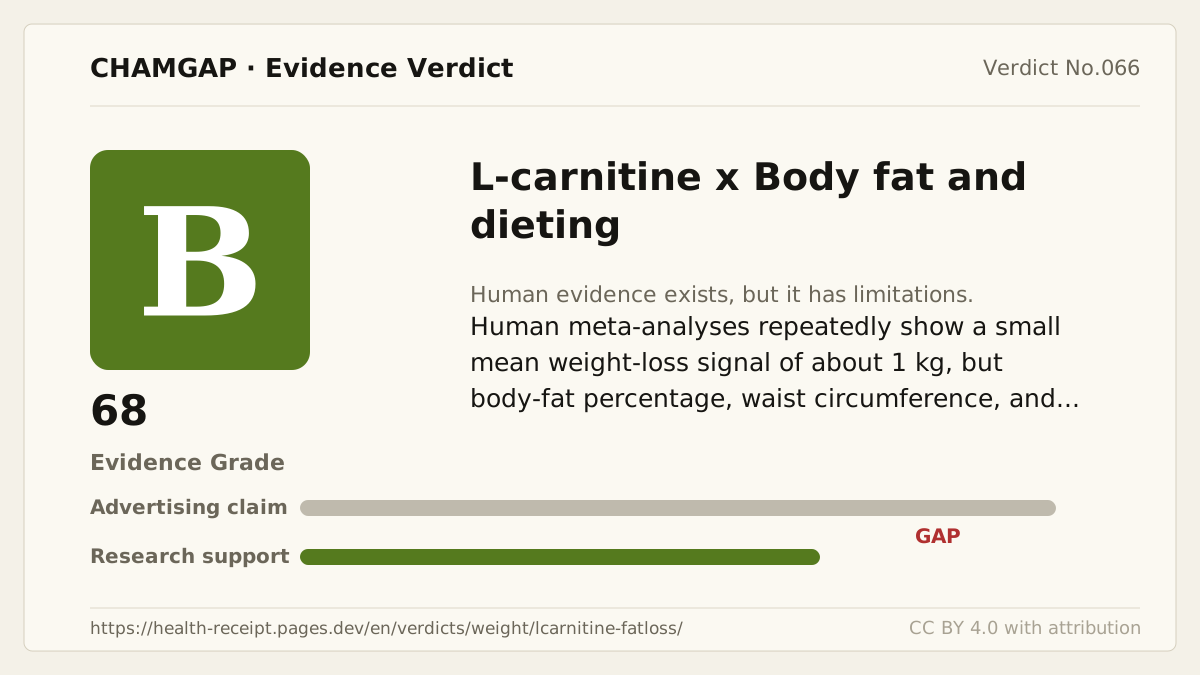
research showsIn randomized human trials and meta-analyses, L-carnitine repeatedly shows results in the direction of reducing body weight by roughly about 1 kg on average. However, the effect size is small, body-shape measures such as body-fat percentage and waist circumference are inconsistent, and the findings are difficult to generalize directly to people with normal body weight.
ads claimIn the Korean market, many products, articles, and broadcast clips describe L-carnitine as a "carrier that turns fat into energy" and connect it with "fat burning," "body-fat reduction," "pre-workout intake," and "exercise efficiency/fatigue improvement." CJ Wellcare Fatdown Booster Carnitine foregrounds L-carnitine tartrate and functionality for body-fat reduction and exercise-induced fatigue improvement, while shopping malls such as Coupang sell products mixed with garcinia, probiotics, and other ingredients under claims such as "weight management," "body-fat reduction," and "helps fat burning." Some informational articles also note the limitations that the effect is small and centered on overweight or obese groups.
Useful facts when choosing a product
- Representative Korean advertising phrases include L-carnitine tartrate, body-fat reduction, improvement of fatigue caused by exercise, and pre-exercise ampoule intake.
- Online products are commonly combination products mixed not only with L-carnitine alone but also garcinia, green-tea catechins, probiotics, and other ingredients, so evidence assessment must separate the single-ingredient effect.
- Salt forms are mixed, including L-carnitine tartrate, fumarate, and acetyl-L-carnitine. The core of the weight/body-fat meta-analytic evidence is mainly supplementation with L-carnitine/levocarnitine or its salts.
- NIH ODS states that supplementation around 3 g/day may cause nausea, vomiting, abdominal cramps, diarrhea, fishy body odor, and possible seizures in people with seizure disorders.
What the research actually shows
A 2016 meta-analysis of 9 RCTs and 911 participants reported differences of body weight -1.33 kg and BMI -0.47 kg/m2. A 2020 Clin Nutr ESPEN meta-analysis of 37 RCTs and 2292 participants reported body weight -1.21 kg, BMI -0.24 kg/m2, and fat mass -2.08 kg, but waist circumference and body-fat percentage were not significant, and in high-quality RCTs only the body-weight effect was confirmed. A 2020 Pharmacological Research meta-analysis of 43 RCTs also reported body weight -1.129 kg, BMI -0.359 kg/m2, and fat mass -1.158 kg, but body-fat percentage and waist circumference were not significant. In individual RCTs, an 8-week trial in overweight women combining 4 g/day with walking showed no between-group difference in body weight or fat mass, while a short-term metabolic trial confirmed only the surrogate marker of increased 13C-fat oxidation. Combination-product studies that include drugs such as orlistat must be separated from the effect of L-carnitine alone.
Why this is classified as B (68)
This is rated B. There are multiple human RCTs, and meta-analyses by independent research groups repeatedly report results in the direction of weight reduction, so the evidence is not low enough for C. However, the mean effect size is small, around about 1 kg; study populations are heterogeneous, including obesity, diabetes, PCOS, and hemodialysis; and body-fat percentage and waist circumference repeatedly fail to reach significance. In many trials, body weight and body composition were also ancillary measures rather than primary endpoints, so the evidence falls short of the consistent confirmation required for A.
Counterpoint. In overweight or obese adults, small weight-loss signals are repeated in meta-analyses. Conversely, the evidence is weak for claims in normal-weight people, ordinary dieters who only add exercise, or expectations of large body-shape change such as a "fat-burning constitution change." Fat-loss claims are partly positive in kg of fat mass, but they are not consistent through body-fat percentage and waist circumference.
Rejudgment record. Convergent — Draft = blinded B. Meta-analyses repeatedly show small weight reduction (~1 kg range), but clinical magnitude and mechanism remain debated.
Cross-check — Codex and Claude
Evidence Table
| Study | Design | Sample | Funding | Endpoint | Result | Weight |
|---|---|---|---|---|---|---|
| Talenezhad N, Mohammadi M, Ramezani-Jolfaie N, Mozaffari-Khosravi H, Salehi-Abargouei A 2020 | Meta-analysis/RCT | 2292 | Body fat/body weight | A meta-analysis of 37 RCTs and 2292 participants found reductions in body weight, BMI, and fat mass, but waist circumference and body-fat percentage were not significant, and high-quality RCTs confirmed only body weight. | Core | |
| Askarpour M, Hadi A, Miraghajani M, Symonds ME, Sheikhi A, Ghaedi E 2020 | Meta-analysis/RCT | Mixed/partly industry related | Body fat/body weight | A meta-analysis of 43 RCTs, mainly in overweight and obese groups, reported reductions in body weight, BMI, and fat mass, but body-fat percentage and waist circumference were not significant. | Core | |
| Pooyandjoo M, Nouhi M, Shab-Bidar S, Djafarian K, Olyaeemanesh A 2016 | Meta-analysis/RCT | 911 | Body weight | A meta-analysis of 9 RCTs and 911 participants reported body weight -1.33 kg and BMI -0.47 kg/m2. | Core | |
| Villani RG, Gannon J, Self M, Rich PA 2000 | 36 | Body weight/liver | In a 36-person RCT of overweight premenopausal women combining 4 g/day for 8 weeks with walking exercise, there was no between-group difference in body weight, fat mass, or resting fat utilization. | Core | ||
| Wutzke KD, Lorenz H 2004 | 12 | Body weight/liver | In 12 slightly overweight people, 3 g/day for 10 days increased 13C-fat oxidation, but this was a metabolic surrogate study rather than evidence of body-composition or weight change. | Supporting | ||
| National Institutes of Health Office of Dietary Supplements | Meta-analysis | Body weight | NIH ODS summarizes mixed weight-loss findings, the 2016 meta-analysis mean of -1.33 kg, the need for larger studies, adverse effects around 3 g/day, and concerns about TMAO. | Supporting | ||
| Wang DD, Wang TY, Yang Y, He SM, Wang YM 2021 | RCT | 1239 | In a model-based analysis of 10 RCTs and 1239 people with type 2 diabetes, L-carnitine tended to lower BMI, but the evidence is limited to patients with diabetes. | Supporting | ||
| Study 8 | Body fat/body weight | Citing German consumer-organization material, Food Safety Korea described L-carnitine being promoted for fat-burning and weight loss, while noting that fat burning and body-fat change are not clear under ordinary conditions. | Supporting | |||
| Study 9 | Possibly manufacturer/industry related | Body fat/gastrointestinal | A Korean product advertises L-carnitine tartrate prominently as a functional ingredient for body-fat reduction and improvement of exercise fatigue. | Supporting | ||
| Study 10 | Body fat/body weight | Online sales copy showed cases in which L-carnitine was sold for weight management, body-fat reduction, help with fat burning, and in combination-product forms. | Supporting | |||
| Study 11 | Gastrointestinal | A Korean informational article introduced the mean additional weight-loss figure of 1.33 kg while also presenting expert opinion that the actual effect is small. | Supporting |
Receipt — 11 References
Of 11 cited sources, 4 had limited original-page access (blocked or summary-only) and were verified via index/summary, marked partial; the rest were verified at the original page. As of 2026-07-07.
Reviewed and approved: Chamgap Editorial Team · Approval date: 2026-07-07 · Corrections: none
Cite this verdict
[Chamgap] L-carnitine × body fat and dieting — Evidence Grade B·68. 11 cited sources checked. Source: https://chamgap.com/en/verdicts/weight/lcarnitine-fatloss/ · CC BY 4.0CC BY 4.0 — free to use with attribution; do not distort grades, numbers, or verdict meaning.
What this document does and does not do
Chamgap is an information source. It reports what research has and has not confirmed; it does not tell readers what to take or buy. That decision belongs to readers and, when needed, medical or legal professionals. This verdict reflects literature available up to the search date and may change as new research appears. Nothing here is medical advice.