
Barley sprout,
does it really help with Diet and liver?
research showsIt is still too early to say that barley sprout reduces body weight or improves liver status. For the liver, some oxidative-stress markers improved in small RCTs in specific drinkers or fatty-liver populations, but liver fat, ALT, AST, and GGT did not show statistically clear differences versus placebo. For diet, cell and animal results and body-composition supporting markers are mainly seen, and independent RCTs directly proving human weight loss are lacking.
ads claimDomestic advertisements and informational articles often bundle diet, suppression of triglyceride generation, detox, liver function, alcoholic liver health, and improvement of hyperlipidemia/diabetes by emphasizing saponarin, policosanol, chlorophyll, and dietary fiber. The Rural Development Administration press release in 2013 emphasized improvement of hyperlipidemia and diabetes as well as policosanol and saponarin, and the 2026 Nongsaro content also introduced a variety under the title 'barley sprout good for liver health.' Conversely, 2019 articles based on MFDS reports stated that diet advertisements for barley sprout powder and disease/diet expressions for general foods raised concerns about consumer misunderstanding, and online product names also included expressions such as 'alcoholic liver health supplement containing barley sprout saponarin.'
Useful facts when choosing a product
- Common market forms include powder, pills, capsules, juice/green juice, and tea, and ingredient labels vary among barley sprout powder, young barley leaf powder, barley grass/young barley leaf, and similar names.
- The key advertising components are saponarin and policosanol/hexacosanol. However, ingredient contents vary by variety, days of cultivation, light conditions, drying/extraction method, and whether the finished product is standardized.
- The raw material used in the liver RCT was 480 mg/day of saponarin-standardized barley sprout extract, and it is difficult to assume it is the same as one spoonful of general powder or green juice.
- In 2019 MFDS collection and inspection reports, there was a safety issue in which 5 barley sprout powder products among diet-marketed products were found in violation of standards/specifications for E. coli, metallic foreign matter, tar color, and similar criteria.
- Because it is a barley-derived raw material, checking the raw material and contamination possibility is important for people with barley allergy, celiac disease, or gluten sensitivity. Safety data during pregnancy and lactation are insufficient.
What the research actually shows
In the literature search, several human RCTs of barley sprout/young barley leaf alone were identified in areas such as liver injury/oxidative stress, blood lipids, and uric acid/body composition. Park 2021 was a 12-week, n=76, 480 mg/day barley sprout extract RCT; urinary MDA and GST were significant versus placebo, but liver fat, ALT, AST, GGT, and the AST/ALT ratio were not significant. Byun 2015 did not find decreases in total cholesterol or LDL in healthy adults (n=51). Yu 2004 compared 15 g/day young barley leaf extract with adlay and found improvements in lipid and LDL oxidation surrogate markers, but there was no placebo, it was small, and it did not assess weight or liver outcomes. Cui 2025 was a hyperuricemia RCT in which uric acid was the primary endpoint and body composition was a secondary supporting outcome, with limitations of corporate funding and lack of blinding. Direct diet evidence mainly consists of high-fat-diet mouse/cell studies. A systematic literature review/meta-analysis for ingredient x diet/liver was not identified within the search scope, and most sources were narrative reviews.
Why this is classified as C (42)
The verdict is C. Human RCTs are not completely absent, but for liver claims, placebo-comparative results for clinically closer liver fat and liver enzymes are close to null, and positive results are concentrated on surrogate markers such as oxidative stress and antioxidant enzymes. For diet claims, no human weight-loss RCT was identified, so the bridge from cell/animal and supporting markers to perceived effects is weak. Because there are no independently repeated large RCTs or meta-analyses, B or higher is difficult, and because a lack of effect has not been repeatedly established, it is kept at low C rather than F.
Counterpoint. The liver RCT has strengths in that it was randomized, double-blind, and placebo-controlled and measured MRI-PDFF. There is room to explore possible response in specific conditions, for example alcoholic fatty liver and subgroups with low baseline antioxidant status. However, subgroup analysis is exploratory and is still insufficient to support general weight-loss and liver-improvement advertising.
Rejudgment record. convergent — Draft = blind C. Liver RCTs centered on oxidative-stress surrogate markers.
Cross-check — Codex and Claude
Evidence Table
| Study | Design | Sample | Funding | Endpoint | Result | Weight |
|---|---|---|---|---|---|---|
| Park H, Lee E, Kim Y, Jung HY, Kim KM, Kwon O 2021 | RCT | 76 | not reported | liver/ALT/AST | 12-week n=76 barley sprout extract RCT: MDA and GST were significant, but liver fat, ALT, AST, and GGT were not significant versus placebo. | core |
| Byun AR, Chun H, Lee J, Lee SW, Lee HS, Shim KW 2015 | RCT | 51, | not reported | LDL/cholesterol | Healthy adults n=51, 12-week randomized placebo-controlled trial: total cholesterol and LDL were not significant versus placebo (p=0.415, p=0.351). | core |
| Yu YM, Chang WC, Liu CS, Tsai CM 2004 | not specified | 40, | not reported | weight/liver/LDL | Men with hyperlipidemia n=40, 4-week comparison of 15 g/day young barley leaf extract versus adlay: some lipid and LDL oxidation surrogate markers improved, with no placebo. | core |
| Cui M, Shao L, Zhao S, Guo Q, Liu X, Liu P 2025 | RCT | 90 | possible manufacturer/industry involvement | gut | Hyperuricemia n=90 RCT: the primary endpoint was uric acid reduction (p=0.049), and body composition and visceral fat were secondary supporting outcomes. | core |
| Kim MJ, Kawk HW, Kim SH, Lee HJ, Seo JW, Kim JT, Jang SH, Kim MJ, Kim YM 2021 | preclinical | 6 | possible manufacturer/industry involvement | weight/liver | Cell and high-fat-diet mouse study: body weight gain and liver TG were lowered with BSE 100 mg/kg/day, but this was not a human study. | supporting |
| Study 6 | not specified | not reported | liver/gut | Presented policosanol and saponarin in barley sprout, improvement of hyperlipidemia and diabetes, and improvement of liver function as informational claims. | supporting | |
| Study 7 | not specified | not reported | not specified | Based on MFDS reports: reported standards/specification violations and detections of false or exaggerated advertising for some barley sprout powder products marketed for diet. | supporting | |
| Study 8 | not specified | not reported | liver/gut | Confirmed sales expressions on an online product page connecting alcoholic liver health with barley sprout saponarin. | supporting |
Receipt — 8 References
Of 8 cited sources, 3 had limited original-page access (blocked or summary-only) and were verified via index/summary, marked partial; the rest were verified at the original page. As of 2026-07-07.
Reviewed and approved: Chamgap Editorial Team · Approval date: 2026-07-07 · Corrections: none
Cite this verdict
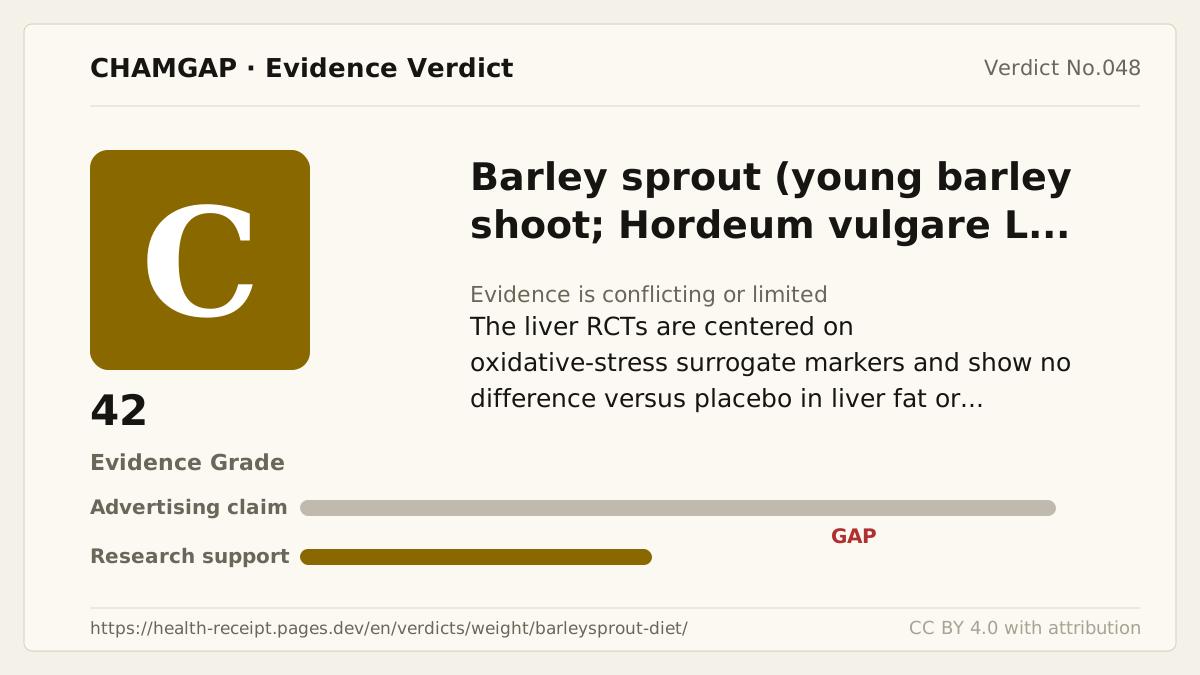
[Chamgap] Barley sprout x diet and liver — Evidence Grade C·42. 8 cited sources checked. Source: https://chamgap.com/en/verdicts/weight/barleysprout-diet/ · CC BY 4.0CC BY 4.0 — free to use with attribution; do not distort grades, numbers, or verdict meaning.
What this document does and does not do
Chamgap is an information source. It reports what research has and has not confirmed; it does not tell readers what to take or buy. That decision belongs to readers and, when needed, medical or legal professionals. This verdict reflects literature available up to the search date and may change as new research appears. Nothing here is medical advice.