
Chitosan, including chitosan derivatives/polyglucosamine,
does it really help with Fat absorption inhibition and body fat/body weight reduction?
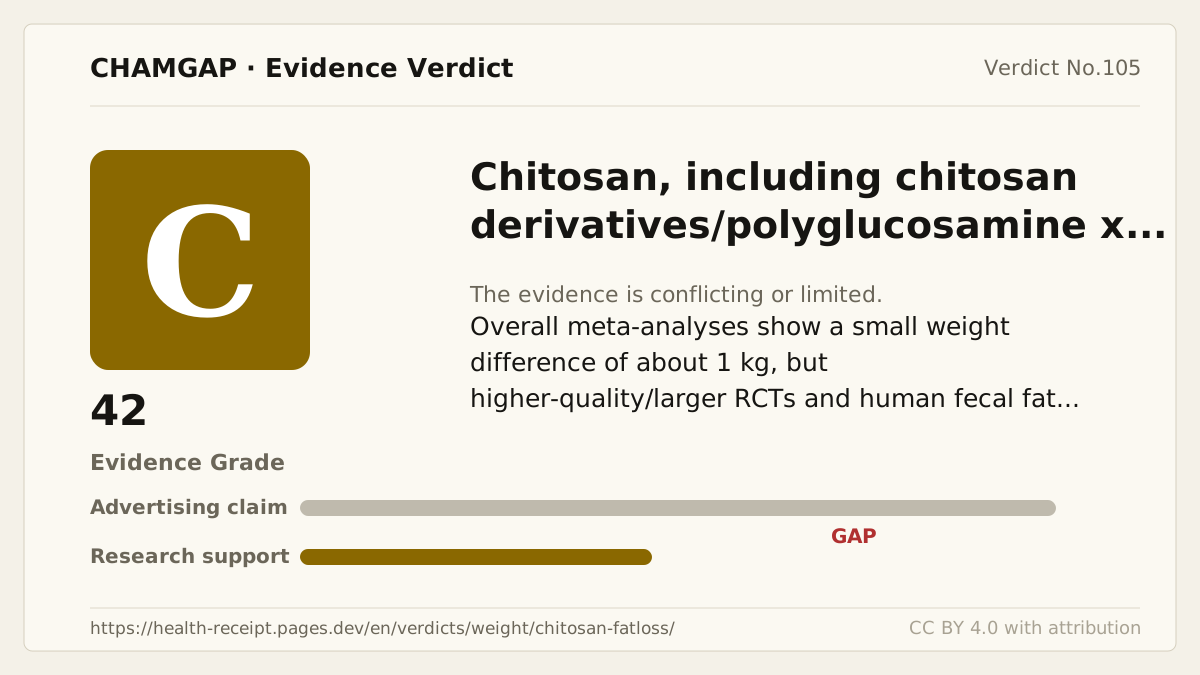
research showsIn human studies, the weight difference with chitosan is generally small, around 1 kg in meta-analyses, and when restricted to higher-quality, longer, and larger trials, clinically meaningful diet effects weaken. The advertised core mechanism, 'binding fat and excreting it in stool,' has not been clearly reproduced in human fecal fat excretion trials.
ads claimIn the Korean market, chitosan or polyglucosamine L112 products are described with phrases such as 'body-fat reduction and blood-cholesterol improvement,' 'ionic binding and excretion of ingested dietary fat out of the body,' 'body-fat loss without starving,' and 'fat adsorption when taken before meals.' Informational articles and shopping copy also cover messages such as 3 g/day, 8-week human trials, synergistic effect when combined with vitamin C, and intake before eating out or oily foods. Official functional information states that chitosan/chitooligosaccharide may help improve blood cholesterol and reduce body fat, but this verdict grade was based on the size and reproducibility of clinical evidence separately from regulatory recognition.
Useful facts when choosing a product
- Domestic official ingredient information presents the daily intake for body-fat-reduction labeling as 3.0-4.5 g of chitosan and 3 g of chitooligosaccharide.
- Chitosan raw material is mainly a deacetylated substance from crustacean-derived chitin, and caution wording related to crab and shrimp allergy is present.
- Products such as formoline L112 are often advertised and studied as specific formulations containing polyglucosamine L112 plus vitamin C/tartaric acid, not ordinary chitosan.
- Some early positive studies mix combination ingredients, diet restriction/exercise co-interventions, supply by a specific manufacturer, or manufacturer sponsorship, and should be separated from the effect of standalone chitosan.
- Fecal fat excretion, the direct surrogate marker for the fat-absorption-blocking claim, was not clear in human trials, unlike orlistat.
What the research actually shows
The Cochrane review reported an overall mean body-weight difference of -1.7 kg across 15 RCTs and 1219 people, but concluded that many trials were low quality and that weight and cholesterol reductions became much smaller when limited to trials with adequate allocation concealment or to larger and longer trials. The 2005 Obesity Reviews systematic review also found an overall WMD of -1.7 kg across 14 RCTs and 1071 people, but when only high-quality studies were considered, the effect was about -0.6 kg and the 95% CI included 0. A 2018 Medicina meta-analysis reported -1.01 kg across 14 RCTs, and a 2024 Food Science & Nutrition meta-analysis reported -0.79 kg across 19 RCTs, but BMI and waist circumference were not significant. The independent/partly independent large ECHO RCT (250 people, 24 weeks, 3 g/day) found a statistical difference in the primary body-weight endpoint, -0.4 kg versus +0.2 kg, but concluded that it had no clinical meaning, and the Pittler 1999 RCT found no body-weight/BMI effect over 4 weeks. Guerciolini 2001 and Gades 2003, which directly measured fecal fat excretion, showed that chitosan's fat-absorption-blocking effect was absent or clinically negligible. Meanwhile, RCTs of polyglucosamine products such as formoline L112 are more positive, but they mix manufacturer sponsorship, specific formulations, diet/exercise co-interventions, and per-protocol analyses, making it difficult to extend them directly to claims for ordinary standalone chitosan.
Why this is classified as C (42)
Grade D. Human RCTs and meta-analyses exist, so this is not '?' or a simple C, but the overall effect size is small and becomes clinically trivial in higher-quality/larger trials. The key advertising mechanism, blocking fat absorption, was directly weak or null in fecal fat excretion trials, and positive data rely heavily on specific formulations, combined/lifestyle interventions, and manufacturer sponsorship. Because the evidence is not repeatedly completely null, it was graded D rather than F.
Counterpoint. A 2023 polyglucosamine L112 RCT and a 2024 updated meta-analysis reported statistical improvements in weight or body-fat percentage. Therefore, the conclusion is not that there is no biological effect at all, but that consumer-level fat-blocking and diet effects have not been shown to be clinically large and independently reproducible enough.
Rejudgment record. Reassessment (upgraded D->C) — The core claim of fat-absorption inhibition is scarcely reproduced in human trials (as stated in the verdict), but body weight has small, low-quality signals, so C rather than F/D. Consistent with blinded C
Cross-check — Codex and Claude
Evidence Table
| Study | Design | Sample | Funding | Endpoint | Result | Weight |
|---|---|---|---|---|---|---|
| Jull AB et al. | Systematic review of RCTs | 1219 | 15 RCTs, 1219 people; overall WMD -1.7 kg, but the conclusion was that effects were smaller and clinical meaning was low in high-quality studies. | Core | ||
| Ni Mhurchu C et al. 2005 | RCT | 1 | ALT | 14 RCTs, 1071 people; overall -1.7 kg, but when limited to high-quality studies the effect was about -0.6 kg and the 95% CI included 0. | Core | |
| Moraru C et al. 2018 | Meta-analysis of RCTs | Mixed; some industry-related involvement | body weight | 14 RCTs; body-weight WMD -1.01 kg (95% CI -1.67 to -0.34), with several studies small, short-term, or using combination ingredients. | Core | |
| Kholdebarin M et al. 2024 | Meta-analysis of RCTs | Mixed; some industry-related involvement | body fat/body weight | 19 RCTs; body weight -0.79 kg and body-fat percentage -0.41%, but BMI and waist circumference were not significant. | Core | |
| Ni Mhurchu C et al. 2004 | RCT | 250 | Possible manufacturer/industry involvement | body weight/ALT | 24 weeks, 250 people, 3 g/day; the primary endpoint body weight was -0.4 kg vs +0.2 kg (P=0.03), but the authors concluded it was not clinically meaningful. | Supporting |
| Pittler MH et al. 1999 | Double-blind RCT | 30 | 4 weeks, 34 people (30 analyzed); no differences in BMI, lipids, or fat-soluble vitamins while maintaining a normal diet. | Supporting | ||
| Guerciolini R et al. 2001 | 12 | Possible manufacturer/industry involvement | 12-person crossover trial, standard diet; orlistat increased fecal fat by +16.13 g/day, while chitosan increased it by +0.27 g/day (P=0.379). | Supporting | ||
| Gades MD, Stern JS 2003 | Male high-fat-diet trial; fecal fat increased by +1.1 g/day with 10 capsules/day, but this was reported as clinically negligible. | Supporting | ||||
| Rondanelli M et al. 2023 | Double-blind RCT | 119 | Possible manufacturer/industry involvement | body weight | Polyglucosamine L112 3 g/day, 90 days, 150 enrolled/119 completed; per-protocol body weight was -3.71 kg vs -1.12 kg. | Supporting |
| Study 10 | body fat | Domestic functional labeling and daily intake: body-fat-reduction labeling uses chitosan 3.0-4.5 g and chitooligosaccharide 3 g; caution for crab and shrimp allergy. | Supporting | |||
| Study 11 | body fat/cholesterol/gut/gastrointestinal | Introduced formoline L112 as a body-fat-reduction/cholesterol-improvement product and explained that fat is excreted by ionic binding. | Supporting | |||
| Study 12 | body fat/cholesterol/gut/gastrointestinal | Presented messages that the main ingredient is chitosan, that it reduces body fat and improves cholesterol, and that body-fat loss occurs without starving. | Supporting |
Receipt — 12 References
Of 12 cited sources, 2 had limited original-page access (blocked or summary-only) and were verified via index/summary, marked partial; the rest were verified at the original page. As of 2026-07-07.
Reviewed and approved: Chamgap Editorial Team · Approval date: 2026-07-07 · Corrections: none
Cite this verdict
[Chamgap] Chitosan, including chitosan derivatives/polyglucosamine x fat absorption inhibition and body fat/body weight reduction — Evidence Grade C·42. 12 cited sources checked. Source: https://chamgap.com/en/verdicts/weight/chitosan-fatloss/ · CC BY 4.0CC BY 4.0 — free to use with attribution; do not distort grades, numbers, or verdict meaning.
What this document does and does not do
Chamgap is an information source. It reports what research has and has not confirmed; it does not tell readers what to take or buy. That decision belongs to readers and, when needed, medical or legal professionals. This verdict reflects literature available up to the search date and may change as new research appears. Nothing here is medical advice.