
Probiotics,
does it really help with Body-fat reduction and dieting?
research showsThe generalization that "you lose weight if you take lactic acid bacteria" is at odds with the evidence. What the MFDS has recognized for "body-fat reduction" is not ordinary lactic acid bacteria but only specific individually recognized strains (Lactobacillus gasseri BNR17 and the HY7601+KY1032 combination), and it does not apply to just any lactic acid bacteria. In randomized controlled trials of overweight and obese adults (not patients), and in several meta-analyses that pooled them, decreases in body weight, BMI, and body-fat percentage were observed to be statistically significant, but the authors themselves explicitly stated that "the effect size is small" (weight loss usually less than 1 kg). Even clinical trials of the individually recognized strain BNR17 had mixed results: in one trial (2018), visceral fat in the high-dose group decreased significantly versus placebo, but in another trial (2013), the between-group difference versus placebo was not significant. In addition, many trials are linked to funding from or affiliated researchers at the manufacturers of the relevant strains (Bioneer, Snow Brand, Nestlé), so conflicts of interest need to be considered as well.
ads claimAdvertisements put "body-fat reduction" and "dieting" front and center, but there is a gap between the range supported by the evidence and the advertising impression. (1) Strain gap: MFDS recognition is limited to specific individually recognized strains (BNR17, HY7601+KY1032 combination), but general-food products that appeal only with a name such as "19 kinds of diet probiotics" without displaying an individually recognized strain or function (Pure Food case) are not recognized for body-fat reduction functionality. In other words, the name "diet probiotics" does not itself mean functional recognition. (2) Effect-size gap: advertising language suggests perceptible weight loss, but according to the evidence, weight loss is usually less than 1 kg, and several meta-analysis authors themselves explicitly stated that "the effect size is small" (statistical significance ≠ felt effect). (3) Funding gap: many clinical trials of individual strains (BNR17, SBT2055, CGMCC1.3724) are linked to manufacturer funding or affiliated researchers, and the fact that 1 of the 2 BNR17 trials failed to prove superiority versus placebo is usually not shown on sales pages.
Useful facts when choosing a product
- Functional labeling for "body-fat reduction" is permitted only for health functional foods that contain the specified amount of individually recognized ingredients. In Korea, representative examples are Lactobacillus gasseri BNR17 (listed as individual recognition No. 2017-6, at least 10 billion CFU per day) and the Lactobacillus combination HY7601+KY1032 (listed as No. 2019-4). However, these recognition numbers are based on seller and media-page statements, and final comparison with the MFDS Food Safety Korea primary source has not been completed.
- A product name or category such as "diet probiotics" alone does not guarantee body-fat-reduction functionality. Products without an individually recognized strain or MFDS functional labeling (e.g., "19 kinds of diet probiotics") are general foods; they can only appeal to gut health (proliferation of lactic acid bacteria, suppression of harmful bacteria, bowel movements) and are not recognized for body-fat reduction.
- The functionality recognized for notified-type (general) probiotics is only "proliferation of lactic acid bacteria and suppression of harmful bacteria, smooth bowel movements (gut health)," and body-fat reduction is not included in this scope.
- Practical checkpoints for distinguishing health functional foods (individually recognized type) from general foods are whether the product detail page specifies the CFU amount per daily intake and the individually recognized strain name (e.g., Lactobacillus gasseri BNR17), and whether an individual recognition number is displayed. In the evidence, body-fat-related effects were usually observed at high dose (≥10 billion CFU/day) and long duration (≥8 weeks).
What the research actually shows
Based on 8 verified human publications. [4 meta-analyses, all in overweight and obese adults (not patients)] Borgeraas 2018 (Obesity Reviews, PMID 29047207): in 15 RCTs and 957 participants, body weight -0.60 kg, BMI -0.27, and body-fat percentage -0.60% were significant, but fat mass -0.42 kg was nonsignificant, and the authors explicitly stated "effect sizes small." Pontes 2021 (Clinical Nutrition, PMID 34358838): body weight -0.70 kg, BMI -0.24, waist circumference -1.13 cm, and fat mass -0.71 kg were all significant, observed at ≥10^10 CFU/day and ≥8 weeks, with a small absolute effect. Sadeghi 2024 (Probiotics Antimicrob Proteins, PMID 39320636): BMI -0.30 and fat mass -0.86 kg were significant (p<0.00001), but the authors explicitly stated that "the included studies were low quality and samples were small, limiting confidence in the evidence." Liu 2026 (Frontiers in Public Health, PMID 41938967): 12 RCTs and 931 participants (10 Korea and 2 China, concentrated in East Asia and therefore highly relevant to the Korean market), body weight -0.52 kg and body-fat percentage -0.59% significant, significant at high dose ≥1×10^10 CFU/day, but waist-circumference publication bias (Egger p=0.041), GRADE moderate. [2 RCTs of the individually recognized strain (BNR17), Korean adults] Kim 2018 (J Medicinal Food, PMID 29688793): high dose 10^10 CFU/day for 12 weeks significantly reduced visceral fat versus placebo (between-group difference about -21.6 cm², P=0.012), partially supported by Bioneer (manufacturer). Jung 2013 (Korean Journal of Family Medicine, PMID 23560206): only within-group changes in body weight and waist circumference were significant, and between-group differences versus placebo were nonsignificant (effectively a failure to prove superiority), with Bioneer-affiliated authors included. [Other strain RCTs] Kadooka 2010 (Eur J Clin Nutr, PMID 20216555): L. gasseri SBT2055 fermented milk reduced visceral fat by -4.6% (CT surrogate indicator), Snow Brand affiliation. Sanchez 2014 (Br J Nutr, PMID 24299712): L. rhamnosus CGMCC1.3724 was significant only in the female subgroup (no effect in men), Nestlé affiliation.
Why this is classified as D (28)
Why it is D: The BNR17 weight and body-fat claim failed to show superiority on the primary endpoint of its representative confirmatory trial, giving E0 and a D baseline. · Endpoint: Weight, BMI, body-fat mass, and abdominal-fat area are anthropometric or imaging surrogates for clinical events, so this axis is S. · Replication and independence: There is one confirmatory trial, giving R1, and Bioneer, the developer with a commercial interest in BNR17, funded it, giving I0. · Effect: At 12 weeks, weight changed by −1.1 kg with BNR17 and +0.2 kg with placebo, an approximate −1.3-kg difference, but the between-group comparison was nonsignificant; body-fat percentage and visceral fat also failed to show superiority, giving E0. · Design: Enrollment of 62 creates one listed flaw, a total sample below 200, giving B1. Why it is not A or B: A null surrogate primary endpoint in one industry-funded trial, without independent replication, is not strong or consistent evidence. Distinguishing D from F: D is the final grade, while F is not warranted because other RCTs and meta-analyses retain small positive signals, so the effect has not been repeatedly refuted. → Under the Chapter 2 ceiling rules, endpoint S and independence I0 cap the evidence at C; applying E0 and zero strength axes in the Chapter 3 baseline table yields D with 28 points.
Counterpoint. Higher-grade (B) view: It is possible to view this as "evidence exists (B)" because 4 meta-analyses from different research teams, regions, and time periods all reported statistically significant reductions in body weight, BMI, and body-fat percentage; effects were consistent in high-dose (≥10^10 CFU/day) and long-duration (≥8 weeks) subgroup analyses; the latest 2026 meta-analysis gave moderate GRADE certainty; and the high-dose group for the individually recognized strain BNR17 significantly reduced visceral fat versus placebo. Rebuttal: however, (a) the effect size is small enough that the authors themselves acknowledge limited perceptible and clinical meaning, (b) some key indicators such as fat mass are nonsignificant (Borgeraas) or the authors explicitly state that confidence in the evidence is low (Sadeghi), (c) the two RCTs of the same strain (BNR17) conflict and one of them failed to prove superiority, and (d) many individual trials are entangled with manufacturer funding or affiliations, so original sensitivity analyses have not established whether the effect is maintained when only independent, high-quality studies are considered. Therefore, the evidence corresponds to "conflicting and limited" evidence, making C more honest than B. Lower-grade (D) view: It is also possible to argue that because one of the two BNR17 RCTs had a nonsignificant between-group difference (failed proof) and the effect is strain-specific, the evidence for a general claim is weak; however, given the existence of human RCTs and meta-analyses and the reality of MFDS individually recognized functionality, D, meaning only observational-study evidence, would be an underestimation.
| Endpoint | S | Surrogate marker - laboratory or imaging measures |
| Replication | R1 | Single confirmatory trial |
| Independence | I0 | Evidence comes only from manufacturer studies |
| Effect size | E0 | Null |
| Precision | C0 | The confidence interval leaves room for benefit |
The scoring table and the verdict agree (D).
Cross-check — Codex and Claude
Evidence Table
| Study | Design | Sample | Funding | Endpoint | Result | Weight |
|---|---|---|---|---|---|---|
| Borgeraas H, Johnson LK, Skattebu J, Hertel JK, Hjelmesaeth J 2018 | Meta-analysis/RCT | 957 | Manufacturer/industry involvement possible | Body fat and body weight | 15 RCTs and 957 overweight and obese adults (general population), mixed strains, body weight -0.60 kg, BMI -0.27, and body-fat percentage -0.60% significant (fat mass nonsignificant), authors explicitly stated effect sizes were small, Non-U.S. Gov't support. | Key |
| Pontes KSDS, Guedes MR, da Cunha MR, de Souza Mattos S, Silva MIB, Neves MF, Marques BCAA, Klein MRST 2021 | Meta-analysis/RCT | Manufacturer/industry involvement possible | Body weight | Overweight and obese adults (general population), body weight -0.70 kg, BMI -0.24, waist circumference -1.13 cm, and fat mass -0.71 kg all significant (observed at ≥10^10 CFU/day and ≥8 weeks), absolute effect small, declared no conflicts of interest. | Key | |
| Sadeghi A, Daroudi R, Davari M, Gharib-Naseri Z, Jafarzadeh J, Tajvar M 2024 | Meta-analysis | Manufacturer/industry involvement possible | Body weight | Overweight and obese adults (Lactobacillus and Bifidobacterium), BMI -0.30, fat mass -0.86 kg, and body weight -0.59 kg significant (p<0.00001), but the authors explicitly stated that included-study quality was low and confidence in the evidence was limited, no competing interests (Tehran University of Medical Sciences). | Key | |
| Liu S, Ouyang K, Fang X, He H, Li M 2026 | Meta-analysis/RCT | 931 | Mixed/some industry involvement | Body fat, body weight, gut, and concentration | 12 RCTs and 931 overweight and obese adults (general population; 10 Korea and 2 China, concentrated in East Asia and highly relevant to the Korean market), body weight -0.52 kg and body-fat percentage -0.59% significant (high dose ≥1×10^10 CFU/day), waist-circumference publication bias (Egger p=0.041), GRADE moderate, public funding from Hubei Province (not manufacturer funding). | Key |
| Kadooka Y, Sato M, Imaizumi K, Ogawa A, Ikuyama K, Akai Y, Okano M, Kagoshima M, Tsuchida T 2010 | RCT | Manufacturer/industry involvement possible | Body weight and gut | Japanese adults with a tendency toward obesity (general population), SBT2055 fermented milk 200 g/day for 12 weeks, visceral fat -4.6% (-5.8 cm²) and body weight -1.1 kg, control group unchanged, small absolute amount of change, centered on CT surrogate indicators. | Supporting | |
| Kim J, Yun JM, Kim MK, Kwon O, Cho B 2018 | Double-blind/RCT | Manufacturer/industry involvement possible | Liver and gut | Korean adults with obesity (BMI 25-35, general population), BNR17 high dose 10^10 CFU/day for 12 weeks, high-dose group had significantly reduced visceral fat versus placebo (between-group difference about -21.6 cm², P=0.012) and reduced waist circumference, low-dose group was not clear, strain-specific and dose-dependent. | Supporting | |
| Jung SP, Lee KM, Kang JH, Yun SI, Park HO, Moon Y, Kim JY 2013 | Double-blind/RCT | Manufacturer/industry involvement possible | Body fat, body weight, liver, and blood glucose | Overweight and obese Korean adults (BMI≥23 and fasting glucose≥100, general population), BNR17 10^10 CFU per capsule × 6 capsules/day for 12 weeks, body weight -1.1 kg and waist circumference -2 cm significant within group, but between-group differences versus placebo nonsignificant (body fat and visceral fat unchanged) = failed to prove superiority. | Supporting | |
| Sanchez M, Darimont C, Drapeau V, Emady-Azar S, Lepage M, Rezzonico E, Ngom-Bru C, Berger B, Philippe L, Ammon-Zufferey C, Leone P, Chevrier G, St-Amand E, Marette A, Dore J, Tremblay A 2014 | Manufacturer/industry involvement possible | Body weight and liver | Adults with obesity (with energy restriction of -500 kcal/day, general population), LPR 1.6×10^8 CFU × 2 capsules/day for 24 weeks, significant weight loss (P=0.02), fat mass, and leptin reduction versus placebo only in women, no between-group difference in men (P=0.53) = sex-specific subgroup finding. | Supporting |
Receipt — 8 References
Of 8 cited sources, 1 had limited original-page access (blocked or summary-only) and were verified via index/summary, marked partial; the rest were verified at the original page. As of 2026-07-06.
Reviewed and approved: Chamgap Editorial Team · Approval date: 2026-07-06 · Corrections: 1
Correction log — 1
Corrections applied to this verdict, in chronological order. Changes are logged, not erased.
- 2026-08-19 · Methodology v0.7 migration (axes recorded, score derived) — Applied the seven axes and anchor table published in methodology v0.7 to this verdict. It had been graded under the pre-axis method and carried no score. The representative trial was re-established from the source, axes 1-6 recorded, and the score derived from the published anchor table. The old grade was less wrong than assigned before the rule was fully specified; the full rule is in section 2-3 of /methodology/. (grade C→D)
Cite this verdict
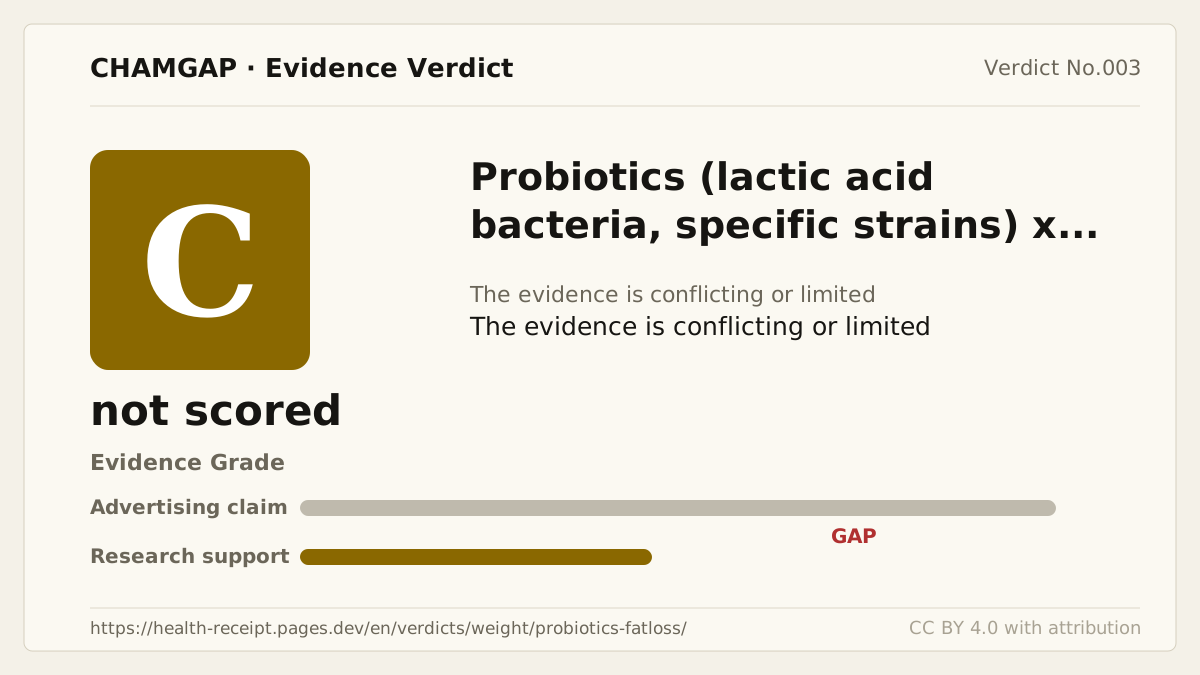
[Chamgap] Probiotics × dieting and body-fat reduction — Evidence Grade D·28. 8 cited sources checked. Source: https://chamgap.com/en/verdicts/weight/probiotics-fatloss/ · CC BY 4.0CC BY 4.0 — free to use with attribution; do not distort grades, numbers, or verdict meaning.
What this document does and does not do
Chamgap is an information source. It reports what research has and has not confirmed; it does not tell readers what to take or buy. That decision belongs to readers and, when needed, medical or legal professionals. This verdict reflects literature available up to the search date and may change as new research appears. Nothing here is medical advice.