
Green tea catechins,
does it really help with body-fat reduction?
research showsThe core points are threefold. (1) Some human studies have found a “small” effect, but that effect mostly appeared under conditions in which catechins were given “together with caffeine” or exercise was combined. Studies that gave catechins alone (with caffeine removed) confirmed no benefit on any body-weight or body-fat indicator (Phung 2010). (2) In an independent review reported to have no conflicts of interest (Cochrane 2012), pooling studies outside Japan produced a weight change of -0.04 kg (P=0.88), which was clinically meaningless. By contrast, Nagao 2007, often cited as a study with a “clear effect,” had all authors affiliated with the green-tea manufacturer Kao, and Maki 2009 also included many Kao-affiliated coauthors. (3) Even in the latest dose-response meta-analysis (2023/2024), where the effect was statistically significant, body-fat “percentage” decreased only slightly, the certainty of evidence was low to very low by GRADE, actual fat “mass” showed no significant reduction, and even a trial that used high-dose EGCG 856.8 mg for 12 weeks achieved only about 1.1 kg of weight loss (Chen 2016). In short, many human RCTs and meta-analyses exist, but at the level of independent evidence without conflicts of interest they did not confirm the causal claim “catechins/EGCG alone -> body-fat reduction.” The grade in this verification is D. Within the confirmed scope, the MFDS is known to have recognized green tea extract as a notified-type ingredient for “may help reduce body fat” (precise cross-check against the original Food Code is outside the scope of this verification), but this is ingredient and labeling regulation and is separate from guaranteeing a perceptible amount of weight loss or clinical benefit. On safety, dose-dependent hepatotoxicity (liver injury) has been reported with high-dose EGCG in concentrated capsule/tablet form, especially when taken on an empty stomach. This risk was effectively not displayed in the sales advertising text within the confirmed scope.
ads claimWithin the confirmed scope, collected advertisements (11st NOW Foods listing, Vitamin Shop company mall, Dr. Adol, Vitalbeautie/Metagreen, etc.) were confirmed to present themselves as “health functional foods” and to use expressions known as MFDS notified-type functional claims (“may help with antioxidant activity, improvement of blood cholesterol, and reduction of body fat”) (precise cross-check of the individual advertising original URLs and screenshots is outside the scope of this verification and remains for follow-up confirmation). Within the confirmed scope, Vitalbeautie emphasizes the effect with expressions such as “captures body fat after meals” and “catechin content 120% UP to CUT body fat.” There are three gaps between what the advertising text conveys and what the research shows. (1) Advertising presents “catechin/EGCG intake -> body-fat reduction” as a stand-alone causal claim, but the replicated effects in research generally appeared under caffeine-combined or exercise-combined conditions, and the independent effect of catechins alone was not confirmed in an independent review without conflicts of interest. (2) Advertising does not state the “size” of the effect, but even when results were significant, the amount of reduction was around about 1 kg of body weight and about -0.6% body-fat percentage. (3) Within the confirmed scope, several advertisements did not state the exact catechin/EGCG mg content on the detail page, making it difficult for consumers to compare their own intake with research and safety doses. The hepatotoxicity risk with high dose and fasting intake was effectively not exposed in the confirmed sales advertising text.
Useful facts when choosing a product
- MFDS regulation (based on secondary sources; precise cross-check against the original Food Code is outside the scope of this verification and remains for follow-up confirmation): green tea extract (catechins) is known to be a notified-type ingredient in the Health Functional Food Code with three functional claims notified together: ① antioxidant activity, ② improvement of blood cholesterol, and ③ may help reduce body fat. Under Methodology 2-1 ④, this is neutral metadata, not a factor that raises the grade.
- Specifications and dose (based on secondary sources; precise cross-check of the Food Code original is incomplete and flagged): the known health-functional-food recognition requirements are at least 200 mg (20%) catechins per 1 g of green tea extract, confirmation of four catechins (EC, EGC, ECG, EGCG), and a daily intake of about 300~1,000 mg as catechins. Precise specifications require reconfirmation against the original Food Code.
- Conditions and sizes in which studies found significant effects: about -1.4 kg body weight when catechins+caffeine were combined (Phung 2010), small significant reductions in body weight and body-fat percentage in a dose-response meta-analysis (Asbaghi 2023/2024, authors: “clinically small”), and about -1.1 kg with high-dose EGCG 856.8 mg for 12 weeks (Chen 2016). Actual fat mass was not significant.
- In the catechin “alone” group (no caffeine), no benefit was confirmed on any anthropometric indicator (Phung 2010). The Cochrane 2012 review, reported as having “None known” conflicts of interest, found -0.04 kg (P=0.88) outside Japan, which was clinically meaningless.
- Safety (warning): dose-dependent hepatocellular hepatotoxicity has been reported with high-dose EGCG in concentrated capsule/tablet (solid bolus) form. EGCG doses related to liver injury are about 140~1,000 mg/day, with large individual variation (including genetic susceptibility), and risk increases when taken fasting. It is almost not seen in brewed tea/beverage form (separating formulation route is important). USP recommends labeling to “take with food” and “do not use in patients with liver disease.” Hu 2018 sets the safe intake level for solid formulations at EGCG 338 mg/day.
- Because it contains caffeine, insomnia, headache, and gastrointestinal discomfort are known to be possible (within the confirmed scope, many products were observed to market decaffeination processes for this reason). There is a mention that concomitant use with garcinia and similar ingredients has reports related to liver injury, but it is not directly supported by the present citation list (follow-up confirmation target).
- Within the confirmed scope, many collected advertisements did not state the exact catechin/EGCG mg content on the detail page, making it difficult for consumers to compare their own intake with research and safety doses (cross-checking individual advertising originals is outside the scope of this verification).
What the research actually shows
Several human RCTs and meta-analyses do exist, and their directions split between “small but statistically significant reduction” and “meaningless null effect.” When narrowed to the causal axis of the target claim, “catechins/EGCG alone,” the effect is not confirmed at the independent layer without conflicts of interest. ▶Caffeine confounding (core): Phung 2010 meta-analysis (15 RCTs, n=1,243) found that the catechin+caffeine group reduced body weight by -1.38 kg (95% CI -1.70, -1.06) and waist circumference by -1.93 cm compared with caffeine-only control, but studies that gave “catechins only without caffeine” had no benefit on any anthropometric indicator. The authors themselves said clinical significance was “modest at best.” ▶Evidence with the lowest conflicts of interest: Cochrane 2012 (conflicts of interest: None known) concluded that in six studies outside Japan, pooling produced -0.04 kg (95% CI -0.5~0.4; P=0.88), clinically meaningless, and that there was no effect on weight maintenance. ▶Dose-response meta-analysis: Asbaghi 2023/2024 (59 RCTs, n=3,802, GRADE assessment) found statistically significant reductions in body weight, body-fat percentage, and BMI, but the authors explicitly called them “clinically small”; certainty for body-fat percentage was low, and there was no significant effect on actual fat mass. ▶High-dose single RCT: Chen 2016 used EGCG 856.8 mg/day (about 2.9 times the MFDS EGCG management upper limit of 300 mg/day known from secondary sources) for 12 weeks, yet net weight loss was only about 1.1 kg (76.8 -> 75.7 kg, p=0.025). ▶Manufacturer-concentrated positive evidence: Nagao 2007, a clearly positive RCT, had all authors affiliated with Kao, and Maki 2009 included many Kao coauthors (conducting institution: Provident Clinical Research), placing them in the industry-conflicted layer rather than independent replication. ▶Safety: Hu 2018 set the safe intake level for solid bolus (concentrated capsule/tablet) at EGCG 338 mg/day, and the USP 2020 comprehensive review identified hepatocellular injury as the critical adverse reaction, reported that liver injury cases occur with large individual variation at EGCG about 140~1,000 mg/day and that risk increases when taken fasting, and recommended labels saying “take with food” and “do not use in patients with liver disease.”
Why this is classified as D
This is judged D (human evidence exists, but it is unconfirmed at the independent, conflict-free, stand-alone level). Application of Methodology chapter 2-1, item ② (independence first): the target claim is “catechins/EGCG alone -> body-fat reduction.” (a) The independent Cochrane 2012 review, reported as having “None known” conflicts of interest, was null in the non-Japanese pooled analysis (-0.04 kg, P=0.88), and (b) the catechin “alone” subgroup in Phung 2010 (with caffeine removed) was null on every anthropometric indicator. In other words, the effect disappears both at the pure stand-alone level after correcting for the confounder caffeine and at the independent, conflict-free level. Conversely, clearly positive RCTs (Nagao 2007, all authors affiliated with Kao; Maki 2009, many Kao coauthors) are concentrated in manufacturer-conflicted and caffeine/exercise-combined conditions, and cannot be treated as independent replication. Because the methodology instructs us to read not the “entire evidence pool” but the “zero-conflict layer” first, even though many human RCTs and meta-analyses exist, failure to confirm the claim at the independent and stand-alone layer points to D. Why not C: C means a conflicting state in which directions diverge, but when the zero-conflict layer is prioritized, the positive signal is attributable to confounding and industry conditions, so stand-alone causality is not defensible (Codex passes A and B both support D). Why not F: statistically significant small reductions have been repeatedly observed under caffeine/exercise/manufacturer conditions, so the evidence has not reached “repeated confirmation of no effect (disconfirmation).” Why not ?: there is enough literature to judge. Chapter 2-1 item ④: the fact that MFDS notified-type recognition is known is neutral metadata, not an upward factor. Why this is not a borderline case: this is not a 029/030-style “absence of independent RCTs”; an independent review exists and is null, so the text of ② explicitly points to D.
Counterpoint. ▶Supportive side (there is an effect): “Several meta-analyses found statistically significant reductions in body weight and body-fat percentage, and the MFDS is also known to have recognized it as a notified-type ingredient.” -> Information: significance and effect size are different. Even when significant, the amount of reduction is about 1 kg of body weight and about -0.6% body-fat percentage, and the authors themselves wrote “modest at best” and “clinically small.” In addition, much of that significant effect spans caffeine-combined, exercise-combined, and manufacturer-funded conditions, which differ from the target claim of “stand-alone causality.” MFDS notification is ingredient and labeling regulation, separate from clinical benefit. ▶Skeptical side (no effect/all industry money): “Positive results are manufacturer-funded and independent reviews are null.” -> Information: the null Cochrane 2012 finding without conflicts of interest and the null catechin-alone group in Phung 2010 are reflected as the basis for the D judgment here. However, large bias is not definitive evidence that the effect is zero, and because small reductions are repeatedly observed under conditions such as caffeine combination, this is D (unconfirmed at the independent, stand-alone layer), not F (disconfirmed). ▶Unresolved issues: subgroup analyses by funding source (whether an effect remains when limited to independent studies) for the individual RCTs included in Phung 2010 and Asbaghi 2023/2024, as well as author affiliations and trial-product providers, remain unconfirmed because the full texts were not read. The specification and daily-intake figures in the original MFDS Food Code are also outside the scope of this verification for precise primary-source cross-checking.
Cross-check — Codex and Claude
Evidence Table
| Study | Design | Sample | Funding | Endpoint | Result | Weight |
|---|---|---|---|---|---|---|
| Phung OJ, Baker WL, Matthews LJ, Lanosa M, Thorne A, Coleman CI 2010 | meta-analysis and RCTs | 1,243 | manufacturer/industry involvement possible | body weight | Meta-analysis of 15 RCTs, n=1,243. The catechin+caffeine group reduced body weight by -1.38 kg (95% CI -1.70, -1.06) and waist circumference by -1.93 cm compared with the caffeine-only control, but studies giving “catechins only without caffeine” had no benefit on any anthropometric indicator. The authors themselves described clinical significance as “modest at best.” (Funding source not stated in the abstract) | core |
| Jurgens TM, Whelan AM, Killian L, Doucette S, Kirk S, Foy E 2012 | meta-analysis and RCTs | 532 | manufacturer/industry involvement possible | body weight and gastrointestinal | Cochrane meta-analysis of RCTs lasting at least 12 weeks. Green tea preparations induced “small, statistically non-significant” weight loss. In the non-Japanese pooled analysis, body weight was -0.04 kg (95% CI -0.5~0.4; P=0.88; n=532), clinically meaningless, and there was no effect on weight maintenance. Conflicts of interest: “None known.” | core |
| Asbaghi O, Rezaei Kelishadi M, Ashtary-Larky D, Bagheri R, Amirani N, Goudarzi K, Kargar F, Ghanavati M, Zamani M 2023 | meta-analysis and RCTs | 3,802 | manufacturer/industry involvement possible | body fat and body weight | Dose-response meta-analysis of 59 RCTs, n=3,802. Body weight, body-fat percentage, and BMI decreased significantly (authors: “clinically small”), but actual fat mass showed no significant effect. Certainty of evidence for body-fat percentage was low to very low by GRADE. | core |
| Nagao T, Hase T, Tokimitsu I 2007 | double-blind randomized controlled trial | manufacturer/industry involvement possible | body fat, body weight, ALT, and gastrointestinal | A 12-week double-blind RCT (Japanese visceral-fat-type obesity). The catechin 583 mg/day group showed significantly greater reductions than the control (96 mg) in body weight, BMI, body-fat percentage, body-fat mass, visceral fat area, and other measures. A representative positive RCT that is frequently cited. | core | |
| Maki KC, Reeves MS, Farmer M, Yasunaga K, Matsuo N, Katsuragi Y, Komikado M, Tokimitsu I, Wilder D, Jones F, Blumberg JB, Cartwright Y 2009 | randomized controlled trial | 132, | manufacturer/industry involvement possible | body fat and body weight | A 12-week RCT (n=132, with exercise >=180 min/week). The catechin about 625 mg+caffeine 39 mg group had total abdominal fat area -7.7% vs control -0.3% (P=0.013), and subcutaneous abdominal fat -6.2% vs -0.8% (P=0.019). However, body weight was only a trend toward reduction, -2.2 vs -1.0 kg (P=0.079), and was not significant. | supporting |
| Chen IJ, Liu CY, Chiu JP, Hsu CH 2016 | double-blind randomized controlled trial | 102 | manufacturer/industry involvement possible | body weight, liver, and gastrointestinal | A 12-week double-blind placebo-controlled RCT (women with central obesity, n=102). High-dose EGCG 856.8 mg/day reduced body weight from 76.8 to 75.7 kg (about -1.1 kg, p=0.025), and significantly reduced BMI and waist circumference. It reported “good tolerability without side effects or adverse reactions.” This is an example showing that effect size is minimal even at high dose. | supporting |
| Hu J, Webster D, Cao J, Shao A 2018 | systematic review | manufacturer/industry involvement possible | body fat and liver | Systematic review (safety). Safe intake level for solid bolus (concentrated capsule/tablet) was EGCG 338 mg/day, and beverage OSL was 704 mg/day. The critical adverse reaction is hepatotoxicity, which occurs dose-dependently with concentrated large bolus intake but is almost absent with brewed tea/beverages (separation of formulation route). | supporting | |
| Oketch-Rabah HA, Roe AL, Rider CV, Bonkovsky HL et al. 2020 | preclinical study | manufacturer/industry involvement possible | liver | USP comprehensive review (highest-authority level for safety). Hepatocellular injury; EGCG related to liver injury about 140~1,000 mg/day (large individual variation); risk increases because catechin bioavailability rises when fasting. Recommended labels: “take with food,” “do not use in patients with liver disease,” and “stop if symptoms such as jaundice occur.” | supporting |
Receipt — 8 References
Of 8 cited sources, 3 had limited original-page access (blocked or summary-only) and were verified via index/summary, marked partial; the rest were verified at the original page. As of 2026-07-06.
Reviewed and approved: Chamgap Editorial Team · Approval date: 2026-07-06 · Corrections: none
Cite this verdict
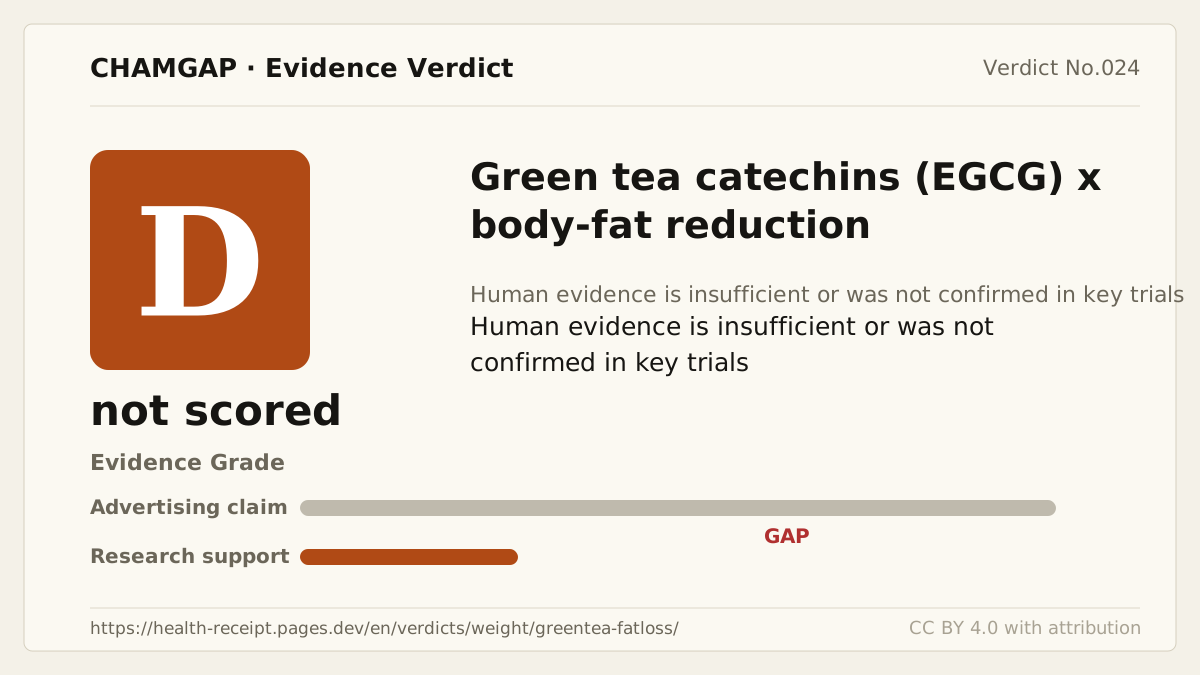
[Chamgap] Green tea catechins x body fat — Evidence Grade D. 8 cited sources checked. Source: https://chamgap.com/en/verdicts/weight/greentea-fatloss/ · CC BY 4.0CC BY 4.0 — free to use with attribution; do not distort grades, numbers, or verdict meaning.
What this document does and does not do
Chamgap is an information source. It reports what research has and has not confirmed; it does not tell readers what to take or buy. That decision belongs to readers and, when needed, medical or legal professionals. This verdict reflects literature available up to the search date and may change as new research appears. Nothing here is medical advice.