
Glucomannan,
does it really help with Weight loss and satiety?
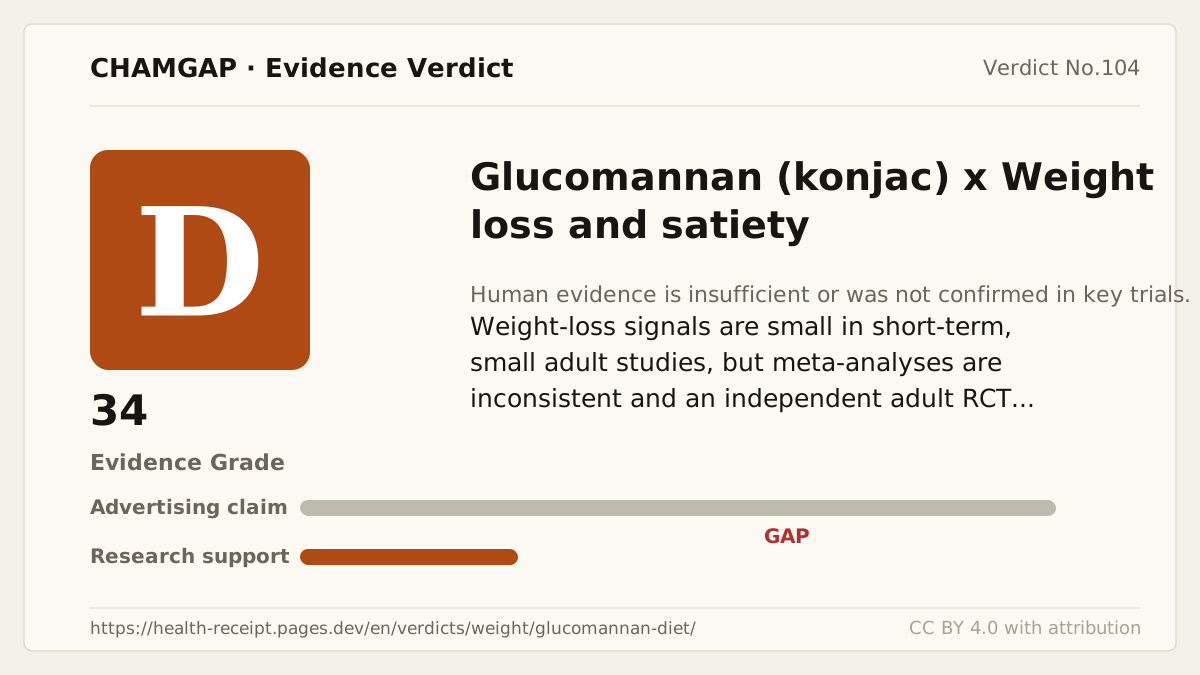
research showsGlucomannan is a water-soluble dietary fiber that absorbs water and creates bulk and viscosity, so replacing higher-calorie foods with low-calorie foods such as konjac noodles or konjac rice can reduce the calories in a meal. However, human evidence that the supplement itself consistently reduces body weight or increases satiety is small and conflicting. Meta-analytic weight effects in adults are inconsistent, roughly in the -0.2 to -1.0 kg range, and a relatively well-designed 8-week adult RCT found no difference in weight, hunger, or satiety.
ads claimIn the Korean market, konjac rice, konjac noodles, konjac jelly, and glucomannan capsules/powders are introduced together with phrases such as 'low calorie,' 'satiety,' 'diet,' 'appetite suppression,' 'weight loss,' 'feel full without calorie burden,' 'delayed carbohydrate absorption,' 'mitigation of blood-glucose rise,' and 'constipation prevention/gut cleansing.' Informational articles sometimes connect konjac's low calories and glucomannan's swelling property to weight-loss and satiety claims, and open-market product names include phrases such as 'appetite suppression weight loss,' 'weight management,' and 'satiety generated in 15 minutes.' This advertising surface often does not distinguish calorie reduction from food substitution from the standalone effect of the supplement.
Useful facts when choosing a product
- Domestic sales forms mix ordinary foods such as konjac rice, konjac noodles, and konjac jelly with konjac flour/powder and imported glucomannan capsules.
- The key property of konjac foods is that their high water content makes them low in calories. This is a 'calorie reduction when replacing the relevant food,' and should be separated from an independent fat-loss effect of glucomannan supplements.
- Supplement labels vary, including 575 mg, 665 mg, 1800 mg, and 2400 mg per serving. Whether actual intake matches the roughly 3 g/day often mentioned in clinical trials and regulatory literature needs to be checked product by product.
- For capsules, tablets, and powders, risks of throat, esophageal, and intestinal obstruction have been reported if they are not taken with enough water, so 'caution' is more appropriate for safety than 'good'.
What the research actually shows
RCTs and meta-analyses examining standalone glucomannan or konjac glucomannan exist. A 2008 meta-analysis of metabolic markers reported body-weight WMD -0.79 kg across 14 studies and 531 people, but a 2014 meta-analysis devoted to weight loss found a nonsignificant body-weight MD of -0.22 kg across 8 RCTs in people with overweight/obesity. A 2015 systematic review judged that short-term weight reduction in adults was possible, but BMI did not improve and only one study was favorable at multiple time points. A 2020 meta-analysis reported -0.96 kg across 6 RCTs and 225 people, but heterogeneity was large. The key independent adult RCT (3.99 g/day, 8 weeks, n=53 randomized) found no difference in the primary body-weight outcome or in hunger/satiety, and a pediatric/adolescent RCT (n=96, 3 g/day, 12 weeks) also found the primary BMI-for-age z-score null. Satiety evidence mainly comes from acute meal-intake studies, such as a crossover trial in 16 healthy people in which konjac noodles replaced a low-calorie preload, and is limited for directly connecting to actual long-term weight loss.
Why this is classified as D (34)
D (34 points). Human RCTs and meta-analyses exist, so this is not '?'. On the claimed endpoint of body weight, however, the trials designed as supplement-only with prespecified primary outcomes were null: the adult double-blind RCT found −0.40 kg with glucomannan versus −0.43 kg with placebo, and the pediatric RCT found a BMI z-score difference of 0.0 (95% CI −0.1 to 0.1). The most conservative meta-analysis was also null at −0.22 kg (95% CI −0.62 to 0.19). Every positive signal is compromised: one significant meta-analysis has an upper confidence bound touching −0.05 kg, another has heterogeneity of I-squared 88.1%, and the positive individual trials combine strong co-interventions such as a 1200 kcal diet with industry-linked funding. Even where significant, the effect is under 1 kg — too small to support a weight-loss claim. Satiety evidence is acute meal-replacement or surrogate in nature and cannot be extended to long-term weight loss. A pattern in which the cleanest designs are null is D. Repeated refutation in the same indication with exclusion of a meaningful benefit is not established, so this is not F.
Counterpoint. If low-calorie konjac foods replace part of rice, noodles, or snacks, energy intake at that meal can decrease, and some meta-analyses suggest that about 3 g/day glucomannan within an energy-restricted diet may slightly reduce adult body weight. This limited possibility is different from claiming that the supplement alone reliably produces satiety and weight loss.
Rejudgment record. Reassessment (downgraded C->D) — In the key independent adult RCT, body weight and hunger/satiety were null, and meta-analytic signals were small and inconsistent -> methodology 2 (independent RCT null). Consistent with blinded D
Cross-check — Codex and Claude
Evidence Table
| Study | Design | Sample | Funding | Endpoint | Result | Weight |
|---|---|---|---|---|---|---|
| Study 1 | body weight/satiety/gut/gastrointestinal | A domestic case in which the konjac food market was introduced with low-calorie, satiety, and weight-loss imagery. | Core | |||
| Study 2 | body weight/appetite | Product names and search results showed phrases such as 'appetite suppression weight loss,' 'weight management,' and high-content mg labeling. | Core | |||
| Study 3 | Preclinical | body weight/satiety/blood glucose/gut/gastrointestinal | Introduced konjac satiety, blood-glucose, and weight-loss claims in the form of a general informational article. | Supporting | ||
| Sood N, Baker WL, Coleman CI 2008 | Meta-analysis | 531 | Possible manufacturer/industry involvement | body weight | A meta-analysis of 14 studies and 531 people reported body-weight WMD -0.79 kg (95% CI -1.53 to -0.05). | Core |
| Onakpoya I, Posadzki P, Ernst E 2014 | Meta-analysis of RCTs | body weight | In a meta-analysis of 8 RCTs in people with overweight/obesity, body-weight MD was -0.22 kg (95% CI -0.62 to 0.19), nonsignificant. | Supporting | ||
| Zalewski BM, Chmielewska A, Szajewska H 2015 | Systematic review of RCTs | Possible manufacturer/industry involvement | body weight | Review of 6 RCTs: there was a short-term adult weight-loss signal, but no favorable effect on BMI, and only 1 study was favorable at multiple time points. | Supporting | |
| Mohammadpour S, Amini MR, Shahinfar H et al. 2020 | Meta-analysis of RCTs | 225 | Possible manufacturer/industry involvement | body weight | A meta-analysis of 6 RCTs and 225 people reported body-weight WMD -0.96 kg (95% CI -1.81 to -0.11), but heterogeneity was I2 88.1%. | Supporting |
| Keithley JK, Swanson B, Mikolaitis SL et al. 2013 | Double-blind RCT | 53 | Possible manufacturer/industry involvement | body weight | n=53 randomized double-blind RCT, 3.99 g/day for 8 weeks; primary weight loss was glucomannan -0.40 kg vs placebo -0.43 kg, with no difference. | Supporting |
| Birketvedt GS, Shimshi M, Thom E, Florholmen J 2005 | 176, | Possible manufacturer/industry involvement | n=176, 5 weeks, with a 1200 kcal diet; the glucomannan-only product group lost 3.8+/-0.9 kg vs placebo 2.5+/-0.5 kg. | Supporting | ||
| Zalewski BM, Szajewska H 2019 | RCT | 96 | Possible manufacturer/industry involvement | body weight | n=96 pediatric/adolescent RCT, 3 g/day for 12 weeks; primary BMI-for-age z-score MD 0.0 (95% CI -0.1 to 0.1), null for weight loss. | Supporting |
| Jovanovski E et al. 2018 | RCT | 16 | Possible manufacturer/industry involvement | body weight/satiety/liver/gut/gastrointestinal | n=16 healthy-person crossover trial; replacing with konjac noodles lowered cumulative energy intake, but subsequent meal intake did not increase and subjective satiety did not consistently improve. | Supporting |
| Health Canada Natural Health Product Monograph: Glucomannan 2024 | gut/gastrointestinal | The monograph states that taking it without enough liquid carries risks of throat, esophageal, and intestinal obstruction/choking, and that use is prohibited in people with swallowing disorders. | Supporting |
Receipt — 12 References
Of 12 cited sources, 1 had limited original-page access (blocked or summary-only) and were verified via index/summary, marked partial; the rest were verified at the original page. As of 2026-08-09.
Reviewed and approved: Chamgap Editorial Team · Approval date: 2026-08-09 · Corrections: 1
Correction log — 1
Corrections applied to this verdict, in chronological order. Changes are logged, not erased.
- 2026-08-09 · Rationale alignment — The rationale read 'C (52 points)... it was not lowered to D', but the final grade was D 34. Because the supplement-only trials with prespecified primary outcomes (adult and pediatric) and the most conservative meta-analysis were all null, D is correct, and the rationale was rewritten around D. Grade, score, and citations are unchanged, following the precedent of correction 2026-0711-02 on verdict 007. The contradiction had reached the live site because the parenthesized 'C (52 points)' form slipped past the build validator's score-prose check; the validator was also hardened to catch parenthesized forms and field-opening self-declarations. Found in the 2026-08-09 internal audit. (grade D unchanged)
Cite this verdict
[Chamgap] Glucomannan (konjac) x weight loss and satiety — Evidence Grade D·34. 12 cited sources checked. Source: https://chamgap.com/en/verdicts/weight/glucomannan-diet/ · CC BY 4.0CC BY 4.0 — free to use with attribution; do not distort grades, numbers, or verdict meaning.
What this document does and does not do
Chamgap is an information source. It reports what research has and has not confirmed; it does not tell readers what to take or buy. That decision belongs to readers and, when needed, medical or legal professionals. This verdict reflects literature available up to the search date and may change as new research appears. Nothing here is medical advice.